Your Complete Guide to Becoming a Neuroscience Nurse

Step-by-step career path, certifications, salary data by state, and what neuro nurses actually do every day.

By Hannah Pierce, BSNReviewed by TopNursing.org TeamUpdated May 29, 202624 min read
How to Become a Neuroscience Nurse: Career & Salary Guide

Points of interest…

  • Neuroscience nurses monitor patients with the Glasgow Coma Scale and NIH Stroke Scale.
  • Two entry paths exist: gain two years of acute-care experience or complete a neuro residency.
  • CNRN certification typically takes 5 to 7 years from the start of nursing school.
  • Neuro nurses earn above the median RN wage, though the BLS does not track the specialty separately.

Roughly 50 million Americans live with a neurological condition, and each year almost 800,000 people in the U.S. have a stroke. Neuroscience nursing specializes in the care of patients with these and other complex disorders, including traumatic brain injury, epilepsy, multiple sclerosis, and brain and spinal cord tumors.

Unlike general medical-surgical registered nurses, neuro nurses perform specialized assessments such as the Glasgow Coma Scale and NIH Stroke Scale, and they intervene rapidly when a patient's condition shifts. Their advanced monitoring skills, from intracranial pressure management to seizure vigilance, are essential in time-sensitive situations.

The growing demand for nuanced neurological expertise, coupled with the emotional demands of caring for patients with altered cognition or speech, makes this a challenging but highly valued specialty.

What Does a Neuroscience Nurse Do? Daily Duties by Setting

Neuroscience nursing looks different depending on where you work, but all settings share a core toolkit: the Glasgow Coma Scale, NIH Stroke Scale, and a watchful eye for the slightest neurological change. The pace, patient load, and focus of your day shift dramatically across the four major practice environments.

Neuro ICU: High-Acuity Monitoring and Rapid Intervention

In a neuro ICU, you typically manage just one or two patients at a time, and every shift hinges on detecting and preventing irreversible brain injury. You perform serial Glasgow Coma Scale assessments to track consciousness, manage intracranial pressure monitors, and oversee external ventricular drains and lumbar drains. Post-craniotomy care, ventilator management, and continuous EEG monitoring for non-convulsive seizures are routine. Your day includes titrating IV antihypertensives, hyperosmolar therapies, and sedation under precise parameters. The stakes are visceral: you watch for signs of herniation, a life-threatening shift of brain tissue, and initiate seizure precautions at a moment’s notice. Neurological checks happen every 15 to 60 minutes, with detailed charting of pupil reactivity, motor response, and cranial nerve function.

Acute Stroke Unit: The Race Against the Clock

On an acute stroke unit, the workflow revolves around one critical window: time. You perform the NIH Stroke Scale at admission and repeatedly afterward to score deficits and track progression. tPA administration timelines dictate a fast-paced, protocol-driven environment where every minute of door-to-needle time counts. Rapid triage, frequent vital sign monitoring, and serial neurological exams are the baseline. You collaborate closely with neurologists, radiologists, and pharmacists to assess eligibility for thrombolytics or endovascular intervention. The documentation burden is high, comprehensive neuro checks and detailed NIHSS scores must be charted at frequent intervals to capture improvement or deterioration.

Outpatient Neurology Clinic: Education and Chronic Management

Here the pace shifts from acute crisis to ongoing management. You see patients with multiple sclerosis, epilepsy, Parkinson’s disease, and other chronic neurological conditions on a scheduled, episodic basis. Your duties center on intake screening, medication reconciliation and titration, and patient education. You teach self-injection techniques for disease-modifying therapies, coach on seizure triggers and lifestyle modifications, and coordinate MRI, EEG, or lab orders. While the setting feels calmer, your assessment skills remain sharp, you are often the first to spot subtle changes in gait, speech, or cognition that signal a medication side effect or disease progression.

Neuro Rehabilitation: Rebuilding Function and Independence

In inpatient or outpatient rehab, your role is goal-directed recovery and functional retraining. You work alongside physical, occupational, and speech therapists to help patients regain mobility, perform activities of daily living, and re-establish bladder and bowel routines after stroke, traumatic brain injury, or spinal cord injury. Your nursing interventions focus on coaching, safety training, and preventing complications like contractures or falls. You monitor for any neurological decline that might require readmission, but the emphasis stays on reinforcing new skills and supporting families through the transition home.

No matter the setting, one constant defines neuroscience nursing: meticulous documentation. Unlike general medical floors, neuro nurses chart detailed assessments every 15 to 60 minutes in acute areas, tracking pupil size and reactivity, motor strength, and subtle shifts in mental status. This vigilance and precision are what separate the specialty, and what make early detection of catastrophic changes possible.

Neuro ICU vs Stroke Unit vs Outpatient vs Rehab: A Quick Comparison

How do salaries and daily demands differ between a neuro ICU, a stroke unit, an outpatient clinic, and a rehab facility?

Where You Work Shapes Your Pay

The setting you choose has a direct impact on your earning potential. While the BLS Occupational Outlook Handbook groups all neuroscience nursing roles under the broad registered nurse category (with a national median annual wage of $86,070 as of May 2023), real-world pay differs sharply by unit type. Critical care and intensive care nurses, including those in neuro ICUs, consistently report base salaries 10, 15% above the RN median, thanks to shift differentials, specialty differentials, and on-call pay. Stroke unit nurses often earn closer to the overall RN median, though those with extra certifications like SCRN can negotiate premium pay. In outpatient neurology clinics, salaries trend slightly below the national median because these roles typically have predictable weekday schedules without nights or weekends, reducing differentials. Inpatient rehab and LTAC settings pay comparably to stroke units, though therapists (PT, OT) working alongside you often follow separate pay scales; for example, physical therapists see a median wage of $97,720 nationally, which influences interdisciplinary team dynamics.

Demand and Hiring Trends

Hiring momentum varies by setting. The BLS projects 6% growth for RN jobs from 2023 to 2033, but neuro-specific demand is uneven. Neurocritical care units are among the hardest to staff, according to employer surveys cited by the American Association of Neuroscience Nurses (AANN), leading to sign-on bonuses and aggressive recruitment. Stroke units, which are now required in comprehensive stroke centers, face steady demand as the population ages. Outpatient neurology is growing faster than the hospital sector overall as health systems shift care out of hospitals, yet these roles often require ambulatory care experience, which creates a hiring bottleneck. Rehabilitation hospitals report consistent openings, but turnover can be lower because many rehab nurses stay long-term.

What Employers Look For

In a neuro ICU, employers prioritize critical care experience and advanced life support credentials, often preferring candidates who already hold or are pursuing the CNRN. Stroke unit managers emphasize NIH Stroke Scale certification and acute care RN experience. Outpatient clinics seek nurses with strong patient education skills and comfort managing chronic conditions like epilepsy or multiple sclerosis. Rehab settings value experience with functional outcome tracking and interdisciplinary teamwork.

How to Become a Neuroscience Nurse: Step-by-Step

The route into neuroscience nursing presents a clear fork in the road: invest a couple of years building a general acute-care foundation first, or secure a direct-entry neuro residency and specialize from day one. Both paths converge at a rewarding bedside career, but the timeline and early support you receive will differ dramatically.

Earn Your Nursing Degree, With an Eye Toward a BSN

While you can step onto the nursing ladder with either an Associate Degree in Nursing (ADN) or a Bachelor of Science in Nursing (BSN), the BSN is increasingly the de facto standard for neuro-unit positions, especially inside academic medical centers and Magnet-designated hospitals. Employers rarely ban ADNs outright, but many make their preference crystal clear. Huntington Hospital's Nurse Residency, for example, requires a BSN or MSN unless the applicant is already an internal employee who commits to earning a BSN within three years. Memorial Hermann accepts both degrees but does expect graduation from an accredited program. Pursuing a BSN from the start widens your net, particularly if you hope to bypass years of generalist roles and land in a neuro-specific residency.

Pass the NCLEX-RN and Secure State Licensure

After graduation your immediate gatekeeper is the NCLEX-RN exam. Passing it allows you to apply for an RN license in your chosen state. Timing matters here: several neuro residencies require an active, unencumbered license at the time of application, not just by the program start date. Huntington Hospital stipulates a valid California RN license up front, and Memorial Hermann requires a Texas RN license. While some programs permit you to apply with a pending license, you will spare yourself stress, and avoid missing a cohort window, by tackling the NCLEX as early as possible.

Build Your Clinical Base: Two Common Routes

This is where the path splits. The traditional road runs through one to two years of general acute care, med-surg, a stepdown unit, or a general ICU. That experience teaches you assessment fundamentals, time management, and the rhythm of a hospital floor, all of which translate directly to a neuro unit. For nurses without access to a residency, this remains the most reliable bridge into the specialty.

For new graduates, a growing number of health systems have carved a more direct path: the neuroscience nurse residency. Large organizations like HCA, Cleveland Clinic, and Mayo Clinic have built structured programs that fold didactic neuro education into precepted clinical hours over 12–18 months. Memorial Hermann’s program runs 12 months, accepts applicants with less than 12 months of experience, and opens applications three times a year. Parkland Health’s Bridge Program and Wellstar’s Rising Stars Nurse Residency also span 12 months, while Mayo Clinic’s Critical Care Nurse Residency concentrates its curriculum into 20 weeks of online modules, live seminars, and discussion boards, automatically enrolling anyone who accepts an RN position. Prisma Health goes a step further with a dedicated Neuroscience Multispecialty Residency, set to start in September 2026, that layers simulation and one-on-one skills validation onto a foundational and specialty clinical core curriculum. Even health systems without a standalone neuro residency increasingly offer neuro-unit tracks within their system-wide programs: Northside Hospital lists neuroscience units in Atlanta and Forsyth as options for its nurse residents, welcoming everyone from newly licensed RNs to those switching specialties.

Earn Your CNRN When the Timing Is Right

Once you have accrued the required hours of neuroscience nursing practice, typically two years, eligibility opens for the Certified Neuroscience Registered Nurse (CNRN) credential. Earning it signals mastery and often comes with salary bumps or advancement opportunities. Many neuro residencies explicitly treat the CNRN as a finish-line goal, threading exam prep into their curriculum so you walk out of the program not just competent but on a clear certification track.

For nurses who enter through a residency, certification tends to arrive faster because the specialty hours start accumulating almost immediately. For those who first spend time in med-surg or a general ICU, the clock starts when you officially move into a neuroscience nursing role. Either way, the step is the same: meet the practice-hour threshold, study, and sit for the exam, a move that separates a skilled generalist from a dedicated neuroscience nurse.

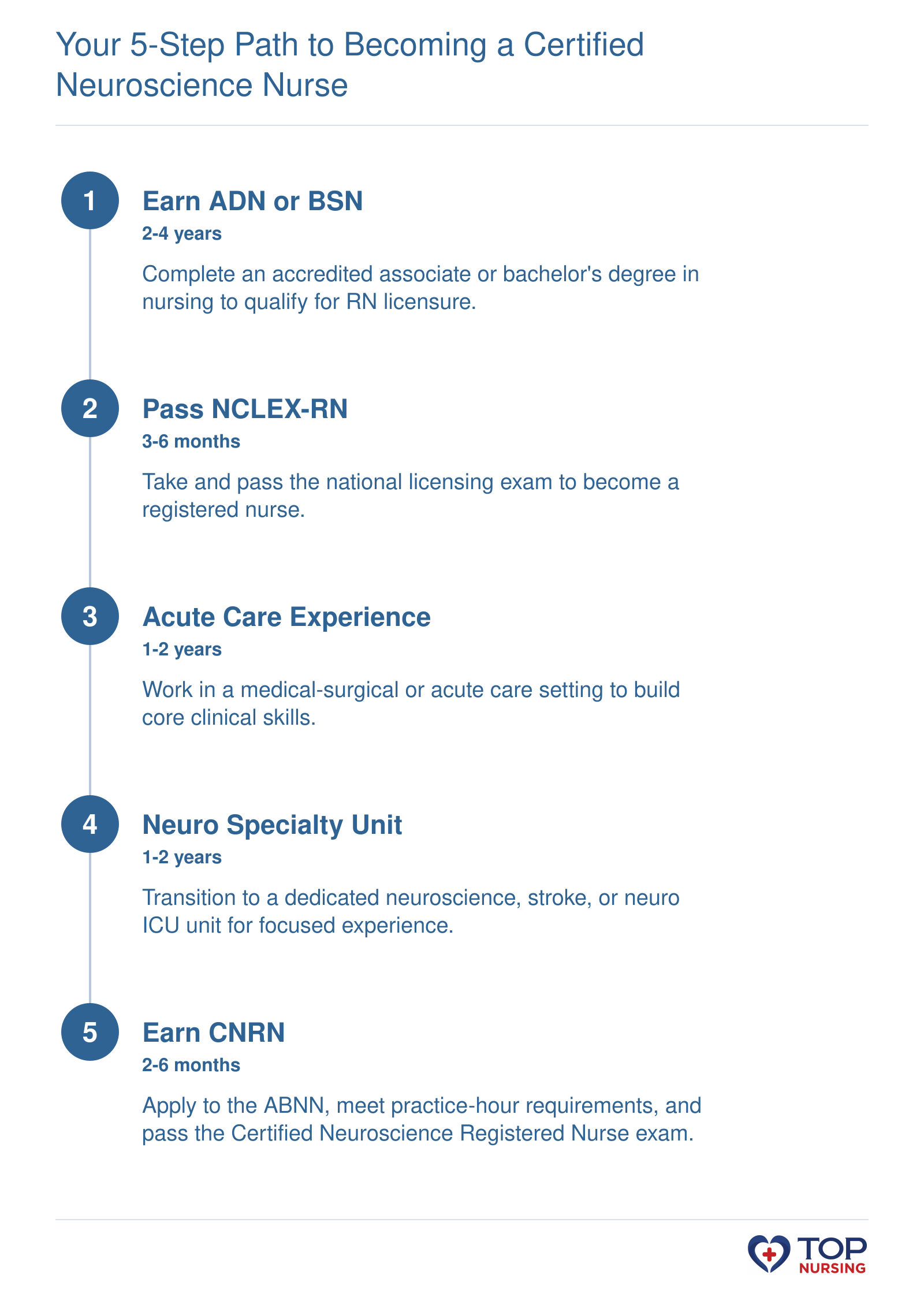
Your 5-Step Path to Becoming a Certified Neuroscience Nurse

Most nurses reach CNRN certification within 5 to 7 years of starting nursing school. The journey progresses from foundational education through targeted clinical experience, culminating in specialty board certification.

5-step progression from nursing school to CNRN certification taking roughly 5 to 7 years

Neuroscience Nurse Certifications: CNRN, SCRN, and More

Neuroscience nurses who want to validate their expertise often weigh two distinct credentials: a broad certification that spans the entire spectrum of neurological care (CNRN) or a focused credential that drills deep into stroke management (SCRN). Both are offered by the American Board of Neuroscience Nursing (ABNN) and signal advanced knowledge to employers and peers.

CNRN: The Broad Neuroscience Credential

The Certified Neuroscience Registered Nurse (CNRN) exam covers head trauma, brain tumors, spinal cord injuries, epilepsy, movement disorders, and neuromuscular diseases. To sit for the exam, you need at least one year, 2,080 hours, of direct neuroscience nursing practice as an RN. The exam itself includes 220 questions over four hours; recent data shows a pass rate of 62%. Initial fees are $300 for AANN members and $400 for non-members. CNRN certification is valid for five years. Renewal requires either 50 continuing education (CE) hours and 4,160 practice hours, or 100 CE hours and 2,500 practice hours within the renewal period.

SCRN: Specialized Stroke Expertise

The Stroke Certified Registered Nurse (SCRN) credential is narrower, focusing exclusively on stroke care across the continuum, from hyperacute interventions to rehabilitation. Like the CNRN, eligibility requires 2,080 hours of stroke nursing experience in the prior two years. The exam is 170 questions administered over three hours. The 2024 pass rate was 67%, with a five-year average of 71%. Cost and renewal cycles mirror the CNRN: $300 member/$400 non-member, five-year validity, and renewal via CE hours and practice hours (50 CE/4,160 hours or 75 CE/2,500 hours). If your daily work centers on a stroke unit or comprehensive stroke center, the SCRN aligns tightly with your clinical focus.

Additional Credentials to Consider

Neuro ICU nurses often pair a CNRN or SCRN with the CCRN (Critical Care Registered Nurse) from AACN to demonstrate high-acuity skills. Beyond these, micro-credentials are emerging in areas like epilepsy monitoring unit nursing and neurosurgical nursing, offering targeted recognition for niche roles. While not yet as widely recognized, they can supplement your primary certification.

What Employers Expect

Certification is rarely a hard requirement for hire, but it is frequently listed as preferred in job postings for experienced neuro nurses. Many hospitals actively support certification through tuition reimbursement or bonus programs, and some offer hourly pay differentials, typically $1 to $3 more per hour, for nurses who hold a CNRN or SCRN. This modest bump can add up over a full-time schedule and often covers the exam and renewal costs within the first year. If your employer doesn't advertise such incentives, it's worth asking about professional development funds during the interview process.

CNRN vs SCRN: Which Certification Should You Pursue?

Deciding between broad neuroscience expertise and focused stroke specialization is the core tradeoff when choosing between the CNRN and SCRN credentials. Both validate advanced knowledge and can strengthen your clinical practice, but they serve different professional paths. This section helps you weigh the options using practical, up-to-date guidance.

Understanding the Core Difference

The Certified Neuroscience Registered Nurse (CNRN) credential covers the full spectrum of neurological conditions across the lifespan, from traumatic brain injury and epilepsy to neurodegenerative disorders. The Stroke Certified Registered Nurse (SCRN) credential zeroes in on stroke care, from acute intervention through rehabilitation. Both are accredited by the Accreditation Board for Specialty Nursing Certification (ABSNC) and administered by the American Board of Neuroscience Nursing (ABNN), and each requires an active RN license and recertification every five years.

Which Certification Fits Your Setting?

Your daily patient population is the best clue. If you work on a dedicated stroke unit, neuro ICU with a high volume of stroke patients, or a comprehensive stroke center, the SCRN aligns directly with your practice. For nurses on general neuroscience floors, step-down units, outpatient neurology clinics, or rehabilitation facilities treating a mix of conditions, the CNRN demonstrates broader competency that employers often prefer. Some nurses pursue both, especially if they transition between settings or want to signal deep specialization alongside wide-ranging neuroscience knowledge.

How to Decide: A Practical Approach

Start by reviewing job postings for roles that interest you or position descriptions within your current organization. Note which certification appears more often. Then talk with nurse educators or managers about how each credential is perceived in your workplace and market. Professional associations like the American Association of Neuroscience Nurses (AANN) and the ABNN publish role delineation studies and exam content outlines that reveal the exact knowledge domains each exam covers. Comparing those outlines can clarify which content aligns with your day-to-day work and long-term goals.

Where to Look for Guidance

For objective data on how certification impacts earnings or advancement, visit the U.S. Bureau of Labor Statistics (BLS.gov). While the BLS does not report salary by certification, you can explore median wages for registered nurses in your state or metro area and note patterns in higher-paying roles that often require or prefer specialty credentials. Hospital websites and professional networks frequently publish nurse profile stories that illustrate career trajectories with each certification. Finally, the CNRN and SCRN handbooks from ABNN offer detailed eligibility requirements, exam blueprints, and recertification criteria that help you map the commitment each path demands.

Questions to Ask Yourself

In neuro nursing, delayed assessments can lead to permanent patient harm. If stress impairs your judgment, this field may overwhelm you.

Neuro care requires constant learning about intricate anatomy. Without genuine curiosity, the cognitive load can become draining.

ICU roles demand adrenaline; outpatient roles prioritize long-term education. Misalignment leads to burnout.

Highest-Paying States for Neuroscience Nurses

Wages for neuroscience nurses are typically higher than the median registered nurse salary, but the Bureau of Labor Statistics (BLS) does not publish a separate category for this specialty. The table below ranks states by median annual RN wages, based on BLS data, to give you a baseline for comparison. Nurses who hold the Certified Neuroscience Registered Nurse (CNRN) or Stroke Certified Registered Nurse (SCRN) credential often see a pay premium, especially in hospitals and universities that recognize the certification. For a closer look at certification options, check the CNRN and SCRN comparison earlier in this article. Keep in mind that cost of living, local demand, and the specific employer can shift actual earnings above or below these figures.

StateMedian Annual Wage25th Percentile Wage75th Percentile Wage
Rhode Island$99,960$83,870$112,540
Arizona$96,890$81,390$105,450
New Hampshire$96,830$79,720$105,500
Maryland$96,830$81,470$104,840
Colorado$96,520$81,790$104,370
Delaware$92,610$82,600$108,360
Texas$90,010$77,450$102,200
Virginia$88,820$77,650$100,920
New Mexico$88,260$82,630$104,720
Pennsylvania$87,610$78,570$102,030

Subspecialties in Neuroscience Nursing

What are the real-world differences between a neuro ICU nurse, a neurosurgical nurse, a stroke coordinator, an epilepsy monitoring nurse, and a neuro rehab nurse, and which path fits your strengths? Neuroscience nursing spans a wide spectrum, and each subspecialty demands a distinct mix of clinical skills, temperament, and career ambitions.

Neurology Nurse vs. Neurosurgical Nurse

A top question from newcomers is how a neurology nurse differs from a neurosurgical nurse. The distinction is straightforward once you see the patient journey. A neurology nurse manages chronic or acute medical conditions, ischemic strokes, multiple sclerosis, epilepsy, Parkinson’s disease, using medications, lifestyle coaching, and long-term surveillance. In contrast, a neurosurgical nurse cares for patients before and after operative procedures: craniotomies for tumor resection, spinal fusions, deep brain stimulator placements, or shunt revisions. The neurology role leans on patient education and symptom tracking, while neurosurgical nursing prioritizes post-op monitoring, wound care, drain management, and early complication recognition.

Neuro ICU Nurse

Neuro ICU nurses work in the highest-acuity environment within neuroscience care. You will manage patients with traumatic brain injury, subarachnoid hemorrhage, large ischemic strokes, status epilepticus, or unstable post-craniotomy courses. Daily work centers on complex hemodynamic and intracranial monitoring, administering vasoactive drips, managing ventilators, and preventing secondary brain injury. This role suits nurses who thrive under pressure, excel at rapid decision-making, and want to pursue advanced practice paths such as acute care nurse practitioner or CRNA tracks later.

Neurosurgical Nurse

Once a patient steps down from the ICU, they often land on a neurosurgical med-surg or step-down unit. Here, you will handle post-craniotomy patients, spine surgery recoveries, shunt placements, and functional neurosurgery cases. Your focus shifts to pain control, mobilization, surgical drain care, and spotting early signs of infection or neurological decline. Neurosurgical nurses can advance into operating room circulator roles, spine nurse navigator positions, or leadership within surgical service lines. The CNRN credential is a natural fit.

Stroke Coordinator and Stroke Nurse

Stroke nursing splits into bedside and system-level roles. A stroke nurse in the ED or dedicated stroke unit performs rapid assessments, initiates code stroke protocols, and supports thrombolytic or thrombectomy workflows. A stroke coordinator, by contrast, is often a non-bedside or hybrid role driving program development: tracking door-to-needle times, overseeing Joint Commission or state designation compliance, educating staff, and organizing community outreach. SCRN certification is the benchmark here. This path attracts nurses who love quality improvement, data analysis, and education, and it frequently leads to manager or director positions in stroke or neuro service lines.

Epilepsy Monitoring Unit (EMU) Nurse

EMU nurses work in a step-down or inpatient unit dedicated to continuous video-EEG recording. Patients are admitted for seizure classification, pre-surgical evaluation, or differentiation of epileptic versus psychogenic events. Your primary responsibility is safety during seizures, accurate event documentation, and marking clinical changes for the EEG technologist. EMU nursing calls for patience, keen observation, and comfort with behavioral changes. Career progression can lead to epilepsy coordinator roles, outpatient epilepsy clinics, or advanced practice in epilepsy care.

Neuro Rehab Nurse

Neuro rehab nursing takes a longer view. In inpatient rehab hospitals, LTACHs, or outpatient programs, you help patients with stroke, spinal cord injury, brain injury, multiple sclerosis, or Parkinson’s regain functional independence. The focus is less on acute physiology and more on bowel/bladder routines, spasticity management, cognitive retraining, and family teaching for community reintegration. This specialty rewards nurses who enjoy building relationships over weeks or months and celebrating incremental functional gains. CRRN certification supports advancement into rehab leadership, case management, or rehab educator roles.

How Your Choice Shapes Your Career

Each subspecialty influences your future options. Neuro ICU nurses often pursue high-acuity advanced practice roles; stroke coordinators move into quality, administration, or service line leadership; neurosurgical nurses may branch into perioperative roles; EMU nurses can grow into epilepsy program management; and neuro rehab nurses frequently step into case management or education. You can pivot across these areas as your interests evolve, but early reflection on whether you prefer constant action, deep patient relationships, data-driven process improvement, or long-term recovery will help you land in the right starting lane.

Job Outlook and Career Advancement for Neuro Nurses

For neuroscience nurses planning their next career move, the decision often balances the certainty of a well-established RN role against the potential of a high-demand specialty that rewards advanced credentials and leadership.

Nursing Employment Projections from the BLS

The Bureau of Labor Statistics projects a 5% growth rate for registered nurses between 2024 and 2034, which translates to about 189,100 openings each year, a pace that is faster than the average for all occupations.1 This foundational growth includes neuroscience nurses as part of the wider RN workforce, but the sub-specialty often experiences demand that outpaces the broader trend because of demographic and medical-system changes. The aging U.S. population brings higher rates of stroke, traumatic brain injury, and degenerative neurological diseases, conditions that require acute and rehabilitative care only neuro-trained nurses can deliver.

Demand Drivers Specific to Neuroscience

Several forces create concentrated demand for neuro nurses. Hospitals are expanding comprehensive stroke center designations, which mandate 24/7 coverage by nurses with advanced neuro assessment skills. The rapid evolution of neurointerventional procedures, such as mechanical thrombectomy for acute strokes, requires interventional radiology and cath lab teams that understand cerebral anatomy and post-procedural monitoring. Additionally, the growth of teleneurology services is opening roles for nurses who coordinate remote consults, triage acute cases, and manage follow-up care from centralized hubs. These developments mean that a neuroscience nurse entering the field today can expect a robust market for specialized clinical skills.

Career Ladder: From Staff Nurse to Advanced Practice

Progression in neuroscience nursing typically follows a stepwise path. A new graduate in a neuro ICU, stroke unit, or neuroscience medical-surgical floor gains experience as a staff neuro nurse. With two to three years of experience and specialty certification such as the CNRN or SCRN, many nurses move into charge nurse or preceptor roles. From there, the ladder branches: nurses who enjoy education and protocol development often become clinical educators or move into quality improvement roles. Those who wish to practice at a higher level can pursue a Master of Science in Nursing (MSN) or Doctor of Nursing Practice (DNP) to become a Clinical Nurse Specialist (CNS) in neuroscience, focusing on system-level improvements and direct complex patient care, or a nurse practitioner in neurology or neurosurgery, with full prescriptive authority and increased autonomy. Both CNS and NP roles require a graduate degree and offer significant salary increases and leadership opportunities.

Opportunities for Travel and Specialty Roles

A neuroscience nurse who holds a CNRN and has robust ICU experience is among the most sought-after candidates for travel nursing contracts. Hospitals facing seasonal surges in neuro patient volumes or opening new stroke programs frequently rely on travelers to bridge staffing gaps. The scarcity of neuro-trained nurses means that those with the right certification and a flexible mindset can command premium pay and diverse assignment experiences across the country. For nurses who prefer a permanent locale but still want to advance, the same certification and experience often open doors into neuro clinical research coordination, device industry education roles, or administrative positions within neuroscience service lines.

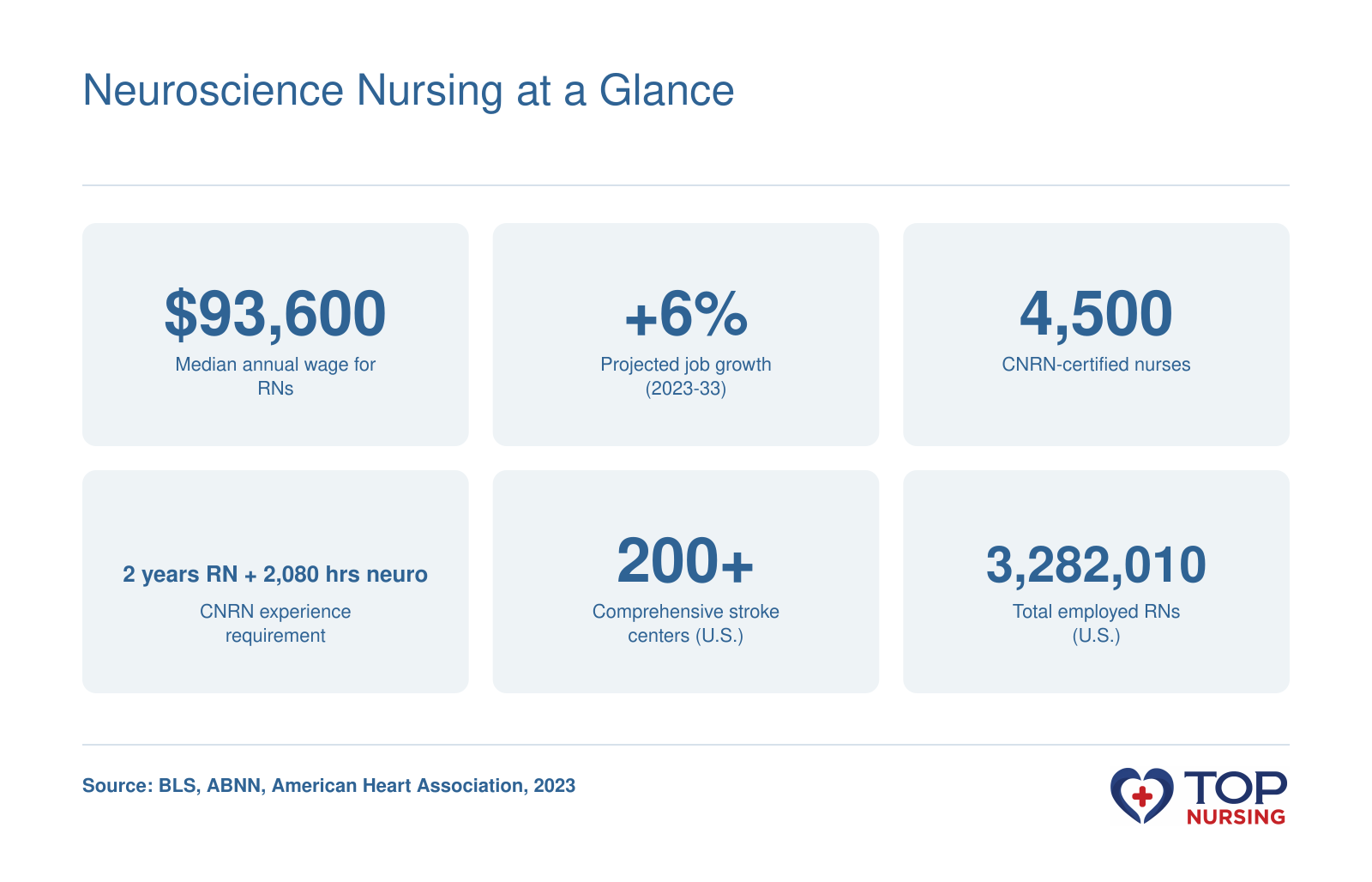
Neuroscience Nursing at a Glance

These headline numbers summarize the neuroscience nursing landscape, from compensation and employment to specialized certification and the facilities that employ neuro nurses. Use them as a quick reference before diving into the detailed sections below.

Key figures on neuroscience nursing including salary, job growth, certification counts, and care settings.

FAQs About Neuroscience Nursing

Neuroscience nursing blends high-acuity patient care with deep specialization. Below are answers to the questions nurses ask most often when exploring this challenging and rewarding field.

How do I become a certified neuroscience nurse?
Earn your RN license, then gain at least two years of full-time neuroscience nursing experience. After meeting eligibility requirements, pass the Certified Neuroscience Registered Nurse (CNRN) or Stroke Certified Registered Nurse (SCRN) exam offered by the American Board of Neuroscience Nursing (ABNN). Maintaining certification requires ongoing continuing education credits.
Can new grad nurses work in neuroscience nursing?
Yes, many hospitals hire new graduates directly into neuroscience, stroke, or neuro ICU units. Most offer structured nurse residency programs that provide extended orientation, didactic training, and preceptor support. Starting here lets you build expertise from day one, though you will need experience before sitting for the CNRN or SCRN certification exams.
What is the difference between a neurology nurse and a neurosurgical nurse?
Neurology nurses manage patients with medical neurological conditions such as stroke, epilepsy, multiple sclerosis, or Parkinson’s disease. Neurosurgical nurses care for patients who have undergone brain or spine surgery, monitoring for post-operative complications. In practice, many neuroscience units blend both populations, and nurses often develop skills across the spectrum.
What certifications do neuro nurses need?
The two primary certifications are the CNRN (covering the full scope of neuroscience nursing) and the SCRN (focused specifically on stroke care). Neither is legally required to practice, but many employers prefer or require one within a few years of hire. Both credentials demonstrate advanced knowledge and can boost your earning potential.
How much do neuroscience nurses make compared to general RNs?
Neuroscience nurses typically earn more than general medical-surgical RNs. While the national median annual wage for all registered nurses is around $86,070, neuro nurse salaries commonly range from $80,000 to over $120,000, influenced by location, experience, certification, and shift differentials. Nurses with CNRN or SCRN credentials often command the higher end.
Is neuroscience nursing stressful?
Yes, it can be. Caring for patients with acute brain injuries, strokes, or spinal cord damage involves rapid clinical changes and high emotional intensity. Heavy workloads and complex family dynamics add to the pressure. However, many neuro nurses find the work deeply meaningful and benefit from strong team camaraderie and opportunities for specialization.
What shift schedules do neuroscience nurses work?
Most hospital-based neuro nurses work 12-hour shifts, rotating between days and nights, including weekends and holidays. Inpatient neuro units operate around the clock. Outpatient neurology clinics and rehabilitation settings more often offer traditional weekday hours, giving experienced nurses some flexibility when ready to transition away from bedside shift work.
What continuing education is required for neuro certifications?
CNRN certification requires 75 continuing education contact hours in neuroscience nursing every five years, or you may recertify by exam. The SCRN requires 60 stroke-specific contact hours in the same period. Many hospitals provide in-house education, and national conferences like the AANN Annual Meeting offer sessions that count toward these requirements.

Recent Articles