Top Online LPN Programs: Accredited & Ranked for 2026

Compare costs, outcomes, and formats for accredited hybrid and online practical nursing programs nationwide.

By Hannah Pierce, BSNReviewed by TopNursing.org TeamUpdated June 7, 202625+ min read
Top Accredited Online LPN Programs for 2026

Points of interest…

  • Most online LPN programs take 12 to 18 months and include in-person clinical hours.
  • NCLEX-PN pass rates are a reliable indicator of program quality for hybrid learners.
  • Net price after grants and scholarships varies widely among the eight ranked programs.
  • Graduates can transition to RN through accelerated LPN-to-RN bridge pathways.

Drawn by flexible schedules, aspiring LPNs often search for "online lpn programs." In practice, online coursework pairs with mandatory in-person clinical hours, creating a hybrid model no program can escape. State boards of nursing require supervised patient care, so fully virtual LPN training does not exist.

LPN employment is projected to grow 5% through 2032, adding about 57,600 positions. That demand makes the convenience of asynchronous classes attractive. But the real differentiators are accreditation, NCLEX-PN pass rates, and net cost. Because approval standards vary by state, a program's licensure pathway may not transfer across state lines.

Can You Get Your LPN Degree Online?

Online LPN programs are structured educational pathways that combine web-based coursework with in-person clinical training to prepare students for practical nursing licensure. The short answer is yes, you can complete a large portion of your training online, but the commitment includes hands-on clinical rotations at approved healthcare facilities.

What 'Online LPN Program' Really Means

No state-approved practical nursing program is fully online. The term refers to a hybrid model: didactic theory courses are delivered through an online learning platform, while supervised clinical experiences happen at local hospitals, clinics, or long-term care facilities. This blend allows students to learn foundational concepts remotely and then apply them directly with patients under instructor guidance.

Hybrid Structure: Online Coursework and In-Person Clinicals

The typical credit split illustrates this balance. Roughly 50 to 70 percent of program hours are spent on online coursework covering subjects like anatomy, pharmacology, and nursing fundamentals. The remaining hours are dedicated to clinical rotations, where you practice skills such as wound care, medication administration, and patient assessment. Because clinical sites must meet state board standards, many programs help arrange placements near your community, but geographic availability can vary.

Important: LPN Programs Grant a Diploma, Not a Degree

A common misconception is that LPN programs award an associate or bachelor's degree. In reality, graduates earn a diploma or certificate upon completion. This distinction matters for career planning: a diploma qualifies you to sit for the NCLEX-PN and become a licensed practical nurse, but if you later want to become a registered nurse, you would need to enter an LPN-to-RN bridge program, which may require additional general education prerequisites.

Out-of-State Enrollment and SARA Restrictions

If you consider an online LPN program based in another state, be aware that nursing programs are not covered by the State Authorization Reciprocity Agreement (SARA).1 While SARA simplifies interstate distance education for many fields, it explicitly excludes programs leading to professional licensure in nursing. This means each state's board of nursing independently decides whether to recognize an out-of-state program. Before enrolling, check with the licensing board in the state where you intend to work. Institutions are required to disclose whether their program meets educational requirements for licensure in each state,1 but the final responsibility is yours. Enrolling in an out-of-state program without verification carries the risk that your training may not qualify you for licensure in your target state.

Start by listing the states where you might practice, then contact those boards directly. A straightforward question to ask: "Will completion of this specific program satisfy your education requirements for LPN licensure?" This step avoids surprises after graduation and ensures your online hybrid learning path leads directly to eligibility for the NCLEX-PN.

Best Accredited Online LPN Programs

The programs below are ranked by a composite of institutional quality metrics and online delivery accessibility, not by tuition or length alone. Each school offers a hybrid or online LPN program that prepares graduates for the NCLEX-PN exam, with data points like graduate earnings and net price drawn from federal sources. Graduation rates shown are institution-wide, not program-specific.

Factors considered
  • Online delivery eligibility
  • Institution-wide graduation rate
  • Net price after financial aid
  • Median graduate earnings
  • Program accreditation and outcomes
Data sources
RankSchoolLocationNet priceBest for
#1
Northland Community and Technical College
Thief River Falls, MN~$14,000/yr (est.)Minnesota residents pursuing online LPN training

Northland Community and Technical College offers a fully online Practical Nursing diploma with a distance/hybrid option, approved by the Minnesota Board of Nursing. The program blends theory with clinical experiences in diverse settings and boasts small clinical groups of 10 students per instructor. Graduates are eligible for NCLEX-PN and benefit from the program's NLN CNEA accreditation and scholarship opportunities.

Practical Nursing — Online
  • Fully online with distance/hybrid coursework
  • Minnesota Board of Nursing approved
  • NLN CNEA accredited
  • Small clinical groups of 10 students
  • Prerequisite: nursing assistant competency
  • ATI TEAS exam required for admission
  • Prepares for NCLEX-PN licensure exam
  • Scholarships available through Northland Foundation

Mitchell Technical College's Licensed Practical Nursing diploma is a one-year hybrid program with no prerequisite courses required. Students gain hands-on experience through clinical rotations and simulation labs, and the college reports a 100% job placement rate and consistent NCLEX-PN pass rates. The program meets licensure requirements in 22 states and South Dakota's Nurse Licensure Compact, offering broad career portability.

Licensed Practical Nursing (LPN) — Hybrid
  • South Dakota Board of Nursing accredited
  • No prerequisite courses required
  • $4,000 total program tuition
  • 100% job placement rate
  • 100% NCLEX-PN pass rate
  • Hybrid format with online general ed
  • Meets licensure requirements in 22 states
  • Capstone practicum and simulation lab

Riverland Community College's Practical Nursing diploma offers both full-time day and part-time evening tracks, making it accessible for working adults. The ACEN-accredited program includes hands-on labs and clinical experiences at partner healthcare facilities, and graduates can transfer seamlessly to A.S. Nursing programs at Minnesota State colleges.

Practical Nursing — Hybrid
  • ACEN accredited
  • Full-time and part-time schedules
  • 2 semesters (full-time)
  • 39 credit hours
  • Fall and spring start dates
  • Clinical experiences in four communities
  • Transfer pathways to RN programs
  • High-demand LPN career outlook in Minnesota

Montgomery Community College offers a nine-month Practical Nursing diploma in a blended format, with classes three to four days a week and online components. The curriculum includes 480 clinical hours, and graduates are eligible for NCLEX-PN licensure, entering fields like hospitals and long-term care.

Practical Nursing — Hybrid
  • 9 months to completion
  • 34 credit hours
  • 480 clinical hours
  • Blended day option with online components
  • Prepares for NCLEX-PN exam
  • Careers in hospitals, clinics, home health
  • Work under RN supervision
  • Patient care across the lifespan

Rasmussen University-Minnesota's Practical Nursing Diploma is a hybrid program that can be completed in as few as 15 months, with eight start dates per year and no prerequisite coursework. The program includes clinical experiences and boasts a 100% NCLEX-PN pass rate at its St. Cloud campus, supported by financial aid and a LPN Care Grant.

Practical Nursing Diploma — Hybrid
  • 15-month completion
  • 56 credit hours, 15 courses
  • 8 start dates annually
  • No prerequisite coursework
  • Hybrid online and on-campus format
  • 100% NCLEX pass rate (St. Cloud)
  • LPN Care Grant up to $2,000
  • Military benefits and employer reimbursement

Ozarks Technical Community College's Practical Nursing Certificate is a one-year hybrid program approved by the Missouri State Board of Nursing. With a 100% employment or education rate post-graduation and a point-based admission system, students prepare for the NCLEX-PN across three campus locations and through hybrid delivery.

Nursing - Practical Nursing Certificate — Hybrid
  • 49 credit hours
  • Fall and spring starts
  • 100% licensure pass rate
  • 100% employment or education rate
  • Average graduate salary $51,000
  • Hybrid course delivery
  • Missouri State Board of Nursing approved
  • Three campus locations (Springfield area)

Bismarck State College's Practical Nursing certificate is an 11-month hybrid program located at West River Health Services in Hettinger, North Dakota. The program uses Interactive Video Network for theory and provides clinical training with a 100% NCLEX-PN pass rate, with a direct pathway to the college's Associate Degree Nursing program.

Practical Nursing — Hybrid
  • 11-month completion
  • Fall start
  • 100% NCLEX-PN pass rate
  • Clinical training at West River Health Services
  • Interactive Video Network theory classes
  • Direct pathway to RN in 9 additional months
  • Rural cohort with personalized instruction

Minnesota West Community and Technical College's ACEN-accredited Practical Nursing diploma spans three semesters and features above-average NCLEX pass rates. The program offers a ladder into an Associate Nursing degree and a BSN pathway with Southwest Minnesota State University, with clinical experiences in southwest Minnesota facilities.

Practical Nursing — Hybrid
  • ACEN accredited
  • 3 semesters (full-time)
  • 39 credit hours
  • Fall start
  • Above state average NCLEX pass rates
  • Direct ladder into Associate Nursing (RN) program
  • BSN pathway with Southwest Minnesota State University
  • Clinical rotations in southwest Minnesota facilities

Western Iowa Tech Community College offers a one-year Practical Nursing Diploma in a hybrid format at multiple campuses, requiring CNA certification for admission. The program reports a high NCLEX-PN pass rate and prepares graduates for a range of LPN roles across healthcare settings.

Nursing - PN — Hybrid
  • 1-year program
  • Hybrid online/in-person format
  • CNA certification required for admission
  • High NCLEX-PN pass rate
  • Multiple campuses: Sioux City, Cherokee, Denison
  • Affordable in-state tuition
  • Additional costs for books and materials
  • Prepares for NCLEX-PN licensure exam

Northwest Technical College's Practical Nursing diploma emphasizes hands-on learning with simulation labs and supervised clinical experiences. Graduates are prepared for LPN licensure and can step into the college's LPN-to-RN track for career advancement.

Practical Nursing — Hybrid
  • Hands-on nursing education
  • State-of-the-art simulation labs
  • Direct supervised clinical experiences
  • Experienced faculty
  • Entrance exam required
  • Clear pathways to licensure
  • Hybrid course delivery
  • LPN Step-In track for RN advancement

Online LPN Program Costs at a Glance

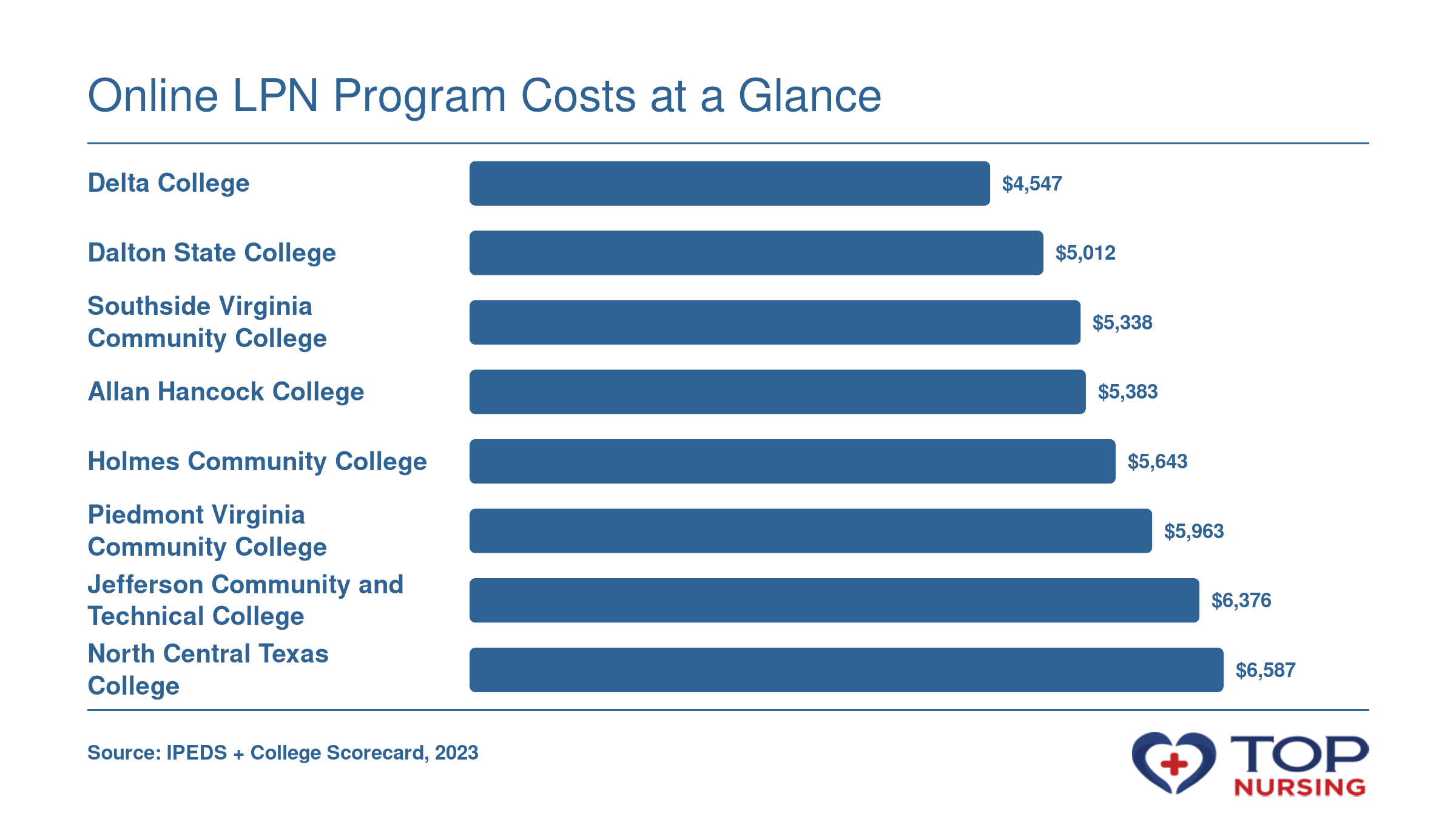
The chart below compares the average net price, what students actually pay after grants and scholarships, across the eight ranked online LPN programs. These figures are institution-wide averages, so your individual cost may be higher or lower depending on your financial aid package and state residency. Net prices range from $4,547 at Delta College to $6,587 at North Central Texas College.

Net price after aid for 8 online LPN programs: Delta College $4,547 to North Central Texas College $6,587, based on 2023 College Scorecard data

How to Choose an Online LPN Program

Choosing the right online LPN program requires more than comparing tuition rates. A program's accreditation, clinical logistics, true cost, and track record all shape your readiness for the NCLEX-PN and your career. Use the following guideposts to narrow your options.

Accreditation Is Non-Negotiable

Start by confirming two credentials. First, the program must hold approval from the state board of nursing in the state where it operates. Without that nod, you cannot sit for the NCLEX-PN. Second, look for programmatic accreditation from the Accreditation Commission for Education in Nursing (ACEN). ACEN evaluates curriculum quality, faculty credentials, and student outcomes. Employers and bridge programs often prefer or require ACEN-accredited training. If either piece is missing, move on.

Unpack Clinical Placement Logistics

Online LPN programs are not fully remote. Every reputable program requires supervised clinical hours in a real healthcare setting. How those hours get arranged is where programs diverge sharply.

  • School-arranged placements: Some programs coordinate clinical rotations for you, often through partnerships with local hospitals or long-term care facilities. This is the lower-stress path, especially for students without healthcare connections.
  • Employment-based verification: In an employment-based model, the school verifies that your current job provides relevant clinical experience but does not actively arrange placements. Excelsior University's AAS in Nursing, for example, uses this approach: you must submit a Verification of Health Care Experience form and complete a capstone clinical, but the school does not set up routine rotations.
  • Student-found preceptors: The most hands-off model asks you to locate your own clinical site and preceptor, then secure approval from the program. This adds significant legwork and may delay your start if you live in a competitive market.

Before enrolling, ask exactly how clinical placements are handled for distance learners in your geographic area. Getting stuck without a site can stall your graduation timeline.

Look Past the Sticker Price

Program websites often highlight per-credit rates that ignore fees, equipment costs, and lost wages during clinicals. A clearer financial picture comes from net price, the amount students actually pay after grants. Federal data sources also publish program-level median debt and estimated 10-year monthly loan payments. Use these figures to compare the true burden, not the advertised number. An affordable program on paper can become expensive if its clinical schedule prevents you from working or if it leaves graduates with above-average debt.

Evaluate Schedule Flexibility and Pace

Online LPN programs come in several flavors:

  • Asynchronous coursework lets you log in anytime, ideal if you work rotating shifts.
  • Synchronous classes require live participation at set times, which helps if you learn better with real-time discussion.
  • Part-time tracks stretch the program over more terms, lowering the weekly load.
  • Accelerated options condense the same curriculum into fewer months, demanding full-time attention.

Accelerated LPN programs online can lead to a faster paycheck, but they often leave little room for outside obligations. Confirm whether the program offers multiple start dates per year and how strict course sequencing is.

NCLEX-PN Pass Rates Signal Quality

Once you have a shortlist, pull each program's first-time NCLEX-PN pass rates for the past three years. Consistently high scores, above the national average, suggest strong instruction and test preparation. A single-year dip might be an anomaly, but a multi-year decline should raise a red flag. These rates are public and typically listed on state board of nursing websites or the program's consumer disclosure page.

Filtering programs through these lenses helps you find a balanced option: accredited, clinically accessible, financially transparent, flexible, and proven to produce competent nurses.

Questions to Ask Yourself

Accreditation ensures quality standards and eligibility for the NCLEX-PN. State board approval is non-negotiable for licensure; without it, you risk investing time and money without a path to practice.

Clinical rotations are mandatory, and securing a local site can be the hardest part of an online LPN program. Clarify whether the school arranges placements or if the burden falls on you, which could delay completion.

Clinicals often demand daytime weekday availability for shifts at partner facilities. Assess your schedule honestly and ask about part-time or evening tracks if you need more flexibility to balance life responsibilities.

Online LPN Program Costs Compared

Understanding the true cost of an LPN program requires looking beyond published tuition figures. The net price shown below reflects the average amount students paid after grants and scholarships, but it is an institution-wide figure and may differ for nursing students specifically. Median program debt offers a more tailored view of LPN graduates' borrowing, though ten-year monthly payment data is not yet available for these programs.

SchoolIn-State TuitionOut-of-State TuitionNet PriceMedian Program Debt10-Year Monthly Payment
Allan Hancock College$1,156$9,892$5,383N/AN/A
Dalton State College$3,336$10,656$5,012$12,937N/A
Southeast Community College Area$3,444$4,032$9,171$11,000N/A
Holmes Community College$3,710$6,610$5,643$9,274N/A
Jefferson Community and Technical College$4,808$6,512$6,376$11,651N/A
Southside Virginia Community College$5,007$11,445$5,338N/AN/A
Piedmont Virginia Community College$5,072$11,510$5,963$8,750N/A
North Central Texas College$5,088$5,739$6,587$11,250N/A
Western Iowa Tech Community College$5,186$5,330$8,770$11,000N/A
Ozarks Technical Community College$5,744$7,040$6,936$10,453N/A
Crowder College$5,784$5,784$9,023$9,000N/A
Quinsigamond Community College$6,262$11,206$9,090$16,575N/A
Riverland Community College$6,297$6,297$7,427$12,000N/A
Atlantic Cape Community College$6,972$8,350$8,392$9,500N/A
Delta College$7,550$7,880$4,547$10,978N/A

NCLEX-PN Preparation and Pass Rates

NCLEX-PN pass rates are now a widely cited indicator of LPN program quality, especially as more students choose hybrid and online learning paths. State boards of nursing publish annual program-specific data, giving prospective students a transparent way to compare outcomes.

What the NCLEX-PN exam covers

The National Council Licensure Examination for Practical Nurses (NCLEX-PN) is a computer-adaptive test administered by the National Council of State Boards of Nursing (NCSBN). Every LPN graduate must pass it to obtain state licensure. The exam adapts to your performance: each question you answer influences the difficulty of the next, so the test pinpoints your competency level efficiently. Content areas include safe and effective care environment, health promotion and maintenance, psychosocial integrity, and physiological integrity, with a strong emphasis on clinical judgment and safe nursing practice.

Which online and hybrid programs deliver top pass rates

First-time pass rates for online and hybrid LPN programs often meet or exceed state and national averages. For example, Lake Area Technical College’s hybrid practical nursing program reported a 96.2% first-time NCLEX-PN pass rate in 2024. Tri‑County Technical College’s blended LPN program posted a 100% pass rate in the third quarter of 2024, outperforming both the South Carolina state average of 97.9% and the national average of 90.04% for the same period. Holmes Community College’s hybrid program was ranked #1 nationally by Nurse.org, and United Career Institute offers an online/hybrid pathway that can be completed in 12 months. Because pass-rate data for these top-rated programs was not immediately available in a consolidated format, always verify the most current figures directly with the school or your state board of nursing.

How online programs build NCLEX readiness

Accelerated and hybrid LPN programs weave NCLEX preparation into every course, not just as a final review. Integrated NCLEX-style question banks, computerized adaptive practice exams, and standardized exit exams such as ATI or HESI are common benchmarks. Many platforms let you track performance by content area, so you can target weak spots before test day. Clinical rotations, even in a hybrid model, reinforce the critical-thinking and hands-on skills that the exam tests, bridging the gap between theory and application.

Where to confirm the latest pass-rate data

Because pass rates can shift from year to year, always check your state board of nursing’s website for the most recent annual report or NCLEX pass-rate dashboard. The NCSBN also publishes national trend data that can help you benchmark program performance. Program websites typically list their most recent cohort results, but state-level reports provide an independent, official source.

How to Become an LPN Online: Step by Step

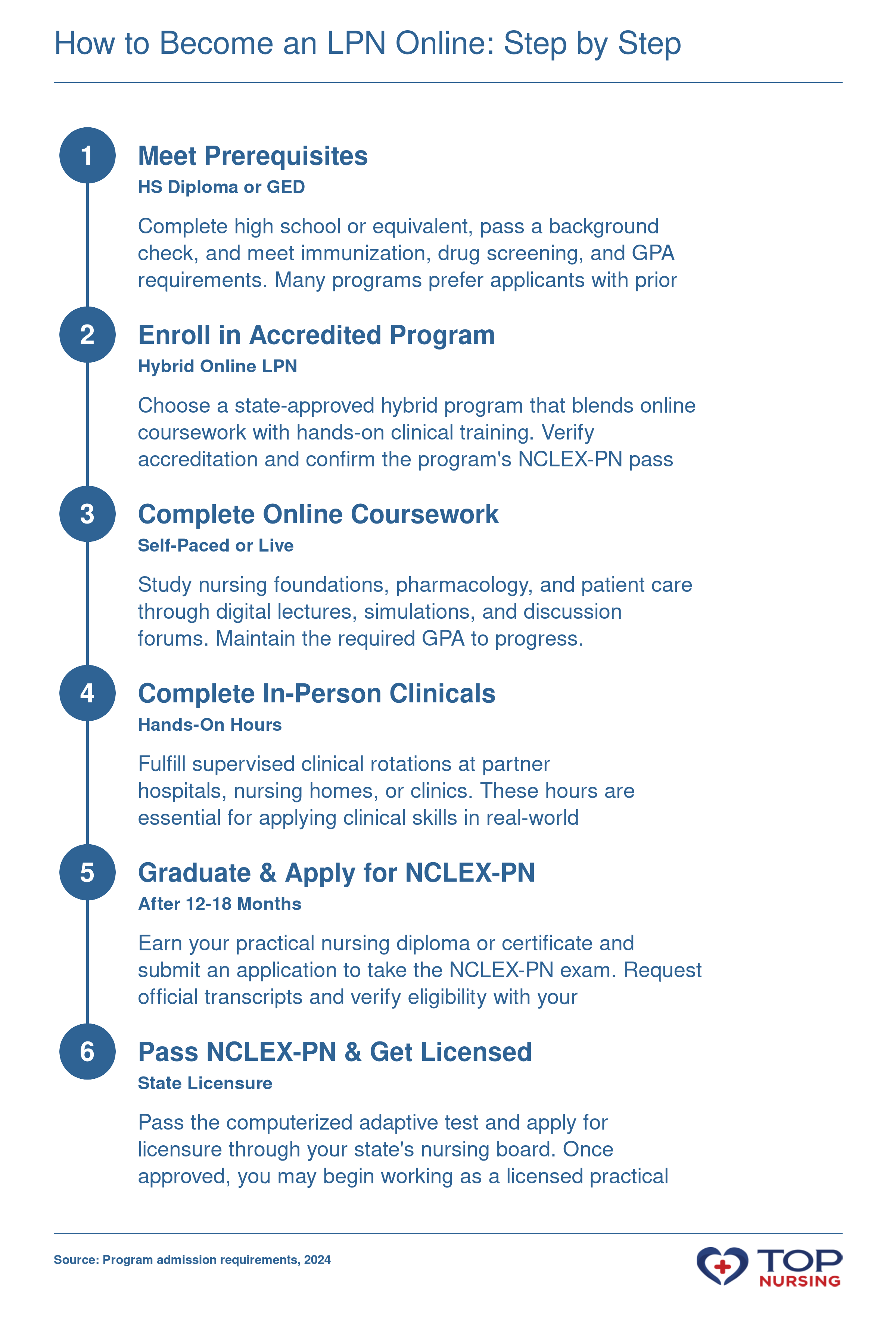
Most online LPN programs follow a structured 12- to 18-month pathway. Before enrolling, you'll need a high school diploma or GED, a background check, and possibly a CNA certification. Some schools offer CNA-to-LPN bridge options for experienced nursing assistants.

Six-step sequence to become an LPN online: meet prerequisites, enroll in an accredited hybrid program, complete online coursework, fulfill in-person clinical hours, graduate and apply for the NCLEX-PN, then pass the exam and obtain state licensure.

LPN-to-RN Bridge Pathways After Graduation

An LPN-to-RN bridge program is a specialized nursing track that allows licensed practical nurses to earn an associate degree in nursing (ADN) or a bachelor of science in nursing (BSN) in fewer semesters than a traditional prelicensure program. These pathways recognize the clinical skills and foundational coursework you have already completed, treating your LPN certificate not as a final stop but as a stepping stone toward expanded scope, higher pay, and broader career options.

Stackable Credentials: LPN as a Launchpad

The idea of stackable credentials means starting with a shorter, focused qualification and then building on it rather than starting from scratch each time you pursue the next level. An LPN license counts as that first stackable piece. Many nursing schools design their ADN and BSN programs with LPN bridge entry points, accepting transfer credits for fundamentals, pharmacology, and clinical hours already documented in your LPN education. This cuts redundant coursework and gets you into advanced nursing content quicker.

Common Bridge Pathways and What to Expect

Bridge programs typically fall into two categories: LPN-to-ADN (associate degree) and LPN-to-BSN (bachelor’s degree). The ADN bridge can be completed in as little as 9 to 18 months2, while BSN bridges generally take 18 to 30 months, though part-time pacing is common. Most programs award advanced standing of 12 to 30 credits for your LPN background. A typical bridge requires 60 to 75 credits of nursing and general education, with clinical rotations arranged near your community.

Several of the accredited schools highlighted in earlier rankings also offer robust bridge options. Examples include: - Indiana State University: Online LPN-to-BSN, 73 to 77 credits, 24 to 54 months, ACEN-accredited. - University of South Alabama: Hybrid LPN-to-BSN, 48 nursing credits (plus 62 credits of prerequisites), 18 to 60 months, CCNE-accredited. - Herzing University: Online LPN-to-ASN bridge, 70 to 72 credits, 20 to 24 months, minimum 2.5 GPA and TEAS exam required, ACEN-accredited.4 - Frostburg State University: Online LPN-to-BSN, 65 credits, 30 months, CCNE-accredited. - North Palm College of Nursing: LPN-to-ASN bridge with 100% online didactic, 74 credits, 9 to 12 months, including 585 clinical hours.2

The Return on Investment: LPN vs. RN Earnings

Moving from LPN to RN brings a significant jump in earning potential. While recent Bureau of Labor Statistics figures place the national median salary for LPNs around $60,000, RNs earn a national median of approximately $86,000 per year, a difference of more than $26,000 annually. Over a career, that differential adds up to hundreds of thousands of dollars, making the tuition and time invested in a bridge program a strong financial decision.

Many employers now actively support LPN-to-RN bridging through tuition reimbursement or flexible scheduling, which further improves the return on investment. The expanded practice authority, supervisory opportunities, and specialization paths open to RNs also influence long-term job satisfaction.


Frequently Asked Questions About Online LPN Programs

Before enrolling in an online or hybrid LPN program, it's essential to verify that your education will meet state licensure requirements. Use the following answers to common questions as a starting point for your research.

How do I verify that an online LPN program meets my state's licensure requirements?
Start by contacting your state board of nursing directly by phone or email, as policies can change. You can also visit the NCSBN website for links to each state board. For example, Georgia requires a minimum of 485 clinical hours and 685 theory hours, totaling 1170 clock hours. Individual program websites often list clinical hour commitments and state-specific licensure acceptance, so review those details carefully before applying.
Which states do not accept online or hybrid LPN program graduates for licensure?
Restrictions vary by state and program. As an illustration, Black Hawk College's practical nursing program identifies Arizona, California, Georgia, New York, Texas, and Washington as states where its curriculum does not meet licensing requirements. Always check each program's licensure disclosure and confirm with your intended state board, because a program approved in one state may not satisfy another state's standards.
Should I consult professional nursing associations for program eligibility guidance?
Yes. Organizations like the National League for Nursing (NLN) and the American Nurses Association (ANA) offer best practices and resources for verifying that a program aligns with professional standards and state requirements. They can help you ask targeted questions about accreditation, clinical placements, and long-term career mobility before you commit to a program.
What are the clinical requirements for online LPN programs?
Every LPN program includes a hands-on clinical component that must be completed in person at approved healthcare facilities. Minimum clinical hours are set by state boards. For instance, Georgia mandates at least 485 clinical hours, while Palm Beach State College's program totals 1350 clock hours. Most hybrid programs clearly state these commitments on their websites, so review them alongside your state board's rules.
How can I find a list of state-approved LPN programs?
Your state board of nursing typically publishes a directory of approved pre-licensure nursing education programs. The Illinois Board of Nursing, for example, provides an online list of approved programs. Always cross-reference a program's approval status with its accreditation and state-specific licensure disclosures, and don't hesitate to call the board directly to confirm current status.

More Accredited Online LPN Programs to Consider

Beyond the top-ranked schools, many other accredited online and hybrid LPN programs offer quality training across the country. The programs listed below are not ranked but represent solid options for students seeking convenient formats, affordable tuition, or locations near them. Use this directory to explore more choices before making your decision.

Piedmont Virginia Community College
Piedmont Virginia Community College’s Practical Nursing certificate is a hybrid program combining online classes with hands-on clinical rotations. It includes 402 clinical hours and prepares graduates for the NCLEX-PN exam. Qualifying Virginia students may receive free tuition through the G3 program.
  • Practical Nursing
Charlottesville, VA · Hybrid
Crowder College
Crowder College offers a hybrid Practical Nurse (LPN) certificate over two semesters. The 52-credit program includes individualized instruction and hands-on training. It provides a seamless bridge to RN programs for those seeking career advancement.
  • Practical Nurse (LPN)
Neosho, MO · Hybrid
North Central Texas College
North Central Texas College’s Vocational Nursing (LVN) program can be completed in one year with online hybrid options. Students can earn a CNA license after the first semester and pursue an LVN-to-ADN transition. It holds Texas Board of Nursing approval.
  • Vocational Nursing
Gainesville, TX · Online
Southeast Technical College
Southeast Technical College’s LPN diploma is an ACEN-accredited hybrid program that can be completed full-time or part-time. Students train in a Healthcare Simulation Center and benefit from scholarship eligibility such as Build Dakota. An LPN-to-RN track is available.
  • Licensed Practical Nurse
Sioux Falls, SD · Hybrid
Southeast Community College Area
Southeast Community College Area offers a hybrid Practical Nursing diploma with an estimated total tuition of $4,890. Clinicals start in the first term at sites in Beatrice, Lincoln, and Falls City. Both full-time and part-time paths are available.
  • Practical Nursing
Lincoln, NE · Hybrid
Holmes Community College
Holmes Community College’s hybrid Practical Nursing program spans five consecutive semesters with enrollment every other fall. Online lectures are paired with in-person lab and clinical rotations. The curriculum includes lifespan nursing care and prepares students for the NCLEX-PN.
  • Practical Nursing
Goodman, MS · Hybrid
Nebraska Methodist College
Nebraska Methodist College’s hybrid Practical Nursing Certificate can be completed in one year. Students train in a high-fidelity Nursing Arts Center and can access employer tuition reimbursement. The program includes a built-in pathway to an LPN-to-BSN degree.
  • Practical Nursing Certificate
Omaha, NE · Hybrid
Anne Arundel Community College
Anne Arundel Community College’s hybrid Practical Nursing certificate offers an evening and weekend schedule for working adults. The 41-credit program includes hands-on clinical experience and is approved by the Maryland Board of Nursing. Total tuition is approximately $6,500.
  • Practical Nursing
Arnold, MD · Hybrid
Jefferson Community and Technical College
Jefferson Community and Technical College’s hybrid Practical Nursing diploma is a 12-month program approved by the Kentucky Board of Nursing. Students choose between a downtown Louisville traditional track or a Carrollton hybrid option combining online lectures with evening clinicals.
  • Practical Nursing
Louisville, KY · Hybrid
Dalton State College
Dalton State College offers a 12-month hybrid LPN certificate with spring and summer start dates. The program combines online coursework with clinical rotations and is approved by the Georgia Board of Nursing. It prepares students for the NCLEX-PN exam.
  • Licensed Practical Nurse (LPN) Certificate
Dalton, GA · Hybrid
Allan Hancock College
Allan Hancock College’s hybrid Licensed Vocational Nursing program is a 12-month pathway for current California CNAs. It is approved by the BVNPT and runs January through December. Applicants must apply between April 1 and June 30.
  • Licensed Vocational Nursing
Santa Maria, CA · Hybrid
Green River College
Green River College’s Practical Nursing program offers online study options with flexible full-time and part-time tracks. Students complete the program in as few as 9 months and benefit from a 92% NCLEX-PN pass rate. Approximate cost ranges from $7,000 to $8,000.
  • Practical Nursing
  • Practical Nursing (Medical Assistants)
Auburn, WA · Online
Delta College
Delta College’s hybrid LPN advanced certificate is an ACEN-accredited program with a 100% job placement rate. Training takes place in a 9,000 sq. ft. simulation lab, and graduates can seamlessly transition to an associate degree in nursing (ADN) program.
  • Nursing (LPN)
University Center, MI · Hybrid
Southside Virginia Community College
Southside Virginia Community College’s hybrid Practical Nursing certificate uses a cohort model with fall and spring starts at the Alberta and South Boston campuses. The 49-credit curriculum focuses on the nursing process and communication skills.
  • Certificate In Practical Nursing (PN)
Alberta, VA · Hybrid
Atlantic Cape Community College
Atlantic Cape Community College’s hybrid Practical Nursing certificate is a 34-credit program that can be completed in 1.5 years. It follows QSEN and NLN competencies and includes a seamless pathway to the associate degree nursing program.
  • Practical Nursing
Mays Landing, NJ · Hybrid

Recent Articles