Top RN to BSN Programs in New Jersey (2026 Rankings)

Compare tuition, completion time, and online options across every NJ RN-to-BSN program

By Maria Delgado, RNReviewed by TopNursing.org TeamUpdated May 29, 202625+ min read
Top RN to BSN Programs in New Jersey for 2026

Points of interest…

  • Net tuition after aid ranges from $12,199 to $27,646, with public schools offering the lowest costs.
  • New Jersey nurses earn above the national median of $86,070, with top earners surpassing $129,000.
  • The fastest RN to BSN programs can be completed in as few as 12 months with maximum transfer credits.
  • Rutgers, Thomas Edison, and Stockton are among the top-rated RN to BSN programs in New Jersey for 2026.

New Jersey’s nursing market is one of the most credential-driven in the country, with the state leading the nation in the share of Magnet-designated hospitals that require a predominantly BSN-educated workforce. For registered nurses with an associate degree or diploma, the state offers 14 ranked RN to BSN programs, available online and in hybrid formats.

Options range from accelerated 10-month tracks to part-time enrollments that let you continue working. In a state where BSN-prepared RNs consistently earn more and advance faster, choosing the right program can pay off quickly.

2026 Best RN to BSN Programs in New Jersey

We evaluated every CCNE- or ACEN-accredited RN to BSN program in New Jersey, weighing net price heavily while also considering graduation rates, format flexibility, and long-term earnings. These are the top programs for New Jersey nurses in 2026.

Factors considered
  • Net price and affordability
  • Institution-wide graduation rates
  • Program flexibility and format
  • Long-term earnings and debt
  • Transfer credit policies
Data sources
RankSchoolLocationNet priceBest for
#1
Thomas Edison State University
Trenton, NJ$5,000 – $10,000/yrCredit-transfer maximizers on a budget

Thomas Edison State University's fully online RN to BSN is among the most affordable in the state, with in-state tuition under $7,000. The program maximizes credit for prior learning, up to 63 credits for passing the NCLEX-RN, making it ideal for nurses with extensive experience. With rolling admissions and six start dates per year, students enjoy exceptional scheduling flexibility.

Nursing (RN to BSN) — Online
  • CCNE accredited
  • 18-month completion time
  • 120 total credit hours
  • Rolling admissions with 6 start dates yearly
  • Up to 63 credits awarded for NCLEX-RN pass
  • Conditional acceptance while awaiting NCLEX results
  • Self-paced online format with 16-week semesters
  • Dedicated nursing advisor support

New Jersey City University's on-campus RN to BSN offers a low net price (around $16,000) and a supportive environment for associate-degree RNs. The curriculum includes population health, pharmacology, and leadership, and the school hosts a chapter of Sigma Theta Tau. Over 80% of students receive Pell Grants, and the institution-wide graduation rate is 34%.

Nursing (RN to BSN) — On-Campus
  • CCNE accredited
  • Sigma Theta Tau Honor Society chapter
  • Population health nursing courses included
  • Develops critical thinking and leadership skills
  • Focus on culturally sensitive care
  • Prepares for hospital and community health roles
  • Designed for RNs with an associate degree

Kean University's hybrid RN to BSN program blends online and in-person learning, with a net price of about $12,450. The ACEN-accredited program can be finished in four semesters and features transfer partnerships with community colleges. Graduates report a $30,000 median salary boost, and the institution-wide graduation rate is 47%.

Nursing (RN to BSN) — Hybrid
  • ACEN accredited
  • Average completion in four semesters
  • 120 total credit hours
  • Transfer partnerships with Ocean, Raritan Valley, and Muhlenberg
  • Faculty mentorship in clinical settings
  • Online and hybrid format options
  • Career paths include surgical, pediatric, and critical care
  • Adult learner-friendly curriculum

Montclair State University's asynchronous online RN to BSN is designed for working nurses, with a net price near $15,600. The CCNE-accredited program includes 90 clinical hours and an integration practicum, and students can transfer up to 90 credits, including 30 for the NCLEX. The institution-wide graduation rate is 65%.

BSN in Nursing (RN to BSN) — Online
  • CCNE accredited
  • Fully asynchronous online classes
  • 90-hour clinical practicum, often at your workplace
  • Up to 30 credits awarded for NCLEX-RN pass
  • Employer reimbursement supported
  • Ranked among top online bachelor's programs
  • Integration practicum capstone course
  • 2.5 minimum GPA required

Rutgers University-Newark's primarily online RN to BS in Nursing is tailored for New Jersey-licensed RNs. At $580 per credit, it offers the chance to earn 12 graduate credits toward a future MSN or DNP. The net price is around $19,700, and the university's graduation rate is 64%.

RN to BS in Nursing — Online
  • $580 per credit tuition
  • Complete in as few as four semesters
  • Earn 12 graduate-level credits toward MSN/DNP
  • Transfer-friendly credit policy
  • Individualized academic plans
  • Clinical practicums conducted in New Jersey
  • Flexible full-time and part-time scheduling
  • Dual admission partnership available

William Paterson University's online RN to BSN costs just $9,930 total, making it one of the fastest and most affordable paths. The 30-credit, CCNE-accredited program uses 7-week terms and boasts a 10-month completion time. The net price is $18,745, and the graduation rate stands at 44%.

RN to BSN — Online
  • CCNE accredited
  • $9,930 total program tuition ($331/credit)
  • 10-month accelerated completion
  • 30 total credit hours
  • Four start dates per year
  • 7-week course terms
  • Pay-by-the-course tuition structure
  • RN to MSN pathways available

Rowan University's online RN to BSN combines a $520 per-credit rate with generous transfer polices, up to 90 credits, plus automatic 30 nursing credits for ACEN-ad graduates. The CCNE-accredited program includes microcredentials and special tuition rates for partner hospital employees. Net price is $22,408, and the graduation rate is 67%.

B.S. in Nursing (RN to BSN) — Online
  • CCNE accredited
  • $520 per credit tuition
  • Complete in 15 to 30 months
  • Asynchronous online classes with 7- and 15-week courses
  • 45 clinical hours, may be completed at your workplace
  • Transfer up to 90 credits, automatic 30 for RNs
  • Optional microcredentials available
  • Full tuition coverage for Virtua/Inspira employees

Saint Peter's University offers both campus-based and fully online RN to BSN pathways, with a surprisingly low net price of $12,199 for a private institution. The CCNE-accredited programs feature rolling admissions, small classes, and a Jesuit-inspired whole-person care philosophy. The university's graduation rate is 58%.

RN to BSN Program (Campus) — On-Campus
  • CCNE accredited
  • 21-month completion timeframe
  • Rolling admissions with prerequisite courses
  • Transfer up to 30 nursing credits
  • Grade of 78 required in nursing courses
  • Clinical component with health exam requirements
  • CCNE accredited
  • 14 to 21 months to complete, 31-36 credits
  • Accelerated 8-week terms
  • 100% online, no campus visits required
  • Personal academic advising provided
  • RN to MSN bridge option available

Eastern International College-Jersey City's online RN to BSN is a 16-month, 90-quarter-credit program geared toward associate-degree nurses. Admission requires a 2.5 GPA and an active RN license. The college's net price is $21,111, and its graduation rate is 34%.

BS in RN to BSN Completion Program — Online
  • 16-month completion time
  • 90 quarter credit hours total
  • 36 general education credits, 54 nursing credits
  • 2.5 minimum GPA for admission
  • Capstone project required
  • Fully online delivery
  • Associate degree in nursing required
  • Active RN license required

The College of New Jersey's off-campus RN to BSN targets working RNs with a focus on quality, safety, and leadership. Although the net price is higher at $27,646, TCNJ boasts an 86% graduation rate and strong earnings outcomes for alumni.

RN to BSN — On-Campus
  • Designed for working registered nurses
  • Off-campus coursework format
  • Focus on quality and safety improvement
  • Develops nursing leadership skills
  • Prepares for advanced practice or leadership roles
  • Emphasizes 21st-century adult learning strategies

Georgian Court University's hybrid RN to BSN combines online coursework with evening classes at its Brookdale location. The CCNE-accredited program costs $564 per credit and accepts up to 90 transfer credits. A long-standing partnership with Hackensack Meridian Health opens doors for graduates. Net price is $19,285, and the graduation rate is 54%.

RN to BSN — Hybrid
  • CCNE accredited
  • $564 per credit tuition
  • 120 total credit hours
  • Hybrid format: online with evening in-person classes
  • Decade-long partnership with Hackensack Meridian Health
  • Accepts up to 90 transfer credits
  • Small student-to-faculty ratio
  • Faculty are experienced nursing leaders

Saint Elizabeth University's ACEN-accredited online RN to BSN can be completed in as little as one year. The 30-credit curriculum uses 7-week sessions and weekly live Zoom sessions with faculty. The net price is $23,125, and the institution-wide graduation rate is 51%.

RN to BSN — Online
  • Accreditation Commission for Education in Nursing (ACEN)
  • One-year completion possible
  • 30 credit hours total
  • Fully online coursework
  • 7-week accelerated course sessions
  • Capstone project applying learning to a clinical change
  • Weekly live Zoom Q&A sessions with faculty
  • Prepares for graduate nursing study

Caldwell University's online RN to BSN offers 7-week courses at $583 per credit and a $0 application fee. The 30-credit program features rolling admissions and an option to apply 12 credits toward an MSN in Population Health. Net price is $24,691, and the graduation rate is 57%.

RN to BSN — Online
  • $583 per credit tuition
  • 30 credit hours to complete
  • Rolling admissions with no application fee
  • Accelerated 7-week course modules
  • Flexible start terms available
  • Dual enrollment opportunity for MSN in Population Health
  • Clinical component included

Centenary University's online RN to BSN combines synchronous and asynchronous classes with special pricing for working RNs. The 30-credit curriculum emphasizes nursing research and leadership, and students earn credit for their nursing license. Net price is $20,503, and the graduation rate is 56%.

RN to BSN Nursing — Online
  • $600 per credit tuition
  • 30 credit hours total
  • Synchronous and asynchronous online options
  • Scholarships available for eligible students
  • Curriculum focuses on evidence-based practice and leadership
  • Credit awarded for an active, unencumbered RN license
  • Designed for working nurses balancing career and study
  • Pathway to advanced nursing degrees

RN to BSN Tuition and Cost Comparison in New Jersey

The cost of an RN to BSN in New Jersey varies widely depending on institution type. After financial aid, net prices range from $12,199 to $27,646, with public universities typically offering lower sticker prices. The table below compares tuition, net price, and median debt for top programs.

SchoolIn-State TuitionOut-of-State TuitionNet PriceMedian Graduate Debt
Saint Peter's University$42,552$42,552$12,199$20,500
Kean University$14,299$22,446$12,447$23,250
Montclair State University$15,912$26,022$15,566$22,000
New Jersey City University$14,460$14,460$16,053$18,500
William Paterson University$15,704$25,344$18,745$22,334
Georgian Court University$37,110$37,110$19,285$21,816
Rutgers University-Newark$17,250$36,762$19,703$21,500
Centenary University$37,732$37,732$20,503$23,163
Eastern International College-Jersey City$18,383$18,383$21,111$24,751
Rowan University$16,574$26,932$22,408$20,500
Saint Elizabeth University$36,740$36,740$23,125$24,934
Caldwell University$40,848$40,848$24,691$25,000
The College of New Jersey$19,632$25,752$27,646$23,250

Questions to Ask Yourself

Balancing work and family means a fully online program offers the most flexibility. If you can commute, a hybrid option may add campus resources and in-person networking.

Maximizing transfer credits shortens your timeline and lowers your total cost. Verify each school's transfer policy early to avoid repeating courses.

Many New Jersey hospitals offer generous tuition benefits that slash your out-of-pocket expense. With full reimbursement, a private program might cost you less than a public option.

Fastest RN to BSN Programs in New Jersey

Speed is often the deciding factor for working nurses who need to earn a BSN quickly, whether for a job requirement, a raise, or a step toward graduate school. But the fastest advertised timeline is not a one-size-fits-all guarantee; it hinges on how many credits you bring with you and whether you can commit to full-time study.

Programs with the shortest advertised timelines

Among RN to BSN programs in New Jersey, William Paterson University stands out for its 10-month, fully online completion track. The program is designed for registered nurses who already hold an associate degree or diploma and can enroll full-time. Rutgers University’s online RN to BSN can be completed in about 12 to 15 months when students transfer in a full complement of prerequisite and general education credits. Thomas Edison State University offers a flexible online RN to BSN that routinely allows motivated learners to finish in under a year if they arrive with most lower-division credits completed and take courses continuously. These timelines assume full-time enrollment and a packed course schedule.

How transfer credits shape your timeline

The single biggest accelerant is a generous transfer credit policy. Many New Jersey programs accept between 60 and 90 credits from prior nursing education and general studies, leaving only the upper-division nursing core to complete. For instance, students with an AAS in nursing typically transfer roughly 64-70 credits, cutting the BSN residency requirement down to 30-36 credits. If your prior coursework meets all general education and elective requirements, you can focus exclusively on nursing leadership, community health, and evidence-based practice courses, moving through the program in two or three semesters of full-time study.

Full-time vs part-time pacing

Accelerated tracks demand full-time enrollment, often with no breaks between terms. That intensity may not be feasible for nurses working full shifts or managing family responsibilities. Part-time enrollment typically extends the timeline to 18-24 months, even with a full credit transfer. Clinical or community health projects, which are standard in most RN to BSN curricula, can add a variable layer: some programs integrate them seamlessly online, while others require scheduled site visits that stretch the calendar.

What ‘fastest’ really means for you

Advertised fast times are instructive but personal. A student entering with all general education credits and a prior bachelor’s degree can finish in under a year; a nurse completing prerequisites while enrolled will take longer. Before you choose a program based on speed, request an official credit evaluation from each school to see exactly how your transcript maps onto their degree plan.

Online vs. Hybrid RN to BSN Options in New Jersey

Deciding between online and hybrid RN to BSN programs in New Jersey hinges on your work schedule and preference for in-person faculty interaction. Fully online programs eliminate campus visits and often let you complete clinical projects at your current job, while hybrid models include required in-person sessions that offer direct mentorship.

AspectFully Online RN to BSNHybrid / On-Campus RN to BSN
Delivery MethodAll coursework delivered via distance learning; no mandatory campus attendance. Example: William Paterson University offers a 100% online RN to BSN.Combination of online lectures with required in-person classes or labs. Example: Rutgers School of Nursing uses a primarily online curriculum with some face-to-face courses.
Campus Visit RequirementZero campus visits required. All support services and instruction are remote. William Paterson confirms no campus attendance is needed.Possible in-person attendance for certain non-nursing or graduate-level courses, plus any orientation or intensive sessions. Rutgers notes that select courses may meet on campus.
Clinical / Practicum FormatTypically a project-based practicum completed at the student's own workplace, integrating theory with real-world nursing practice without external placement. William Paterson uses this model.Requires a structured, in-person clinical practicum under a preceptor at a New Jersey healthcare facility. Rutgers arranges supervised clinical hours at approved sites.
Employer as Clinical SiteAllowed and encouraged. Practicum projects are designed to be carried out where you work. William Paterson explicitly permits using your current employer.Feasible but requires program approval. Rutgers indicates that employer sites can often be used if they meet the preceptor and learning objectives, subject to faculty sign-off.
Scheduling FlexibilityLargely asynchronous, allowing working nurses to complete readings and assignments on their own time. Some programs, like Montclair State, are fully asynchronous; others may include optional live review sessions.In-person components follow a fixed schedule, which may conflict with rotating shifts. Online coursework may still offer some asynchronous flexibility, but the face-to-face sessions are set.
Best ForNurses with unpredictable shift patterns, family obligations, or those living far from campus who still want a BSN. Maximum convenience without sacrificing accreditation.Nurses who value direct peer and faculty networking, learn best through hands-on guidance, or are comfortable commuting occasionally to a campus or partner hospital.

Transfer Credit and Admission Requirements by School

Transfer credit rules and admission requirements determine how quickly you can move from an associate degree or diploma into a BSN program. They outline which courses you can bring with you and what you still need to complete. Each New Jersey school sets its own policies, but the core expectations are remarkably consistent: an active RN license, a nursing education from an accredited program, and a solid academic record.

How Transfer Credits Work in RN-to-BSN Admissions

Most RN-to-BSN programs in New Jersey accept a large block of transfer credits from your prior nursing education. A typical ADN program carries about 60 to 72 credits, and schools often accept up to 90 credits total toward a BSN. However, residency requirements mean you will still need to complete a minimum number of credits at the BSN institution, often 30 or more. Rutgers, for example, requires at least 30 credits in residence. Course equivalency evaluations are common, so credits from regionally accredited institutions generally transfer smoothly, while those from national or non-accredited programs may require additional review. Prerequisite courses like anatomy and physiology, microbiology, English composition, and statistics sometimes have grade minimums, and some schools ask for a recent version of these classes.

Common Admission Requirements

Across New Jersey, these items create the baseline for RN-to-BSN admission:

  • Active New Jersey RN license: Nearly every program requires a current, unencumbered license, though some may allow recent graduates to start while awaiting licensure.
  • Nursing diploma or ADN from an accredited program: Accreditation from ACEN or CCNE is standard.
  • Minimum GPA: Most programs set a threshold between 2.5 and 3.0. Rutgers recommends a 3.2 GPA for a strong application, but applicants with lower GPAs may still be considered with strong supporting materials.
  • Prerequisite coursework: Some schools require specific science or general education courses completed with a grade of C or better. William Paterson University, for instance, requires BIO 1120 – General Anatomy & Physiology I as part of its nursing major prerequisites.
  • Background checks and drug screenings: Often required for clinical placements, but policies vary.

Admission Details by Institution

  • Rutgers University: Applicants need a nursing diploma or ADN from an accredited program and an active RN license. Rutgers recommends at least a 3.2 GPA and requires completion of 30 credits in residence.
  • William Paterson University: The program admits students for fall and spring entry. Prerequisites include BIO 1120 – General Anatomy & Physiology I. An active RN license is required.
  • Thomas Edison State University: This program requires an active RN license and a nursing degree from an accredited program. Its flexible credit transfer policies are designed for working RNs.
  • Kean University: Kean typically looks for an unencumbered RN license and a minimum cumulative GPA around 2.5 from previous nursing coursework. Many general education requirements can be transferred in.
  • Ramapo College: Applicants should hold an unencumbered RN license and a nursing diploma or ADN. Ramapo evaluates transfer credits on a course-by-course basis, with a focus on nursing and science prerequisites.
  • Felician University: Admission requires an active RN license and graduation from an accredited nursing program. Felician accepts a generous number of transfer credits, often allowing students to start the BSN portion quickly.
  • Stockton University: An unencumbered RN license and an ADN or diploma from an accredited program are required. Stockton may ask for a minimum GPA of 2.5 or higher and reviews prior coursework for equivalency.
  • Monmouth University: Monmouth requires a valid RN license and a nursing degree from an accredited program. Transfer credit evaluations consider both nursing and liberal arts courses, and a minimum GPA of 2.75 is common.
  • Caldwell University: Caldwell asks for an active RN license and a diploma or ADN. It accepts up to 90 transfer credits, allowing many students to complete the BSN in as few as 12 to 18 months.

Requirements can shift from year to year, so always confirm directly with the school’s admissions office before applying. Many programs also offer credit for prior nursing experience or certifications, which can further accelerate your timeline.

RN to BSN Salary and ROI in New Jersey

Two-year associate degree vs four-year bachelor's: the choice of nursing entry point shapes long-term earning power. New Jersey's healthcare employers consistently reward the BSN credential with higher salaries, broader clinical opportunities, and faster advancement tracks. Understanding the financial return on your educational investment helps you weigh tuition costs against the tangible gains a BSN unlocks over a full career.

What Registered Nurses Earn in New Jersey

The U.S. Bureau of Labor Statistics reports a national median annual wage of $93,600 for registered nurses in 2024, with top earners in the 90th percentile reaching $132,450.1 New Jersey's nursing salaries consistently rank among the highest in the country, driven by dense metro markets like Newark, Camden, and Atlantic City where hospital systems compete for BSN-prepared talent. While exact state-level medians fluctuate with demand, nurses in these urban corridors often see premiums of 10 to 20 percent above the national figure, especially for roles in specialty units, management, or magnet-designated facilities.

The BSN Wage Premium

National surveys by the American Association of Colleges of Nursing and other workforce studies confirm that nurses with a bachelor's degree out-earn their ADN counterparts over time. The gap widens as experience builds: entry-level pay may be comparable, but within five to ten years, BSN-holders access roles in case management, public health, and leadership that accelerate wage growth. In New Jersey, where magnet hospitals and academic medical centers increasingly require or strongly prefer the BSN, the earnings difference becomes a career-long advantage that compounds with each promotion.

Calculating Your Return on Investment

Most RN to BSN programs in New Jersey carry a tuition range from $10,000 to $30,000, depending on the school and transfer credits applied. When you compare that upfront cost to even a modest annual salary bump of $5,000 to $10,000, the break-even point can arrive in just two to three years. Many top nursing schools in New Jersey publish salary outcomes or ROI calculators for their nursing graduates, allowing you to model the payoff based on your own timeline and work setting. The math becomes even more favorable when employer tuition reimbursements and public-service loan forgiveness are factored in.

Job Market Outlook for BSN-Prepared Nurses

The New Jersey Department of Labor and Workforce Development projects steady demand for registered nurses across the state, with BSN-holders seeing the strongest employment growth in hospital systems, outpatient clinics, and community health organizations. As value-based care models expand, the BSN credential serves as a signal of readiness for complex, coordinated patient care, giving graduates a durable hedge against economic shifts and unit reorganizations.

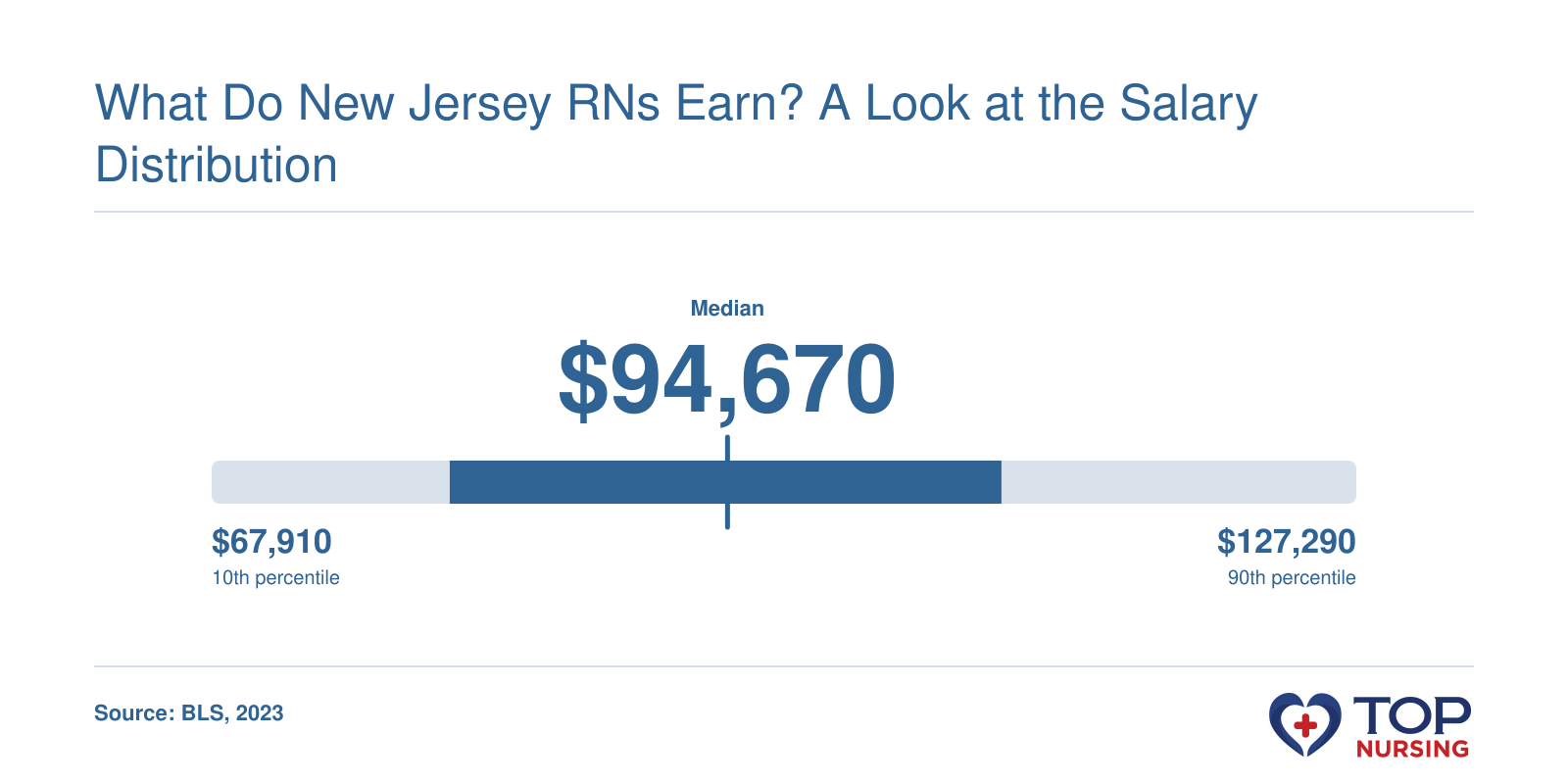
What Do New Jersey RNs Earn? A Look at the Salary Distribution

Registered nurses in New Jersey earn wages well above the national median of $86,070. The chart below breaks down the salary range from entry-level to top earners, giving you a clear picture of earning potential across experience levels.

New Jersey RN salary percentiles from 10th to 90th, with median of $94,670 in 2023, per BLS.

Financial Aid, Scholarships, and Employer Tuition Benefits in NJ

A BSN in New Jersey doesn't have to carry a five-figure price tag, state grants, employer tuition benefits, and generous institutional aid often slash the real cost by half or more. Nurses who take time to map out all three funding streams can move from RN to BSN with far less financial strain than many expect.

State-Funded Grants and Scholarships for Working Nurses

New Jersey runs several programs that directly reduce tuition for RN to BSN students. The key options are listed below, though eligibility rules vary:

  • NJ STARS and STARS II: STARS covers tuition for up to five semesters at a community college (for students who graduated in the top 15% of their high school class, with a 3.0 GPA and household income under $250,000). STARS II then provides up to $1,250 per semester for full-time enrollment at a four-year BSN program.
  • Tuition Aid Grant (TAG): A need-based award for full-time undergraduates. The amount depends on financial need and enrollment status, but it can trim hundreds or thousands off each semester.
  • NJBEST 529 Plan: While primarily a savings vehicle, NJBEST offers state tax deductions on contributions and a one-time scholarship opportunity for beneficiaries.

Additionally, the New Jersey Higher Education Student Assistance Authority (HESAA) is the central hub for state aid applications, and local nursing associations occasionally offer their own named scholarships. Submitting the FAFSA early unlocks most of these options automatically.

Employer Tuition Reimbursement from Major NJ Health Systems

New Jersey's largest hospital networks actively invest in nurses moving to the BSN level. Reimbursement rules are standard: employees must typically earn a grade of C or better and commit to a certain period of post-reimbursement service.

  • RWJBarnabas Health: $3,000 – $5,000 per year in tuition assistance for eligible programs.
  • Hackensack Meridian Health: Up to $5,250 annually, often aligned with IRS tax-free education benefit limits.
  • Atlantic Health System: Between $3,000 and $5,250 per academic year, depending on the role and program.

These amounts often cover a large chunk of tuition at the most affordable online programs. Nurses who plan their course load around the annual max can essentially earn their BSN with no out-of-pocket expense beyond books and fees.

How Pell Eligibility Drives Real Cost Down

Sticker prices at private universities can look alarming, but Pell Grant eligibility dramatically lowers the actual price. At Saint Peter's University, over 79% of undergraduates receive Pell Grants, and the typical net price after all aid is $12,199, a fraction of the $42,552 listed tuition. New Jersey City University serves a similarly high share of Pell-eligible students (nearly 80%), with a net price of $16,053. Even public universities like Kean and William Paterson, where Pell rates hover around 66–67%, show net prices well below $20,000.

Federal programs like FAFSA and HRSA Nurse Corps Loan Repayment can layer on top of state and employer aid, but the New Jersey-specific opportunities often go unclaimed. By combining employer dollars with state grants and federal need-based aid, many RNs finish their BSN with little or no tuition debt.

Did you know? New Jersey leads the nation in the share of Magnet-designated hospitals. The ANCC Magnet Recognition Program requires facilities to target an 80% BSN nursing staff, pushing employers to prioritize BSN-prepared nurses and often offering tuition assistance for RN to BSN completion.

Frequently Asked Questions About RN to BSN Programs in New Jersey

Navigating RN to BSN programs in New Jersey means comparing options from multiple schools and understanding licensure requirements. The answers below focus on where to find the most current and reliable information so you can make a confident decision based on official sources.

How can I find current RN salary data for New Jersey?
For the latest wage figures, visit the U.S. Bureau of Labor Statistics website (bls.gov) and search for registered nurses in New Jersey. The BLS breaks down pay by metro area and percentile, so you can see what nurses earn across the state. Keep in mind that BSN-prepared RNs often command higher pay, especially in hospital settings.
What is the fastest way to earn a BSN after an RN in New Jersey?
Some New Jersey schools offer accelerated RN to BSN tracks that can be finished in as few as 9 to 12 months, but program length depends on your transfer credits and course load. The most accurate and up-to-date timelines are found directly on each school’s nursing program website. Look for phrases like “accelerated,” “fast-track,” or “degree completion” and then check with an admissions advisor to map out your specific plan.
Can I complete an RN to BSN program entirely online in New Jersey?
Yes, many New Jersey colleges offer fully online RN to BSN options, often with flexible asynchronous classes. However, some schools may include a hybrid component with short on-campus intensives or local clinical practicums. The safest way to confirm a program’s delivery format is to review the “program format” or “online learning” page on the institution’s official site, or contact the nursing department directly.
How many credits are typically required for an RN to BSN in NJ?
Most RN to BSN programs in New Jersey require between 30 and 40 upper-division nursing credits, though the total can vary if general education requirements are still needed. Because schools have different curriculum structures and transfer policies, you should ask each program for a personalized degree audit. The official academic catalog and program webpage are the best places to start.
What are the common admission requirements for RN to BSN programs in New Jersey?
Standard requirements include an active, unencumbered RN license, an associate degree or diploma in nursing, and a minimum GPA (often 2.5 or higher). Additional expectations, such as prerequisite courses, letters of recommendation, or a personal statement, vary by school. Always check the “admissions” or “prospective students” tab on the program website; it is the only place you will find the most current, school-specific criteria.
Which RN to BSN program in New Jersey is the most affordable?
Cost varies widely based on whether you qualify for in-state tuition, transfer credits, and employer tuition assistance. Instead of looking for a single “most affordable” label, compare per-credit tuition rates published on each college’s bursar or tuition page. Also visit the New Jersey Board of Nursing website for links to state scholarships, and ask your employer about tuition reimbursement programs.

Recent Articles