Top LPN Programs in Alabama for 2026: Rankings & Comparison

Compare tuition, NCLEX-PN pass rates, program length, and graduate earnings across every Alabama LPN program.

By Hannah Pierce, BSNReviewed by TopNursing.org TeamUpdated May 27, 202622 min read
Top LPN Programs in Alabama (2026 Rankings & Guide)

At a Glance

  • Alabama program-level LPN graduate earnings data is not yet available through College Scorecard.
  • No fully online LPN program exists in Alabama; state licensing mandates in-person clinical hours.
  • The Alabama Board of Nursing publishes annual NCLEX-PN pass rates for every approved LPN program.
  • Nationally, LPN employment is projected to grow 3% from 2024 to 2034, with additional Alabama-specific projections.

Alabama’s nursing homes and rural clinics rely on LPNs to deliver most bedside care, keeping demand steady despite national employment growth projected at just 3% through 2034. In many smaller communities, LPNs are the primary licensed staff.

Seventeen practical nursing programs now publish cost, NCLEX pass rates, and graduate earnings. The net price after grants ranges from $1,739 to $25,946 per year, a spread that can determine whether a new nurse builds savings or struggles with debt for a decade.

With Alabama LPN salaries typically ranging from $30,000 to $40,000, that financial gap is significant. Community colleges consistently offer the lowest costs and strongest completion rates, making them the default choice for students who compare value before enrolling.

2026 Best LPN Programs in Alabama (Ranked)

The 2026 rankings below evaluate Alabama's LPN programs through an affordability-first lens, emphasizing net price, graduation rate, and graduate earnings. Programs with strong completion counts and favorable debt-to-earnings ROI ratios also earn high marks, helping you find an education path that balances cost and career payoff.

Factors considered
  • Affordability and net price
  • Graduation rate performance
  • Median graduate earnings
  • Program completion counts
  • ROI and debt metrics
Data sources
RankSchoolLocationNet priceBest for
#1
Northeast Alabama Community College
Rainsville, AL$5,000 – $9,000/yrApprenticeship-focused nursing candidates

Northeast Alabama Community College offers a standout Practical Nursing Certificate that blends rigorous academics with an apprenticeship-style training option, leading to a near-perfect licensure pass rate and a 100% employment rate for graduates. The ACEN-accredited program is approved by the Alabama Board of Nursing and features hands-on clinical experiences, dedicated faculty, and a fast-track curriculum that builds a direct bridge into the local workforce. Financial aid and scholarships are available to help offset costs.

Practical Nursing Certificate — On-Campus
  • ACEN-accredited program approved by Alabama Board of Nursing
  • Hands-on clinical rotations in diverse healthcare settings
  • Apprenticeship-style training option available
  • Fast-track curriculum: complete in three semesters
  • Prepares graduates for NCLEX-PN exam
  • Near-perfect licensure pass rate reported by program
  • 100% employment rate for nursing graduates
  • Financial aid and scholarships available for eligible students

Wallace Community College-Dothan delivers a Practical Nursing certificate program with ACEN accreditation and Alabama Board of Nursing approval, preparing students for NCLEX-PN licensure in just three terms. The program features two campus locations (Dothan and Eufaula) and competitive admission with fall and spring start dates, blending classroom instruction with supervised clinical experiences. Graduates are equipped for entry-level LPN roles and can stack the credential toward advanced nursing education.

Practical Nursing — On-Campus
  • ACEN-accredited and Alabama Board of Nursing approved
  • Offered at Dothan and Eufaula campuses
  • Fall and spring start dates available
  • Three-term program for efficient entry
  • Competitive admission process
  • Clinical experiences in local healthcare facilities
  • Prepares students for NCLEX-PN licensure
  • Stackable toward further nursing education

Gadsden State Community College, an HBCU, provides a three-semester Practical Nursing program that emphasizes concept-based learning and clinical experiences within a 65-70 mile radius. Students benefit from four nursing campuses, a dedicated Simulation Center, and a stackable pathway into the ADN Mobility Nursing Program. With competitive admission and a 75% minimum in nursing courses, graduates are well-prepared for the NCLEX-PN and immediate workforce entry.

Practical Nursing — On-Campus
  • Three-semester program with concept-based curriculum
  • Prepares students for NCLEX-PN exam
  • Stackable credential: LPN to ADN Mobility Program
  • Simulation Center for hands-on skill building
  • Clinical sites within 65-70 mile radius
  • Four nursing campuses: Gadsden, Cherokee, Ayers, Valley Street
  • Requires minimum 75% in nursing courses
  • Competitive admission based on entrance scores

Northwest Shoals Community College offers an ACEN-accredited Practical Nursing certificate that spans three semesters and 45 credit hours, with a single summer start each year. The program is approved by the Alabama Board of Nursing and provides clinical training at accredited healthcare agencies, with campuses in Muscle Shoals and Phil Campbell. A seamless transfer pathway to the ADN program and a 2.5 GPA admission requirement make it a solid stepping stone for career advancement.

Practical Nursing — On-Campus
  • ACEN-accredited and Alabama Board approved
  • Three-semester program with 45 credit hours
  • Summer start date each year
  • Offered at Muscle Shoals and Phil Campbell campuses
  • Minimum 2.5 GPA for admission
  • No minimum ACT score required
  • Seamless transfer pathway to ADN program
  • Clinicals at accredited healthcare agencies

Chattahoochee Valley Community College's Practical Nursing certificate takes a unique stackable approach: students earn CNA certification after the first semester and MACE eligibility after the second, culminating in PN certification and NCLEX-PN eligibility. The three-semester campus-based program starts each January with a July-to-September application window, and clinical rotations prepare graduates for roles in hospitals, long-term care, and home health.

Practical Nursing — On-Campus
  • Three-semester program with January start
  • Stackable credentials: earn CNA after first, MACE after second semester
  • Eligible for NCLEX-PN upon completion
  • Campus-based with clinical rotations
  • Part of Alabama Community College System
  • Application window July 1 to September 30
  • Prepares for roles in hospitals, clinics, long-term care
  • Fast path to licensure with multiple exit points

Bevill State Community College's Practical Nursing certificate uses a concept-based curriculum adopted in 2016, emphasizing active learning and interdisciplinary collaboration. The three-semester program admits students in spring and summer, requiring a minimum ACT score of 18 and a 2.5 GPA. Clinical rotations with background checks and health insurance are mandatory, and small class sizes ensure focused support from dedicated faculty. The certificate also serves as a bridge to the ADN program.

Practical Nursing — On-Campus
  • Concept-based curriculum adopted in 2016
  • Three-semester program with spring and summer starts
  • Requires minimum ACT score of 18 and 2.5 GPA
  • Clinical rotations with background checks and insurance required
  • Prepares for NCLEX-PN exam
  • Stackable: bridges to ADN program
  • Small class sizes with dedicated faculty
  • Holistic support and diversity emphasis

George C Wallace State Community College-Selma provides an on-campus Practical Nursing certificate grounded in four core nursing courses (NUR 112-115) plus general education requirements. Guided clinical experiences in local healthcare settings build essential patient care skills, aligning with Alabama nursing education standards. Graduates are prepared to sit for the NCLEX-PN and pursue LPN positions in hospitals, clinics, and long-term care facilities.

Practical Nursing — On-Campus
  • On-campus Practical Nursing certificate program
  • Includes four core nursing courses (NUR 112-115)
  • Guided clinical experiences in local healthcare settings
  • Prepares graduates for LPN roles in hospitals and clinics
  • Part of Health Sciences Department
  • Follows Alabama nursing education standards
  • Prepares for NCLEX-PN licensure
  • Stackable foundation for further nursing education

Lawson State Community College, an HBCU, delivers an ACEN-accredited Licensed Practical Nurse program on its Bessemer campus, boasting a reported 100% licensure pass rate and job placement. The three-semester, 49-credit curriculum features competitive admission based on ACT scores, GPA, and prerequisite coursework, with summer and fall start dates. An LPN-to-RN track, financial aid, and Skills for Success training add further value for aspiring nurses.

Licensed Practical Nurse (LPN) — On-Campus
  • ACEN-accredited program at Bessemer campus
  • Three-semester program with 49 credit hours
  • Summer and fall start dates available
  • Reports 100% licensure pass rate and job placement
  • Minimum 2.5 GPA for admission
  • Competitive admission with point system
  • Offers LPN to RN track for advancement
  • Financial aid available and Skills for Success training options

Calhoun Community College's ACEN-accredited Practical Nursing Program Certificate can be completed in three semesters (45 credits) with fall and spring starts at both Decatur and Huntsville campuses. Selective admission requires an ACT or HESI A2 score and a 2.0 cumulative GPA, while small class sizes foster individualized attention. Clinical rotations at local healthcare facilities and a curriculum focused on evidence-based clinical reasoning prepare graduates for the NCLEX-PN and immediate employment.

Practical Nursing Program Certificate — On-Campus
  • ACEN-accredited program at Decatur and Huntsville campuses
  • Three-semester program with 45 credit hours
  • Fall and spring start dates available
  • Selective admission with ACT or HESI A2 exam
  • Minimum 2.0 cumulative GPA required
  • Clinical rotations at local healthcare facilities
  • Small class sizes for individualized attention
  • Prepares for NCLEX-PN and career advancement

J. F. Drake State Community and Technical College, an HBCU in Huntsville, offers a three-semester ACEN-accredited Practical Nursing certificate with fall and spring start dates. The curriculum integrates nursing theory with clinical practice, and graduates are eligible to sit for the NCLEX-PN. A seamless LPN-to-RN Mobility pathway, a supportive learning environment, and a low student-faculty ratio make this program an accessible entry point into the nursing profession.

Practical Nursing — On-Campus
  • ACEN-accredited three-semester certificate
  • Fall and spring start dates offered
  • Prepares students for NCLEX-PN exam
  • Seamless LPN to RN Mobility pathway
  • Hands-on clinical practice integrated with theory
  • HBCU designation with supportive environment
  • Located in Huntsville, Alabama
  • Small student-faculty ratio for personalized instruction

Alabama LPN Program Comparison Table

This table compares key metrics for LPN programs in Alabama. 'Net price' is the average annual cost after grants and scholarships for first-time, full-time students, giving a clearer picture of affordability than sticker tuition. Graduation rates are institution-wide figures, not specific to the LPN program. Median earnings reflect earnings 10 years after entering the college, and median debt is for graduates who completed programs.

SchoolIn-State TuitionNet PriceGraduation RateMedian Earnings (10 yr)Median DebtFormat
Northeast Alabama Community College$5,040$2,75656.0%$34,913$6,100Campus
Wallace Community College-Dothan$4,980$1,17035.0%$31,399N/ACampus
Gadsden State Community College$4,272$3,51538.2%$32,937N/ACampus
Northwest Shoals Community College$5,131$2,83838.7%$33,828$10,000Campus
Chattahoochee Valley Community College$5,100$4,24436.0%$36,438$10,500Campus
Bevill State Community College$4,734$5,93738.0%$34,107N/ACampus
George C Wallace State Community College-Selma$4,740$9,27240.6%$31,598N/ACampus
Lawson State Community College$5,040$6,27526.6%$31,701N/ACampus
Calhoun Community College$5,120$7,66041.5%$38,192$12,000Campus
J. F. Drake State Community and Technical College$5,190$6,00514.0%$28,281N/ACampus
Wallace State-Hanceville$5,220$13,17051.2%$39,842$11,000Campus
H Councill Trenholm State Community College$5,190$8,32516.1%$32,183N/ACampus
Central Alabama Community College$5,110$15,99632.9%$33,506$9,766Campus
Coastal Alabama Community College$5,040$13,64431.3%$34,894$11,000Campus
Shelton State Community College$5,127$14,55729.6%$35,014N/ACampus
Reid State Technical College$5,454$1,73958.9%$28,982N/ACampus
Fortis Institute-Birmingham$15,335$25,94633.7%$32,886$12,346Campus

Questions to Ask Yourself

Many LPN programs in Alabama offer part-time or evening tracks. Without flexible scheduling, balancing work and school can delay your graduation.

Clinical rotations often occur at facilities across the city or region. Long commutes can add stress and eat into study time, especially during intensive semesters.

Some Alabama schools have seamless LPN-to-RN or LPN-to-BSN pathways, saving time and tuition. Choosing a program with this option now can streamline your future advancement.

NCLEX-PN Pass Rates for Alabama LPN Programs

One-year pass rates show whether a program’s graduates passed on their first attempt, but a school that maintains a high rate over several years demonstrates consistent quality.

2024 Alabama LPN Program Pass Rates

The Alabama Board of Nursing (ABON) publishes annual NCLEX-PN pass rates for all approved practical nursing programs. For the 2024 testing cycle, Alabama’s overall first-time pass rate reached 94.81%, well above the national average of approximately 86% for practical nursing candidates. The ABON report for this year did not include the number of test-takers for each school, but the percentages alone offer a clear view of how graduates performed.

  • Bevill State Community College: 97.46%
  • Bishop State Community College: 91.30%
  • Calhoun Community College: 99.15%
  • Central Alabama Community College: 100.00%
  • Chattahoochee Valley Community College: 100.00%
  • Coastal Alabama Community College: 99.24%
  • Drake State Community and Technical College: 95.24%
  • Enterprise State Community College: 94.12%
  • Gadsden State Community College: 96.08%
  • Herzing University – Birmingham: 100.00%
  • Lawson State Community College: 85.71%
  • Lurleen B. Wallace Community College: 100.00%
  • Northwest-Shoals Community College: 97.01%
  • Shelton State Community College: 100.00%
  • Trenholm State Community College: 87.50%
  • Wallace Community College – Dothan: 100.00%
  • Wallace State Community College – Hanceville: 100.00%
  • Wallace Community College – Selma: 94.44%

How the Board of Nursing Uses Pass Rates

The ABON requires each approved program to maintain a minimum first-time NCLEX-PN pass rate of 80% annually. If a program falls below that threshold for two consecutive years, the Board may place it on probation, require a corrective action plan, or withdraw approval entirely. In 2024, every Alabama LPN program exceeded the 80% floor, so no school faced immediate regulatory action. A handful of programs did land in the 85% to 87% range, noticeably lower than the state average but still above the national mean and the Board’s minimum.

Programs That Stand Out in 2024

Seven Alabama LPN programs posted perfect 100% first-time pass rates: Central Alabama, Chattahoochee Valley, Herzing (Birmingham), Lurleen B. Wallace, Shelton State, Wallace-Dothan, and Wallace-Hanceville. Calhoun (99.15%) and Coastal Alabama (99.24%) were essentially flawless. On the other end, Lawson State’s 85.71% and Trenholm State’s 87.50% represent the lowest figures, yet both remain well above the national average and the state’s minimum. Because the ABON’s public report does not include prior-year rates, prospective students should ask programs directly about multi-year trends, consistently strong pass rates, year after year, are a stronger indicator than a single snapshot. When evaluating a program, pair these numbers with campus visits, curriculum details, and clinical placement records to get the fullest picture of a school’s NCLEX preparation.

How Alabama LPN Graduate Earnings Compare

The U.S. Department of Education’s College Scorecard reports median earnings of former students one year after they complete a program. These figures reflect what graduates of specific nursing programs actually earn, not broad occupational wage estimates. At this time, program-level earnings data for LPN programs in Alabama has not been published. As soon as the data is released, we will update this comparison.

Median earnings one year after graduation for Alabama LPN programs is not yet available in College Scorecard data.

Online and Hybrid LPN Programs in Alabama

Healthcare education increasingly embraces online delivery, but becoming a licensed practical nurse remains firmly grounded in hands-on clinical experience. Fully online LPN programs do not exist in Alabama (or anywhere) because state licensing boards require supervised patient care hours that cannot be earned through virtual simulation alone. Every program on this list combines classroom or online theory with mandatory in-person labs and clinical rotations at local healthcare facilities.

The Reality of Online LPN Training

The Alabama Board of Nursing mandates that LPN candidates complete a set number of clinical hours in real patient-care settings. Even programs that advertise online components still require shifts at hospitals, nursing homes, or clinics. This guarantees you graduate with the physical assessment, medication administration, and bedside skills employers expect. If a program claims to be “online,” ask directly how many hours you will spend on site: the answer is always a substantial portion of the total program.

Evening and Weekend Options in Alabama

While true hybrid delivery (online didactic with in-person clinicals) remains rare, two schools in this directory provide structured evening schedules for working students:

  • Wallace State-Hanceville highlights an evening program option, allowing you to attend class and clinicals during non-traditional hours.
  • Shelton State Community College notes that evening clinical shifts are possible, offering additional flexibility for those with daytime jobs.

Several other programs list multiple start dates (fall/spring) and campus locations, helping you piece together a manageable schedule. For example, Calhoun Community College and Bevill State Community College each offer two entry points per year, so you can align the start with your work calendar. However, dedicated weekend-only tracks are not currently advertised among the ranked Alabama programs.

What to Expect from Hybrid Learning

A true hybrid LPN program delivers lectures online through a learning management system, reserving in-person time for lab skills and clinical rotations. You might watch prerecorded lectures on your own time, yet still report to a campus simulation lab once or twice a week and complete 12-24 hours of clinicals each week. In Alabama, no ranked school in this guide markets a fully hybrid LPN pathway, but the movement toward flexible scheduling is growing. Before enrolling, always verify with the program coordinator exactly which components are online and which require physical attendance.

The BLS projects 3% national employment growth for LPNs from 2024 to 2034. Alabama-specific projections through 2032, including annual job openings, are available from the Alabama Department of Labor and the Projections Central tool. This steady demand makes practical nursing a stable career choice.

Admission Requirements for Alabama LPN Programs

Standard Program Prerequisites

Every Alabama practical nursing program expects applicants to meet a set of baseline academic and non-academic requirements, which align with broader LPN education requirements across the country. While specifics vary by school, the following elements are nearly universal:

  • High school diploma or GED: Official transcripts must show completion of secondary education.
  • GPA minimum: Most programs set a cumulative GPA floor between 2.0 and 2.5 on a 4.0 scale. Some competitive tracks may require a higher average.
  • TEAS exam: The Test of Essential Academic Skills is standard. A composite score above the 50th-60th percentile is common, but top candidates often score higher.
  • Background check and drug screening: Applicants must pass a criminal background check and a drug test, typically during the application process and again before clinical placements.
  • Prerequisite courses: Foundational college-level courses in anatomy and physiology, basic math or algebra, and English composition usually need to be completed with a grade of C or better. Some programs also require a psychology or human growth and development course.

Meeting minimums does not guarantee admission. Many Alabama LPN programs use a point-based ranking system that rewards higher grades, stronger TEAS scores, and relevant work or volunteer experience.

Competitive Admission and the Alabama Community College System

The majority of LPN programs in Alabama operate within the Alabama Community College System (ACCS). These schools follow broadly similar academic standards, but admission is often selective. A program may have higher cutoffs than the system-wide minimum, especially at campuses with more applicants than seats. Prospective students should contact each program directly to confirm current score thresholds and any additional requirements, such as an interview or CPR certification. Because curricula are aligned with Alabama Board of Nursing regulations, graduates from ACCS schools are well-prepared for the licensure exam.

Licensure Through the Alabama Board of Nursing

After completing an approved practical nursing program, graduates must apply to the Alabama Board of Nursing for licensure by examination. The process involves several steps and fees.

  • Application fee: The total application fee is $128.50 (a $125 base fee plus a $3.50 online transaction fee). Fees are valid for the 2025-2026 cycle and may be updated periodically.1
  • Background check: A Live Scan fingerprint-based background check is required. This is completed through the IdentoGO vendor; the cost is paid directly to the vendor at the time of fingerprinting.2
  • NCLEX-PN registration: Candidates must register with Pearson VUE and pay the $200 exam fee.2 Registration should be done before or shortly after submitting the state application.
  • Supporting documents: The Board requires proof of Social Security number, documentation of citizenship or legal presence, and an official transcript sent directly from the nursing program.1

Once the Board receives all materials and clears the applicant, an Authorization to Test (ATT) email is issued. The ATT allows scheduling the NCLEX-PN at a testing center. Processing may take several weeks, so submitting the application as soon as possible after graduation is advisable. Upon passing the exam, the license is issued, and the nurse can begin working as an LPN in Alabama.

How to Become an LPN in Alabama

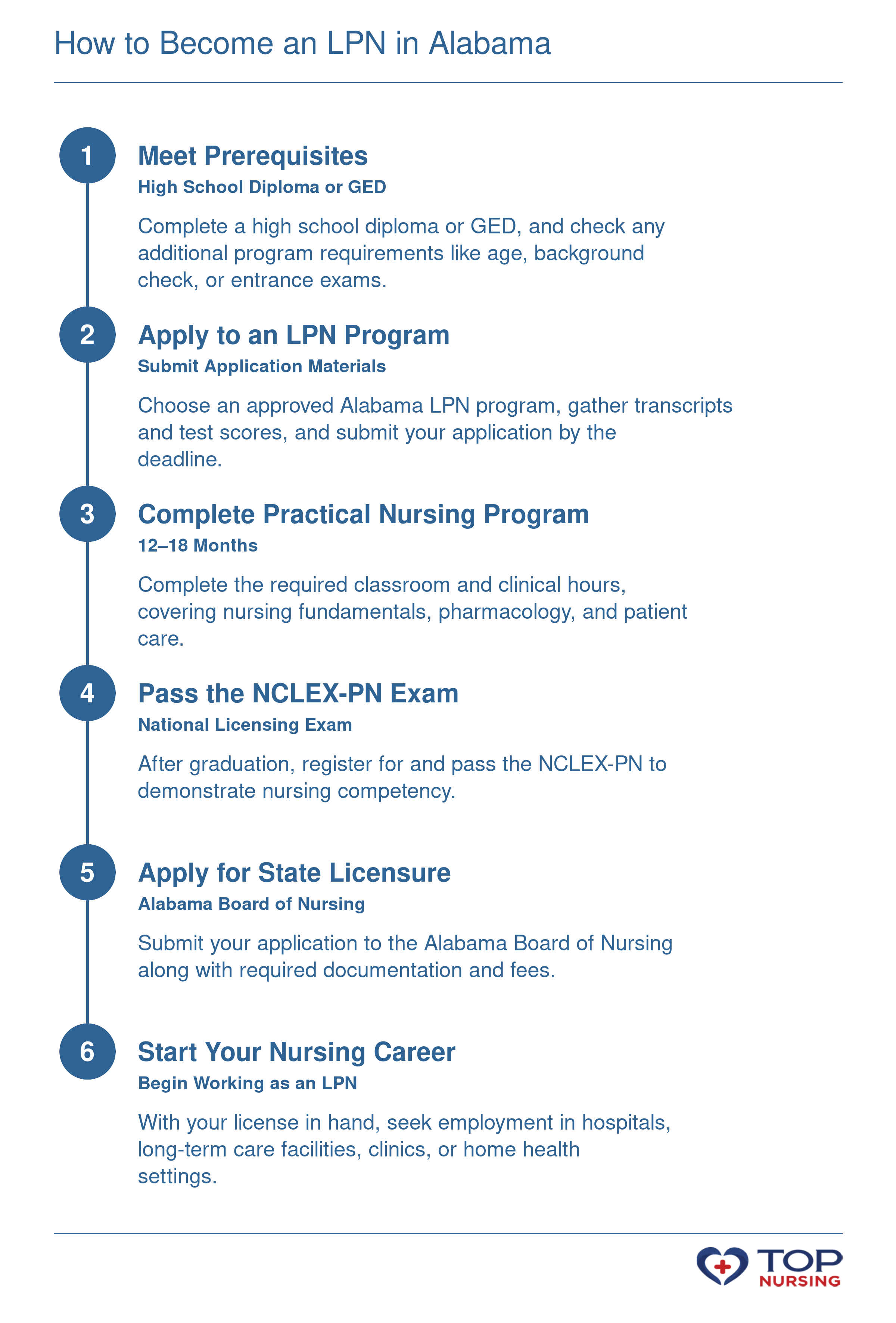
The path to becoming a Licensed Practical Nurse in Alabama follows a clear sequence. From meeting admission requirements to landing your first job, each step brings you closer to a rewarding nursing career.

Six-step pathway to become an LPN in Alabama: meet prerequisites, apply, complete program, pass NCLEX-PN, apply for license, start working.

LPN Salary and Job Outlook in Alabama

Licensed Practical Nurses in Alabama earn wages that vary by location and employer. The table below shows median annual earnings along with the 25th and 75th percentiles to illustrate the earning range across major metro areas. Registered nurses in the same areas earn significantly higher wages, with median salaries typically $15,000 to $25,000 more per year.

Metro AreaMedian Annual Wage25th Percentile75th PercentileMean Annual WageTotal Employment
Birmingham, AL$51,580$47,300$59,770$52,7602,580
Huntsville, AL$54,470$45,880$63,690$53,990950
Montgomery, AL$51,880$43,600$59,970$50,400840
Tuscaloosa, AL$49,110$40,200$58,250$49,590780
Mobile, AL$50,670$47,000$59,080$51,680730
Dothan, AL$39,780$39,090$50,280$43,850560
Florence-Muscle Shoals, AL$49,320$43,150$57,580$49,220340
Daphne-Fairhope-Foley, AL$52,160$47,900$61,160$53,330320
Gadsden, AL$47,730$43,250$56,600$48,450250
Anniston-Oxford, AL$53,390$46,070$57,990$51,430240
Decatur, AL$51,170$44,540$59,040$50,340220
Auburn-Opelika, AL$48,590$44,430$58,200$49,160180

LPN-to-RN Bridge Programs and Advancement Pathways in Alabama

What LPN-to-RN bridge programs are available in Alabama, and how do you choose the right one? For many LPNs, the next step is an associate degree in nursing (ADN) that leads to RN licensure, or even a direct path to a bachelor of science in nursing (BSN). Alabama’s community college system and several universities offer structured bridge options designed to credit your existing practical nursing knowledge, shortening the time and cost to advance.

Where to Find LPN-to-RN Bridge Programs in Alabama

The primary gateway is the Alabama Community College System (ACCS), which maintains a list of member colleges offering LPN-to-ADN mobility tracks. On the ACCS website, you’ll find system-wide policies for credit-for-prior-learning, along with links to individual campuses. Jefferson State Community College and Calhoun Community College, for example, typically offer these programs, but details like program length, start dates, and specific credit awards vary. Always visit each school’s nursing department page directly for the most current application windows, prerequisite updates, and any hybrid or evening options.

How Credit for Prior Learning Works

Most LPN-to-RN bridge programs grant advanced standing based on your current, unencumbered LPN license and work experience. This may translate to credit for foundational nursing courses, allowing you to enter the ADN program at a designated transition point rather than starting from scratch. However, the exact number of credits you receive depends on the school’s evaluation of your transcripts and, in some cases, a challenge exam or skills validation. Contact program advisors to clarify what portion of your prior learning can be applied before you apply.

Statewide Approval and Articulation

The Alabama Board of Nursing approves all pre-licensure nursing programs, including LPN-to-RN tracks. Their website lists every board-approved program in the state so you can verify that a school’s offering meets regulatory standards. The Board also oversees statewide articulation agreements, which can ease transfer between ACCS colleges and four-year institutions if you later decide to pursue a BSN. Checking with the Board directly helps you identify programs with a clear, recognized pathway to RN licensure.

Weighing Salary and Job Prospects Before You Enroll

Before committing, research employment outlook and earnings through the Bureau of Labor Statistics and the Alabama Career Center System. National data can provide a broad benchmark for RN salaries, but state-level figures from the Alabama Career Center offer a more realistic picture of what you might earn in cities like Birmingham or Huntsville. Review current job postings and projected growth for RNs in Alabama to see whether a bridge program aligns with your career goals and financial expectations.

Frequently Asked Questions About Alabama LPN Programs

Prospective nursing students often have questions about LPN program details, cost, and career outlook. Here are straightforward answers to the most common inquiries.

How long does it take to complete an LPN program in Alabama?
Most Alabama LPN programs take 12 to 18 months of full-time study. Accelerated or fast-track options may be completed in as few as 9-11 months, while part-time tracks can extend to 24 months. Program length depends on the school's curriculum structure and whether you attend during summers.
Are there any fully online LPN programs in Alabama?
No fully online LPN programs exist in Alabama because hands-on clinical hours are required by the state board. However, many schools offer hybrid programs where didactic coursework is online, and labs and clinical rotations are completed in person. Check each program's format for details.
How much does LPN school cost in Alabama?
Tuition for Alabama LPN programs ranges from $3,000 to $15,000, with community colleges generally on the lower end. Total cost includes fees, books, uniforms, and supplies. Financial aid, scholarships, and payment plans are often available. For the most affordable options, see the rankings list on this page.
What is the NCLEX-PN pass rate for Alabama LPN programs?
Alabama LPN programs report NCLEX-PN pass rates annually to the state board. Many top-ranked programs achieve pass rates above 90%. The state average has been around 85-88% in recent years. Individual program rates are available on the Alabama Board of Nursing website and in our program comparison table.
What are the requirements to become an LPN in Alabama?
To become an LPN in Alabama, you must complete a state-approved practical nursing program, pass the NCLEX-PN exam, and apply for licensure with a background check and fingerprinting. Some programs also require CPR certification, entrance exams like the TEAS, and proof of immunizations.
How much do LPNs make in Alabama compared to RNs?
According to the U.S. Bureau of Labor Statistics, the median annual wage for LPNs in Alabama is around $44,000, while RNs earn about $64,000. LPN salaries vary by location and experience. The gap reflects differences in education scope. For detailed salary data, refer to the salary table in this guide.
Can I work as an LPN while completing an RN bridge program?
Yes, many LPN-to-RN bridge programs in Alabama are designed for working nurses, with evening, weekend, or part-time formats. You can work as an LPN while studying for your RN. However, the workload can be demanding; some students reduce work hours during clinical semesters. Check individual program schedules.

Recent Articles