Top RN to BSN Programs in Arizona for 2026

Compare costs, program length, and online options across every Arizona RN-to-BSN pathway.

By Maria Delgado, RNReviewed by TopNursing.org TeamUpdated May 29, 202625+ min read
Top RN to BSN Programs in Arizona (2026 Rankings)

Points of interest…

  • Arizona State University’s online RN to BSN can be completed in just 14 months, the fastest timeline available.
  • Net price after aid ranges from $7,929 at public community colleges to $40,096 at Chamberlain University.
  • Chamberlain University graduates report $92,405 median earnings with only $20,919 in median debt.
  • Scholarships and tuition assistance can reduce out-of-pocket costs by $2,500 to $15,000 or more.

BSN-prepared nurses are fast becoming the baseline in Arizona’s large health systems, where Magnet designation and payer-linked quality metrics make the degree a competitive necessity. For many RNs, the question is not whether to earn a BSN, but when and at what cost.

Arizona’s 11 RN-to-BSN programs include fully online, hybrid, and campus-based tracks, from community college bachelor’s degrees at Cochise and Yavapai to university offerings at NAU and ASU, giving working nurses flexibility over delivery and pace.

Net prices range from under $8,000 to over $40,000, and completion takes anywhere from 10 to 24 months, making the financial and time calculus vary sharply by school.

Best RN to BSN Programs in Arizona, 2026 Rankings

Arizona’s RN to BSN landscape reflects the state’s diverse communities and workforce needs, from rural delivery expansion to strong university–community college partnerships. The programs ranked here blend affordability, flexibility, and local relevance, with many designated as Hispanic-Serving Institutions and several offering accelerated paths for ADN- or AAS-educated nurses. Use this list to compare net price, graduation support, and unique program features that align with your career stage and location.

Factors considered
  • Affordability and net price
  • Program length and delivery
  • Graduation outcomes
  • Arizona-specific partnerships
  • Student support indicators
Data sources
RankSchoolLocationNet priceBest for
#1
Cochise County Community College District
Sierra Vista, AZ$8,000/yrBudget-conscious local ADN graduates

Cochise College offers a post-licensure RN to BSN designed for nurses holding an active RN license. Students engage in theory and clinical experiences across Cochise and Pima counties, with a competitive admission process that includes a TEAS exam. The institution is designated as a Hispanic-Serving Institution and serves a high Pell-eligible population, reflecting its commitment to diverse student success.

Registered Nurse to Bachelor of Science in Nursing (RN to BSN) — On-Campus
  • Post-licensure pathway for RNs with active license
  • Competitive entry: TEAS exam score of 66.1+ and prerequisite courses
  • Lectures at Downtown Center; labs on multiple campuses
  • Clinical experiences in hospitals across Cochise and Pima counties
  • Spring application deadline; fingerprint clearance card required
  • Prepares graduates for the NCLEX-RN exam
  • HSI-designated college with strong Pell Grant support

Yavapai College’s fully online RN to BSN is tailored for working Arizona RNs, with 8-week courses and flexible full- or part-time pacing. The program emphasizes leadership, population health, and community-based projects with local organizations, aligning directly with Arizona’s rural healthcare needs. As an HSI with strong Pell support, Yavapai delivers an ACEN-accredited path that can be completed in as little as one year.

Bachelor of Science in Nursing (RN-BSN) — Online
  • 100% online with 8-week terms and multiple start dates
  • Complete in as little as 1 year (3 semesters) full-time
  • ACEN-accredited; $305 per credit in-state
  • Transfer up to 90 credits; 120 total credits required
  • Option to earn a Certificate in Strategic Leadership concurrently
  • Service-learning projects with Arizona community organizations
  • Designed for working RNs; part-time pacing available

Eastern Arizona College’s new online BSN is part of a rural workforce initiative, targeting RNs in the state’s eastern region. The program is scheduled to launch its first cohort in Fall 2026, featuring four-semester completion and flexible co-requisite courses designed for working nurses. An HSI institution, EAC aims to expand BSN access beyond the Phoenix–Tucson corridor.

Bachelor of Science in Nursing (RN to BSN) — Online
  • First cohort starting Fall 2026; four-semester schedule
  • Fully online with flexible co-requisite courses
  • HLC accredited; plans to seek ACEN accreditation
  • Targets rural and eastern Arizona RNs
  • Affordable in-state tuition of $2,352/year
  • Transfer-friendly for ADN-prepared nurses
  • Personalized academic advising and online tutoring

GateWay Community College provides a part-time RN to BSN with in-person lab and clinical components at Phoenix-area sites. Preferential admission is extended to Maricopa Community Colleges AAS nursing graduates, making it a strong choice for RNs already within that system. The program accepts 62–75 block credits from prior nursing education and focuses on leadership and evidence-based practice.

Nursing (RN to BSN) — On-Campus
  • Part-time program completed in 5 terms
  • Preferential admission for Maricopa AAS nursing graduates
  • ACEN accredited; 120 total credits
  • Accepts 62–75 block credits from prior nursing education
  • In-person lab, simulation, and clinical components in Phoenix
  • Focus on leadership, evidence-based practice, and health promotion
  • Background check and drug test required

Pima Medical Institute offers a fully online RN to BSN that can be completed in approximately one year, catering to working RNs with an unencumbered license. The Tucson-based institution has strong relationships with Arizona healthcare employers and an impressive 72% graduation rate across the campus. Coursework emphasizes leadership, management, and evidence-based research.

Bachelor of Science in Nursing (RN to BSN) — Online
  • Online delivery; complete in approximately 1 year
  • Requires unencumbered RN license and high school diploma
  • 79 semester credits of coursework
  • CCNE accredited; no entrance exam
  • Emphasis on leadership, management, and evidence-based research
  • Strong employer ties with Banner, HonorHealth, and Tucson hospitals
  • Capstone course and asynchronous online classes available

Aspen University, headquartered in Phoenix, delivers a 100% online RN to BSN completion program with 8-week terms and no mandatory login times. The program requires 30 credits and can be finished in as little as 12 months, with tuition set at $11,850 plus fees. Admission requires a current RN license, a 2.50 GPA, and one year of nursing experience.

RN to BSN (Bachelor of Science in Nursing Completion Program) — Online
  • 100% online with 8-week terms; start dates every 2 weeks
  • 30 credits; can be finished in 12 months
  • $11,850 tuition plus fees; monthly payment plan available
  • CCNE accredited; requires 2.50 GPA and current RN license
  • One year of RN experience required; no mandatory login times
  • 60 credits awarded for RN license; transfer up to 90 credits
  • Field experience hours required; no thesis or capstone

Northern Arizona University’s online RN to BSN is one of the most accelerated and cost-efficient options in the state, especially for Arizona community-college graduates. ADN-prepared nurses can often complete the 30 nursing credits in just one or two semesters, with clinical projects rooted in local Arizona communities. NAU maintains strong articulation agreements with Maricopa, Pima, Yavapai, and other AZ colleges, and markets a flat per-semester tuition that keeps costs low for in-state residents.

Nursing - Option for Registered Nurses, Bachelor of Science in Nursing — Online
  • Online RN to BSN; complete in as few as 1 semester for AAS grads
  • 30 nursing credits; capstone project in your local community
  • CCNE accredited; transfer up to 90 units
  • Flat per-semester tuition model for affordability
  • Strong articulation agreements with AZ community colleges
  • Focus on evidence-based practice and leadership
  • Clinical projects in tribal, rural, and border health settings

The University of Phoenix, headquartered in Arizona, offers a flexible online RN to BSN with a competency-based track option for experienced nurses. The program can be completed in 14 months and includes 90 direct care clinical hours, with an estimated total cost of $14,000 for students who maximize transfer credits. While pricing is largely flat, its Arizona roots and employer partnerships make it accessible for local working professionals.

Registered Nurse to Bachelor of Science in Nursing — Online
  • Online RN to BSN; complete in 14 months
  • 33 core credits; estimated $14,000 total for max transfer
  • 90 direct care clinical hours; capstone course
  • CCNE accredited; one course every five weeks
  • Active RN license required; minimum 2.0 GPA
  • Separate competency-based track available for experienced nurses
  • Arizona-based headquarters with local employer partnerships

Grand Canyon University, a private Christian institution in Phoenix, provides an online RN to BSN with five-week classes and up to 90 transfer credits accepted. The program is CCNE-accredited and can be finished in 14 months, with a tuition rate of $340 per credit. GCU maintains strong education partnerships with major Arizona health systems, offering tuition discounts and a pipeline for employees pursuing the BSN.

Bachelor of Science in Nursing (RN to BSN) — Online
  • Online program with 5-week courses; complete in 14 months
  • $340 per credit; 120 total credits (up to 90 transfer credits)
  • CCNE accredited; 3.0 GPA or 2.5 with ACT/SAT for admission
  • High NCLEX pass rate (95.57%) for pre-licensure programs
  • Christian worldview integration; leadership and EBP curriculum
  • 40 clinical hours; flexible for working nurses
  • Strong partnerships with AZ health systems for tuition discounts

Arizona State University’s online RN to BSN is a 36-credit program delivered in 7.5-week courses, designed for RNs with an associate degree. A standout feature is the Concurrent Enrollment Program, allowing ADN students at partner Arizona community colleges to take BSN coursework simultaneously. The program is taught by Edson College faculty and includes an Earned Admission pathway for applicants who need to meet eligibility criteria.

Online RN to BSN — Online
  • Online RN to BSN; 36 credits, 7.5-week courses
  • Multiple start dates; next start: July 2026
  • Active RN license and 2.5 GPA required
  • Concurrent Enrollment Program with AZ community colleges
  • Earned Admission pathway for those not meeting initial criteria
  • Taught by award-winning Edson College faculty
  • No on-campus requirements; focuses on pediatric, public health roles

Chamberlain University’s Phoenix campus offers a CCNE-accredited RN to BSN online option that can be completed in as few as 10 months. The program awards 77 proficiency credits for an ADN or diploma, leaving 45 credits to finish, with additional transfer credits accepted. With no mandatory login times and a direct care practicum component, Chamberlain provides a fast-paced, flexible path for Arizona nurses seeking upward career mobility.

RN to BSN (Bachelor of Science in Nursing) — Online
  • Online RN to BSN; complete in as few as 10 months
  • CCNE accredited; $635 per credit hour
  • 77 proficiency credits awarded for ADN/diploma
  • Transfer up to 15 additional credits; no mandatory login times
  • 2.0 GPA and active RN license required
  • Direct care practicum component; 24 clinical hours
  • Tuition Advantage Grant available; military and employer discounts

Arizona RN to BSN Cost Comparison

Net prices shown are institution-wide averages after financial aid and serve as a useful comparison point rather than an exact quote for each student. Public community colleges like Cochise, Yavapai, and Eastern Arizona offer the most affordable net costs, driven by low in-state tuition and high shares of Pell Grant recipients.

SchoolIn-State TuitionOut-of-State TuitionNet Price (Avg. After Aid)Pell Grant Recipients
Cochise County Community College District$2,280$6,120$7,92993.5%
Yavapai College$2,948$9,486$8,68393.2%
Eastern Arizona College$2,352$9,552$9,197N/A
GateWay Community College$2,358$8,959$13,33985.4%
University of Phoenix-Arizona$9,552$9,552$13,52085.8%
Northern Arizona University$12,619$20,044$14,15863.1%
Grand Canyon University$18,508$18,508$22,47270.6%
Chamberlain University-Arizona$21,520$21,520$40,09645.0%

How Long Does an RN to BSN Take in Arizona?

Arizona State University’s online RN to BSN program can be completed in as few as 14 months of full-time study, placing it among the fastest pathways in the state. Across Arizona, most RN to BSN programs require 30 to 40 credits of upper-division nursing coursework, above the associate degree credits you bring in. That credit load translates to 12 to 18 months of full-time enrollment or 2 to 3 years part-time, with the exact duration shaped by your personal schedule and transfer credit situation.

Typical Timelines: Full-Time vs Part-Time

Full-time tracks are designed for nurses who can dedicate significant weekly hours to coursework. Arizona State University’s full-time plan wraps up in 14 months, while part-time options extend from 18 to 24 months. Many programs across the state, including those at Northern Arizona University and Grand Canyon University, follow similar patterns. Part-time pacing reduces the per-session load to one or two courses, making it the default choice for nurses who work 12-hour shifts. In practice, it is common for a working RN to take 2 to 3 years even when the catalog states a faster pace.

Accelerated Options in Arizona

“Accelerated” can mean different things. At ASU, the Arizona Pathway Program offers a streamlined route for graduates of Maricopa Community College or Pima Community College ADN programs, leveraging pre-articulated credit blocks to minimize redundant coursework. The term accelerated here refers less to self-paced modules and more to a curriculum that awards maximum credit for prior learning, so you move quickly through the remaining 36 credits. Chamberlain University’s Phoenix campus and other private providers may offer 8-week terms that let you progress faster if you carry a lighter work schedule, but the total credit-hour requirement remains consistent.

How Transfer Credits Shorten the Path

Arizona’s AZTransfer system links community college associate degree nursing programs directly to university RN to BSN curricula. Graduates of MaricopaNursing at the Maricopa County Community College District or Pima Community College can transfer a block of 75 or more lower-division credits to ASU, satisfying general education and nursing prerequisite requirements in one step. This leaves only the 10-course (36-credit) core BSN sequence to complete. Without such agreements, an RN might spend extra time addressing course gaps, potentially adding a semester or more. When evaluating programs, confirm whether your ADN credits align with a signed articulation agreement rather than requiring a course-by-course transcript review.

Balancing Work and School: The Part-Time Reality

Calendar time and credit time often diverge for Arizona nurses. While a program’s full-time pace might be listed as 14 to 16 months, part-time enrollment that fits around a three-day-per-week hospital schedule commonly stretches to 2.5 or 3 years. Some programs allow you to pause for a term without penalty, which can further extend the overall timeline. The key variable is not the number of credits; it is your ability to sustain a consistent course load. If you work full-time, a part-time track that sets realistic due dates and light group work requirements can be more sustainable, even if it adds an extra year to the finish line.

Questions to Ask Yourself

Some RN to BSN programs in Arizona, like ASU's, have brief in-person requirements for intensives or labs, while others are entirely remote. Your work schedule and location might make travel impractical.

Many Arizona hospitals partner with universities for tuition benefits, which can cover most or all costs if you meet certain conditions. Without reimbursement, a lower net price program might be a better fit.

Accelerated RN to BSN tracks can be completed in under a year, but demand intense commitment. Part-time options stretch over 18 to 24 months, accommodating unpredictable nursing schedules.

Online vs Hybrid RN to BSN Options in Arizona

Arizona nursing students can choose among fully online programs with no campus requirements, hybrid formats combining online coursework with in-person clinicals, and campus-based tracks that meet on site. Each format trades off schedule flexibility against hands-on mentorship and structured support.

Fully OnlineHybrid (Online + In-Person)Campus-Based
ASU Online RN to BSN, UAGC RN to BSNUniversity of Phoenix RN to BSN, NAU RN to BSN, GCU RN to BSN, Chamberlain RN to BSNCochise College RN to BSN, GateWay Community College RN to BSN
No clinical hours or practicum requirements90-120 direct care or clinical hours completed locally; some programs assign specific sitesExtensive in-person labs, simulations, and clinical rotations at designated facilities
No campus visits or residencies; entirely remoteOnline coursework with minimal campus visits; clinicals arranged in local communitiesRegular on-campus attendance for lectures, labs, and simulations
Maximum flexibility for working nurses; self-paced options; ideal for rural and tribal students with no residency requirementsBalance of online convenience and hands-on mentorship; fixed clinical schedules can limit flexibilityStructured in-person support but least flexible; commuting and rigid schedules required
Best for nurses in remote areas or those needing complete schedule controlBest for those seeking real-world practice and networking while studying mostly onlineBest for learners who thrive in classroom settings and want consistent face-to-face faculty interaction

Admission Requirements and Transfer Credit Policies

What Most Arizona RN-to-BSN Programs Require

The baseline admission criteria across Arizona’s major RN-to-BSN programs share common threads, but exact numbers and deadlines vary. When reviewing programs at Arizona State University (ASU), University of Arizona, Northern Arizona University (NAU), Grand Canyon University (GCU), or Chamberlain University, confirm the typical requirements on each program’s admissions page.

  • RN license: Active, unencumbered Arizona RN license or a multistate compact license recognized by the Arizona State Board of Nursing.
  • GPA: Cumulative GPA minimums usually range from 2.5 to 3.0, with some programs requiring a higher GPA specifically in nursing or science prerequisites.
  • Prerequisite coursework: Most programs demand completion of designated general education and lower-division nursing courses with a grade of C or better. Common prerequisites include anatomy, physiology, microbiology, statistics, and English composition.
  • Application deadlines: Flexible models are common. Many schools offer rolling admissions or multiple start dates per year, while others have fixed deadlines for fall, spring, or summer cohorts.

Navigating Transfer Credits from Arizona Community Colleges

If you hold an ADN from a Maricopa Community College or Pima Community College, your credits often transfer smoothly into university BSN programs thanks to statewide articulation agreements. AZTransfer.org is the authoritative hub for viewing official course equivalency guides and established pathway agreements. Use the site’s search tools to match your ADN transcript directly against the BSN degree requirements at the target university.

Be mindful of transfer credit limits. While many RN-to-BSN programs accept a generous share of credits, sometimes up to 90 credits or more, institutional residency policies may cap the number of transfer credits, requiring a set number of upper-division BSN credits to be completed at the university. The AZTransfer pathway documents outline these caps for each partnership.

Verifying Licensure and Transcript Evaluation

Before applying, verify your RN license status through the Arizona State Board of Nursing (AZBN.gov). If you hold a license from another compact state, confirm that it is active and that you have met any Arizona-specific jurisprudence exam requirements if needed.

Once admitted, the university’s registrar office will evaluate your ADN transcript thoroughly. This evaluation determines exactly how your completed courses apply toward the BSN degree plan, so it’s wise to request a preliminary credit evaluation early in the process. Nursing advising offices can clarify which prerequisites may still be outstanding and whether any credit cap might affect your timeline. Because requirements can shift from year to year, a phone call or email to the advising office remains the most reliable way to get current information on prerequisites, credit policies, and application start dates.

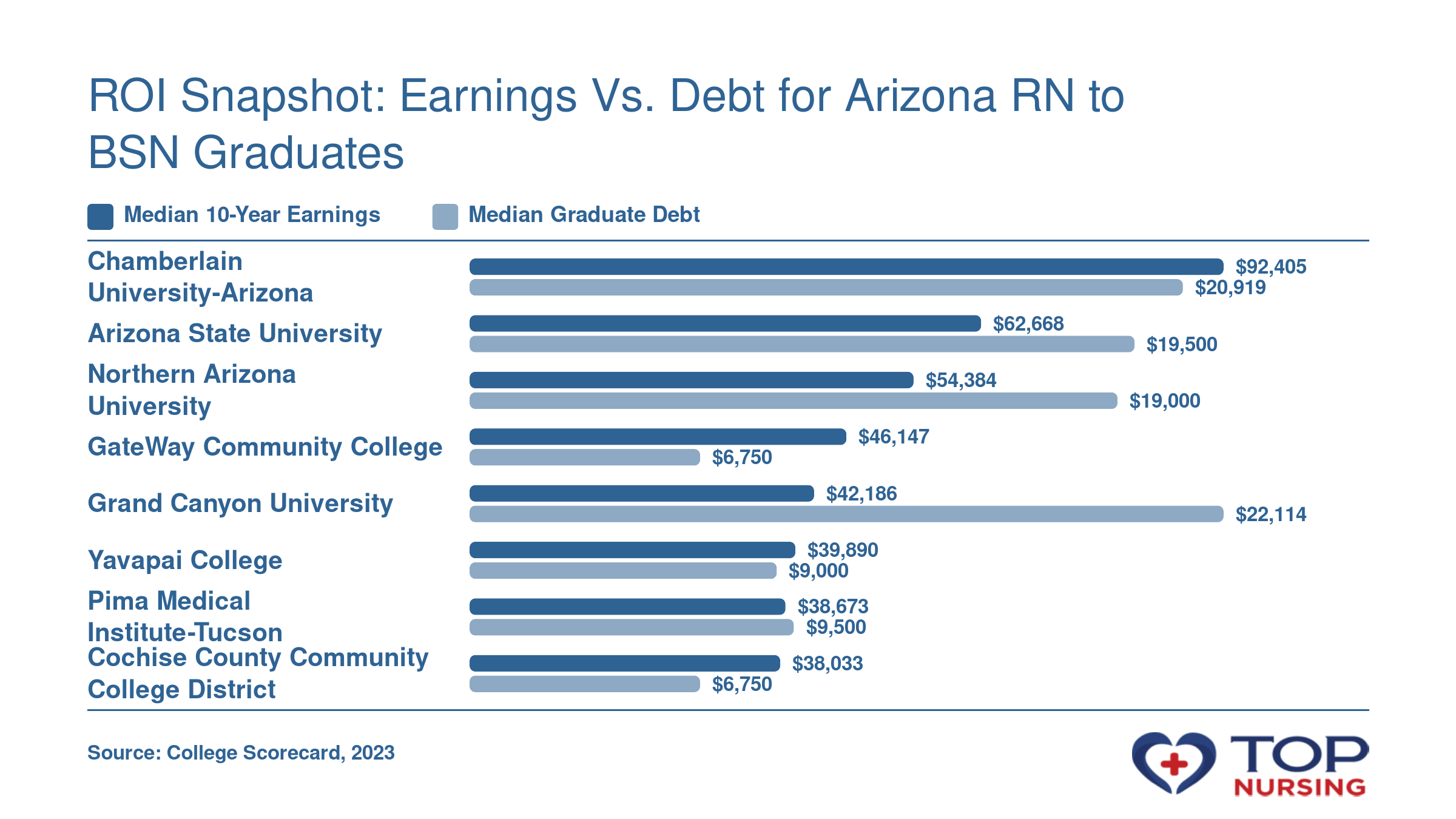
ROI Snapshot: Earnings vs. Debt for Arizona RN to BSN Graduates

The 10-year median earnings of RN to BSN completers in Arizona range substantially by institution, while median graduate debt remains modest at most schools. Chamberlain University-Arizona leads with $92,405 in median earnings against $20,919 in debt, while community college pathways like GateWay and Cochise report some of the lowest debt loads.

Median 10-year earnings and median graduate debt for eight Arizona RN to BSN programs: Chamberlain ($92,405 earnings, $20,919 debt), ASU ($62,668, $19,500), NAU ($54,384, $19,000), GateWay ($46,147, $6,750), GCU ($42,186, $22,114), Yavapai ($39,890, $9,000), Pima Medical Institute-Tucson ($38,673, $9,500), Cochise ($38,033, $6,750).

The BSN Advantage: Arizona Employer Preferences and Career ROI

Earning a BSN in Arizona is not just an academic milestone, it’s a strategic career move that unlocks higher earning potential, wider job options, and faster advancement into leadership roles.

Employer Preferences and the BSN Mandate

Arizona’s largest health systems are increasingly basing hiring decisions on national initiatives that prioritize baccalaureate-prepared nurses. Banner Health, for example, lists a BSN as preferred for new graduate RNs and covers tuition for its ADN-prepared nurses to complete an RN-to-BSN pathway. While ADN nurses are still accepted at select Banner locations, the system’s investment in BSN completion signals a clear direction. Other major networks, such as HonorHealth, Dignity Health (CommonSpirit), and Tucson Medical Center, mirror this trend through internal policies that align with Magnet Recognition Program standards and the Institute of Medicine’s recommendation that 80% of nurses hold a BSN. The practical effect: nurses with an associate degree face narrowing job options at top Arizona hospitals, while BSN holders access the full spectrum of inpatient and specialty roles.

The Financial ROI of an RN to BSN in Arizona

Return-on-investment data from RN-to-BSN programs in the state shows that the upfront cost of the degree is rapidly offset by stable, competitive earnings. Graduates of GateWay Community College’s RN-to-BSN program, for instance, see median earnings of $46,147 with a median debt of just $6,750, an ROI ratio above 6.8. Even programs with higher tuition demonstrate strong returns: Chamberlain University’s RN-to-BSN alumni report median earnings of $92,405 against a median debt of $20,919, yielding an ROI ratio over 4.4. Low-cost public options like Eastern Arizona College and Yavapai College produce median earnings of $38,018 and $39,890, respectively, often with minimal or no student debt. While a salary differential for BSN vs. ADN nurses is not publicly published by Arizona employers, national data consistently shows that BSN-prepared nurses earn more over a career and reach salary ceilings later, making the degree a durable financial asset.

Career Doors a BSN Opens

Beyond bedside nursing, a BSN qualifies nurses for positions that ADN-prepared colleagues rarely access:

  • Charge nurse and unit leadership: Most hospitals require a BSN for these roles, which carry higher pay and management responsibility.
  • Case management and care coordination: These roles increasingly list a BSN as a minimum credential, blending clinical judgment with system-level thinking.
  • Public and community health: School nursing, tribal health services, and county health departments often mandate a BSN.
  • Pathway to MSN and advanced practice: A BSN is the required stepping stone to become a nurse practitioner, clinical nurse specialist, nurse educator, or nurse executive.

The Arizona job market reinforces this: BSN nurses are positioned to move into Magnet-driven shared governance, quality improvement, and evidence-based practice initiatives that shape the future of care delivery.

Worth Noting

Net price among Arizona's top RN-to-BSN options spans from $7,929 at Cochise College to $40,096 at Chamberlain University, a clear reminder that total cost varies widely and choosing an affordable program can save tens of thousands.

Scholarships and Tuition Assistance for Arizona RN to BSN Students

RN-to-BSN students in Arizona can access scholarships ranging from $2,500 to $15,000, plus full-tuition commitments through federal service programs. Tapping into state-based, employer, and national funding sources dramatically reduces the net cost of completing a BSN while working as a registered nurse.

Arizona-Specific Nursing Scholarships

Arizona-based organizations offer targeted aid for nurses advancing their education. The Arizona Nurses Foundation (AzFFN) Academic Nursing Scholarship provides $2,500 to students enrolled in a prelicensure BSN or an ADN-with-concurrent-BSN program, including many RN-to-BSN pathways, who have completed at least one BSN semester, maintain good academic standing, belong to the Student Nurses Association, and plan to practice in Arizona.1 Applicants submit a 7-10 minute video. The National Association of Hispanic Nurses (NAHN) , Arizona chapter awards three $10,000 scholarships to NAHN student members enrolled in an undergraduate nursing degree at Arizona College of Nursing, with selection based on community service and an essay.2

  • AzFFN Academic Nursing Scholarship: $2,500; requires SNA membership, one completed BSN semester, and a commitment to practice in Arizona.
  • NAHN Arizona College of Nursing Scholarship: $10,000 each (three awards); for NAHN student members at Arizona College of Nursing.
  • NAHN Abbott Scholarship Fund: $10,000 each (eight awards nationally); open to NAHN members in BSN, NP, or PhD programs.

Employer Tuition Reimbursement Programs

Major Arizona healthcare systems invest in RN-to-BSN completion through tuition assistance. Banner Health, HonorHealth, Dignity Health/CommonSpirit, and Tucson Medical Center typically offer up to $5,250 per year in tax-free reimbursement under IRS Section 127, often covering tuition, books, and fees. Eligibility usually requires full- or part-time employment, a minimum tenure (often six months to one year), and enrollment in an accredited BSN program. Most require a grade of C or better and a one- to two-year post-reimbursement work commitment. Because annual caps and eligibility vary by facility and job classification, nurses should consult their HR benefits portal for the most current details.

  • Common benefit: Up to $5,250 annually tax-free, per IRS education assistance exclusion.
  • Typical conditions: Six-month employment minimum, passing grade, and a 1-2 year service obligation after course completion.

Federal and National Scholarship Opportunities

Federal programs and national nursing associations provide substantial funding for RN-to-BSN students. The HRSA Nurse Corps Scholarship covers full tuition, eligible fees, and a monthly living stipend in exchange for a commitment to work at a Critical Shortage Facility in a designated shortage area after graduation.3 The National Black Nurses Association (NBNA) offers multiple scholarships worth $1,000 to $15,000; applicants must be NBNA members enrolled in an accredited nursing program with at least one full academic year remaining, and RN-to-BSN students are eligible.4

  • HRSA Nurse Corps Scholarship: Full tuition, fees, and a monthly stipend; requires post-graduation service at an eligible facility.
  • NBNA Scholarships: $1,000-$15,000; open to RN-to-BSN students with at least one year of study left.

Program-Specific Discounts and Partnerships

Several Arizona nursing schools and community colleges maintain scholarship lists or service-linked programs that reduce RN-to-BSN costs. Grand Canyon University offers a Nursing Scholarship Service Program that covers tuition and fees after all grants and gift aid, with a four-year post-graduation service commitment at qualifying partner facilities. The University of Arizona College of Nursing provides internal scholarships through its Office of Scholarships and Financial Aid, and Estrella Mountain Community College curates a regularly updated list of nursing scholarships from associations and external funders. Additionally, many hospitals have direct tuition-contracting partnerships with local universities, effectively locking in a lower per-credit rate for employees; nurses should ask both their employer and prospective program about such agreements.

Frequently Asked Questions About RN to BSN Programs in Arizona

Below are answers to common questions about RN to BSN programs in Arizona, covering costs, time commitment, online options, and employer expectations.

What is the best RN to BSN program in Arizona?
The best program depends on your priorities. Arizona State University is highly regarded for its fully online, self-paced format and strong student support. University of Arizona accepts many transfer credits. Northern Arizona University and Grand Canyon University offer flexible scheduling and competitive costs. Compare net price, timeline, and accreditation. Check the rankings above for detailed profiles.
Does Arizona State University offer an RN to BSN program?
Yes, Arizona State University offers a 100% online RN to BSN program through the Edson College of Nursing. It is designed for working nurses, with 7.5-week courses and six start dates yearly. ASU accepts up to 64 transfer credits, allowing completion in about 14 months. Tuition is roughly $12,500 total. The program is entirely asynchronous, letting you study on your schedule.
Can you complete an RN to BSN fully online in Arizona?
Yes, several Arizona universities offer fully online RN to BSN programs. Arizona State University, University of Arizona, Northern Arizona University, and Grand Canyon University all provide online pathways with no campus visits. Courses are typically asynchronous, and clinical practice can be arranged locally. This flexibility lets you balance work and family while advancing your education.
Are there accelerated RN to BSN programs in Arizona?
Many Arizona programs feature accelerated pacing. ASU's online RN to BSN uses 7.5-week courses for completion in about 14 months. University of Arizona offers a 12-month option. Northern Arizona University can be done in three semesters. These programs require an active RN license and an associate degree. Check each school's schedule for specific timelines.
How much does an RN to BSN cost in Arizona?
Total tuition ranges from roughly $6,500 to $20,000. Arizona State University charges about $12,500. University of Arizona costs around $15,000. Grand Canyon University is near $20,000, while Northern Arizona University offers a more affordable $6,500 option. Many programs have flat-rate online tuition. Refer to the cost comparison table earlier for details.
What is the difference between an ADN-to-BSN and an ASN-to-BSN program?
ADN and ASN are essentially equivalent associate nursing degrees. Both qualify you for RN licensure, and RN to BSN programs accept either. The curriculum is similar; degree titles may reflect the granting institution's preference. Transfer credit evaluation depends on your transcript and courses, not the degree acronym. The transition to a BSN works the same regardless.
Do Arizona employers require a BSN?
While not mandated by state law, many Arizona hospitals prefer or require a BSN, especially Magnet-recognized facilities like Banner Health. Some employers set timelines for associate-degree nurses to earn a BSN after hire. A BSN can lead to leadership roles and higher pay. Policies vary, so confirm with individual employers.

Recent Articles