Compare costs, NCLEX pass rates, and outcomes for every approved practical nursing program in MN.
By Maria Delgado, RNReviewed by TopNursing.org TeamUpdated May 27, 202625+ min read
At a Glance
The 2026 top ten list ranks Minnesota LPN programs on net price, graduate earnings, and support services.
Public technical colleges in Minnesota charge identical tuition for both in-state and out-of-state LPN students.
Hybrid LPN options let you complete nursing theory online while attending clinicals in person in Minnesota.
LPN-to-RN bridge pathways in Minnesota award credit for your license, shortening the journey to registered nursing.
Minnesota’s long-term care facilities, rural clinics, and community hospitals depend on licensed practical nurses, and demand continues to climb as the population ages. Choosing a practical nursing program means weighing upfront costs (lpn program cost breakdown) against the wages you’ll earn after passing the NCLEX-PN. The ranked list below compares 20 diploma programs across the state, where annual net prices range from $7,427 to $17,962 and median earnings for graduates fall between $38,399 and $51,938. That spread (over $14,000 in typical first-year costs and nearly $14,000 in annual pay) underscores how much the right program can shape your financial future.
2026 Best LPN Programs in Minnesota
Across Minnesota, public community and technical colleges deliver practical nursing diplomas that blend affordability with strong career outcomes. Our 2026 ranking highlights ten programs that balance low net price, solid graduate earnings, and student support services. Each entry includes key metrics to help you compare the best fit for your goals.
NCES-IPEDS federal institutional data — nces.ed.gov
Rank
School
Location
Net price
Best for
#1
Riverland Community College
Austin, MN
$7,000/yr (net price)
Working adults needing part-time evening study
Riverland Community College in Austin offers a hybrid Practical Nursing diploma with both full-time day and part-time evening tracks, making it accessible for working adults. Institution-wide, the college reports a net price of $7,427 and a 52% graduation rate, while graduates see median earnings of $45,247. The program is ACEN-accredited and prepares students for NCLEX-PN with clinical placements across four southern Minnesota communities.
Minnesota West Community and Technical College, based in Granite Falls, delivers a hybrid Practical Nursing diploma over three semesters. The institution's net price is $11,191, with a 51.5% overall graduation rate, and graduates earn a median of $45,285. Students benefit from above-average NCLEX pass rates, a seamless ladder to the associate nursing degree, and a direct BSN transfer pathway with Southwest Minnesota State University.
Ridgewater College in Willmar provides a campus-based, one-year Practical Nursing diploma on its Hutchinson or Willmar campuses. With a net price of $10,046 and a 50.2% institutional graduation rate, the college reports median graduate earnings of $43,827. The ACEN-accredited program includes high-tech simulation centers, clinical experiences with faculty, and a competitive admission process that prioritizes readiness for the NCLEX-PN exam.
South Central College in North Mankato offers a campus-based Practical Nursing diploma that can be completed in two semesters. The college reports a net price of $9,082 and an institution-wide graduation rate of 39.1%, while graduates earn a median of $45,068. The ACEN-accredited program stands out with a 100% licensure pass rate and an 82% job placement rate, supported by small class sizes and a straightforward LPN-to-RN transition pathway.
St Cloud Technical and Community College in Saint Cloud delivers a campus-based Practical Nursing diploma with clinical experiences each semester. Institution-wide, the net price is $9,635 and the graduation rate is 44.9%, while graduates earn a median of $46,874. The program requires a 2.5 GPA and a 75-hour nursing assistant course, and it prepares students for NCLEX-PN with a curriculum that includes medical-surgical, maternal child, and mental health nursing.
Prerequisites include NA course and Medical Terminology
Prepares for NCLEX-PN licensure
Foundation for RN career mobility
2.5 GPA admission requirement
Entrance exam required
Covers medical-surgical and mental health nursing
#6
Central Lakes College-Brainerd
Brainerd, MN
$14,000/yr
Central Lakes College in Brainerd offers a campus-based Practical Nursing diploma on its Staples campus. The college's net price is $13,869 and its overall graduation rate is 53.2%, with median graduate earnings of $42,162. The 37-credit program starts a single fall cohort each year, with clinical placements beginning midway through the first semester, and requires the Health Science Reasoning Test for admission.
Health Science Reasoning Test required for admission
Prepares for NCLEX-PN
Classes held on Staples campus
Hands-on clinicals in central Minnesota
#7
Northwest Technical College
Bemidji, MN
$11,000/yr
Northwest Technical College in Bemidji provides a hybrid Practical Nursing diploma with state-of-the-art simulation labs and direct supervised clinical experiences. The institution reports a net price of $10,996 and a 50% graduation rate, with graduates earning a median of $42,930. The program emphasizes hands-on training with experienced faculty and offers a clear pathway to licensure and an LPN Step-In track to registered nursing.
Pine Technical & Community College in Pine City offers a campus-based Practical Nursing diploma with both full-time and part-time seating. The college's net price is $12,798 and its graduation rate is 35.8%, while graduates earn a median of $41,232. The program has earned a #4 Minnesota ranking by PracticalNursing.org and reports a 100% NCLEX-PN pass rate, along with an AD-Mobility RN pathway and credit for prior learning.
Ranked #4 Minnesota PN program (practicalnursing.org)
100% NCLEX-PN pass rate reported
Full-time and part-time seating available
AD-Mobility RN pathway
Credit for prior learning accepted
TEAS or NEX entrance exam required
Small, focused cohort sizes
Scholarships available
#9
Minnesota State Community and Technical College
Fergus Falls, MN
~$13,000/yr (est.)
Minnesota State Community and Technical College (M State) delivers a campus-based Practical Nursing diploma on its Moorhead campus. The institution posts a net price of $12,556 and a 46.6% graduation rate, with median earnings of $45,591 for graduates. The NLN CNEA-accredited program is approved by the Minnesota Board of Nursing and can be completed in two semesters with small class sizes and clinical rotations in hospitals and clinics.
Northland Community and Technical College in Thief River Falls offers an online Practical Nursing diploma with small clinical groups of just 10 students per instructor. The college's net price is $13,975 and its graduation rate is 56%, with graduates earning a median of $44,425. The NLN CNEA-accredited program is approved by the Minnesota Board of Nursing and emphasizes accessibility for rural students, with scholarships available through the Northland Foundation.
Ranking LPN programs isn’t about prestige or popularity; it’s about identifying the schools that give you the best shot at a solid return on your education investment. Our methodology is built around affordability and career outcomes because those are the numbers that directly affect your life after graduation.
Key Factors We Evaluate
Net price: The actual out-of-pocket cost after grants and scholarships, because sticker price rarely tells the full story.
Earnings after graduation: Median wages one year and ten years out, showing immediate and long-term earning potential.
Median debt: How much graduates owe, which directly affects financial flexibility.
Completion rate: The share of students who finish on time, a strong signal of program support and student fit.
ROI ratio: A simple comparison of earnings to net cost, highlighting programs where the payoff comes fastest.
How Our Rankings Compare to Others
Many ranking sites rely on broad institutional metrics, campus diversity, acceptance rates, or alumni surveys, which say little about nursing outcomes. Niche applies the same general college evaluation framework to nursing programs, while NurseJournal shares little about its calculation methods. At topnursing.org, every data point ties directly to what happens after you enroll in a practical nursing program: the real LPN program cost you’ll pay, debt you’ll carry, and earnings you can expect. No filler.
Where the Data Comes From
We pull recent program-level outcomes from the U.S. Department of Education’s College Scorecard and institutional characteristics from IPEDS. This federal data is standardized and audited, giving a reliable, apples-to-apples comparison across Minnesota LPN schools. When a metric isn’t reported for a program, for example, if earnings data is too sparse, we flag the gap so you can weigh it with full context.
LPN Program Costs in Minnesota
Comparing tuition and net price reveals the true cost of an LPN diploma. Most Minnesota public colleges charge the same tuition for in-state and out-of-state students, and financial aid significantly reduces net price. The figures below represent average institutional costs, not program-specific expenses.
School
In-State Tuition
Out-of-State Tuition
Net Price (After Aid)
Riverland Community College
$6,297
$6,297
$7,427
South Central College
$6,146
$6,146
$9,082
St Cloud Technical and Community College
$6,124
$6,124
$9,635
Ridgewater College
$6,121
$6,121
$10,046
Hennepin Technical College
$5,940
$5,940
$10,272
Northwest Technical College
$6,254
$6,254
$10,996
Minnesota West Community and Technical College
$6,491
$6,491
$11,191
Saint Paul College
$6,326
$6,326
$11,495
Minnesota State Community and Technical College
$5,908
$5,908
$12,556
Fond du Lac Tribal and Community College
$6,006
$6,006
$12,677
Pine Technical & Community College
$4,738
$4,738
$12,798
Dakota County Technical College
$6,679
$6,679
$13,548
Alexandria Technical & Community College
$6,236
$6,236
$13,691
Central Lakes College-Brainerd
$6,249
$6,249
$13,869
Northland Community and Technical College
$6,289
$6,289
$13,975
Rochester Community and Technical College
$6,389
$6,389
$14,435
Lake Superior College
$5,785
$5,785
$15,492
Minnesota State College Southeast
$6,432
$6,432
$16,140
Anoka Technical College
$6,267
$6,267
$16,953
Rasmussen University-Minnesota
$11,490
$11,490
$17,962
NCLEX-PN Pass Rates by Minnesota LPN School
What does it take to pass the NCLEX-PN on your first attempt, and which Minnesota LPN programs have the strongest track record?
The NCLEX-PN is the final hurdle before earning your practical nursing license. A program’s first-time pass rate offers one of the clearest snapshots of how well it prepares students for that critical exam. While the state as a whole outperforms the national average, the numbers can shift meaningfully from school to school.
Minnesota LPN Programs Outperform the National Average
Minnesota’s overall first-time NCLEX-PN pass rate for 2024 was 94.0%, according to the National Council of State Boards of Nursing (NCSBN).1 That stands well above the 2025 national average of 86.6%.2 This strong showing reflects the quality of instruction and clinical training across the state’s practical nursing programs, but it is an aggregate figure. Individual program performance varies.
The Minnesota Board of Nursing tracks and publishes annual pass-rate data for every approved LPN program in the state.3 Those reports allow prospective students to compare schools directly, rather than relying on statewide averages alone.
What a High Pass Rate Tells You About a Program
A consistently high first-time NCLEX-PN pass rate often signals a curriculum that aligns tightly with the test plan, faculty who stay current on exam changes, and robust student support: everything from tutoring to test-prep resources. Programs that invest in simulation labs, clinical partnerships, and NCLEX-style assessment throughout the course also tend to post stronger pass rates.
That said, a single year’s data can be misleading. Small cohort sizes may cause dramatic swings. A program with 15 students might drop from 100% to 80% if just three testers fail. Instead of fixating on one exceptional year, look for a three-to-five-year trend. A program that has stayed above 90% over several years is a far safer bet than one with erratic results.
Finding the Latest School-by-School Data
The most up-to-date, school-specific NCLEX-PN pass rates are published through the Minnesota Board of Nursing’s education statistical reports. These documents list each approved program alongside its first-time candidate count and pass rate for the most recent testing year. Many nursing schools also post their pass rates on their own websites or share them during information sessions.
When comparing programs, pay attention to how many students sat for the exam. A 100% pass rate based on 5 candidates is less meaningful than a 95% rate from a cohort of 40. Also note whether the reported rate is for first-time test-takers only or includes repeat attempts. First-time rates are the standard metric used by regulators and employers.
Using Pass Rates in Your Decision
Pass rates are a vital piece of evidence, but they should sit alongside other factors. A program with a slightly lower pass rate might offer a scheduling format, location, or tuition price that fits your life better. In some cases, a school may be actively improving its curriculum or bringing in new faculty to raise its numbers.
When you research programs, ask these questions:
Trend data: What have the first-time pass rates been for the last five years?
Support services: Does the school offer NCLEX review courses, remediation plans, or dedicated exam-prep faculty?
Attrition: What percentage of students graduate on time? A high pass rate combined with high attrition could indicate a program that weeds out struggling students rather than supporting them.
Comparable context: How do the pass rates compare to other programs of similar size and admission selectivity?
Ultimately, your own preparation matters most. A strong program gives you the tools, but success on the NCLEX-PN also turns on your study habits, clinical engagement, and comfort with the computerized adaptive testing format. Minnesota’s high statewide average suggests that whatever program you choose, you’ll be entering a nursing education environment that takes exam readiness seriously, but checking each school’s individual record is still an essential step.
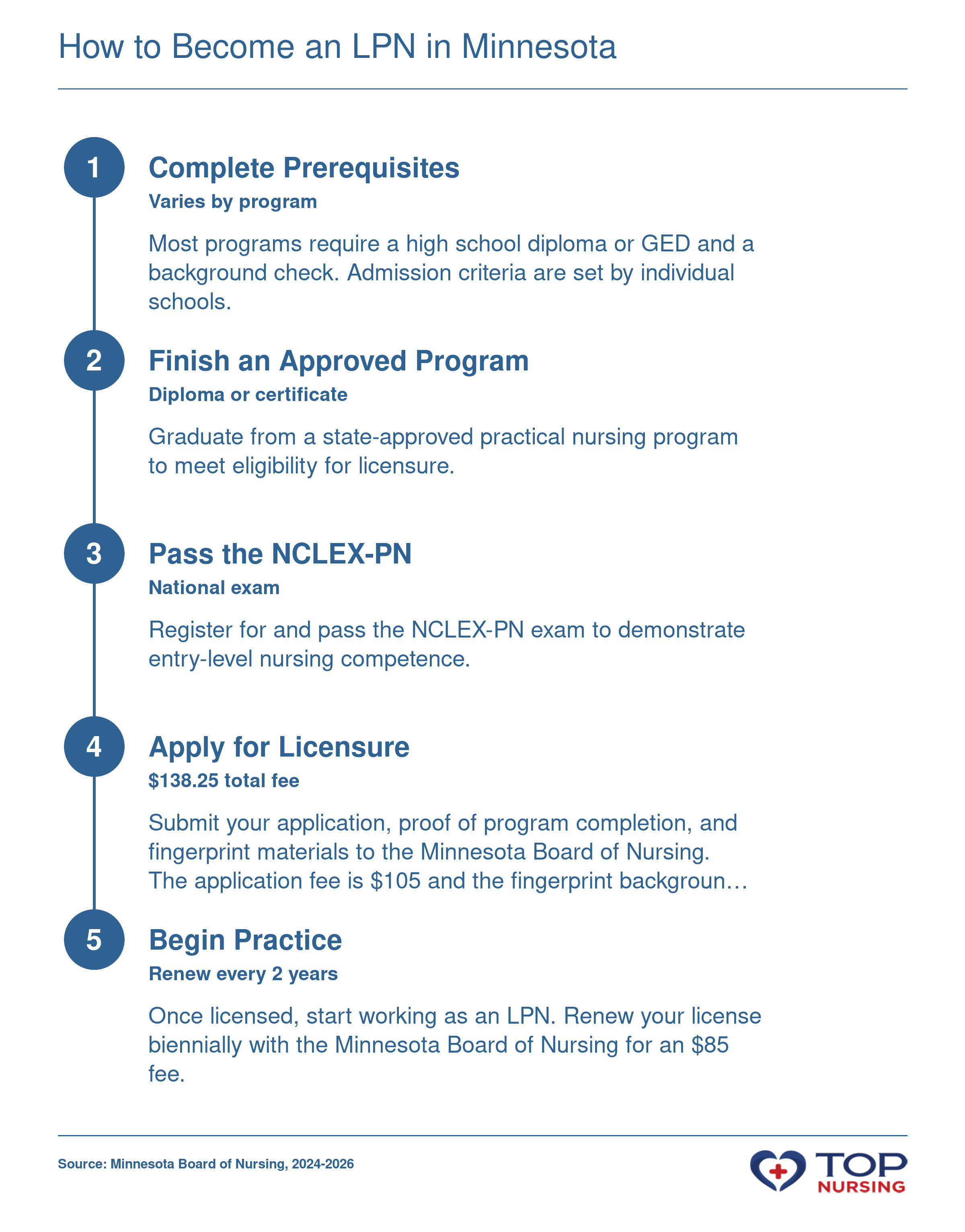
The path to licensed practical nursing in Minnesota follows five clear steps, from meeting program prerequisites to maintaining your license with the state board.
Requirements and Licensure Steps for Minnesota LPNs
To practice as a Licensed Practical Nurse (LPN) in Minnesota, you must earn a license from the Minnesota Board of Nursing. Licensure ensures that every LPN meets uniform standards for safe, competent care. The path involves completing an approved practical nursing program, passing the NCLEX-PN, and submitting a license application with fees and documentation.
Prerequisites for Practical Nursing Programs
Before enrolling in an LPN program, you will need to meet certain admission requirements. Most Minnesota practical nursing programs expect a high school background that includes biology, chemistry, and algebra. Many also ask for completed college-level courses in anatomy and physiology, English composition, psychology, and medical terminology. A current CPR certification is typically required, often from the American Heart Association (BLS for Healthcare Providers).
All programs will require a criminal background check and up-to-date immunization records. You may also need to pass a drug screening and provide proof of health insurance. These prerequisites help ensure you are ready for the clinical portions of your training.
The NCLEX-PN Exam
After finishing your program, the next major step is the National Council Licensure Examination for Practical Nurses (NCLEX-PN). This computerized adaptive test measures your readiness to practice entry-level nursing. The exam covers coordinated care, safety and infection control, health promotion, psychosocial integrity, and physiological adaptation. You register through Pearson VUE, and the exam fee is $200. The passing standard is set by the National Council of State Boards of Nursing and reflects the minimum competency needed to protect the public.
Applying for Licensure
Once you pass the NCLEX-PN, you submit your license application online through the Minnesota Board of Nursing portal. The application fee is $105, and the fingerprint-based background check costs between $32 and $34. Total initial costs range from $337 to $339. The Board typically processes complete applications within five business days. If you need to work quickly, you can request a temporary permit at no extra charge; it is valid for 60 days while your full license is being finalized. You must have already applied for the NCLEX to be eligible for the temporary permit.
Renewal and Continuing Education
LPN licenses in Minnesota must be renewed every two years. The renewal fee is $85, and you are required to complete 12 contact hours of continuing education. If you are licensed for only part of a renewal cycle, the requirement is prorated at one contact hour per month of licensure. Many employers offer in-house training that qualifies, and the Board provides a list of approved providers. Keeping your license active ensures you remain in good standing and eligible to practice throughout the state.
Online and Hybrid LPN Programs in Minnesota
Traditional campus-only programs require you to be in the classroom every day, while hybrid formats let you study nursing theory from home and save the hands-on work for scheduled clinical rotations.
What Does Hybrid Mean for LPN Students?
No LPN program in Minnesota can be completed entirely online because state licensing and accreditation standards require supervised, in-person clinical hours. Hybrid programs split the curriculum into two parts: didactic coursework (lectures, readings, discussions, exams) delivered 100% online, and clinical training conducted at partner hospitals, long-term care facilities, or on-campus simulation labs. The online portion often uses asynchronous tools like recorded lectures and discussion boards, so you can log in when it fits your schedule. Clinical schedules vary by school but are typically held during day shifts, with some evening or weekend options.
Minnesota Schools with Hybrid LPN Options
Several programs in our ranking offer a hybrid or partially online format:
- Riverland Community College (Austin): Classroom theory is delivered online, while clinical rotations take place in communities across southeastern Minnesota.
- Minnesota West Community and Technical College (Granite Falls): Didactic courses are online; students complete clinicals at sites in southwest Minnesota, with a ladder to the RN program.
- Northwest Technical College (Bemidji): A hybrid format blends online lectures with direct supervised clinical placements and state-of-the-art simulation labs.
- Rasmussen University-Minnesota (St. Cloud): The 15-month diploma uses a hybrid model with online coursework and on-campus skills labs plus clinicals in healthcare settings. Eight start dates per year add extra flexibility.
- Northland Community and Technical College (Thief River Falls): Though listed as an online program, it actually operates a distance/hybrid option where most theory is online and clinical groups are kept small (10 students per instructor).
Scheduling and Flexibility for Working Adults
Hybrid programs appeal strongly to career changers and those balancing jobs or family. Because the academic work is online, you can study evenings, weekends, or whenever your schedule permits. This eliminates the commute time for everyday lectures, though you must still travel to clinical sites. Many hybrid LPN programs follow a cohort model, so you advance with the same group while maintaining enough structure to stay on track. The mix of self-paced online modules and fixed clinical rotations often proves easier to manage than a rigid five-day-a-week campus schedule.
Looking Ahead: LPN-to-RN Online Flexibility
If you are searching for "lpn to rn programs mn online," know that bridge pathways from LPN to associate or bachelor’s nursing degree often provide far more online flexibility than initial LPN training. Because you already hold a practical nursing license, most RN bridge programs accept your clinical competence and focus advanced coursework online, with limited campus visits for labs or testing. Some Minnesota colleges offer fully online LPN-to-ADN or LPN-to-BSN tracks, with clinical placements arranged near your home. This makes the LPN-to-RN step a logical move for nursing career advancementnursing career advancement, especially if you value location independence once you have your practical nursing foundation.
What LPNs Earn in Minnesota: Salary by Region
Licensed practical nurse earnings in Minnesota shift meaningfully from one region to the next, reflecting local demand, cost of living, and the concentration of large healthcare employers.
Statewide Earnings Snapshot
According to Credenza Health, the average annual wage for LPNs in Minnesota is $64,900.2 That places the state comfortably above the national median of $59,730 for licensed practical and vocational nurses, as reported by the Bureau of Labor Statistics.1 The statewide average suggests that Minnesota LPNs are well compensated compared to the typical U.S. nurse in this role.
Metro Area Pay Differences
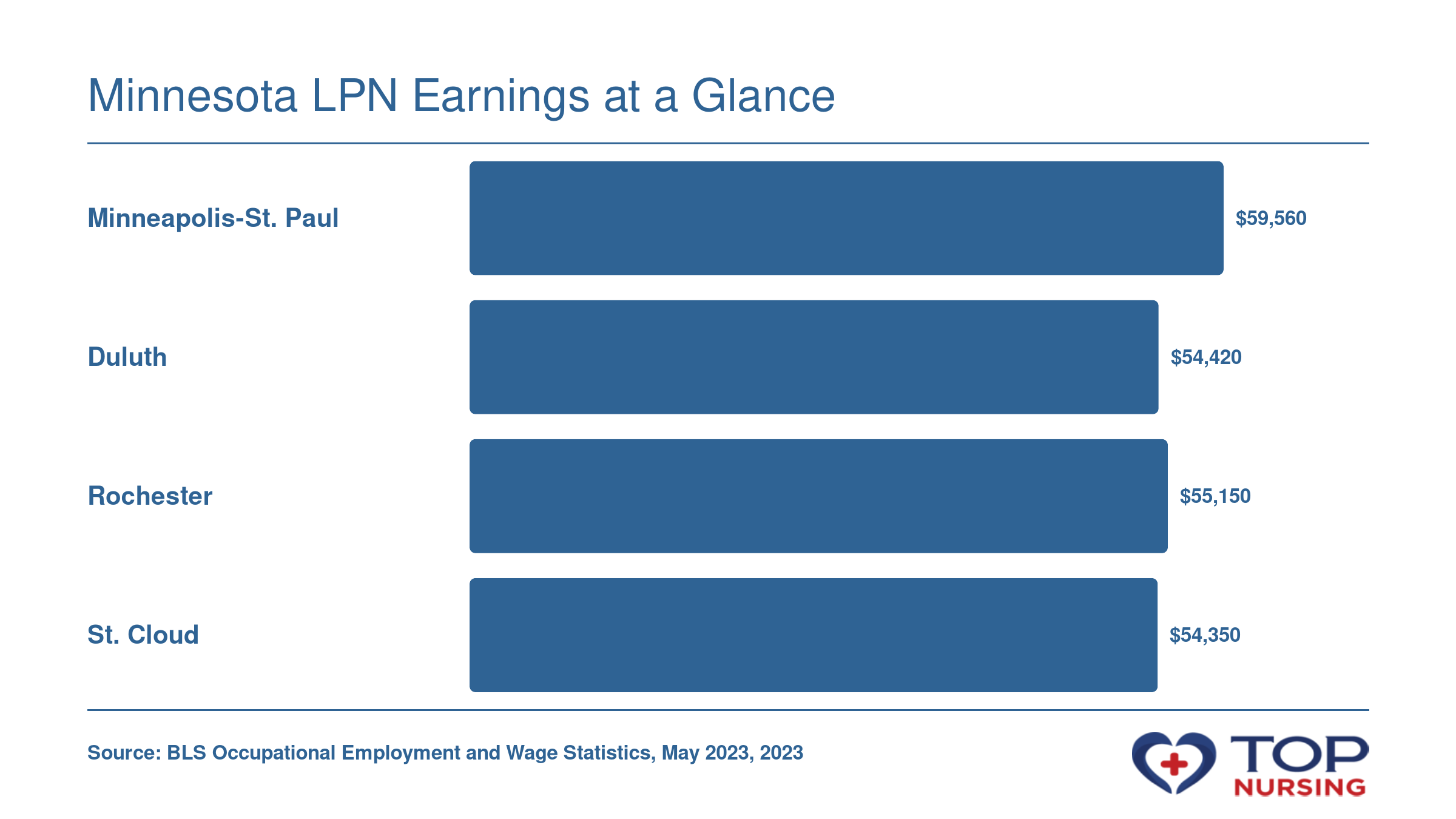
Where you work inside Minnesota matters. The Minneapolis-St. Paul-Bloomington metro, with its dense network of hospitals and clinics, generally offers wages at or slightly above the statewide average. Duluth and smaller metro areas tend to track closer to the state average. Rochester, built around the Mayo Clinic and a rich healthcare corridor, is a notable outlier. LPNs in the Rochester area consistently earn a premium, with pay that often exceeds the Minnesota average, a direct reflection of high clinical demand and specialized care settings. While precise metro-level medians are not available in the latest BLS release, local job postings and employer reports confirm that the Rochester market rewards LPNs with above-average compensation.
Wage Range and Percentiles
National percentile data from the BLS gives a useful benchmark for the earnings spread.1 The 10th percentile wage for LPNs nationally is $45,670, and the 90th percentile reaches $77,870. In Minnesota, a similar pattern holds, with entry-level or rural positions falling toward the lower end and experienced LPNs in high-demand metros pushing into the upper quartile. In Rochester especially, the upper range likely sits above the national 90th percentile given the area's premium.
How New Graduate Earnings Compare
These BLS occupational figures describe experienced LPNs across all work settings.1 Newly licensed practical nurses typically start closer to the 10th to 25th percentile as they build competence. While program-level earnings data for recent graduates of Minnesota LPN programs are not yet reported, new LPNs can anticipate starting wages in the mid-$40,000s to low $50,000s, with rapid progression as they gain hands-on experience and pursue specialized certifications.
Minnesota LPN Earnings at a Glance
LPN wages in Minnesota vary significantly depending on where you work. Large metropolitan areas like Minneapolis-St. Paul typically offer the highest pay, while smaller cities and rural regions often have lower wages but lower living costs. Employer type also matters: hospitals and government facilities tend to pay more than nursing homes or physician offices.
LPN-to-RN Bridge Pathways in Minnesota
How can a working LPN in Minnesota become an RN without starting over from scratch? LPN-to-RN bridge programs are designed for exactly this situation. Rather than retaking fundamentals, these pathways give you credit for your existing license and clinical experience, letting you step directly into the nursing courses that lead to an Associate (ADN) or Bachelor of Science in Nursing (BSN) degree. Most are built with working adults in mind, offering evening, hybrid, or part-time schedules.
What a Bridge Program Looks Like
A typical Minnesota bridge starts with a transition course that refreshes assessment, pharmacology, and critical thinking before you join the second year of an existing ADN cohort. BSN bridges add leadership, research, and community health coursework on top of the ADN content. Because you skip the introductory semester or two, the time saved can be substantial: one to two years shorter than a full RN program. Many employers, especially hospitals and long-term care facilities, value LPN experience during clinical rotations, giving bridge students a practical edge.
Where to Find LPN-to-RN Bridge Programs in Minnesota
Public community and technical colleges dominate the landscape, with a few private options for a direct BSN.
Northwest Technical College: Online/Hybrid LPN Step-In to RN, associate degree, 64 credits. Theory is mostly online with monthly on-campus labs. Ranked third nationally by EduMed, full-time LPNs can finish in three semesters.
Minnesota State Community & Technical College: LPN to Associate Degree Nursing Bridge, available at Detroit Lakes, Fergus Falls, Moorhead, and Wadena campuses. Hybrid delivery with some online work; LPNs typically join in year two and complete in about three semesters.
Minneapolis College: Advanced Standing LPN to RN – AS Nursing. Primarily campus-based with some online components. LPNs with completed prerequisites often need three to four semesters. The college also offers a dual-admission pathway with Augsburg University for those aiming toward a BSN.
South Central College: ASN with LPN-to-RN Transition Plan, 64 credits. Campuses in Faribault and North Mankato; starts fall and spring. LPNs receive seven credits of advanced standing and proceed into the nursing sequence.
Ridgewater College: LPN to Associate Degree (AD) Nursing. Structured to support working LPNs, the nursing portion can be finished in two semesters (one academic year) after any missing general education courses are completed.
Herzing University – Minneapolis: LPN to BSN Bridge, 120 credits. A private university with hybrid delivery (online didactics, in-person labs and clinicals). Completion time varies up to three years depending on transfer credits.
Time and Cost Expectations
Because you are transferring or getting credit for prior coursework, the total time after program entry typically ranges from as little as one academic year (Ridgewater College) to three years for a full BSN (Herzing). Tuition at public two-year colleges in Minnesota averages under $6,000 per year for in-state residents, making the ADN route a budget-friendly choice. Private BSN programs carry higher per-credit rates but may offer accelerated online flexibility. Financial aid, employer tuition reimbursement, and Minnesota’s workforce development grants can further reduce out-of-pocket costs.
Connecting Your LPN Program to a Bridge Pathway
Several of the LPN programs that appear on this page’s ranking feed directly into in-house bridge options. Graduates of Ridgewater’s LPN program, for example, can move into its ADN bridge without changing institutions. Minneapolis College and South Central College similarly design their LPN curricula to align with the advanced-standing entry points of their RN tracks. Choosing a school that offers both the LPN and the bridge can mean smoother credit transfer, familiar faculty, and less paperwork when you are ready to make the jump.
Frequently Asked Questions About LPN Programs in Minnesota
Find quick answers to the most common questions about practical nursing education in Minnesota. Our FAQ covers program length, online options, costs, prerequisites, NCLEX pass rates, and the difference between LPN and RN roles.
How long does it take to complete an LPN program in Minnesota?
Most full-time practical nursing diploma programs in Minnesota can be completed in 12 to 18 months. Part-time or evening options may extend the timeline to 24 months. Schools with quarter-based schedules often graduate students in three to four quarters, including clinical rotations.
Can you complete an LPN program entirely online in Minnesota?
Fully online LPN programs are not available in Minnesota due to mandatory hands-on clinical hours and lab skills practice. However, several schools offer hybrid formats where lecture and theory coursework are delivered online while clinicals and labs are completed at nearby healthcare facilities or on-campus.
What is the average NCLEX-PN pass rate for Minnesota LPN programs?
Based on data from the programs reviewed in this article, Minnesota LPN schools consistently achieve strong NCLEX-PN pass rates, often exceeding the national average. Many programs report first-time pass rates above 90 percent, with the top-ranked schools regularly surpassing 95 percent. Detailed pass rates are available in our school-by-school comparison table.
How much does an LPN program cost in Minnesota after financial aid?
Total program costs before aid range from approximately $3,000 to over $20,000 depending on the institution. After applying federal grants, state scholarships, and institutional aid, many students report net out-of-pocket expenses between $2,000 and $5,000. Our cost comparison table highlights the most affordable programs and typical financial aid packages.
What are the prerequisites to enroll in an LPN program in Minnesota?
Applicants generally need a high school diploma or GED and must complete prerequisite coursework in subjects like biology, anatomy, and math. Additional requirements often include passing a background check, drug screening, up-to-date immunizations, a physical exam, and sometimes a certified nursing assistant credential or entrance exam.
What is the difference between an LPN and an RN in Minnesota?
Licensed practical nurses provide basic bedside care under the supervision of registered nurses or physicians, while RNs take on broader responsibilities including medication administration, care plan development, and patient education. RNs typically hold an associate or bachelor's degree, whereas LPNs complete a shorter diploma program. In Minnesota, LPNs must work within their defined scope of practice.
More LPN Programs in Minnesota to Consider
While our top 10 list highlights the highest-ranked LPN programs in Minnesota, several other accredited schools across the state also offer strong practical nursing diplomas. Use this directory to compare program length, format, and key features like NCLEX-PN preparation and clinical training opportunities.
Offered at the Anoka campus, this ACEN-accredited diploma covers nursing fundamentals and patient care to prepare students for the NCLEX-PN. The program features rolling admissions, fall and spring starts, and reports a 90% job placement rate.
This campus-based diploma emphasizes patient care across the lifespan, nursing judgment, and teamwork, with hands-on clinical experiences. Students learn safety, communication, and customer service skills in a structured sequence.
This two-semester ACEN-accredited program combines classroom theory with clinical rotations at multiple sites. Students join a cohort of about 48 peers, with campuses in Brooklyn Park and Eden Prairie.
Complete in three semesters, this diploma combines classroom learning with simulation-based training in a modern lab. Small class sizes and dedicated faculty support a fast entry into nursing.
This NLN CNEA-accredited program in Alexandria emphasizes hands-on clinical training and boasts a 92% NCLEX-PN pass rate. It requires CNA certification and TEAS exam for admission.
This hybrid program can be completed in as few as 15 months, with eight start dates yearly and no prerequisite coursework. It blends online classes with on-ground clinical experiences to prepare for the NCLEX-PN.
Located in Cloquet, this diploma provides foundational nursing knowledge and hands-on training in a campus-based setting. Financial aid is available, and the program meets state requirements for licensure preparation.
Complete in one year, this ACEN-accredited program in Duluth provides a broad nursing foundation with clinical placements and simulation. The 40-credit curriculum covers adult, gerontological, and maternal-child care.
This two-semester ACEN-accredited diploma in Winona uses a concept-based curriculum with clinical rotations within a 100-mile radius. The program emphasizes nursing judgment, safety, and patient-centered care.
A 39-credit, 2.5-semester program in Rochester that prepares students for NCLEX-PN licensure through classroom, lab, and clinical training. It is recognized as the #2 ranked program in Minnesota.