Compare tuition, NCLEX-PN outcomes, and career earnings across every approved Kentucky practical nursing program.
By Maria Delgado, RNReviewed by TopNursing.org TeamUpdated May 27, 202617 min read
Points of interest…
Kentucky LPN programs through KCTCS take about one year and require selective admissions.
A program’s first-time NCLEX-PN pass rate reveals how well it prepares graduates for the licensing exam.
No fully online LPN programs exist here; state rules mandate hands-on clinical training.
KCTCS bridge options help LPNs transition to RN roles without starting over.
LPN programs in Kentucky exhibit a sharp cost divide: net prices after aid range from under $3,000 at rural community colleges to over $28,000 at private institutions. Choosing where to enroll means balancing upfront cost with program quality and long-term earnings.
The 2026 ranking evaluates 17 programs across the state, comparing affordability, NCLEX-PN pass rates, and career prospects to highlight options for different budgets and goals.
Since LPNs fill essential roles in Kentucky’s long-term care facilities and rural clinics, selecting a program that combines rigorous clinical training with manageable cost is a strategic decision.
How to Become an LPN in Kentucky
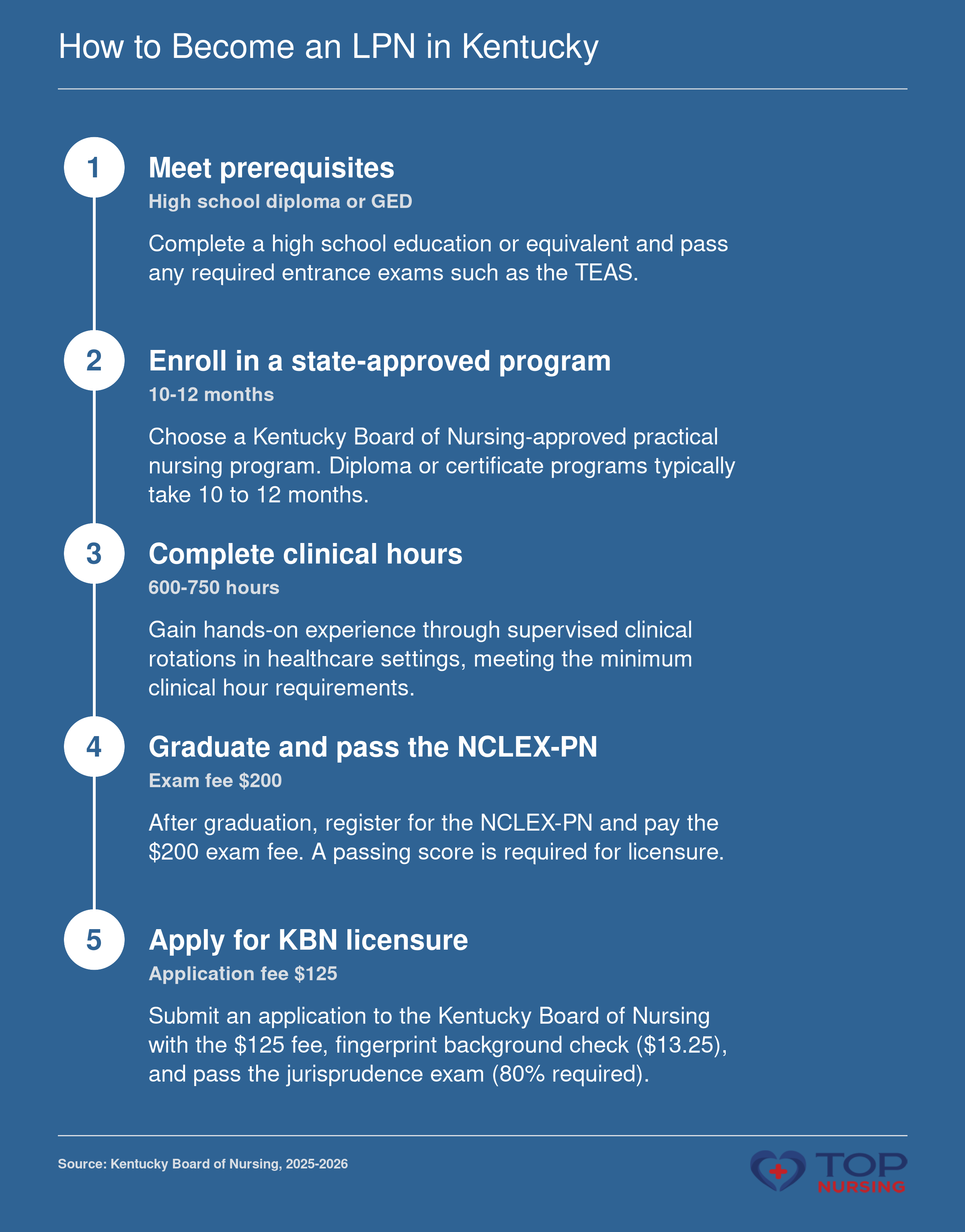
Becoming a licensed practical nurse in Kentucky follows a clear path from classroom to credential. The process takes about one year and requires completing an approved program, passing the NCLEX-PN, and meeting Kentucky Board of Nursing requirements. Here's how it works step by step.
LPN Program Costs and Financial Aid in Kentucky
Understanding the full cost of an LPN program in Kentucky means looking beyond sticker price. The net price shown is an institution-wide average after grant and scholarship aid, not a guaranteed quote for every student. Median graduate debt gives a clearer picture of total investment, which varies widely across public and private programs.
School
In-State Tuition
Out-of-State Tuition
Net Price (After Aid)
Median Graduate Debt
Hazard Community and Technical College
$4,728
$6,432
$2,955
$10,125
Southcentral Kentucky Community and Technical College
$4,728
$6,432
$3,537
$10,175
Southeast Kentucky Community & Technical College
$4,728
$6,432
$3,731
$6,919
Big Sandy Community and Technical College
$4,728
$6,432
$3,873
$9,357
Somerset Community College
$4,728
$6,432
$4,398
$12,215
Maysville Community and Technical College
$4,728
$6,432
$4,605
$11,500
Elizabethtown Community and Technical College
$4,728
$6,432
$5,143
$9,055
West Kentucky Community and Technical College
$4,728
$6,432
$5,353
$8,986
Madisonville Community College
$4,728
$6,432
$5,406
$8,450
Ashland Community and Technical College
$4,728
$6,432
$5,717
$10,950
Hopkinsville Community College
$4,728
$6,432
$5,875
$10,691
Bluegrass Community and Technical College
$4,808
$6,512
$6,113
$10,500
Jefferson Community and Technical College
$4,808
$6,512
$6,376
$11,651
Galen College of Nursing-Louisville
N/A
N/A
$18,540
$24,166
Sullivan University
$15,480
$15,480
$25,532
$20,000
Beckfield College-Florence
$13,295
$13,295
$28,133
$23,500
Galen Health Institutes-Pikeville
$16,364
$16,364
$28,475
$24,166
Questions to Ask Yourself
Can you commit to a full-time, 10-12 month program with daytime clinical rotations?
LPN training is fast-paced and rigidly scheduled; missing clinical hours can stall progress. If you have daytime work or caregiving constraints, confirm scheduling feasibility with the program before enrolling.
Have you researched whether your local program offers evening or hybrid scheduling?
Some Kentucky LPN schools provide evening tracks or partially online coursework, which can help you balance a job and family responsibilities while progressing toward licensure on a more flexible timeline.
Do you qualify for KHEAA grants or WIOA workforce funding that could cut your out-of-pocket cost significantly?
The Kentucky Higher Education Assistance Authority and federal WIOA funds can cover a large share of tuition. Eligibility depends on income, employment status, or other factors, so apply early to maximize aid.
NCLEX-PN Pass Rates for Kentucky LPN Programs
NCLEX-PN pass rates are the single most reliable public indicator of how well an LPN program prepares its graduates for licensure and entry-level practice. While factors like tuition cost and location matter, a program’s first-time pass rate reflects the alignment between what is taught and what the national exam actually measures: clinical judgment, safety, and foundational nursing knowledge.
What NCLEX-PN Pass Rates Tell You
A high first-time pass rate signals a curriculum that stays current with NCLEX test plans, strong clinical placements, and faculty who closely track student progress. Conversely, a rate that dips below 80 percent for multiple years often points to gaps in core content coverage, insufficient remediation support, or a student population that may be underprepared for the rigor of a nursing program. Because the NCLEX-PN is a single, standardized exam, pass rates allow for an apples-to-apples comparison across schools.
Kentucky Program Performance
The Kentucky Board of Nursing publishes program-specific NCLEX-PN pass rates annually, and prospective students should review the most recent report before enrolling. For context, the national first-time pass rate for US-educated PN candidates in the first quarter of 2026 stood at 86.0 percent, according to NCSBN.1 Several Kentucky programs consistently outperform that benchmark. MedQuest College’s Lexington campus, for example, reported a perfect 100 percent pass rate on the 2025 NCLEX-PN, a mark few programs achieve and one that speaks to a highly focused curriculum and robust student support. While not every school in the state discloses pass rates in the same format, publicly available KBN data shows clusters of programs above 90 percent and a smaller number that have fallen under 80 percent in recent testing cycles. Programs with pass rates trailing the national average often share characteristics: limited simulation resources, high student-to-instructor ratios, or admission criteria that do not screen for academic readiness.
Why Pass Rates Should Guide Your Choice
A program’s NCLEX-PN outcome directly affects your timeline and finances. Graduates who fail the exam must wait at least 45 days to retest, incurring additional fees and delaying the start of their nursing career. Repeated failures can lead to coaching costs and, in some cases, restrictions on the number of attempts allowed by the state board. Exam-first-time pass rates are not just a statistic for institutional accreditation; they are a practical measure of the likelihood that you will move from graduation to employment without a costly detour. When comparing LPN programs in Kentucky, treat the NCLEX-PN pass rate as a non-negotiable quality signal, and always ask admissions counselors for the program’s most recent three-year trend, not just a single favorable year.
Most Kentucky LPN programs operate through the Kentucky Community and Technical College System (KCTCS). While the colleges themselves are open-admission, the practical nursing programs typically use a selective admissions process. All applicants need a high school diploma or GED. Beyond that, you will encounter a set of common requirements, though the specifics vary by campus.
GPA: Minimum cumulative GPAs often range from 2.0 to 2.5. Some programs list a recommended GPA above the minimum, so a stronger academic record can improve your chances.
Entrance Exam: The TEAS is widely used, with many programs expecting scores in the 72 to 74 percent range. A few schools, such as Southeast Kentucky Community & Technical College (SKCTC), use the NLN NEX PN instead, requiring a minimum composite score of 150.
Prerequisites: Anatomy and physiology, medical terminology, and math or quantitative reasoning are common. SKCTC, for example, requires PSY 110, BIO 137, and a quantitative reasoning course. Southcentral Kentucky Community & Technical College (SKYCTC) requires AHS 115 and BIO 137 or BIO 135.
Background checks and drug screenings are standard across all schools before you can begin clinical training.
Selective Programs vs. Open Doors
Some programs are more accessible than others, but competitive admission does not necessarily mean higher quality, and open-door policies do not guarantee an easier path. SKCTC lists a minimum GPA of 2.0 and a recommended 2.5, while SKYCTC requires CNA certification and has a firm May 15 application deadline. Programs that require CNA licensure as a prerequisite tend to attract applicants who already have patient care experience, making the pool somewhat more competitive.
Easier admission thresholds, such as a lower TEAS cutoff or no CNA requirement, can open the door to candidates who need a fresh start. However, the rigor of the program itself is what determines NCLEX-PN readiness. Passage rates vary significantly by campus, so look beyond admission criteria to how well a program supports students through to licensure.
Clinical Readiness Requirements
Even after academic acceptance, you must meet clinical placement requirements before treating patients. These almost always include:
Current CPR certification (American Heart Association BLS for Healthcare Providers)
A clear background check and drug screen
Proof of health insurance (at some schools)
Where CNA certification is required, it must be valid and listed on the Kentucky Nurse Aide Registry. SKCTC and SKYCTC both mandate this, so plan on completing a nurse aide training program if you do not already hold the credential. Meeting these clinical requirements early can keep your admission from being deferred.
LPN Salary and Job Outlook in Kentucky
Licensed practical nurse salaries in Kentucky depend on where you work, the type of facility, and your years of experience, but a clear look at recent wage data and employment projections can help you set realistic career expectations. Nationally, the median annual wage for LPNs was $59,730 in May 2023, with the lowest 10 percent earning under $45,670 and the highest 10 percent above $77,870.1 While these national figures provide context, Kentucky-specific data shows meaningful regional variation that can influence your job search.
LPN Wages Across Kentucky
The Bureau of Labor Statistics publishes occupational wage estimates for multiple Kentucky metro areas. Among the largest, the Louisville-Jefferson County, Lexington-Fayette, Bowling Green, Owensboro, and Northern Kentucky regions each report distinct pay ranges. For the most current metro-level medians, visit the BLS Kentucky page, where you can filter by area and compare directly. Generally, pay is higher in metropolitan and specialty hospitals than in rural clinics or long-term care facilities, though smaller communities may offer lower living costs and additional perks.
Employment Growth and Demand
Nationally, the BLS projects a 3 percent increase in LPN jobs from 2024 to 2034,2 reflecting the ongoing need for skilled nursing staff in long-term care, home health, and outpatient settings. In Kentucky, employment projections can vary based on local healthcare expansions and population aging. For state-specific 10-year forecasts, Projections Central and the Kentucky Labor Market Information portal offer regularly updated numbers. Demand remains strongest in urban hubs and regions with growing retirement communities, but rural areas also face persistent shortages that can create rapid hiring opportunities for new graduates.
Where to Find Reliable Local Data
BLS Kentucky page: Direct metro-area wage and employment figures.
Projections Central and KY Labor Market Information: State and regional hiring outlooks.
LPN program graduates: Many community colleges and vocational schools track job placement rates and starting salary surveys for their recent cohorts; contact program coordinators for this information.
Kentucky Board of Nursing and Kentucky Nurses Association: Both organizations release periodic reports on workforce trends, license renewal data, and salary benchmarks that can supplement government data.
Using these sources together gives you a practical, location-specific picture of what you can earn and how quickly you can find work after graduation.
Online and Hybrid LPN Programs in Kentucky
Can you find an entirely online LPN program in Kentucky?
The short answer is no. Fully online licensed practical nursing programs are virtually nonexistent in any state because hands-on clinical training is a mandatory component for licensure. The Kentucky Board of Nursing (KBN) requires all LPN candidates to complete supervised clinical hours, which cannot be replicated online. However, a growing number of schools offer hybrid formats that combine online coursework with in-person labs and clinical placements; one program in our ranking fits that model.
The reality of “online” LPN programs
When you search for “online LPN programs in KY,” the results are almost always hybrid, not fully online. These programs move lectures, readings, and discussion boards to a virtual learning platform while reserving skill development and patient care experiences for campus labs and healthcare settings. Nationally, a truly online LPN program does not exist because nursing education demands in-person competency demonstrations. In Kentucky, out of the 17 ranked programs, only Jefferson Community and Technical College (JCTC) in Louisville is explicitly listed as a hybrid program. All other schools on our list deliver instruction in a traditional campus-based format.
Jefferson’s hybrid practical nursing program
Jefferson Community and Technical College’s Practical Nursing program is a 12-month diploma pathway that holds approval from the Kentucky Board of Nursing. The hybrid design allows students to complete didactic coursework online while attending on-campus skills sessions and clinical rotations at partner healthcare facilities. JCTC operates the program at its downtown Louisville and Carrollton campuses, giving students some geographic flexibility. Admission requires a preadmission conference, and the curriculum prepares graduates for the NCLEX-PN exam.
What a hybrid LPN program looks like in practice
In a hybrid program like JCTC’s, you might attend live online lectures in the morning and then visit the campus simulation lab that afternoon for skills practice. Clinical rotations happen in long-term care facilities, hospitals, or clinics under the supervision of nursing instructors. The online portion typically includes video lectures, quizzes, and forum discussions that you can complete on your own schedule. This blend can save commuting time for the theory portion but still demands reliable internet access and self-discipline. It’s important to check the program’s specific attendance requirements, as some hybrid courses may require synchronous online sessions.
Watch out for unaccredited and out-of-state “online” programs
If a program claims to offer a 100% online LPN program leading to licensure in Kentucky, treat it as a red flag. No KBN-approved program can forgo clinical hours, and many out-of-state programs may not meet Kentucky’s curriculum standards. Always verify a school’s accreditation status. Look for institutional accreditation through a regional agency and programmatic accreditation from the Accreditation Commission for Education in Nursing (ACEN), and confirm that the program is on the KBN’s list of approved practical nursing programs. Unaccredited programs may leave you ineligible for the NCLEX-PN and saddled with debt.
In short, your best bet for a flexible path to LPN licensure in Kentucky is a hybrid program like Jefferson’s, not a phantom fully-online option. If you need even more flexibility, you might consider part-time campus-based programs, but always prioritize KBN approval and accreditation over convenience.
LPN Career Advancement Pathways in Kentucky
Many aspiring nurses face a tradeoff: begin working quickly as an LPN, or invest more time upfront for a broader scope of practice and higher earning potential. The good news is that Kentucky's nursing education system is built for upward mobility. LPNs in the commonwealth have clearly defined routes to advance their careers while continuing to earn, making it feasible to start practical nursing and later pursue a registered nurse career or beyond.
Common Bridge Pathways
Kentucky offers several structured bridge options for LPNs who want to further their education:
LPN-to-ADN: Allows LPNs to earn an Associate Degree in Nursing, qualifying them to sit for the NCLEX-RN. These programs typically take 12 to 18 months, with credit awarded for prior LPN coursework and clinical experience.
LPN-to-BSN: Some four-year institutions offer direct LPN-to-BSN programs, which build on LPN training and confer a Bachelor of Science in Nursing in about 2 to 3 years of full-time study.
LPN-to-MSN or NP: For those interested in advanced practice, a few schools offer streamlined master's entry pathways, though these are less common and often require additional prerequisites.
Kentucky's Articulation Agreements
The Kentucky Community and Technical College System (KCTCS) plays a central role in smoothing the LPN-to-RN transition. Most KCTCS nursing programs have articulation agreements that grant LPN graduates advanced standing when they enter an ADN program. This means fewer prerequisite courses, a shorter time to degree, and a curriculum designed to avoid repeating what you already know. Always confirm that your chosen LPN program has a current articulation agreement with a desired RN program; it can save a semester or more of tuition and time.
Earnings Growth After Bridging
Moving from LPN to RN isn't just a title change. Program-level earnings data for Kentucky nursing graduates consistently shows that RN completers earn substantially higher median wages than their LPN counterparts. While new LPNs can quickly enter the workforce and begin building experience, RNs typically command a salary premium that grows over a career. Over a lifetime, the return on investment for bridging to RN is significant, often covering the cost of the additional education within a few years.
Choosing an LPN Program with Advancement in Mind
If you know you might eventually pursue an RN license, evaluate LPN programs not just on today's criteria but on their bridge readiness. Ask admissions counselors these questions:
Does this program have a formal articulation agreement with an ADN or BSN program?
What percentage of credits transfer toward an RN degree?
Are there any time limits on using LPN coursework toward further education?
A little foresight during enrollment can make your nursing career ladder both shorter and more affordable.
Frequently Asked Questions About LPN Programs in Kentucky
Below are answers to common questions about LPN programs in Kentucky. From tuition costs and program length to NCLEX pass rates and career advancement, this FAQ covers the key details to help you choose the right path.
How much do LPNs make a year in Kentucky?
According to the Bureau of Labor Statistics, the annual mean wage for licensed practical nurses in Kentucky is approximately $48,000 as of 2025, though entry-level pay may be lower. Salaries in metropolitan areas like Louisville and Lexington tend to exceed the state average, while rural regions offer slightly less. Experience, specialty certifications, and employer type also influence earnings.
How long does it take to complete an LPN program in Kentucky?
Full-time practical nursing programs in Kentucky generally take 12 to 18 months, including classroom instruction and clinical rotations. Part-time tracks can extend to 24 months. Accelerated options at some schools may be finished in under a year. The exact length depends on the curriculum structure and whether prerequisites are required before starting the core nursing courses.
What are the requirements to become an LPN in Kentucky?
You must graduate from a Kentucky Board of Nursing approved practical nursing program, pass the NCLEX-PN exam, and submit a licensure application. Additional prerequisites typically include a high school diploma or GED, a criminal background check, CPR certification, and up-to-date immunizations. Some programs may require entrance exams or prior healthcare experience.
Which Kentucky LPN programs have the highest NCLEX-PN pass rates?
Several Kentucky institutions report NCLEX-PN first-time pass rates above 90%. Community and technical colleges like Madisonville, Jefferson, and West Kentucky often perform well. Exact rates fluctuate yearly; for the most current data, consult the Kentucky Board of Nursing’s annual NCLEX report or individual program disclosures.
Are there online LPN programs available in Kentucky?
While fully online LPN programs are uncommon due to required clinical hours, many Kentucky schools offer hybrid formats with online theory courses and in-person labs or clinicals. Schools like Galen College of Nursing and Bluegrass Community and Technical College provide flexible options that reduce on-campus time while maintaining hands-on training.
How much does an LPN program cost in Kentucky?
Tuition ranges from roughly $5,000 at public community colleges to over $20,000 at private institutions. Additional expenses for books, uniforms, and fees typically add $1,000 to $3,000. Financial aid, such as federal grants, state scholarships, and employer tuition reimbursement, can significantly reduce out-of-pocket costs for eligible students.
Can I work as an LPN while completing an RN bridge program?
Yes, many LPNs continue working while enrolled in an LPN-to-RN bridge program. Programs often feature evening, weekend, or part-time schedules to accommodate employment. Working during your studies not only provides income but also strengthens clinical skills and may make you a more competitive candidate for registered nursing positions after graduation.