Top LPN Programs in Kansas for 2026

Compare costs, NCLEX pass rates, and program lengths at every accredited Kansas LPN school.

By Maria Delgado, RNReviewed by TopNursing.org TeamUpdated May 27, 202625+ min read
Top LPN Programs in Kansas (2026 Rankings & Guide)

Points of interest…

  • One Kansas practical nursing track prepares students for licensure in just 9 months.
  • Nationwide, 77.3% of first-time NCLEX-PN test takers passed in 2025.
  • Approximately 54,400 LPN job openings are projected each year from 2024 to 2034 nationally.
  • Hybrid LPN programs in Kansas deliver didactic courses online but require in-person clinicals.

Kansas healthcare employers are scrambling for licensed practical nurses, especially in rural counties where the workforce is aging faster than new graduates can replace it. In-state practical nursing programs at community and technical colleges remain among the most affordable LPN programs into the profession, with annual tuition running from $2,424 at Johnson County Community College to nearly $10,000 at institutions like Manhattan Area Technical College. Most programs require a competitive entrance exam, specific prerequisites, and a criminal background check, and cohorts often fill quickly. Choosing where to train means weighing not just price, but also NCLEX pass rates, clinical placement quality, and the speed of a program that gets you to the licensure exam while still preparing you for the realities of floor nursing.

2026 Best LPN Programs in Kansas

This ranking highlights the top LPN programs in Kansas for 2026, selected with a heavy emphasis on affordability. Programs are compared using net price after aid, institution-wide graduation rates, and long-term earnings data from the College Scorecard. Schools that combine low out-of-pocket cost with strong student outcomes rise to the top, making it easier for aspiring nurses to find a program that balances quality and value.

Factors considered
  • Net price after financial aid
  • Institution-wide graduation rates
  • Median graduate earnings
  • Student-to-faculty ratio
  • Program accreditation and outcomes
Data sources
RankSchoolLocationNet priceBest for
#1
Seward County Community College
Liberal, KS$4,000 – $5,000/yrRural western Kansas LPN-to-RN ladder

Seward County Community College in Liberal offers a Licensed Practical Nursing certificate that is the first level of a bi-level program laddering directly into an Associate Degree in Nursing. The program admits one cohort each fall with a competitive points-based selection process that prioritizes Kansas healthcare experience and a TEAS exam proficiency requirement. With recent NCLEX pass rates of 82%, expanded simulation, and a small cohort cap of 30 students, SCCC provides an affordable, structured entry point for rural and southwest Kansas students pursuing practical nursing.

Certificate in Practical Nursing (LPN) — On-Campus
  • Designed for occupational entry into practical nursing
  • Part of Seward County Community College's Nursing department
  • Bi-level '1+1' structure feeding into the ADN program
  • Fall-start cohort with a competitive points-based admission
  • Requires TEAS score of 'proficient' and algebra readiness
  • Recent NCLEX-PN pass rate of 82% with expanded simulation
  • Small cohort size of up to 30 students ensures personalized attention

Coffeyville Community College's Practical Nursing program is a one-year, campus-based certificate pathway with a remarkable 100% NCLEX-PN pass rate and 100% job placement. It requires an active CNA certificate and a pre-admission exam, with graduates earning a median salary around $44,337. The program serves as the first year of a two-year ADN track, providing a direct pathway to registered nursing, and is approved by the Kansas State Board of Nursing with technical scholarships available.

Practical Nursing — On-Campus
  • 100% NCLEX-PN pass rate and 100% job placement track record
  • Starts in August and requires an active CNA certification for admission
  • Prepares for NCLEX and serves as the first year of the ADN pathway
  • Scholarships available and eligible for federal financial aid
  • Entrance exam required as part of the admission process
  • Program reports median earnings of $44,337 for graduates
  • Approved by the Kansas State Board of Nursing

Salina Area Technical College provides a standalone Practical Nursing certificate that can be completed in three semesters with both full-time and part-time options. The curriculum emphasizes hands-on simulation, clinical rotations, and diverse nursing faculty, with a total program tuition of $13,650. As a KSBN-approved PN-only program, it is an excellent choice for central Kansas students seeking a focused, accelerated path into LPN practice without an embedded ADN requirement.

Practical Nursing — On-Campus
  • Three-semester program with full-time and part-time scheduling options
  • Total program tuition of $13,650, competitive for technical colleges
  • Prepares candidates for the NCLEX-PN licensure exam
  • Hands-on simulations and clinicals integrated into the curriculum
  • Faculty bring diverse nursing backgrounds to the classroom
  • Prerequisite courses are required before starting the program
  • Institutionally accredited with financial aid available to eligible students

Dodge City Community College's Practical Nurse Certification is a one-year program that forms the initial phase of an Associate of Applied Science in Nursing. It is both ACEN-accredited and KSBN-approved, offering strong clinical orientation with on-campus clinicals during the week. The program starts each fall and provides financial aid options, making it an accessible rural pathway for southwest Kansas students aiming to become LPNs or advance to RN roles.

Practical Nurse Certification — On-Campus
  • Accredited by ACEN and the Kansas State Board of Nursing
  • Strong clinical orientation with on-campus clinicals during the week
  • Fall start; financial aid available for qualifying students
  • Part of an Associate of Applied Science in Nursing degree track
  • Prepares graduates for roles in hospitals, extended care, and home health
  • Advanced standing available if continuing to the complete ADN
  • Low net price after aid of $4,068 increases affordability

Hutchinson Community College offers a Practical Nurse certificate through a laddered nursing pathway that feeds into in-state RN education. The program features both full-time (10-month) and part-time (18-month) schedules, with a 90% NCLEX-PN pass rate. Approved by the Kansas State Board of Nursing, it provides clinical rotations in local healthcare settings and two start dates per year, serving as a common route for central Kansas students targeting long-term nursing careers.

Practical Nurse (LPN) — On-Campus
  • Full-time (10-month) and part-time (18-month) options available
  • Kansas State Board of Nursing accredited with a 90% NCLEX pass rate
  • Two start dates per year, in fall and spring
  • Clinical rotations offer hands-on experience in healthcare facilities
  • Prepares graduates to sit for the NCLEX-PN licensure exam
  • Institutionally accredited by the Higher Learning Commission
  • Integrated pathway into associate and bachelor's nursing programs

Colby Community College's Certificate in Practical Nursing serves the rural High Plains region with a focus on caring, critical thinking, and adaptability. The program is accredited by both the Kansas State Board of Nursing and ACEN, supporting smooth transfer to ADN programs. Financial aid is available, and a criminal background check is required for admission, with an on-campus delivery model that prioritizes small class environments for western Kansas students.

Certificate in Practical Nursing — On-Campus
  • Prepares students for LPN licensure after completion
  • Dually accredited by the Kansas State Board of Nursing and ACEN
  • Financial aid available; criminal background check required for admission
  • Curriculum emphasizes caring, critical thinking, and professional adaptability
  • Supports a clear transition into the Associate Degree in Nursing program
  • On-campus program with English proficiency expectations
  • Serves as a key educational pipeline for the western Kansas healthcare workforce

Barton County Community College's Certificate in Practical Nursing is a 45-credit hour program that prepares students for the NCLEX-PN exam through campus-based instruction, clinical partnerships, and simulation labs. Located in Great Bend, it serves central Kansas and offers financial aid and scholarships. The program focuses on comprehensive nursing education across diverse clinical settings, though its institution-wide graduation rate of 33% is among the lower in this ranking.

Certificate in Practical Nursing (PN) — On-Campus
  • 45 credit hours leading to a practical nursing certificate
  • Prepares for the NCLEX-PN licensure examination
  • Campus-based with clinical partnerships and state-of-the-art simulation labs
  • Financial aid and scholarships available for eligible students
  • Trains for roles as Licensed Practical Nurses in varied healthcare environments
  • A variety of clinical settings provide comprehensive nursing exposure
  • Part of Barton County Community College's commitment to central Kansas health education

WSU Tech's Practical Nursing program in Wichita is a KSBN-approved technical certificate that leverages its connection to Wichita State University, creating direct articulation pathways into ADN and BSN programs. The curriculum includes classroom instruction and clinical training, and graduates are prepared for the NCLEX-PN. As a public technical college with a metro location, it offers financial aid eligibility and personalized academic advising for students pursuing nursing in Kansas's largest healthcare market.

Practical Nursing — On-Campus
  • Kansas State Board of Nursing accredited technical certificate program
  • Prepares for the NCLEX-PN and grants a Technical Certificate
  • Embedded pathways to ADN and BSN programs at Wichita State University
  • Federal financial aid available; no credit is granted for experiential learning
  • Campus-based with a blend of classroom and clinical instruction
  • Part of the Kansas Board of Regents university system, easing credit transfer
  • Located in Wichita, providing access to the state's largest healthcare job market

Manhattan Area Technical College offers a selective Practical Nursing certificate with strong outcomes: a 96% first-time NCLEX pass rate and 100% job placement. Admission requires prerequisites with a minimum C grade and a TEAS entrance exam. The program starts each fall and combines on-campus lectures with clinical rotations at partner facilities. With a total tuition of $19,978 and a supportive learning environment, it is a premier choice for north-central Kansas students willing to invest in a robust LPN education.

Practical Nursing — On-Campus
  • Kansas State Board of Nursing accredited with a 96% NCLEX pass rate
  • 100% job placement record for graduates
  • Total program tuition of $19,978 for 46 credit hours
  • Fall start only; prerequisites like anatomy and physiology require a minimum C grade
  • TEAS entrance exam required, along with a non-refundable $100 seat deposit
  • On-campus lectures and clinicals at partner healthcare facilities
  • Financial aid available; prepares for immediate employment or further RN education

Neosho County Community College's Practical Nursing Certificate is delivered across its Chanute and Ottawa campuses, expanding access for southeast and east-central Kansas. The 39-credit, 1.5-year program includes hands-on practicums and a mandatory informational meeting as part of the admission process. Graduates are eligible for the NCLEX-PN and can transition into the college's LPN-to-RN bridge, with an institution-wide graduation rate of 33.8% and a net price of $10,271.

Practical Nursing Certificate — On-Campus
  • 39 credit hours, completable in 1.5 years
  • Prepares students to sit for the NCLEX-PN licensure exam
  • Offered on both the Chanute and Ottawa campuses through the Mary Grimes School of Nursing
  • Mandatory informational meeting is required before admission
  • Includes hands-on practicum experiences in diverse healthcare settings
  • LPN-to-RN bridge option available for further advancement
  • Financial aid and scholarship information provided during the admission process

Johnson County Community College's Practical Nursing certificate can be finished in just nine months full-time or 14 months part-time, with three start dates per year. The selective program, limited to 32 students per cohort, boasts low student-to-instructor ratios and training at the OHEC simulation center. As a KSBN-approved and Kansas Promise Scholarship-eligible program in Overland Park, it is well-suited for students in the Kansas City metro area seeking fast entry into practice, though its net price of $14,176 is higher than some peers.

Practical Nursing (LPN) Certificate — On-Campus
  • Complete in 9 months full-time or 14 months part-time
  • Three start dates per year (fall, spring, summer)
  • Selective admission with cohorts limited to 32 students
  • Kansas State Board of Nursing approved and Kansas Promise Scholarship eligible
  • Training at the Olathe Health Education Center's state-of-the-art simulation lab
  • Low student-to-instructor ratios for personalized instruction
  • Financial aid and scholarships available; prepares for NCLEX-PN

Rasmussen University-Kansas offers a Practical Nursing Diploma in Topeka that can be completed in as few as 12 months with no prerequisite courses and eight start dates yearly. The hybrid online and on-campus format includes clinical experiences across healthcare settings. While its $23,980 net price and $20,899 median debt are the highest in this ranking, the program is designed for rapid entry and features an LPN Care Grant, military benefits, and employer reimbursement options.

Practical Nursing — On-Campus
  • 12-month diploma program with no prerequisite coursework required
  • Eight start dates per year for flexible enrollment
  • Hybrid format combining online coursework with on-campus and clinical components
  • Prepares for the NCLEX-PN exam and LPN licensure
  • LPN Care Grant of up to $2,000 may reduce tuition
  • 56 credit hours and 15 courses total
  • Military benefits and employer tuition reimbursement accepted
  • Financial aid available to those who qualify

Kansas LPN Program Costs Compared

The figures below are drawn from institutional data reported to the U.S. Department of Education, reflecting all students who received federal aid, not only those in the LPN program. Your actual cost will depend on your state residency, financial aid package, and other factors. Among Kansas public programs, the lowest median graduate debt is found at Seward County Community College ($6,500) and Salina Area Technical College ($7,000). Keep in mind that tuition alone does not cover required books, uniforms, clinical supplies, background checks, or NCLEX-PN fees, which can add $1,000-$2,000 or more to your total expense.

SchoolIn-State TuitionOut-of-State TuitionNet Price After AidMedian Graduate Debt
Dodge City Community College$5,550$5,850$4,068$8,800
Coffeyville Community College$3,600$4,680$4,957$8,103
Salina Area Technical College$7,128$7,128$6,468$7,000
Seward County Community College$4,160$5,408$6,717$6,500
Hutchinson Community College$3,840$4,770$6,727$9,773
Colby Community College$4,290$5,830$7,886$8,908
Wichita State University-Campus of Applied Sciences and Technology$7,237$7,237$8,805$9,500
Barton County Community College$4,032$4,960$9,905$9,501
Manhattan Area Technical College$9,844$9,844$10,074$9,500
Neosho County Community College$4,704$4,704$10,271$8,500
Johnson County Community College$2,904$5,688$14,176$8,750
Rasmussen University-Kansas$16,316$16,316$23,980$20,899

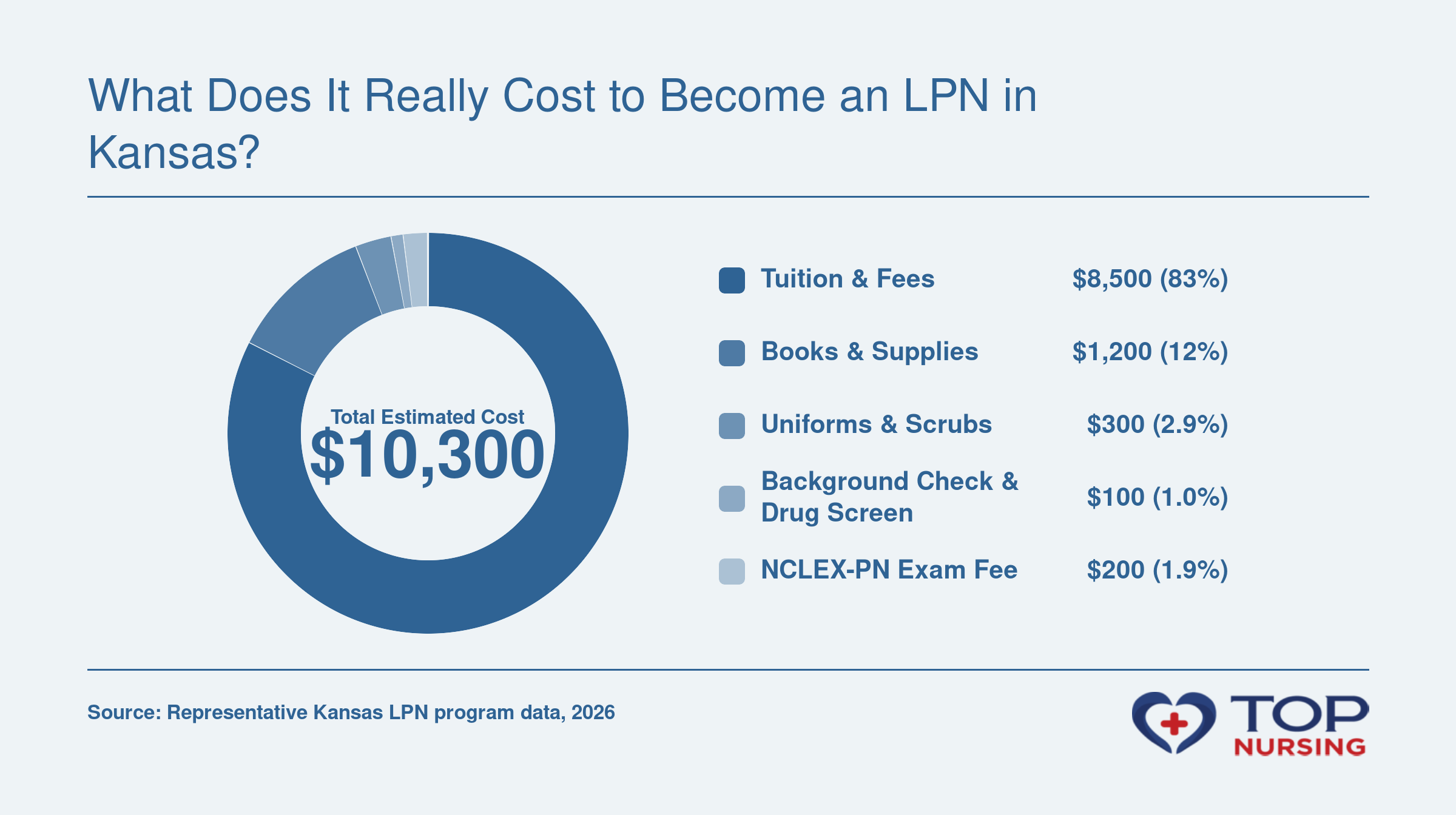
What Does It Really Cost to Become an LPN in Kansas?

The total price tag for an LPN program can look overwhelming at first glance, but breaking it into individual expenses makes budgeting far more manageable. Using a representative Kansas practical nursing program, the figures below show how the total cost breaks down into tuition, supplies, and exam fees.

LPN program cost breakdown for a representative Kansas school showing tuition and fees $8,500, books and supplies $1,200, uniforms $300, background check $100, and NCLEX-PN exam $200, totaling $10,300.

NCLEX-PN Pass Rates at Kansas LPN Schools

Across the country, first-time NCLEX-PN test takers in 2025 achieved a 77.3% pass rate1, but the number that matters most for your career is your own program’s track record. In Kansas, where the State Board of Nursing (KSBN) monitors every approved practical nursing program, pass rates vary widely , and knowing them upfront can save you time, money, and disappointment.

What the NCLEX-PN Covers

The NCLEX-PN (National Council Licensure Examination for Practical Nurses) is the standardized exam all aspiring LPNs must pass to earn a license. It uses computerized adaptive testing to measure entry-level nursing competence across four major client-needs categories: safe and effective care environment, health promotion and maintenance, psychosocial integrity, and physiological integrity. Because the test adapts to your performance, a high first-time pass rate signals that a program consistently prepares students for the breadth and depth of these topics.

Why Pass Rates Should Influence Your Program Choice

First-time NCLEX-PN pass rates are among the most transparent quality indicators a school can offer. A consistently high rate , typically 85% or above , suggests strong curriculum alignment with licensing standards, effective clinical training, and adequate student support. A low or declining rate may point to gaps in instruction, outdated resources, or insufficient exam preparation. Since you cannot work as an LPN without a passing score, choosing a program with a solid track record directly impacts your ability to enter the workforce on schedule.

Kansas LPN Pass Rates and the KSBN Annual Report

The Kansas State Board of Nursing publishes annual NCLEX-PN performance data for every approved LPN program in the state. In the most recent reporting year (2025), several Kansas practical nursing programs posted first-time pass rates above 90%, well outpacing the national average of 77.3%1. While specific school-by-school figures are updated yearly and available on the KSBN website, prospective students can expect variation , some programs hover near perfect pass rates, while others cluster closer to the national median. The top-performing Kansas programs often attribute their success to small cohort sizes, simulation-based learning, and dedicated NCLEX review courses.

How to Use Pass Rates in Your Decision

Rather than looking at a single year’s number, examine a three- to five-year trend. A program that maintains pass rates above the national average over time demonstrates resilience and continuous improvement. Also consider cohort size: a 100% pass rate from a class of eight is less telling than a 92% rate from a class of 40. Finally, cross-reference NCLEX outcomes with graduate employment data and student satisfaction surveys to get the fullest picture of program quality.

Questions to Ask Yourself

Kansas LPN programs often run on rigid daytime schedules, especially for clinical rotations. If your availability is limited, filtering for schools with evening or hybrid tracks upfront can save you from withdrawing mid-program.

Clinical placements may be up to 60 miles from campus, and unreliable transportation is a leading cause of attrition. Map out potential sites from your shortlisted schools to see if the weekly drive is realistic with your other responsibilities.

If you intend to become an RN later, prioritize programs with established LPN-to-RN articulation agreements. Choosing a school that lacks these pathways can force you to repeat coursework when you advance.

Admission Requirements by School

Admission standards for practical nursing programs in Kansas have stabilized around a standardized test and prerequisite coursework, but the details still vary from campus to campus.

Which entrance exam do Kansas LPN programs use?

Every researched Kansas practical nursing program currently requires the Test of Essential Academic Skills (TEAS). Schools that confirm the TEAS requirement include Johnson County Community College, Manhattan Area Technical College, Neosho County Community College, Salina Area Technical College, and Dodge City Community College. Although score minimums are not published uniformly, competitive applicants typically score above the national mean. Most programs permit one retake, and some allow alternative composite scores from within a set time window.

What GPA and prerequisite courses do you need?

Minimum cumulative GPA expectations fall in the 2.75–3.0 range at schools that disclose a threshold, such as Johnson County and Dodge City. Even where no minimum is posted, accepted cohorts often carry higher averages.

Common prerequisite courses across Kansas programs include:

  • Anatomy & Physiology: required with a lab component at most schools.
  • English Composition: often a prerequisite before program entry.
  • Psychology: general or lifespan development psychology is listed by several colleges.
  • Math: typically college-level algebra or a designated dosage-calculation course.

Johnson County Community College specifies English Composition, A&P, and Psychology. Dodge City adds Human Growth and Development to the same core set. Other programs, such as Manhattan Tech, Neosho County, and Salina Tech, align with similar general-education patterns, so a strong foundation in the sciences will serve you well regardless of your target school.

Background checks, immunizations, and health requirements

Every Kansas LPN program that publishes admission criteria mandates a criminal background check, often through a state-designated vendor. Manhattan Area Technical College and Johnson County Community College explicitly list this step. Immunization requirements are equally stringent and typically include:

  • Hepatitis B series (or titer)
  • MMR (measles, mumps, rubella)
  • Tdap (tetanus, diphtheria, pertussis)
  • Varicella (chickenpox)
  • Seasonal influenza vaccine
  • Tuberculosis screening (PPD or blood test)

Johnson County also requires proof of COVID-19 vaccination. Students should anticipate a drug screening, current CPR certification, and sometimes a physical exam before clinical placements begin.

Do you need a CNA certification first?

Several Kansas practical nursing programs prefer or require applicants to hold a current Certified Nursing Assistant (CNA) credential or documented healthcare experience. This requirement is not universal, but it is common enough to investigate early. If you are researching three or four target schools, check each program’s selection criteria to see whether a CNA license boosts your application or is an absolute prerequisite.

Application deadlines and cohort models

Deadlines and start dates vary widely. Most Kansas community and technical colleges operate on rolling or annual cohort admissions. For instance, Salina Area Technical College and Johnson County Community College run focused 9- to 11-month daytime tracks that may admit once or twice a year. Dodge City Community College offers its practical nursing option as part of an associate-degree pathway, which can affect entry timing. Contact each program directly to confirm the next available start, as capacity often fills months before the first class.

Fastest LPN Programs in Kansas

Kansas offers some of the fastest LPN programs in the region, with at least one program preparing you for licensure in as few as 9 months. For students who want to enter the workforce quickly without sacrificing quality, these accelerated timelines are a practical option, but they demand full-time commitment and careful scheduling.

Accelerated Program Durations in Kansas

Several Kansas community and technical colleges offer full-time LPN programs that finish in under a year. The durations below represent calendar months, not academic semesters.

  • Johnson County Community College: 9-month full-time (August start), 11-month full-time (January start), and 14-month part-time option.1
  • Hutchinson Community College: 10-month full-time, 18-month part-time.2
  • Seward County Community College: 10-month full-time.3
  • Flint Hills Technical College: 11-month full-time.3
  • Kansas City Kansas Community College: 12-month full-time.4
  • Northeast Tech: 12-15 months, depending on start date and campus, totaling 1463 clock hours.5

These lengths reflect continuous enrollment with few or no extended breaks. Even the 12-month programs are compact by design.

Calendar Length vs. Credit Hours

A shorter program length does not mean fewer credit hours or clinical requirements. A 9-month program packs the same curriculum into a tighter window by holding classes through summer and winter breaks. Students in a 12-month track might get a short winter recess; those in a 9-month track typically do not. You earn the same practical nursing certificate and are equally eligible to sit for the NCLEX-PN. The difference is solely the pace and schedule intensity.

Trade-offs of a Fast-Track Program

Accelerated programs require a heavy weekly commitment, often 30 to 40 hours between classwork, labs, and clinical rotations. This leaves little room for part-time employment, so many students rely on savings, family support, or financial aid during the program. However, the benefit is clear: you can complete training, pass the licensing exam, and start working as an LPN months ahead of peers in longer programs. If you can manage the condensed schedule, the faster entry to a paycheck can offset the short-term financial pinch.

How LPN Programs Compare to Other Nursing Degrees

Even the longest LPN programs in Kansas are brisk compared to other nursing pathways. An associate degree in nursing (ADN) takes about two years, and a bachelor of science in nursing (BSN) typically requires four. The 11- to 12-month duration of most Kansas practical nursing certificates already represents a streamlined route into healthcare. Accelerated options push that efficiency even further, making LPN training one of the quickest ways to become a licensed nurse.

Online and Hybrid LPN Options in Kansas

Fully online LPN programs are virtually non-existent, but hybrid options blend online coursework with in-person clinicals, a contrast many aspiring nurses need to understand before committing.

The Hybrid Reality: Online Didactics, On-Site Clinicals

All practical nursing programs require hands-on clinical hours that cannot be replicated online, so no accredited LPN program in Kansas is 100% remote. Only one of the 12 ranked schools, Rasmussen University-Kansas, advertises a hybrid format where didactic courses are delivered online while labs and clinicals remain on campus. Every other program on our list is designated campus-based, with in-person lectures and skills training. If you see a program labeled "online," it almost certainly refers to a hybrid model; the clinical component will still require your physical presence at approved facilities.

Which Kansas Programs Offer Flexible Formats?

A few schools build flexibility into their schedules to help students balance work and study:

  • Rasmussen University-Kansas combines online coursework with on-campus labs and offers eight start dates yearly, with no prerequisite courses required.
  • Johnson County Community College offers full-time (9-month) and part-time (14-month) tracks, with start dates in fall, spring, and summer. Cohorts are capped at 32 students.
  • Hutchinson Community College provides both full-time and part-time options, with starts in fall and spring.
  • Salina Area Technical College allows students to choose full-time or part-time pacing across its three-semester program.

These programs do not eliminate on-campus attendance, but part-time pathways and multiple entry points give working adults more control over their weekly load.

Scheduling Options for Working Adults

Dedicated evening or weekend tracks are uncommon among Kansas LPN programs. Most clinical rotations take place during weekday shifts, and lectures often follow a daytime schedule. Still, schools like Neosho County Community College run the program at two locations (Chanute and Ottawa), potentially cutting commute times. Seward County Community College and Coffeyville Community College also serve rural regions, though they operate on traditional academic calendars. If you need significant evening or weekend availability, contact individual schools directly, as some may accommodate requests, but you should verify before applying.

Clinical Placements: Where You’ll Train

Regardless of delivery format, you will complete clinical hours at local hospitals, long-term care facilities, or community health centers. These sites are typically within driving distance of the campus and require in-person attendance during scheduled shifts. For example, Dodge City Community College notes that on-campus clinicals occur during the week, and Manhattan Area Technical College partners with area facilities for rotations. Because clinicals are supervised, unexcused absences can jeopardize your progress, so plan to treat them like a job.

How to Get Licensed as an LPN in Kansas

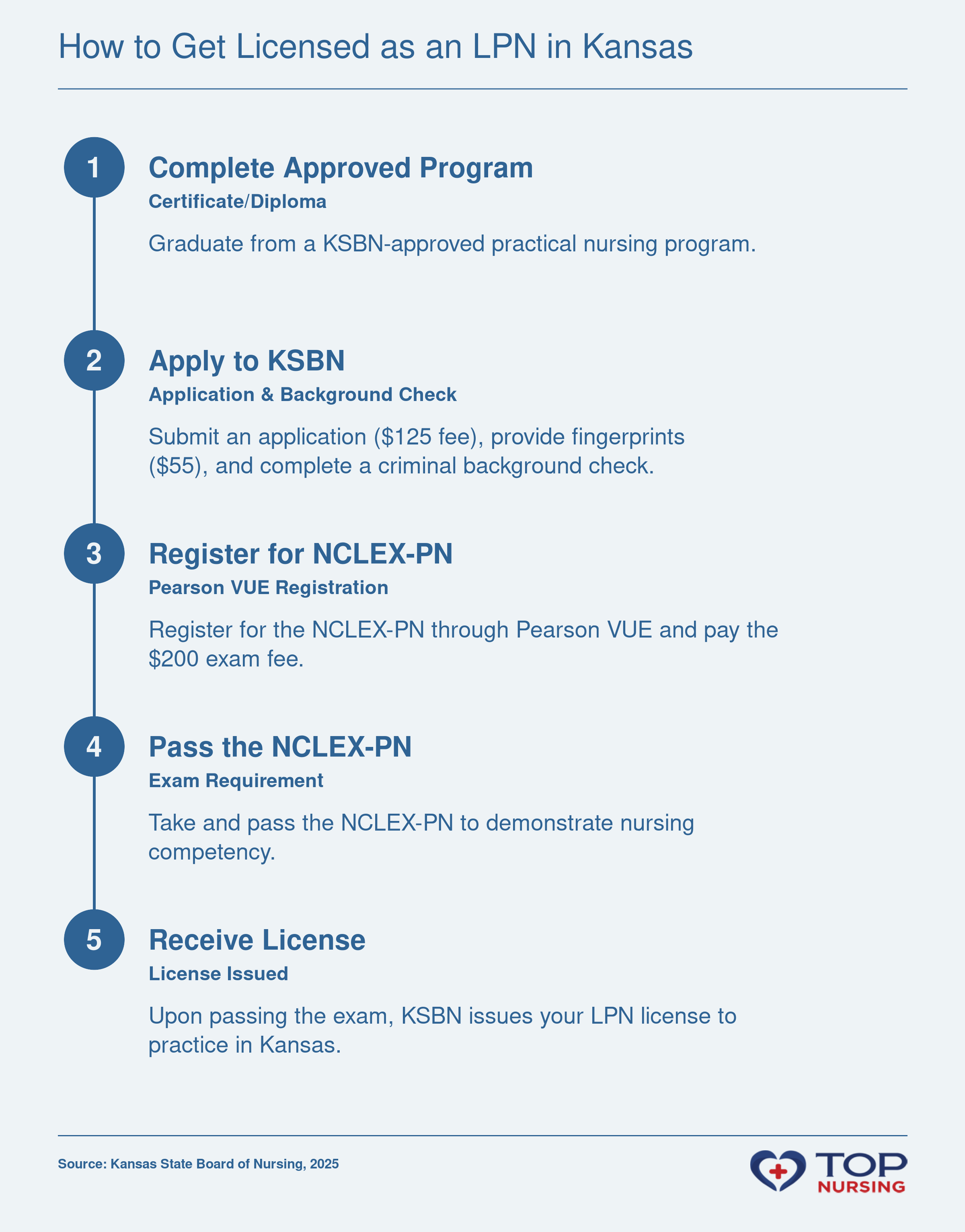
Licensed Practical Nurses in Kansas complete an approved program, pass the NCLEX-PN, and apply for licensure through the Kansas State Board of Nursing (KSBN). LPNs already licensed in another state may apply by endorsement if they meet Kansas requirements, and all LPN licenses must be renewed every two years with 30 hours of continuing education.

Sequence showing LPN licensure steps: complete approved program, apply to KSBN, register for NCLEX-PN, pass exam, receive license.

Did you know? The Bureau of Labor Statistics projects around 54,400 job openings each year for licensed practical nurses across the country from 2024 to 2034. That steady demand means new LPNs can expect ample opportunities in hospitals, nursing homes, and home health settings.

LPN-to-RN Bridge Programs in Kansas

LPN-to-RN bridge programs are designed for licensed practical nurses who want to earn RN licensure and take on broader nursing responsibilities. Because these programs credit your existing LPN knowledge, they are shorter than traditional RN programs. Many Kansas LPNs choose this path to increase their earning potential and move into hospital, leadership, or specialty roles that often require an RN license.

Why Transition from LPN to RN?

RNs in Kansas earn significantly higher wages, and the role opens doors to settings that employ fewer LPNs, such as acute care and community health. The Kansas job market values RNs for their expanded scope, including patient assessment and care planning.

Kansas Schools with LPN-to-RN Bridge Options

Several Kansas community colleges that train LPNs also offer bridge programs to an Associate Degree in Nursing (ADN) or Associate of Applied Science (AAS) in nursing. These include:

  • Hutchinson Community College: LPN to RN Online Bridge (AAS), ACEN accredited, completed in 12 months through online delivery.
  • Butler Community College: LPN to RN Articulation (ADN), on-campus, 12 months, leading to an AAS in Nursing.
  • Johnson County Community College: LPN to RN Bridge (AAS), on-campus, 56-59 credits, designed for completion in 12 months.
  • Metropolitan Community College Kansas City: LPN to ADN Bridge, 12 months, awarding an AAS in Nursing.
  • Garden City Community College: LPN-to-ADN Bridge, ACEN accredited, spans 12 to 16 months.

All programs provide a clear pathway from LPN to RN, often at the same institution where you earned your practical nursing certificate.

Program Length and What to Expect

The bridge portion itself typically lasts 12 months of full-time study. However, students must complete prerequisites and general education courses, bringing the total timeline to about 1.5-2 years after LPN licensure. Formats vary; Hutchinson offers an online option, while others use on-campus labs and clinicals. Most award an associate degree, which qualifies graduates for the NCLEX-RN and state licensure.

A Strategic Approach: Work as an LPN While You Advance

Earning your LPN first can be a smart, cost-effective strategy. You can work in a healthcare setting, gain experience, and fund your RN education. Many employers offer tuition assistance for LPNs pursuing RN advancement. The bridge option means you do not start over; you build on what you have already mastered.

Frequently Asked Questions About Kansas LPN Programs

Here are answers to the most common questions about practical nursing programs in Kansas, covering costs, timelines, online options, and licensure requirements.

How long does it take to complete an LPN program in Kansas?
Most full-time LPN programs in Kansas take between 12 and 18 months to finish. Part-time options can extend the timeline to 24 months or more. The exact duration depends on the school's curriculum structure and whether you enroll in a standard certificate or an accelerated track.
How much do LPN programs cost in Kansas?
Tuition for LPN programs in Kansas typically ranges from $5,000 to $25,000. Costs vary by school type (public community college vs. private vocational school), program length, and in-state or out-of-state status. Additional expenses like books, uniforms, and exam fees can add $1,000 to $3,000.
Can you complete an LPN program online in Kansas?
Fully online LPN programs are not available because state licensing requires in-person clinical hours. However, some Kansas schools offer hybrid options where you take lecture courses online and complete labs and clinical rotations on campus or at approved healthcare facilities. Check individual programs for hybrid availability.
What are the requirements to become an LPN in Kansas?
To enroll in an LPN program, you need a high school diploma or GED, a minimum GPA (often 2.0 or higher), and passing scores on the TEAS exam. Most programs also require a background check, drug screening, immunization records, and current CPR certification. Upon graduation, you must pass the NCLEX-PN to obtain licensure.
Which Kansas LPN program has the highest NCLEX-PN pass rate?
NCLEX-PN pass rates fluctuate annually. The Kansas State Board of Nursing publishes detailed reports for every approved program. Rather than naming one school, prospective students should review the most recent Board data to identify programs consistently above the state and national averages, then consider other fit factors like cost and location.
What is the average LPN salary in Kansas?
According to the most recent BLS data, the average annual salary for licensed practical nurses in Kansas is approximately $50,560. Entry-level wages are lower, but experienced LPNs or those in metropolitan areas like Kansas City can earn over $58,000 per year. The job outlook remains steady with consistent demand in long-term care and clinics.

Recent Articles