Top LPN Programs in Idaho for 2026: Rankings & Comparisons
Compare tuition, NCLEX-PN pass rates, program length, and admission requirements across every Idaho LPN program.
By Hannah Pierce, BSNReviewed by TopNursing.org TeamUpdated May 29, 202619 min read
Points of interest…
College of Southern Idaho offers Idaho's lowest net price LPN program at $6,095 after grants and scholarships.
Idaho LPN programs outperform national NCLEX-PN averages, with Carrington College and College of Eastern Idaho achieving 100% pass rates.
LPN employment in Idaho is projected to grow 18.9% by 2032, much faster than most occupations.
New Idaho LPNs earn about $53,000 shortly after graduation, nearly matching the state's median of $54,000.
Idaho’s Department of Labor projects an 18.9% increase in LPN jobs from 2022 to 2032, far outpacing the national average. This demand spans rural clinics and growing urban centers like Boise, but training supply remains concentrated in a handful of community colleges and one private school.
Six programs appear in the 2026 ranking, all offering certificate-level practical nursing education. With the exception of Eagle Gate College’s hybrid option in Boise, every program is campus-based. Admission is competitive, often requiring a CNA certification and entrance exam scores, so comparing cost, pass rates, and job placement is essential.
2026 Best LPN Programs in Idaho, Ranked
Our ranking of Idaho’s top LPN programs prioritizes affordability and strong financial outcomes, drawing on metrics like net price, median graduate debt, and earnings. We also consider program quality indicators such as accreditation status, NCLEX-PN pass rates, and hands-on clinical opportunities. The following schools offer Idaho’s best combination of value, career preparation, and student support in 2026.
NCES-IPEDS federal institutional data — nces.ed.gov
Rank
School
Location
Net price
Best for
#1
College of Southern Idaho
Twin Falls, ID
$6,000/yr
Rural-focused students needing IV certification
College of Southern Idaho’s Practical Nursing program in Twin Falls stands out for its integrated IV Therapy Certification, allowing graduates to practice without needing additional coursework. The competitive, points-based admission process admits about 30 students each fall and spring, with no waitlist. Graduates typically leave with just $8,000 in median debt and strong early-career earnings, making this a high-value choice for rural healthcare aspirants.
Integrated IV Therapy Certification – no separate course needed after licensure
Admits approximately 30 students each fall and spring semester
Points-based competitive admission with no waitlist
Rural healthcare focus prepares you for hospitals, long-term care, and home health
Math and science prerequisites must be within 5 years
Separate program application required beyond general college admission
Prepares for NCLEX-PN licensure exam
Intermediate Technical Certificate stackable into higher nursing education
#2
College of Eastern Idaho
Idaho Falls, ID
~$9,000/yr (est.)
Direct-admission students planning an RN bridge
College of Eastern Idaho in Idaho Falls offers a direct-admission, three-semester Practical Nursing program that leads to an Intermediate Technical Certificate. The curriculum combines classroom learning with hands-on clinical experience, and the program boasts a 100% licensure pass rate and strong job placement. Alumni report low median debt of $12,000 and solid earnings, underscoring the program's value and seamless LPN-to-RN bridge pathway.
Direct admission – start your nursing education right away
Complete the three-semester program and earn an Intermediate Technical Certificate
Tuition: $150 per credit, total program cost about $6,900
100% NCLEX-PN pass rate and 89% job placement rate
Candidate for ACEN accreditation, approved by Idaho Board of Nursing
Clear pathway to RN through an LPN-to-RN Bridge program
Mandatory orientations and clinical experiences required
#3
College of Western Idaho
Nampa, ID
~$9,000/yr (est.)
Students choosing between certificate and associate
College of Western Idaho’s Nampa-based Practical Nursing program is fully ACEN accredited and available as both an Intermediate Technical Certificate and an Associate of Applied Science. The program features a rigorous application process requiring the Kaplan Nursing Admissions Exam, with a single annual entry each fall. Graduates have reported 100% NCLEX-PN pass rates and job placement, and carry manageable median debt under $10,000.
Fully ACEN accredited program at the Nampa Campus Health and Science Building
Choose between an Associate of Applied Science (AAS) or Intermediate Technical Certificate (ITC)
Single fall entry; application window Sept. 1 to Oct. 19, 2026
Kaplan Nursing Admissions Exam required for applicants
100% NCLEX-PN pass rate and job placement for recent grads
Clinical rotations at partner hospitals including Saint Alphonsus and St. Luke's
No Practical Nursing-to-RN bridge program currently offered
#4
North Idaho College
Coeur d'Alene, ID
$11,000/yr
North Idaho College in Coeur d’Alene delivers an 11-month Practical Nursing certificate with options for full-time or part-time study. The program’s clinical rotations span Idaho and Washington, giving students diverse hands-on experience in medical-surgical, maternal-child, and psychiatric nursing. Competitive entry requires a CNA certification and a minimum 2.5 GPA, and graduates enjoy high NCLEX-PN pass rates with median debt of $9,000.
11-month certificate program with full-time and part-time tracks
Single fall start; competitive admission requires TEAS exam
Prerequisite courses and current CNA certification required
Clinical rotations across Idaho and Washington for broad experience
Curriculum covers medical-surgical, maternal-child, psychiatric, and geriatric nursing
100% NCLEX-PN pass rate among recent graduates
Small cohorts and hands-on lab and clinical training
#5
Idaho State University
Pocatello, ID
$12,000/yr
Idaho State University in Pocatello offers a Practical Nursing Intermediate Technical Certificate that can be completed in three to four semesters. A standout feature is its veteran-friendly bridge curriculum, which awards credit for prior military medical experience. Graduates earn a median of $45,608, though debt is higher at $20,039, and benefit from a 95% placement rate and a career ladder to an Associate Degree in Nursing.
Veteran-friendly: awards credit for prior military medical experience
95% job placement rate and a clear career ladder to Associate Degree in Nursing
Requires current CPR and CNA certifications
Prerequisites in anatomy, English, and math required
Clinical hours may include evenings, weekends, or overnights
Located on the Pocatello campus in the Roy F. Christensen Complex
#6
Eagle Gate College-Boise
Boise, ID
$30,000/yr (net price)
Eagle Gate College’s Boise campus provides a 12-month hybrid Practical Nursing program that blends online coursework with on-site clinical training. The accelerated format and comprehensive NCLEX-PN preparation are designed for students eager to enter the workforce quickly, though the program’s higher tuition and student debt levels are important considerations. Median graduate debt is $43,021 with average earnings of $37,518, so students should carefully weigh the financial investment.
12-month accelerated hybrid program – online coursework plus on-site clinicals
Prepares you for the NCLEX-PN exam with a high pass rate
Financial aid available for eligible students
Job placement assistance provided to graduates
Hands-on clinical training near Boise’s major medical centers
Comprehensive curriculum covering pharmacology, medical-surgical, and patient care
Higher tuition and median debt than public options
Idaho LPN Tuition & Cost Comparison
College of Southern Idaho stands out with the lowest average net price at $6,095 after grants and scholarships, but the actual cost you pay will depend on your financial aid package and personal situation. The net price figure reflects what in-state students in the lowest family income bracket typically pay, so costs may be higher for those with different financial circumstances. Pell Grant recipient data underscores accessibility: at CSI, 86% of undergraduates receive Pell Grants, signaling strong support for lower-income students, while even the most expensive option, Eagle Gate College-Boise, has 81.7% Pell recipients, though its net price is notably higher at $30,241.
School
In-State Tuition
Out-of-State Tuition
Average Net Price
Median Graduate Debt
Pell Grant Recipients
College of Southern Idaho
$4,560
$6,840
$6,095
$8,000
86%
College of Western Idaho
$4,446
$7,454
$8,500
$9,720
80.1%
College of Eastern Idaho
$4,390
$6,750
$8,778
$12,000
82.2%
North Idaho College
$4,960
$8,736
$10,575
$9,000
78.7%
Idaho State University
$8,610
$27,720
$12,193
$20,039
67.6%
Eagle Gate College-Boise
$19,068
$19,068
$30,241
$43,021
81.7%
Questions to Ask Yourself
Can you attend full-time, in-person classes for about a year?
In-person attendance is mandatory; balancing a job or family needs planning.
Are you ready with prerequisites and TEAS scores?
Complete anatomy, math, and TEAS early. Many programs require them for admission.
Is LPN your final step, or a path to RN?
If you plan to advance, select programs with LPN-to-RN bridge agreements.
Program Length & Schedule Options in Idaho
Choosing an LPN program isn’t just about a school’s reputation; it’s also about fitting a rigorous curriculum into your existing commitments. Most Idaho practical nursing programs follow a compact, full-time format, but the details can make or break your ability to balance work, family, and studies.
How Long Do LPN Programs Take?
Most Idaho LPN programs run about 11 to 12 months, or roughly three semesters, from start to finish. For example, the Practical Nursing program at College of Eastern Idaho (CEI) is a three-semester sequence with no summer classes, leading to an Intermediate Technical Certificate.1 This pace is typical across the state, though some schools might offer a slightly extended timeline if you need to complete prerequisites first. Always confirm with the current catalog, as program lengths can shift when curricula are updated.
Day, Evening, and Hybrid Options
Schedule flexibility varies by campus. CEI runs its LPN cohort on a full-time, Monday through Friday day schedule, with no evening or weekend track available.2 Other Idaho schools may offer more variety; some community colleges periodically experiment with evening cohorts or part-time pathways to accommodate working students. If you need a non-traditional schedule, reach out to multiple programs early to ask about upcoming cohort plans. Keep in mind that even with flexible didactic hours, clinical rotations almost always take place during daytime shifts at healthcare facilities.
Can You Take LPN Classes Online?
Fully online LPN programs do not exist in Idaho because state regulations and accreditation standards require hands-on clinical training. Some general education prerequisites, like anatomy or English, may be available online, but core nursing courses and skills labs must be completed in person; the clinical and lab components cannot be substituted virtually. If you see programs touting “hybrid” elements, they typically mean a mix of on-campus labs and asynchronous lectures. The clinical hours will always demand your physical presence at approved sites.
Program length and schedule details are drawn from current school catalogs and may change from year to year. Contact nursing departments directly for the most accurate, up-to-date information before applying.
Admission Requirements by Program
What do Idaho LPN programs actually require for admission? The short answer: it varies by school, but you will almost always need a solid GPA, specific prerequisites, and a clean background check. Most programs in the state use competitive admission with limited cohort sizes, so meeting the bare minimums does not guarantee a seat. The table-format breakdown below helps you compare requirements side by side and spot paths that may be more accessible based on your background.
College of Eastern Idaho
Minimum GPA: Not explicitly published; admission is competitive and all prerequisites must be completed with a grade of C or higher.
Entrance exam: None required.
CNA certification: Required (or successful completion of NUR 101).
Prerequisite courses: ENGL 101, MATH 153, BIOL 227 with lab, BIOL 228 with lab, and the CNA certificate or NUR 101.
Background check and drug screen: Required after conditional acceptance; clinical sites mandate a satisfactory report.
College of Southern Idaho
Minimum GPA: 2.5 (on a 4.0 scale) for prerequisite courses.
Entrance exam: None required.
CNA certification: Not required.
Prerequisite courses: Specific list available on the program website; courses include anatomy and physiology, English, and math.
Background check and drug screen: Required prior to clinical placement.
College of Western Idaho
Minimum GPA: 2.5 (based on recent admission cycles; verify current threshold).
Entrance exam: Kaplan Nursing Admissions Exam.
CNA certification: Required (based on prior year data; confirm with the program before applying).
Prerequisite courses: Check the program page for the most current list, which typically includes sciences, math, and English.
Background check and drug screen: Mandatory for all clinical rotations.
Idaho State University
Minimum GPA: 2.0 (the lowest published among Idaho LPN programs).
Entrance exam: Nationally normed admission test (not TEAS); details are provided within the application packet.
CNA certification: Required.
Prerequisite courses: HO 0111 or BIOL 2227/2227L & BIOL 2228/2228L or BIOL 3301/3301L & BIOL 3302/3302L, ENGL 1101, LLIB 1115, and an online dosage calculation module.
Background check and drug screen: Required for all enrolled nursing students.
North Idaho College
Minimum GPA: 2.5.
Entrance exam: TEAS (Test of Essential Academic Skills).
CNA certification: Required.
Prerequisite courses: CAOT-179 Medical Terminology, PHAR-150 Introduction to Pharmacology, ENGL-101, MCTE-102 Computational Skills for Allied Health, BIOL-175 Human Biology, and PSYC-101 Introduction to Psychology.
Background check and drug screen: Required upon admission into the program.
Finding a Less-Stringent Entry Point
If you are looking for programs that lower the bar in one area, two schools stand out. College of Southern Idaho does not require CNA certification, which saves significant time upfront for applicants who lack it. Idaho State University sets the lowest GPA floor at just 2.0, though its nationally normed exam and CNA requirement still apply. College of Eastern Idaho forgoes an entrance exam entirely, making it attractive if standardized testing is a hurdle for you. Keep in mind that all programs demand thorough prerequisite completion and a clean background check, so no path eliminates every gatekeeper. Always verify details directly with the program before applying, as requirements can shift between application cycles.
How Do Idaho LPN Programs Perform on the NCLEX-PN?
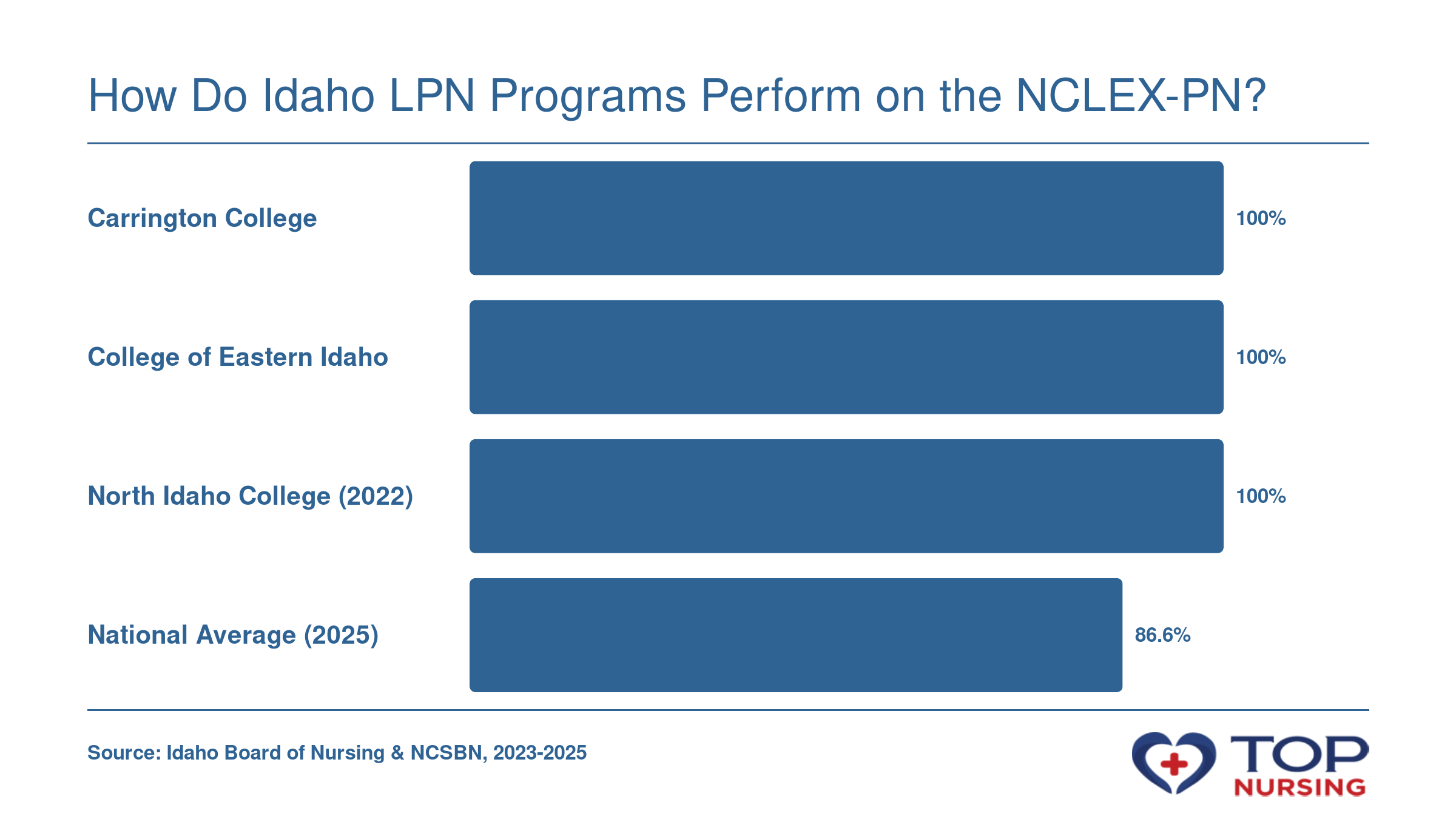
Idaho LPN programs consistently outperform the national average on the NCLEX-PN first-time pass rate. Carrington College and College of Eastern Idaho each report a 100% pass rate for 2023-2025, while North Idaho College achieved 100% in its most recent reported year (2022). With small cohort sizes, pass rates can shift from year to year.
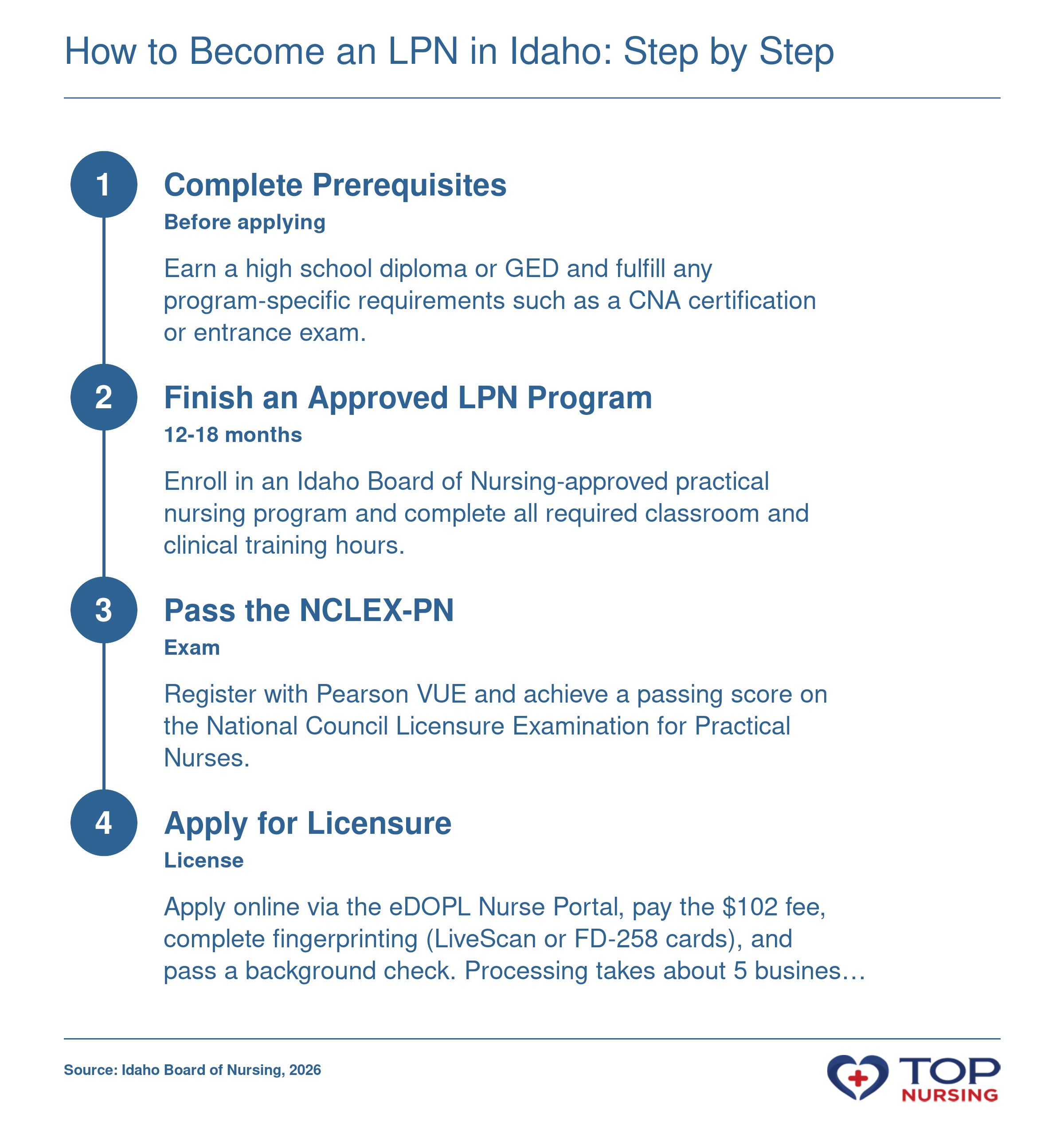
How to Become an LPN in Idaho: Step by Step
Becoming a licensed practical nurse in Idaho follows a clear, sequential path. Most candidates complete the process in about two years, from meeting prerequisites through receiving their license.
Idaho LPN Salary & Job Outlook
According to the Idaho Department of Labor, employment for licensed practical nurses in the state is expected to grow by 18.9% from 2022 to 2032, a rate much faster than the average for all occupations. This expansion is projected to create about 285 job openings each year, adding to the existing workforce of approximately 2,380 LPNs across Idaho. The table below provides salary ranges for licensed practical nurses in several metropolitan areas, using the most recent Bureau of Labor Statistics data available.
Metro Area
Total Employment
25th Percentile
Median Annual Wage
75th Percentile
Boise City, ID
940
$59,790
$65,170
$73,000
Coeur d'Alene, ID
260
$52,650
$64,060
$73,660
Idaho Falls, ID
240
$47,180
$55,160
$61,320
Lewiston, ID-WA
100
$53,000
$62,610
$73,970
Pocatello, ID
160
$25,970
$57,610
$61,550
Twin Falls, ID
180
$52,740
$59,700
$68,140
Did You Know?
Idaho LPNs earn a median of $54,000 per year (BLS), and program scorecards report median earnings of $53,000 one year after graduation: a gap of just $1,000, confirming that Idaho's LPN programs prepare graduates for wages that match real-world market rates.
LPN-to-RN Bridge Programs in Idaho
LPNs ready to become registered nurses can choose either an associate-degree (ADN) or bachelor's-degree (BSN) bridge, each with its own timeline and career scope. An ADN bridge typically takes less time and leads to entry-level RN positions, while a BSN bridge aligns with the growing emphasis on higher education and can open doors to leadership roles. The right choice depends on your career goals, existing credits, and how quickly you want to advance.
Find Approved Programs
Start with the Idaho Board of Nursing website, which maintains a current list of approved LPN-to-RN bridge programs and their accreditation status. This is the most reliable first stop; it ensures any program you consider meets state educational standards for RN licensure. Look for programs labeled as LPN-to-ADN or LPN-to-BSN, and note the accreditation type; it affects credit transfer and employer recognition.
Explore Pathway Options at Idaho Colleges
Several Idaho institutions offer structured bridge pathways. Visiting the nursing program pages of community colleges such as the College of Southern Idaho and North Idaho College, as well as Idaho State University, gives you direct insight. These sites typically outline which LPN credits transfer, how much advanced standing you receive, and whether the curriculum is delivered on campus, online, or in a hybrid format. Because details shift frequently, always verify that the information you find reflects the upcoming application cycle.
Contact Nursing Departments for Details
Admission requirements for bridge students often differ significantly from those for traditional pre-licensure tracks. Call or email the nursing department at each school to ask specific questions: How many of your LPN credits will apply toward the RN degree? What is the total additional time required to complete the program? Are there prerequisite courses you still need? Some programs require a minimum number of hours worked as an LPN before applying, while others may request letters of recommendation or a certain GPA in your practical nursing coursework. This direct conversation can also clarify whether the LPN-to-BSN option includes courses that might be taken concurrently with your LPN job.
Leverage Professional Resources
Beyond individual schools, the Idaho Nurses Association and similar professional groups can point you toward bridge program options and financial aid resources tailored to working LPNs. These organizations often compile scholarship lists, employer tuition-reimbursement partnerships, and updates on new bridge tracks that may not yet appear on college websites. Connecting with them early can save both time and money.
An LPN-to-RN bridge is a significant step, but Idaho provides clear pathways for motivated nurses. By mapping out your options and contacting programs directly, you can find the most efficient path to your RN license.
Financial Aid & Scholarships for Idaho LPN Students
Financial aid for LPN students in Idaho spans state scholarships, federal grants and loans, and employer tuition benefits, all designed to lower the upfront cost of practical nursing training. Tapping one or more of these sources can make a certificate program affordable and reduce reliance on debt.
Idaho-Specific Scholarships for Nursing Students
Idaho Opportunity Scholarship: Awards up to $3,500 per year (renewable for four years) to Idaho residents pursuing a certificate, associate, or bachelor's degree. A minimum 2.7 GPA is required, and the annual deadline is March 1. The Adult Learner variant extends the same award to returning students who have a 2.5 GPA, 24 prior credits, and a two-year break in education.
Idaho LAUNCH Grant: Provides up to $8,000 total, with $4,000 maximum in the first year, covering 80% of tuition for recent Idaho high school graduates entering high-demand fields. Many LPN programs qualify. The application deadline is April 15. You cannot combine LAUNCH with the Opportunity Scholarship in the same year.
Idaho Governor's Cup Scholarship: A merit-based state scholarship for Idaho high school graduates, often used by LPN students to reduce program costs.
Federal Financial Aid Options
All six ranked LPN programs in Idaho participate in federal student aid, so filing the Free Application for Federal Student Aid (FAFSA) opens the door to Pell Grants and Direct Loans. Pell Grants are need-based awards that do not require repayment, while Direct Loans offer low-interest borrowing with flexible repayment. Submit the FAFSA as soon as possible after October 1 each year to maximize eligibility.
Employer-Sponsored Tuition Programs
Major Idaho healthcare employers, including St. Luke's Health System and Saint Alphonsus Health System, frequently provide tuition reimbursement or scholarships for nursing students. These programs often cover a portion of tuition in exchange for a post-graduation work commitment. Contact human resources departments at hospitals and clinics to learn about current offerings.
Additional Funding Sources
Workforce training grants: The Idaho Department of Labor and local workforce boards may fund healthcare training programs, particularly in rural or underserved areas. Check with your program’s financial aid office and your local one-stop career center.
Institutional and private scholarships: Many LPN schools offer their own scholarships or emergency grants; search each program’s website and explore community foundation awards. Nursing associations and healthcare foundations also sponsor scholarships targeting practical nursing students.
Frequently Asked Questions About Idaho LPN Programs
Below are answers to the most common questions about practical nursing education in Idaho. Whether you're curious about program length, cost, or licensure, these quick answers will help you move forward. For more detailed guidance, explore our rankings and career pages.
How long does it take to become an LPN in Idaho?
Most full-time LPN programs in Idaho take between 12 and 18 months to complete, including classroom instruction and supervised clinical hours. Part-time and evening options may extend the timeline. After finishing, you must pass the NCLEX-PN to earn your license.
What are the requirements to get into an LPN program in Idaho?
Typical requirements include a high school diploma or GED, passing a background check and drug screening, proof of immunizations, and completion of prerequisite courses like anatomy, biology, and math. Some schools also require a minimum GPA and a pre-entrance exam such as the TEAS.
How much do LPN programs cost in Idaho?
Total tuition for LPN programs in Idaho ranges from about $5,000 to $20,000, depending on whether you attend a public community college or a private technical school. This typically covers tuition, fees, and sometimes uniforms and textbooks. Financial aid is available for those who qualify.
What is the average LPN salary in Idaho?
According to the latest Bureau of Labor Statistics data, LPNs in Idaho earn a median annual wage of approximately $52,000, though this varies by location and employer. Entry-level salaries may be lower, while experienced LPNs in specialized settings can earn more.
Can you take LPN classes online in Idaho?
Some LPN theory courses may be available online through Idaho schools, but the required clinical rotations must be completed in person at approved healthcare facilities. Fully online LPN programs are not available due to the hands-on nature of the training.
What is the NCLEX-PN pass rate for Idaho nursing schools?
Idaho's overall NCLEX-PN pass rate for first-time test-takers is typically around 85%, which is near the national average. Pass rates vary by school, so it's wise to compare programs before enrolling. High pass rates often reflect strong curriculum and student support.
Is there a waiting list for Idaho LPN programs?
Some Idaho LPN programs do have waiting lists due to limited clinical placements and high demand. However, many community colleges and technical schools offer multiple start dates each year to reduce wait times. Applying early and meeting all prerequisites promptly can improve your chances.