Compare tuition, NCLEX pass rates, program length, and accreditation across every approved CT LPN school.
By Hannah Pierce, BSNReviewed by TopNursing.org TeamUpdated May 27, 202622 min read
Points of interest…
Connecticut licensed practical nurses earn a median annual salary of $69,130.
Roughly 15 DPH-approved LPN programs serve the entire state, making seats competitive.
No program offers a fully online or 12-month fast-track option; most take 15–28 months.
With only a handful of DPH-approved practical nursing programs in Connecticut, how do you identify one that fits your timeline, budget, and career goals? The state’s demand for LPNs remains high. Median pay tops $69,000, but not every program delivers strong NCLEX-PN pass rates or hands-on clinical hours that make you a competitive hire.
We compared tuition costs, program lengths, and graduate outcomes across all approved schools, including Goodwin University and Lincoln Tech’s Shelton and New Britain campuses. The data reveals stark differences in net price and completion times, even among programs with similar credentials.
The question isn’t whether becoming an LPN pays off; it’s whether you choose a program that gets you there without unnecessary debt or delays.
Top LPN Programs in Connecticut, 2026 Rankings
Connecticut has only a small number of LPN programs approved by the Department of Public Health, making each seat in these accredited programs competitive. With limited options statewide, aspiring practical nurses need to compare cost, format, and clinical training carefully. The programs below represent the top choices based on affordability, student outcomes, and alignment with Connecticut's healthcare workforce needs.
NCES-IPEDS federal institutional data — nces.ed.gov
Independent program research
Internal program database
Rank
School
Location
Net price
Best for
#1
Goodwin University
East Hartford, CT
~$29,000/yr (est.)
CNAs advancing to LPN roles
Goodwin University's LPN certificate, approved in 2024 to help address Connecticut's nursing shortage, is offered at both East Hartford and Bridgeport campuses. The program emphasizes flexibility with day and evening options, a 16-28 month completion timeline, and a $1,000 scholarship for CNAs. Institution-wide data shows a net price of $29,249 and a graduation rate of 58%, but program-level earnings are not yet reported. With 67% of students receiving Pell Grants, affordability is a key strength.
Licensed Practical Nurse (LPN) Certificate program — On-Campus
Complete in as few as 16 months (28 months for evening track)
Flexible day and evening class schedules available
$1,000 scholarship for students with CNA credentials
Hands-on clinical training at Connecticut healthcare sites
No TEAS test fee required for admission
Prepares graduates to sit for the NCLEX-PN exam
Campus-based with expert nursing faculty mentorship
Training includes advanced nursing tasks and medication administration
#2
Lincoln Technical Institute-Shelton
Shelton, CT
$39,000/yr
Holistic care oriented nursing students
Lincoln Technical Institute-Shelton offers a Practical Nursing diploma grounded in Watson's human caring theory, with a focus on holistic and culturally competent care. The program provides day (52 weeks) and evening (92 weeks) options and 1,500 instructional hours. With a net price of $38,521 and 80% Pell Grant recipients, it serves a largely low-income student body. Program-level earnings are not yet available, but the institution's 10-year median earnings are $38,683.
Diploma program with eligibility for NCLEX-PN exam
Day option completes in approximately 52 weeks
Evening option completes in approximately 92 weeks
Curriculum covers pharmacology and mental health nursing
Includes maternity and pediatric nursing clinicals
Grounded in Watson's human caring theory
Hands-on clinical experiences integrated throughout
High school diploma required; no entrance exam
#3
Lincoln Technical Institute-New Britain
New Britain, CT
$33,000/yr
Future LPNs seeking clinical leadership training
Lincoln Technical Institute-New Britain's Practical Nursing diploma combines 1,500 instructional hours with clinical rotations in mental health, maternity, and pediatric settings. The program stands out for its emphasis on leadership development, IV therapy education, and evidence-based practice. With a net price of $33,240 and 80% Pell Grant recipients, it offers strong affordability. Institution-wide 10-year median earnings are $38,683; program-level earnings are not yet published.
Diploma program preparing students for the NCLEX-PN
Day track finishes in about 52 weeks
Evening track finishes in about 92 weeks
Leadership experience integrated into final clinical
IV therapy education sessions included
Curriculum emphasizes evidence-based practice
Hands-on clinicals in mental health, maternity, and pediatrics
Financial aid options available for qualifying students
How We Ranked These Connecticut LPN Programs
Connecticut’s Department of Public Health approves roughly 15 LPN programs, a small pool compared to states with dozens of schools. When the field is narrow, every detail counts, and we prioritized measurable value over brand recognition. Our rankings reveal which schools deliver a meaningful return on your tuition dollar, not just which names you recognize.
Data Sources and What They Capture
We pulled institution-level and program-level numbers from the U.S. Department of Education’s College Scorecard. For each school, we examined: net price after aid, the institution-wide graduation rate, median earnings of program completers one year after graduation, the share of undergraduates who received a Pell Grant, and the total number of LPN completions. These metrics zero in on LPN program cost breakdown, student success, and labor-market outcomes, exactly what a working adult needs to weigh.
What These Rankings Leave Out
No single dataset tells the whole story. The Scorecard does not report NCLEX-PN pass rates, clinical placement quality, faculty-to-student ratios, or student satisfaction surveys. A program with a lower sticker price might still have weak clinical partnerships. A school with a modest earnings figure might place graduates into high-demand specialties that pay off later. Treat our list as a starting point for comparison, not a substitute for campus visits and conversations with current students.
Why Transparency Matters
Many directory sites present a list of schools without explaining how they arrived at the order. We are explicit about our criteria because the small pool of Connecticut LPN programs means small score differences can shift a rank. When you see a program ranked highly here, you know it excelled on cost, completion, or early-career earnings relative to other in-state options. That clarity helps you choose with confidence, especially when every program option is an approved one.
All CT DPH-Approved LPN Programs and Their Accreditation Status
Connecticut Department of Public Health Approval
Before enrolling in any practical nursing program in Connecticut, verify current approval from the Connecticut Department of Public Health (CT DPH). Approval confirms that the program meets state educational standards and prepares graduates to sit for the NCLEX-PN licensure exam. The list below reflects the status of all CT DPH-approved programs as of the 2025, 2026 academic year.1
Public Community College Programs
CT State Community College Norwalk (Norwalk, CT): CT DPH-approved.1 Not yet accredited by the Accreditation Commission for Education in Nursing (ACEN); the college plans to apply.2 Currently accepting students.2
CT State Community College Quinebaug Valley (Quinebaug Valley, CT): CT DPH-approved.1 Not yet ACEN-accredited; the college plans to apply.2 Currently accepting students.2
Private and Hospital-Based Programs
Goodwin University (East Hartford, CT): CT DPH-approved.1 ACEN accreditation status is not publicly documented.3 Currently accepting students.3
Goodwin University (Bridgeport, CT): CT DPH-approved.1 ACEN accreditation status is not publicly documented.3 Currently accepting students.3
Griffin Hospital School of Allied Health Careers (Naugatuck, CT): CT DPH-approved.1 ACEN accreditation status is not publicly documented.1 Currently accepting students.1
Lincoln Technical Institute (New Britain, CT): CT DPH-approved.1 ACEN accreditation status is not publicly documented.4 Currently accepting students.4
Lincoln Technical Institute (Shelton, CT): CT DPH-approved.1 ACEN accreditation status is not publicly documented.4 Currently accepting students.4
Porter and Chester Institute (Hamden, CT): Holds conditional approval from CT DPH for 2025, 2026.5 ACEN accreditation status is not publicly documented.5 Accepting students in 2026.5
Porter and Chester Institute (Waterbury, CT): Holds conditional approval from CT DPH for 2025, 2026.5 ACEN accreditation status is not publicly documented.5 Accepting students in 2026.5
Understanding Conditional Approval and Accreditation
Conditional approval means the program meets CT DPH's essential requirements but must satisfy additional conditions or benchmarks. Conditional approval does not prevent students from enrolling or graduating, and graduates remain eligible to take the NCLEX-PN. However, students should ask the program about the specific conditions and any potential impact on financial aid or future enrollment.
ACEN accreditation is a voluntary, nationally recognized quality indicator for nursing programs. While it is not required for LPN licensure in Connecticut, attending an ACEN-accredited program can ease the transfer of credits into LPN-to-RN bridge programs later. At present, most approved LPN programs in the state are not yet ACEN-accredited; CT State Community College locations are actively pursuing accreditation.2 Always confirm the current status directly with the school before applying.
Questions to Ask Yourself
Can you commit to a full-time, 10-12 month schedule with daytime clinical rotations?
LPN programs are intensive and require in-person clinical rotations. Falling behind on hours can extend your timeline and jeopardize your NCLEX eligibility.
Do you have a plan to cover tuition if financial aid falls short?
Tuition gaps often arise from limited aid or added fees. Have a backup like a payment plan or private loan so an unexpected bill doesn't stop your enrollment.
Have you checked whether your top-choice program has full or conditional approval from CT DPH?
Programs with conditional approval may ask for extra steps or restrict financial aid. Full approval guarantees your credits count toward CT licensure without complications.
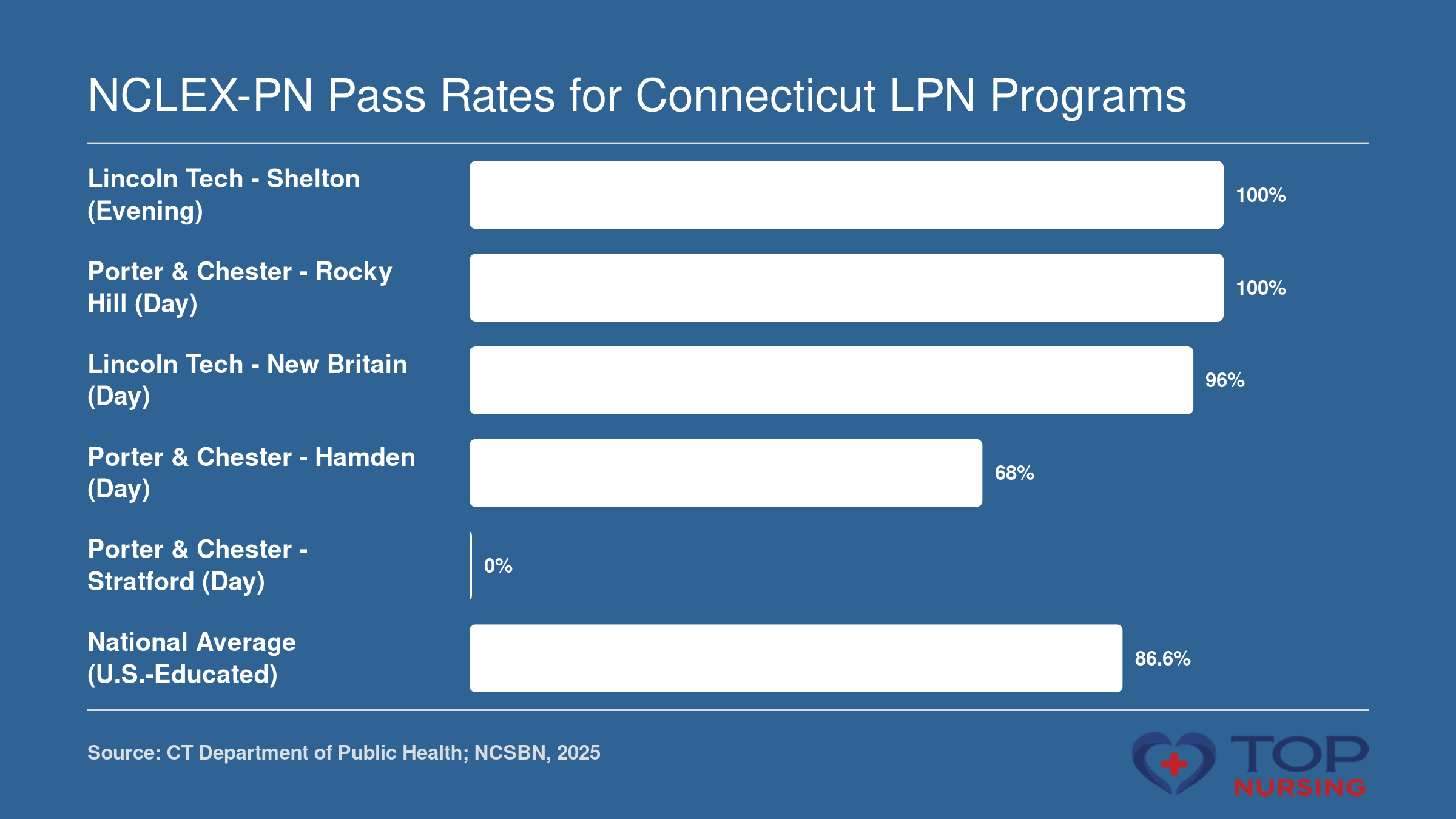
NCLEX-PN Pass Rates for Connecticut LPN Programs
NCLEX-PN first-time pass rates directly measure whether a program's graduates are prepared to meet the minimum competency standard for entry-level nursing practice. Because the exam is standardized nationally, pass rates offer an objective comparison of program outcomes that is not swayed by local grading policies or reputation. High pass rates signal strong curriculum, effective clinical training, and student support systems.
LPN Program Costs and Financial Aid in Connecticut
What Drives the Cost of an LPN Program in Connecticut?
Tuition for practical nursing programs in Connecticut can range widely depending on the type of school. Public community colleges, like those in the CT State system, often offer the lowest per-credit rates, while private vocational schools may charge more but promise accelerated formats. Beyond tuition, factor in uniforms, books, NCLEX-PN exam fees, and any background checks or immunization requirements. Many students offset these costs through a mix of federal aid (start with the FAFSA), state grants, and employer assistance.
State-Specific Financial Aid That LPN Students Often Miss
Connecticut offers several financial aid resources tailored to healthcare students. The Roberta B. Willis Scholarship, administered by the Connecticut Office of Higher Education, provides need-based grants to state residents enrolled in eligible nursing programs. Eligibility criteria and application steps are updated annually on the Office of Higher Education website, so checking there directly is a smart early move. The CT Health Horizons Scholarship Fund is another targeted option for students from qualifying Alliance towns who demonstrate high financial need. These state-level programs can significantly reduce out-of-pocket costs, but deadlines are strict, verify for the 2026-2027 aid year as soon as possible.
Tapping Workforce Grants and Hospital Tuition Assistance
Employer-sponsored tuition programs are a valuable but under-utilized path. Major healthcare systems like Yale New Haven Health and Hartford HealthCare frequently offer tuition reimbursement or upfront sponsorship for employees pursuing LPN licensure. These arrangements often come with a service commitment, but they can cover a substantial portion of program costs. Additionally, the Connecticut Department of Labor often funds workforce development grants aimed at high-demand fields like nursing. Contact financial aid offices at your target LPN program directly, they maintain current lists of these grants and can guide you on eligibility.
Scholarships Through Professional Nursing Groups
Professional nursing associations are another funding source that many applicants overlook. The Connecticut Nurses Foundation offers a scholarship for associate-degree nursing students who are Connecticut residents; selection is based on scholastic ability, professional promise, and financial need. Even if you plan to earn a diploma or certificate, you can ask the foundation about any updates for practical nursing pathways. The Connecticut League for Nursing and the Connecticut Nurses’ Association also maintain scholarship listings and financial aid guidance, so visiting their websites or reaching out directly can uncover opportunities you won’t find elsewhere.
Putting Together a Financial Aid Plan
Start by completing the FAFSA to unlock federal Pell Grants and student loans. Then layer on state aid by checking the Roberta B. Willis Scholarship portal and the CT Health Horizons timeline. Simultaneously, contact the financial aid office at every program you’re considering, they can flag workforce grants, payment plans, and hospital partnerships. If you’re already working in healthcare, ask your employer’s HR department about tuition benefits. By combining multiple small awards, an LPN education becomes far more affordable than the sticker price suggests.
Program Length, Format, and Clinical Hours Compared
Most Connecticut LPN programs span 15 to 28 months, with no approved program currently offering a fully online or 12-month fast-track option. The time you invest depends on whether you attend full-time or part-time, and each school structures its schedule differently.
Program Duration at a Glance
CT State Community College: 15–16 months (full-time day)
Porter and Chester Institute: 15 months (residential, in-person)
Goodwin University: 16–28 months (full-time or part-time)
CT State’s 54-credit, 1,500-clock-hour curriculum packs didactic and clinical training into a concise full-time track. Porter and Chester’s residential program also targets a 15-month finish. Goodwin’s wider 16–28 month range reflects its part-time evening option, which lets working students spread coursework over additional semesters. No Connecticut LPN program currently advertises a 12-month completion path; the fastest you can expect is approximately 15 months of continuous full-time enrollment.
Delivery Formats: In-Person and Scheduling Options
Every CT DPH-approved LPN program is delivered primarily in person. Nursing skills labs, simulation exercises, and direct patient contact require hands-on participation that cannot be replicated online. Goodwin University does offer both day and evening sections, giving students some flexibility, but the core instruction remains face-to-face. CT State and Porter and Chester operate on traditional weekday schedules. While hybrid or fully remote options are rare at the LPN level nationwide, Connecticut’s clinical hour mandates reinforce the need for on-site attendance, so plan your work and family commitments around a consistent in-person routine.
Clinical Hour Requirements
Clinical training is the backbone of any practical nursing program. CT State Community College’s curriculum, for example, encompasses 1,500 total clock hours, a figure that includes both classroom theory and supervised patient-care experiences in hospitals, long-term care facilities, and clinics. Most other programs follow a similar breakdown, devoting roughly half of program hours to clinical rotations. The exact hour count varies by school, but all must meet minimum standards set by the Connecticut Department of Public Health to ensure graduates are ready for the NCLEX-PN and entry-level practice. Expect to spend several hundred hours on direct patient care before you graduate.
Admission Requirements for CT LPN Programs
What do I need to apply to an LPN program in Connecticut? Admission requirements vary by school, but most programs share a foundation of prerequisites, entrance exams, and background checks. Before you start an application, it helps to understand the typical expectations and the specific demands of the programs you are targeting.
Common Prerequisites Across CT LPN Programs
Almost every approved LPN program in Connecticut requires applicants to hold a high school diploma or GED and be at least 18 years old. A minimum cumulative GPA of 2.5 is a widespread baseline, though some programs set the bar higher. You will also need to pass a criminal background check and a drug screening before clinical placements begin, as these are mandated by healthcare facilities. Many programs mandate that prerequisite courses be completed with a grade of C or better, so plan your coursework accordingly.
Program-Specific Requirements
Requirements can differ significantly between schools. Below are the current admission standards for two well-known CT options.
CT State Community College (Norwalk / Quinebaug Valley)
Exam: TEAS with a minimum composite score of 58.7% (2025-2026 cycle).
GPA: Minimum 2.70 cumulative.
Prerequisites: You must complete ENG 1010 (English), BIO 2111 (Anatomy & Physiology I), and MAT 1200 (Statistics or a higher math) before applying.
Deadline: Applications are due February 1 for the next academic year.
Porter and Chester Institute (Hamden / Waterbury)
Exam: Both the Wonderlic and the TEAS are required. Specific score cutoffs are not always published, so check directly with the admissions office.
GPA and Coursework: The institute evaluates each applicant’s transcript for readiness, and while a high school diploma is required, they may consider relevant college coursework.
Other DPH-approved programs may have their own exam preferences. Some use the HESI exam instead of or in addition to the TEAS. Since waitlists are common, submitting a complete application early is essential. Always verify the latest requirements on each school’s admissions webpage, as cutoffs and prerequisites can shift annually.
What LPNs Actually Earn in Connecticut
Most recent Bureau of Labor Statistics figures show Licensed Practical Nurses in Connecticut earning a median annual salary of $69,130, with the middle 50% ranging from $64,760 to $77,170. These statewide numbers provide a baseline, but wages do vary by metro area; for example, LPNs in the Hartford or Bridgeport-Stamford regions may see different pay scales. Also note that early-career earnings from the College Scorecard may look different because those data capture all program completers, not only those who end up working as LPNs.
Measure
Connecticut LPNs
25th Percentile
$64,760
Median
$69,130
75th Percentile
$77,170
Average (Mean)
$70,240
Estimated Employment
8,890
LPN Job Outlook and Career Growth in Connecticut
Job outlook measures more than the number of open positions; it reflects the stability of the field, long-term demand, and the pathways available to advance once you begin working. In Connecticut, practical nursing continues to offer a solid career foundation, with multiple industries hiring LPNs and a clear infrastructure for professional growth.
Demand for LPNs in Connecticut
State-specific growth projections for licensed practical nurses have not yet been released by the Connecticut Department of Labor. However, national trends provide useful context: the U.S. Bureau of Labor Statistics projects a 3% increase in LPN employment from 2024 to 2034, which translates to roughly 54,400 annual openings nationwide, mostly from the need to replace workers who retire or leave the field. Connecticut’s aging population is a powerful local driver. As more residents require long-term care, rehabilitation, and home-based services, demand for LPNs in those settings is expected to stay strong, even if overall growth rates appear modest.
Where LPNs Work in Connecticut
The employment landscape is shaped heavily by acute care. General hospitals employ 46.2% of the state’s LPNs, with an additional 7.1% working in state and teaching hospitals, pushing the hospital sector above 53%. Physician offices account for another 7.7% of LPN jobs. While nursing care facilities (5.8%) and home health services (4.8%) represent smaller shares, these sectors are especially relevant to an aging population and often actively recruit LPNs to manage chronic conditions and post-acute care. Outpatient care centers employ about 4.9% of Connecticut LPNs, rounding out a mix of settings that gives nurses flexibility in choosing a work environment.
Is LPN a Dead-End Job? Not in Connecticut
The idea that an LPN role limits your career is not supported by the opportunities available. LPNs can pursue specialty certifications in areas like IV therapy, wound care, and gerontology, increasing their value and earning potential. The most substantial career ladder, however, is the LPN-to-RN bridge pathway. These programs build directly on practical nursing education, allowing you to transition to registered nursing without repeating prerequisite coursework. Connecticut’s growing population of older adults ensures that LPNs remain essential, particularly in long-term care and home health, where the practical nursing scope aligns closely with patient needs. Far from a dead end, an LPN credential in Connecticut serves as both a stable career and a gateway to higher nursing roles.
From LPN to RN: Your Next Step
Many Connecticut schools offer bridge programs designed specifically for working LPNs, often with part-time or evening formats that let you continue earning while you study. The next section walks through the LPN-to-RN options available in the state and what you can expect from the admission process.
From LPN to RN: Bridge Programs in Connecticut
Starting an RN program from scratch can take two to three years, but for licensed practical nurses, Connecticut offers accelerated bridge paths that shave months off that timeline and instantly boost earning power. Instead of repeating fundamentals they already know, LPNs receive credit for their license and clinical experience, stepping directly into advanced nursing courses.
CT State Community College ADN Bridge
The Associate of Science in Nursing (ADN) program at CT State Community College welcomes LPNs as advanced placement candidates. After completing two bridge courses, NUR*1150 (online theory) and NUR*1152C (in-person clinical), qualified LPNs enter the ADN program in the third semester. This cuts the total time to RN by roughly a year compared with traditional entry. Admission requires TEAS scores and runs from October 1 through February 1. The program blends on-ground and hybrid formats, offering schedule flexibility.
Albertus Magnus LPN-to-BSN
For LPNs aiming higher, Albertus Magnus College launched Connecticut’s first LPN-to-BSN pathway in January 2025. The 36-month bachelor’s program uses a blended model: evening in-person classes paired with online coursework. Applicants need a minimum 3.0 overall GPA (2.75 in LPN coursework) and must pass the NACE exam with subject-specific cut scores. The curriculum builds on existing clinical skills while adding leadership, research, and public health training, all without repeating introductory nursing content.
Charter Oak Articulation Bridge
Charter Oak State College offers an online LPN-to-RN Articulation Bridge Course that isn’t a standalone RN program, but a transfer-friendly credit-bearing course designed to ease the shift into partner RN programs. LPNs who complete it satisfy core prerequisites and demonstrate readiness for upper-division nursing coursework, often reducing time-to-degree further.
Salary Return and Next Steps
Upgrading from LPN to RN brings a substantial pay bump. According to the Bureau of Labor Statistics, Connecticut RNs earn a median salary significantly above LPNs, with the gap often exceeding $30,000 per year. Over a career, that extra income can exceed half a million dollars. The return on a semester or two of bridge courses is hard to ignore.
Once you have your RN license, continuing toward a BSN unlocks management and specialty roles. The site’s RN and BSN program pages lay out everything from accelerated BSNs to online degree completion options, helping you map your next move.
Frequently Asked Questions About LPN Programs in Connecticut
Choosing the right LPN program in Connecticut raises plenty of questions. Below we tackle the most common ones so you can compare options with confidence.
Who has the best nursing program in CT?
Best depends on your priorities. Some programs excel in NCLEX-PN pass rates, while others offer faster completion or lower tuition. For 2026, schools like Porter and Chester Institute and Lincoln Technical Institute often rank high for their strong clinical partnerships and graduate employment rates. Check our rankings above for detailed breakdowns.
What is the highest paying LPN salary in CT?
According to the latest Bureau of Labor Statistics data (national, not state-specific), the top 10% of LPNs earn over $63,000 annually. In Connecticut, wages are typically higher than the national median. Experienced LPNs in specialized settings such as nursing homes or home health can earn above $65,000 per year.
How long does it take to become an LPN in Connecticut?
Most certificate or diploma programs take 12 to 18 months of full-time study. Some schools offer accelerated tracks that can be completed in as little as 12 months. Part-time options may extend to 24 months. After graduation, you must pass the NCLEX-PN exam to obtain your license.
How much does LPN school cost in Connecticut?
Tuition varies widely. Community college programs may cost $5,000 to $10,000, while private career schools can range from $15,000 to $30,000. Additional expenses include uniforms, textbooks, and exam fees. Financial aid, scholarships, and payment plans are often available. Look for accredited programs to ensure federal aid eligibility.
Are there online LPN programs in Connecticut?
LPN training requires hands-on clinical hours, so fully online programs are not available. However, some schools offer hybrid formats where theory coursework is online, and labs and clinicals are completed in person. This flexibility can help working students, but you still need to attend on-campus components regularly.
Is LPN a dead-end job?
No. LPNs are in steady demand in long-term care, rehabilitation, and home health settings. Many LPNs use their license as a stepping stone to become an RN through bridge programs, which often build on existing knowledge and can be completed in as little as 12 to 18 months. It is a valued role with advancement potential.
What is the difference between full and conditional approval for CT nursing programs?
The Connecticut Department of Public Health grants full approval to programs that consistently meet all standards, including NCLEX pass rates and curriculum requirements. Conditional approval indicates the program is under review or must address deficiencies but is still allowed to enroll students. Graduates from conditionally approved programs are still eligible to sit for the NCLEX-PN.