Top LPN Programs in Colorado: 2026 Rankings & Guide

Compare tuition, NCLEX pass rates, program length, and outcomes for every accredited Colorado LPN school.

By Hannah Pierce, BSNReviewed by TopNursing.org TeamUpdated May 29, 202624 min read
Top LPN Programs in Colorado (2026 Ranked & Compared)

Points of interest…

  • Colorado LPN programs can be completed in as few as 14 months including NCLEX-PN preparation.
  • Employment for LPNs in Colorado is projected to grow 13 percent between 2022 and 2032.
  • The state's top 10 percent of LPNs earn over $80,000 yearly exceeding the national median.
  • Program level graduate earnings are not yet published so the statewide median serves as a benchmark.

Colorado’s expanding healthcare footprint makes the LPN credential one of the fastest, most affordable nursing entry points in the state. These affordable LPN programs have net prices after aid that stretch from Lamar Community College’s $9,161 to Colorado Mesa University’s $15,103, and most can be completed in under 14 months, putting a practical nursing career within reach even for students who need to work while training.

Program formats split between daytime and evening schedules, rural and metro locations, and admission standards that range from open enrollment to competitive prerequisites. Because NCLEX-PN pass rates and graduate earnings vary sharply across schools, a quick cost comparison alone can mislead. Colorado’s 13% projected LPN job growth through 2032 rewards graduates who enter the field, but only programs with strong clinical preparation translate that demand into a lasting foothold in nursing.

2026 Best LPN Programs in Colorado, Ranked

This ranking evaluates Colorado LPN programs based on net price, graduation rates, graduate earnings, and program strengths.

Factors considered
  • Net price affordability
  • School-wide graduation rate
  • Graduate earnings potential
  • Pell Grant accessibility
  • Program format and features
Data sources
RankSchoolLocationNet priceBest for
#1
Trinidad State College
Trinidad, CO$10,000 – $15,000/yrRural students needing evening/weekend options

Trinidad State College, a public institution with campuses in Trinidad and Alamosa, charges a net price of $10,772 and serves a student body where 83.9% receive Pell Grants. The school's overall graduation rate is 54.5%, and median graduate earnings are $36,475. The Practical Nursing program offers an evening/weekend schedule, a one-year PN exit option, and pathways to ADN and BSN degrees.

Practical Nursing — On-Campus
  • ACEN-accredited one-year certificate
  • 39 credit hours, $175 per credit
  • Preps for NCLEX-PN with med-surg and maternal-child clinicals
  • Evening/weekend schedule available at Trinidad campus
  • PN exit option: sit for boards after summer course
  • Stacks into ADN and dual-enrollment BSN pathway
  • Scholarships like San Rafael Hospital Nursing Scholarship available
  • Two campus locations: Trinidad and Alamosa

Colorado Mesa University, a public university in Grand Junction, has a net price of $15,103 and a Pell share of 58.7%. The institution's graduation rate is 40.6%, and median graduate earnings are $45,823, the highest among ranked Colorado LPN providers. Its Practical Nursing Technical Certificate is a university-based program with a March 1 deadline, running August to May, and reports strong NCLEX pass and job placement rates.

Practical Nursing (Technical Certificate) — On-Campus
  • Campus-based program starting in August, ending by May
  • March 1 application deadline
  • Focuses on direct patient care and evidence-based practice
  • High NCLEX pass rate reported
  • High job placement rate for graduates
  • College-level reading and writing skills required
  • Tuition details available on university website

Front Range Community College, located at the Larimer Campus in Westminster, is a public institution with a net price of $13,031 and a Pell share of 68.2%. The school's overall graduation rate is 35.5%, while median graduate earnings stand at $45,910. The Practical Nursing Certificate is a competitive three-semester program featuring hands-on training in modern labs and a documented high NCLEX-PN pass rate.

Practical Nursing Certificate — On-Campus
  • Three-semester, full-time campus program at Larimer Campus
  • Prepares for NCLEX-PN with high documented pass rate
  • Hands-on training in state-of-the-art nursing labs
  • Competitive admission process based on prerequisites
  • Clinical rotations in varied healthcare settings
  • Part of FRCC's broader nursing education ladder

Arapahoe Community College in Littleton, a public institution, offers a net price of $11,571 and serves a student body where 64.7% receive Pell Grants. The college's overall graduation rate is 29.1%; however, median graduate earnings are $48,341, the highest in this ranking. The Practical Nursing Certificate is an alternative pathway requiring acceptance into the RN program, with a 3.0 GPA prerequisite and a summer transition course.

Practical Nursing Certificate — On-Campus
  • 47-credit certificate requiring RN program acceptance first
  • 3.0 GPA minimum in prerequisite courses
  • Covers med-surg, pharmacology, maternal-child nursing
  • Summer transition course (NUR 169) bridges into clinicals
  • Prepares for NCLEX-PN exam
  • Financial aid available to eligible students
  • Alternative nursing pathway with stackable design

Lamar Community College, a public institution in Lamar, provides the lowest net price at $9,161 among ranked programs, with a Pell share of 79%. The school's institution-wide graduation rate is 54.7%, and median graduate earnings are $38,719. Its Practical Nursing Option is approved by the Colorado State Board of Nursing and includes hands-on clinical experiences, with competitive admissions requiring prerequisites and a minimum GPA.

Practical Nursing Option (PN) — On-Campus
  • Colorado State Board of Nursing approved program
  • Prepares for NCLEX-PN with hands-on clinical experiences
  • Competitive admission: prerequisite coursework and minimum GPA required
  • Financial aid and scholarships may be available
  • Comprehensive curriculum focusing on patient care skills
  • Located in Lamar, serving southeastern Colorado

Otero College, a public institution in La Junta, has a net price of $11,103 and a very high Pell share (84.1%). The school-wide graduation rate is 38.1%, and median graduate earnings reach $39,018. The Practical Nursing certificate is a two-semester program aligned with the Colorado Nursing Articulation Model, requiring a 2.5 GPA and providing hands-on clinical training, with the option to stack into advanced nursing programs.

Practical Nursing LPN (cert) — On-Campus
  • Two-semester certificate aligned with Colorado Nursing Articulation Model
  • Prepares for state licensure exam (NCLEX-PN)
  • Hands-on clinical training in medical-surgical nursing
  • Requires 2.5 GPA in prerequisite biology and anatomy courses
  • Stacks into advanced nursing programs at Otero
  • Small class sizes with 14:1 student-faculty ratio

Pueblo Community College, a public institution with its LPN program at the Mancos campus, posts a net price of $12,045 and a Pell share of 84.7%. The institution's overall graduation rate is 30.7%, and median graduate earnings are $37,434. The Practical Nursing certificate features selective admissions, simulation labs, clinical rotations across multiple settings, and ACEN accreditation.

Practical Nursing (LPN Certificate) — On-Campus
  • ACEN-accredited, 43-credit certificate at Mancos campus
  • Selective admissions process; starts in fall only
  • Prepares for NCLEX-PN exam
  • Clinical rotations in hospitals, clinics, and long-term care
  • Simulation labs with experienced faculty from OB, pediatrics, critical care
  • Daytime course schedule; THC drug screening required
  • Focuses on adult, geriatric, obstetric, and psychiatric nursing

How Much Do Colorado LPN Programs Cost?

LPN program costs in Colorado vary between community colleges and public universities. The table below shows in-state and out-of-state tuition, the estimated net price after financial aid, and median debt for graduates. Comparing these figures can help you understand the true cost of attendance.

SchoolIn-State TuitionOut-of-State TuitionNet PriceMedian Graduate Debt
Lamar Community College$4,550$7,260$9,161$8,750
Trinidad State College$4,608$7,318$10,772$8,908
Otero College$4,576$7,286$11,103$10,250
Arapahoe Community College$4,434$17,034$11,571$11,884
Pueblo Community College$5,049$17,649$12,045$10,000
Front Range Community College$4,663$17,263$13,031$12,251
Colorado Mesa University$9,927$25,124$15,103$22,000

Questions to Ask Yourself

Colorado LPN programs vary widely in schedule flexibility. If you work full-time or have family commitments, you may need evening or weekend classes, but many programs still run primarily on weekdays. Clinical rotations almost always take place during daytime hours, so plan accordingly.

Clinical sites are often hosted at healthcare facilities across the state, and some programs place students up to an hour away. A longer commute adds both time and expense to your day, so factor in travel when choosing a school, especially if you live outside the Front Range.

Tuition at LPN programs in Colorado ranges from about $5,000 to over $30,000. If you rely on federal aid like Pell Grants, look for schools that enroll a high percentage of Pell-eligible students; they tend to offer more resources for financial navigation and support.

Program Length, Format & Schedule Options

What schedule can you expect in a Colorado LPN program? Whether you need to work full-time or want to finish quickly, the available options matter as much as the curriculum. Colorado LPN programs vary in length, time commitment, and delivery style. Choosing one that fits your life is often the first big decision.

How Long Does It Take to Become an LPN in Colorado?

Most accredited LPN programs in Colorado take between 12 and 18 months to complete1, with total credit hours typically falling in the 39- to 53-credit range. A traditional full-time schedule mirrors a college semester system, while accelerated formats can trim the timeline slightly.

  • Trinidad State College: 1-year program, 39 credit hours
  • Pueblo Community College: 43 credit hours, typically completed in 12 months
  • Otero College: Two-semester certificate, often finished in about 10 months
  • Colorado Mesa University: Structured as a technical certificate running from August to May

Shorter programs like the one at Otero College pack the same clinical and didactic requirements into fewer months, which can mean a more intense weekly schedule. If you need a slower pace, ask about part-time tracks. Several community colleges extend the program length for students who take fewer credits per term.

What Schedule Formats Are Available?

The daily routine varies by school, and not every campus offers evening or weekend options. Among our ranked programs, the clearest schedule offerings include:

  • Pueblo Community College: Full-time day classes and an extended evening/weekend track designed for working students.
  • Trinidad State College: Traditional daytime sections plus evening/weekend cohorts at both the Trinidad and Alamosa campuses.
  • Front Range Community College: A three-semester, primarily daytime program with clinical rotations scheduled during weekdays.
  • Arapahoe Community College, Lamar Community College, Otero College, and Colorado Mesa University: These programs generally follow a full-time day schedule, though limited part-time or evening slots may open depending on cohort size.

If daytime attendance is impossible because of work or family obligations, focus your search on schools like Trinidad State and Pueblo Community College, which explicitly build flexible pathways into their scheduling.

In-Person vs. Hybrid: What’s the Learning Environment Like?

Because hands-on skill development and supervised clinical experiences are central to LPN training, every Colorado program relies heavily on in-person instruction. Didactic coursework, such as pharmacology, anatomy, and nursing theory, is sometimes delivered in a hybrid format that mixes online lectures with on-campus labs. Pueblo Community College lists in-person or hybrid options for lecture portions, and Trinidad State structures its program similarly. Even when hybrid elements exist, you should expect to be on campus or at a clinical site several days each week.

Clinical Hours and Hands-On Training

Colorado LPN programs require between 450 and 600 hours of direct patient care in clinical settings before you can sit for the NCLEX-PN1. These hours are spread across medical-surgical units, long-term care facilities, pediatric offices, and other partner sites. All of the ranked schools schedule clinical rotations at facilities throughout their regions. For instance, Pueblo Community College places students in multiple settings across southern Colorado, and Otero College coordinates experiences in La Junta and nearby communities. Because rotations may be at sites that are not on campus, you should plan for a reliable commute and possibly some travel, especially if you live outside a metro area.

Admission Requirements Compared

Choosing an LPN program often hinges on a tradeoff: schools with rigorous prerequisites tend to offer deeply structured preparation, while more flexible admission paths can get you into the classroom quickly. In Colorado, each institution sets its own bar, so parsing the details early prevents surprises down the line.

Prerequisite Courses and Academic Readiness

Some Colorado programs expect a strong science foundation before you apply. Emily Griffith Technical College requires Anatomy & Physiology, Medical Terminology, and a CNA or MA credential, using a portfolio-based review rather than a fixed GPA cutoff.1 Concorde Career Institute asks for Biology, Chemistry, and Mathematics at the high school or college level. Other schools like Pickens Technical, Pueblo Community College, IBMC, and IntelliTec College may not publish standalone prerequisite lists, but typical expectations include a high school diploma or GED, a minimum GPA (often 2.0 to 2.5), and courses in algebra and biology. Many programs also require or strongly recommend a certified nursing assistant (CNA) license before applying, as it confirms hands-on aptitude.

Entrance Exams and Testing

Standardized exams serve as a common academic filter. Emily Griffith uses the ATI TEAS in 2026, assessing reading, math, science, and English.1 Concorde administers its own entrance exam in reading, math, and English instead of a national test. For other Colorado LPN programs, the HESI or TEAS is typical, though exact cut scores vary. If testing is a barrier, ask about retake policies or preparation resources.

Background Checks, Drug Screening, and CPR

Because clinical rotations place you in hospitals and long-term care facilities, nearly every Colorado LPN program mandates a criminal background check and drug screen. Emily Griffith explicitly lists both as admission requirements.1 CPR certification is another near-universal expectation: some schools require it for admission, others let you complete it during the first term. Check the timeline so you can budget both time and cost.

Application Deadlines and Timelines

Deadlines differ sharply. Concorde operates on a rolling basis, accepting applications year-round until seats fill. Emily Griffith’s portfolio process may not follow a strict date, but early submission is still wise.1 Schools like Pueblo Community College and Pickens Technical often have firm fall or spring start dates, with deadlines months in advance. Since many programs fill quickly, submitting a complete application early gives you the best chance. Always confirm current deadlines on each school’s website, as they can shift.

NCLEX-PN Pass Rates & Program Outcomes

Comparing pass rates across Colorado LPN programs reveals stark differences in exam readiness, but outcomes go beyond a single test score. A high NCLEX-PN pass rate signals strong foundational training, yet it tells only part of the story. Long-term earnings and job placement speak to a program's ability to launch sustainable nursing careers, and the picture varies considerably from one school to the next.

NCLEX-PN Pass Rates: What's Available

The most reliable indicator of a program's classroom and clinical preparation is its first-time NCLEX-PN pass rate, and the strongest applicants look at two to three years of data to spot consistent performance. For 2025, the national first-time pass rate for US-educated practical nursing candidates sits at 86.6%, up from 79.93% in 2022. These benchmarks are useful, but school-level rates for Colorado in recent years are not compiled in a single public dashboard for this guide. The Colorado Board of Nursing and NCSBN release annual reports, and many programs publish their own rates. When you evaluate a school, ask for its pass rates from 2023 through 2025 and compare them directly to that 86.6% national figure. A program that consistently falls below 80% deserves extra scrutiny, while one that hovers near or above the national average suggests a solid curriculum and effective clinical placements.

Earnings and Employment Outcomes

Federal data sources do not yet break out median earnings specifically for LPN program completers at the campus level. What is available, however, is institutional-level earnings data, which offers a rough proxy for the economic return a college delivers to its students overall. The Department of Education tracks median annual earnings of former students ten years after they first enroll. Across the seven ranked Colorado schools, that figure ranges from $36,475 at Trinidad State College to $48,341 at Arapahoe Community College. Front Range Community College ($45,910) and Colorado Mesa University ($45,823) fall in a similar upper tier, while Otero College ($39,018), Lamar Community College ($38,719), and Pueblo Community College ($37,434) show more modest long-term earnings. Remember, these numbers reflect all alumni, not just nursing graduates. Completion counts for LPN programs are not reported in the same dataset, so the size and throughput of each cohort remains unclear. Prospective students should contact schools directly for job placement rates and employer partnerships, which often paint a more accurate picture of career launch.

Why Pass Rates and Earnings Matter Together

A program with a stellar pass rate but weak local employer connections may still leave graduates hunting for jobs. Conversely, a school with slightly lower pass rates but strong clinical pipelines into major Denver-area hospitals or long-term care networks might offer faster entry into the workforce. When you compare these institutions, weight pass rates as a minimum threshold for licensure readiness, then dig into the less visible details: clinical rotation sites, career services support, and the share of graduates who find nursing work within six months. The modest spread in long-term earnings across these schools suggests that location and employer choice ultimately play a large role, but a program that aligns with your schedule, budget, and learning style will set you up for success both on exam day and in your first nursing role.

What Do Colorado LPNs Earn?

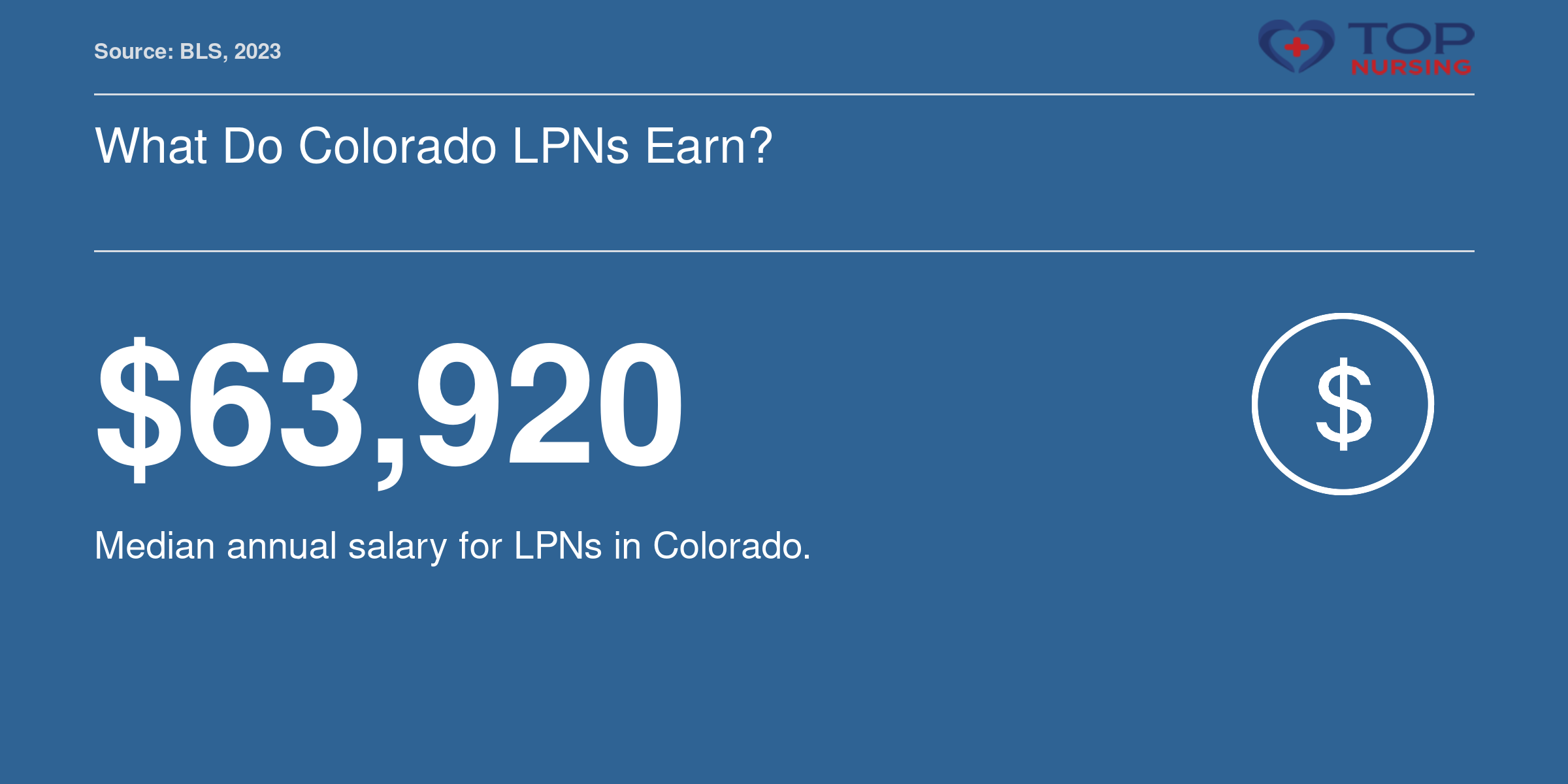
Program-level earnings one year after completion are not yet published for Colorado LPN schools. The statewide median provides a useful earnings benchmark while you compare programs.

Median LPN salary of $63,920 in Colorado, 2023, per BLS.

How to Become an LPN in Colorado

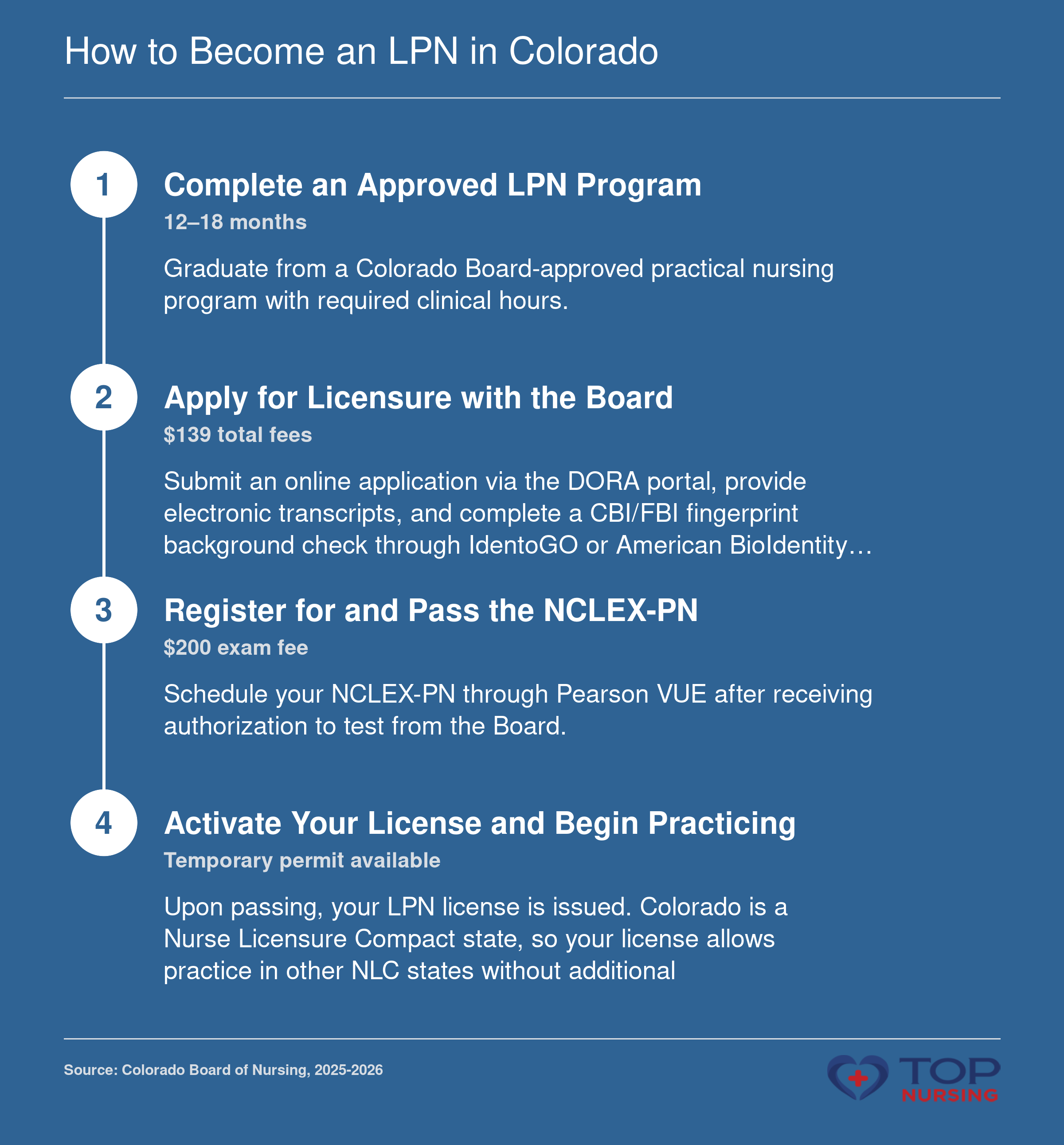
Becoming a licensed practical nurse in Colorado follows a clear path from classroom to career. The Colorado Board of Nursing oversees licensure, which requires completing an approved program, passing the NCLEX-PN, and clearing a fingerprint background check. As an NLC state, Colorado's LPN license also opens doors to practice across multiple states.

Four-step process to become an LPN in Colorado: complete approved program, apply to Board, pass NCLEX-PN, obtain license.

How to Become an LPN in Colorado: The Complete Process

Becoming a licensed practical nurse in Colorado follows a clear, state-defined pathway that can be completed in as little as 14 months. The process progresses from choosing an approved program to passing the NCLEX-PN and securing your license, with each step designed to ensure you are prepared for safe, effective practice.

Step 1: Select and Enroll in a CBON-Approved Program

Every LPN program in Colorado must hold approval from the Colorado Board of Nursing (CBON). Begin by comparing Colorado LPN programs that are approved and fit your location, schedule, and budget. Application materials typically include official high school or GED transcripts, a completed application form, and a nonrefundable fee. Many schools also require a pre-entrance exam such as the TEAS, along with proof of immunizations, a current CPR card, and a criminal background check. Some programs may ask for a short personal statement or letters of recommendation. Once accepted, you will complete classroom instruction and supervised clinical rotations covering fundamentals of nursing, pharmacology, maternal-child health, and medical-surgical nursing.

Step 2: Pass the NCLEX-PN Exam

After graduating from your program, you must register for the National Council Licensure Examination for Practical Nurses (NCLEX-PN) through Pearson VUE. The Colorado Board of Nursing will send you an Authorization to Test (ATT) once it verifies your eligibility. The ATT is valid for a limited window, usually 90 days, so schedule your exam promptly. Pearson VUE testing centers are available in Denver, Colorado Springs, and other locations across the state. To prepare, invest in a structured NCLEX-PN review course, use question banks from publishers like Saunders or UWorld, and take multiple practice exams. Many graduates complete 4 to 8 weeks of focused study before sitting for the exam.

Step 3: Apply for Licensure Through the Colorado Board of Nursing

After passing the NCLEX-PN, submit a licensure application through the CBON online portal. You will need to provide official transcripts sent directly from your nursing program, documentation of the completed background check, and payment of the application fee. The board processes applications on an ongoing basis, and you can check the status of your license online. New licenses are typically issued within two to four weeks after all documents are received and the NCLEX results are posted.

License Renewal and Compact Multistate Privileges

Colorado LPN licenses expire every two years, and you must renew through the CBON portal. The renewal process requires a fee and documentation of continuing competency, which can be met through practice hours, continuing education, or a combination. Colorado is a member of the Nurse Licensure Compact (NLC), so a Colorado LPN multistate license allows you to practice in over 40 other compact states without applying for additional licenses. This is a significant advantage for nurses who live near state borders or plan to travel for work.

Timeline: How Long Does It Take?

A full-time LPN program in Colorado generally takes 12 months to complete, followed by NCLEX preparation and licensing. If you begin a program in August, you could graduate the following August, pass the NCLEX by October, and start working as an LPN by November. The entire process from enrollment to employment typically falls within 14 to 20 months, depending on program length, exam readiness, and board processing times. Part-time or evening programs will extend the timeline, but they offer flexibility for students who need to work while attending school.

Colorado expects LPN employment to grow 13 percent between 2022 and 2032, outpacing the national average for all occupations and adding steady demand for new graduates across clinics, long-term care facilities, and home health settings.

LPN Salary & Job Outlook in Colorado

Licensed practical nurses in Colorado earn wages that often surpass the national median, with the top 10% exceeding $80,000 per year. The table below consolidates the most recent salary figures from the Bureau of Labor Statistics and industry compensation surveys. Keep in mind that wages vary by metropolitan area, employer, and years of experience.

Wage MetricValue
Mean annual wage (Colorado, 2024)$62,340
10th percentile annual wage (Colorado, 2024)$47,960
90th percentile annual wage (Colorado, 2024)$80,510
Average hourly wage (Colorado, 2025-2026)$25.57
Average annual wage (Colorado, 2025-2026)$70,820
National median annual wage (May 2023)$59,730

LPN to RN Advancement Pathways in Colorado

The leap from licensed practical nurse to registered nurse is a balancing act: understanding the LPN vs RN scope of practice can help you decide whether to prioritize a faster, more affordable ADN or invest in a BSN that opens doors to leadership and specialty roles. Colorado’s landscape offers both, but the right path depends on your timeline, budget, and long-term vision.

ADN Bridge Programs at Colorado Community Colleges

The most common entry point is an LPN-to-ADN bridge at a community college. These programs typically take 12 to 24 months and culminate in an Associate Degree in Nursing, qualifying you to sit for the NCLEX-RN. Notable options include:

  • Pueblo Community College: Offers an LPN-to-RN transition track with advanced standing; completion prepares you for RN licensure.
  • Front Range Community College: Provides a mobility option that recognizes prior LPN coursework and clinical hours.
  • Pikes Peak State College: Features a bridge pathway designed for working LPNs, with part-time and evening schedules available.

Because each program structures its admission and credit transfer differently, consult the Colorado Community College System (CCCS) site for an updated directory.

BSN Pathways and University Options

For nurses aiming at management, public health, or graduate school, a Bachelor of Science in Nursing (BSN) is the standard. Some Colorado universities accept LPN credits directly into a BSN program, though these are less common than ADN bridges.

  • University of Colorado (Anschutz Medical Campus): Offers a traditional BSN and an RN-to-BSN completion track; LPNs often first complete an ADN before enrolling.
  • Colorado State University (CSU): CSU-Pueblo’s nursing school may provide advanced standing for LPNs in its RN-to-BSN online program.
  • Metropolitan State University of Denver: Known for flexible RN-to-BSN pathways that build on prior ADN coursework.

When evaluating these programs, confirm how many LPN credits are accepted and whether the institution offers a direct LPN-to-BSN route or requires an intermediate RN step.

Articulation Agreements and Advanced Standing

A key advantage for Colorado LPNs is the network of articulation agreements between community colleges and universities. These formal partnerships grant credit for prior coursework and clinical experience, shortening time to degree. Look for language like “LPN to RN articulation,” “advanced standing,” or “career mobility” on a college’s nursing department page, especially for RN to BSN programs in Colorado. Such agreements can allow you to skip certain foundational courses, but renewal and specifics vary; always check for the current policy.

How to Verify Programs and Stay Current

With so many moving parts, start with the Colorado Board of Nursing’s list of approved pre-licensure nursing programs and review nursing schools in Colorado for additional program details. Professional organizations like the Colorado Nurses Association also publish guidance on career ladders and transfer policies. Finally, reach out directly to admissions advisors; they can clarify credit transfers, prerequisites, and any waiting lists.

Frequently Asked Questions About LPN Programs in Colorado

Below are answers to the most common questions prospective LPN students in Colorado ask. From program length and costs to licensure and salary expectations, find clear, concise information to guide your nursing education journey.

What are the top nursing schools in Colorado?
Several Colorado schools are well-regarded for their LPN programs, including Front Range Community College, Pueblo Community College, Emily Griffith Technical College, and Pickens Technical College. These programs are known for strong NCLEX-PN pass rates and hands-on clinical training. Always verify current accreditation and graduate outcomes directly with the school.
How long does it take to become an LPN in Colorado?
Most full-time LPN programs in Colorado take about 12 to 18 months to complete. Part-time and evening options may extend the timeline to 18 to 24 months. The length depends on the program structure, including prerequisites, classroom instruction, and supervised clinical rotations required for licensure.
How much do LPNs make in Colorado?
According to the U.S. Bureau of Labor Statistics, as of May 2024, LPNs in Colorado earned a median annual wage of $62,520, or about $30.06 per hour. Actual pay varies by location, experience, and work setting: the Denver metro area often reports higher wages than rural parts of the state.
Are there online LPN programs available in Colorado?
Fully online LPN programs are rare due to required in-person clinical hours. However, many Colorado schools offer hybrid formats where coursework is online and labs or clinicals are held on campus or at approved healthcare sites. This blend provides scheduling flexibility while meeting state licensure requirements.
Which LPN makes the most money?
LPNs in government facilities, nursing care facilities, and specialized roles like dialysis or IV therapy often earn higher wages. Geographic location also matters: metropolitan areas such as Denver and Boulder typically offer higher pay than rural regions. Experience and additional certifications can further increase earning potential.
What are the admission requirements for LPN programs in Colorado?
Typical requirements include a high school diploma or GED, a minimum GPA (often 2.5 or higher), completion of prerequisite courses like anatomy and biology, a current CPR certification, a background check, drug screening, and up-to-date immunizations. Some programs also require a passing score on the TEAS entrance exam.
How difficult is the NCLEX-PN exam?
The NCLEX-PN is a computer-adaptive test designed to measure entry-level nursing competency. While challenging, Colorado LPN programs consistently report pass rates above the national average when graduates prepare thoroughly. Using review courses and practice questions greatly improves first-attempt success.
Does Colorado participate in the Nurse Licensure Compact for LPNs?
Yes, Colorado is a member of the Nurse Licensure Compact (NLC). This allows LPNs with a multistate license from another compact state to work in Colorado without applying for a separate license. LPNs from non-compact states can still practice by applying for licensure by endorsement.

Recent Articles