Compare costs, NCLEX pass rates, program length, and outcomes for every approved Arkansas LPN program.
By Hannah Pierce, BSNReviewed by TopNursing.org TeamUpdated May 27, 202625+ min read
Points of interest…
Some Arkansas LPN programs can be completed in as few as 11 months.
First-attempt NCLEX-PN pass rates are the strongest indicator of program quality.
In-state tuition varies widely, with net price often lower after grants and scholarships.
Graduates can transition to RN through LPN-to-RN bridge programs, including fast associate degree options.
Which Arkansas LPN programs give you the strongest shot at passing the NCLEX-PN on the first try without piling on debt? The state’s aging population keeps demand for licensed practical nurses high, and its network of community colleges has responded with training pipelines that cost a fraction of private programs. Across 22 programs, the highest-rated schools thread a narrow needle: they keep tuition low while logging NCLEX pass rates above the national average and moving students from classroom to clinic in under a year. What makes that possible is a deliberate alignment between state board standards and program design: a reality that puts a reliable nursing career within reach for thousands of Arkansans.
2026 Best LPN Programs in Arkansas
Our rankings highlight Arkansas LPN programs that combine affordability, strong student outcomes, and proven preparation for the NCLEX-PN. Each school’s position reflects a balance of net price, completion data, and graduate earnings, with special attention given to programs recognized for exceptional licensure and job placement rates.
Factors considered
Net price for in-state students
Program completion data
Graduate earnings
NCLEX-PN pass rates
External recognition
Data sources
NCES-IPEDS federal institutional data — nces.ed.gov
Black River Technical College in Pocahontas offers a 10.5-month LPN program consistently ranked first in the state by independent evaluators. The program blends classroom learning, skills labs, and clinical rotations, with small class sizes and dedicated faculty. Graduates are prepared for the NCLEX-PN and benefit from articulation agreements for further education.
Phillips Community College of the University of Arkansas
Helena, AR
$3,000 – $5,000/yr
Outcome-driven students wanting licensure success
Phillips Community College offers a Practical Nursing Technical Certificate on its DeWitt and Helena-West Helena campuses, serving the Arkansas Delta. The program boasts a 100% first-time NCLEX-PN pass rate and a 100% job placement rate, making it one of the most reliable pathways to licensure. Students receive hands-on clinical training and benefit from small cohorts and dedicated faculty support.
Criminal background check and drug testing required
#3
University of Arkansas Community College Rich Mountain
Mena, AR
$5,000/yr
Budget-conscious students wanting low net price
University of Arkansas Community College Rich Mountain in Mena provides an 11-month LPN program with the lowest net price on our list. Approved by the Arkansas State Board of Nursing, the program combines classroom and clinical experiences, preparing students for the NCLEX-PN. With a median graduate debt of just $6,500, it offers strong value for budget-conscious students.
East Arkansas Community College in Forrest City offers a Technical Certificate in Practical Nursing with just 39 credits needed to sit for the NCLEX-PN. The program is approved by the Arkansas State Board of Nursing and emphasizes therapeutic communication, cultural competence, and safe patient care. With a 70% retention rate and 10:1 student-faculty ratio, students receive strong support throughout their studies.
Focus on therapeutic communication and safe patient care
Technical Certificate in Practical Nursing awarded
Prepares for LPN licensure exam
#5
Cossatot Community College of the University of Arkansas
De Queen, AR
~$4,000/yr (est.)
Cossatot Community College of the University of Arkansas in De Queen offers a flexible LPN program with an 11-month day track or 18-month evening track. Approved by the Arkansas State Board of Nursing, the program features clinical experiences, competitive admission, and scholarship opportunities. Graduates earn a median $33,775 ten years after enrollment, reflecting strong long-term value.
Arkansas Northeastern College in Blytheville provides a Technical Certificate in Practical Nursing emphasizing direct patient care and theory-based practice. Located in the northeast corner of the state, the program serves students near the Missouri and Tennessee borders. It is approved by the Arkansas State Board of Nursing and prepares graduates for the NCLEX-PN in a fast-track format.
Technical Certificate in Practical Nursing — On-Campus
University of Arkansas Community College-Batesville
Batesville, AR
$8,000/yr (net price)
University of Arkansas Community College-Batesville stands out for its 65.9% institution-wide graduation rate and 70% retention rate, well above average for community colleges. The LPN Technical Certificate combines classroom learning with clinical experience and meets Arkansas State Board of Nursing standards. Graduates have a median debt of $10,250 and median earnings of $33,706, offering solid returns.
Combines classroom learning with clinical rotations
Meets Arkansas State Board of Nursing standards
Eligible for NCLEX-PN upon completion
Technical Certificate in Practical Nursing
Financial aid available for qualifying students
Campus-based program with strong retention rates
#8
Southern Arkansas University Tech
Camden, AR
~$9,000/yr (est.)
Southern Arkansas University Tech in Camden offers a stackable Practical Nursing certificate with high graduate earnings ($36,376 median). The program includes simulation labs, skills labs, and clinical rotations, and it maintains a competitive admission process requiring the TEAS exam. SAU Tech's 11:1 student-faculty ratio ensures personalized attention.
In-person instruction with simulation and skills labs
Stackable credentials: LPN to RN pathway
Approved by Arkansas State Board of Nursing
TEAS entrance exam required
Prerequisite courses required
Application deadline June 2, 2026
Prepares for NCLEX-PN exam
Career opportunities in clinics, hospitals, and long-term care
#9
University of Arkansas Hope-Texarkana
Hope, AR
$9,000/yr
University of Arkansas Hope-Texarkana provides a Technical Certificate in Practical Nursing with clinical rotations at regional healthcare agencies. Students can attend classes in Hope or Texarkana, making it accessible for southwest Arkansas residents. The program is approved by the Arkansas State Board of Nursing and prepares graduates for diverse entry-level nursing roles.
Technical Certificate in Practical Nursing — On-Campus
Clinical rotations at regional healthcare agencies
Limited readmission policy
Technical Certificate in Practical Nursing
#10
Arkansas State University-Newport
Newport, AR
$8,000/yr
Arkansas State University-Newport offers a practical nursing certificate on three campuses (Newport, Jonesboro, Marked Tree) with spring and fall starts. The 11-month program requires a minimum NEX exam score of 130 and includes clinical rotations in hospitals and long-term care settings. Graduates report the highest median earnings among all programs listed ($41,524), demonstrating strong career outcomes.
Clinical rotations in hospitals and long-term care
Financial aid and scholarships available
Prepares for NCLEX-PN licensure
Highest median graduate earnings among listed programs
LPN Program Cost Comparison in Arkansas
The cost of an LPN program in Arkansas varies significantly by institution. In-state tuition and net price (what students typically pay after grants and scholarships) are shown below for 2026 data from IPEDS and College Scorecard.
School
In-State Tuition
Out-of-State Tuition
Net Price
Cossatot Community College of the University of Arkansas
$4,740
$5,190
$4,385
University of Arkansas Community College Rich Mountain
$4,032
$4,272
$4,842
Phillips Community College of the University of Arkansas
$3,800
$4,550
$4,848
Black River Technical College
$4,776
$7,488
$5,095
Arkansas Northeastern College
$2,850
$4,250
$5,375
NorthWest Arkansas Community College
$4,926
$5,238
$7,196
East Arkansas Community College
$3,630
$4,380
$7,220
South Arkansas College
$3,684
$5,532
$7,486
University of Arkansas Community College-Batesville
$4,014
$4,662
$8,044
Arkansas State University Three Rivers
$3,788
$4,388
$8,070
Arkansas State University-Newport
$3,312
$4,752
$8,444
University of Arkansas Community College-Morrilton
$3,888
$4,728
$8,725
Arkansas State University-Mountain Home
$3,312
$4,776
$8,847
Southern Arkansas University Tech
$5,040
$6,480
$9,018
University of Arkansas Hope-Texarkana
$4,455
$5,565
$9,270
North Arkansas College
$3,864
$5,592
$10,180
University of Arkansas-Fort Smith
$7,334
$12,182
$10,574
National Park College
$6,050
$7,280
$12,720
University of Arkansas at Monticello
$9,292
$14,857
$14,287
University of Arkansas-Pulaski Technical College
$6,300
$9,450
$14,327
Southeast Arkansas College
$5,200
$8,650
$19,038
Baptist Health College Little Rock
$14,143
$14,143
$25,454
NCLEX-PN Pass Rates by Arkansas LPN Program
NCLEX-PN pass rates are the single most reliable indicator of how well an Arkansas LPN program prepares students for licensure. A program's first-attempt pass rate reflects the quality of its curriculum, faculty support, and clinical training. For aspiring nurses, these numbers can mean the difference between starting a career on schedule and retaking an expensive exam.
Why Pass Rates Should Guide Your Decision
The NCLEX-PN is a high-stakes test designed to ensure entry-level practical nurses possess the critical thinking and clinical knowledge to practice safely. Arkansas programs with consistently high pass rates typically invest in rigorous test-prep resources, offer abundant simulation lab time, and maintain low student-to-instructor ratios. When you compare programs, look beyond one year's snapshot; multi-year trends reveal whether a school sustains excellence or struggles with fluctuating outcomes.
Even a modest dip in pass rates may signal curriculum gaps, faculty turnover, or a less selective admissions process. Conversely, a program that posts pass rates above the state and national averages year after year demonstrates a stable learning environment that sets graduates up for first-time success.
What the Arkansas Numbers Tell Us
The Arkansas Department of Health publishes annual NCLEX exam results for every approved practical nursing program in the state. The public dataset covers test-taker volumes and pass rates from 2021 through 20251, allowing prospective students to track each school's performance over several admission cycles. While the latest report groups both first-time and repeat test-takers, the first-attempt figure is the number most employers and educators watch.
Arkansas programs span a wide range: some large community college cohorts produce 50 or more test-takers each year, while smaller hospital-based programs might graduate fewer than a dozen. Large programs with steady pass rates can signal well-resourced departments; small programs posting perfect or near-perfect rates often boast personalized mentoring and tight-knit clinical placements. Neither size alone is a guarantee of quality, so it pays to dig into the data.
Interpreting Pass Rates With Caution
A 100% pass rate in a cohort of eight students carries less statistical weight than a 95% pass rate in a cohort of 60. Always note the number of test-takers alongside the percentage. In addition, a single poor year may reflect outlier circumstances rather than a failing program. Look for consistent performance over three to five years before drawing conclusions.
Some programs also publish their own NCLEX statistics on their websites, but verify these against the state board's official release. The Arkansas Department of Health site provides the most current, unedited data, usually updated by early summer for the preceding calendar year. If you're comparing schools in late 2026, you'll want to see 2025 figures; a program still touting its 2021 numbers may be hiding a downward trend.
How to Use This Information
When you visit an LPN program in person or attend an information session, ask about its NCLEX review resources, remediation policies, and whether graduates receive individualized test-plan support. A program that tracks its own data transparently and discusses strategies for improvement demonstrates accountability. The state-reported pass rate is the starting point; a program's culture around NCLEX preparation determines your individual odds.
Check the official Arkansas Department of Health NCLEX exam results page for the latest numbers before you submit applications. The table layout lets you sort by school name, number of test-takers, and pass rate, making it easy to shortlist programs that consistently perform well. No other quality metric, not accreditation alone, not faculty degrees, not facilities, predicts your licensure outcome as directly as these pass rates.
Questions to Ask Yourself
Do you need evening or weekend classes to keep working while in school?
Many LPN programs run during typical business hours, so verify whether your target school offers part-time, evening, or weekend tracks. Missing work for full-time day classes could strain your finances.
Is commute distance a dealbreaker, and would a hybrid or online-didactic format solve that?
With campus locations spread thin in Arkansas, a long daily commute can lead to burnout. Hybrid programs that move lectures online let you cut travel to a few days a week for labs and clinicals.
Are you planning to bridge to an RN afterward, and does your chosen school offer a clear pathway?
If an ADN or BSN is in your future, look for LPN programs with formal LPN-to-RN bridge agreements. These can streamline prerequisites and credit transfer, potentially shaving months off your RN timeline.
Online and Hybrid LPN Programs in Arkansas
If you're hoping to become a licensed practical nurse without ever setting foot on campus, that's just not possible in Arkansas. Every LPN program requires significant hands-on clinical hours, which means a fully online LPN track does not exist. That said, a few schools have started weaving online components into their curriculum to lighten the commute and add flexibility.
Hybrid didactic with in-person clinicals
Baptist Health College Little Rock's Practical Nursing program incorporates limited online coursework, but the bulk of the learning still happens in person. Classes begin in January and July, and you'll complete supervised clinical rotations at local facilities. While the program is campus-based, the online elements can reduce your time on campus for some lecture portions.
Other approved programs1, such as those at NorthWest Arkansas Community College and South Arkansas College, deliver their entire curriculum in a traditional classroom and lab setting. These schools remain excellent choices for students who learn best with face-to-face instruction.
Online prerequisites and flexible scheduling
A bright spot is that many general education prerequisites, like Anatomy and Physiology or Medical Terminology, can often be taken online through the college or transferred from another accredited institution. For example, NorthWest Arkansas Community College's practical nursing program requires these courses before you apply, and their flexible delivery can be a head start.
Scheduling flexibility also matters. South Arkansas College offers its 12-month practical nursing program with both a day track and an evening track on the El Dorado campus, along with a day option in Warren. This setup helps students who need to work or manage family commitments while in school.
Out-of-state students
Arkansas LPN programs are primarily designed for residents. Clinical rotations take place at nearby healthcare facilities, so if you live across state lines, you'll need to plan for relocation or a substantial commute. No schools explicitly advertise acceptance of distance learners for the core nursing courses, and licensure upon graduation is tied to the Arkansas State Board of Nursing requirements.
Fastest LPN Programs in Arkansas
Eleven months: that's the shortest possible time to complete an LPN program in Arkansas. Several schools offer accelerated tracks that condense the curriculum into an intensive, year-round format, while other programs stretch across 15 to 18 months with traditional semester breaks.
Which Arkansas LPN Programs Are the Fastest?
Multiple Arkansas institutions run 11-month LPN programs for qualified students who already have the necessary prerequisites. These include Black River Technical College, Arkansas State University-Beebe, Cossatot Community College, Ozarka College (Ash Flat campus), and Pulaski Technical College. University of Arkansas - Fort Smith comes in at 12 months, while Arkansas Northeastern College requires 13 months. For those who prefer a standard pace, Ozarka College's Melbourne campus spreads the same content over 18 months.
What Accelerated Formats Demand of Students
Fast-track LPN programs pack the same clinical hours and coursework into a shorter calendar. That means heavier weekly course loads, summer enrollment with no long breaks, and very limited flexibility for outside work. Many students in 11-month tracks find it difficult to maintain even part-time employment because clinical rotations and lab sessions often run during daytime hours. The intensity works well for someone who can focus on school full-time, but it leaves little room for unexpected personal obligations.
Prerequisites Extend the Real Timeline
The advertised program length assumes all prerequisite courses are already finished. Most LPN programs require anatomy and physiology, developmental psychology, college-level math or English, and sometimes certified nursing assistant (CNA) training before you can apply. Completing these prerequisites can add a full semester or more if you are starting from scratch. In practice, the total time from your first prerequisite course to LPN licensure often reaches 18 to 24 months, even at a school with an 11-month clinical phase.
CNA-to-LPN Bridge Options Are Not Available
None of the LPN programs in Arkansas currently offer a formal CNA-to-LPN bridge that reduces the total length of the nursing coursework. However, holding an active CNA certification can strengthen your application and may help you move more comfortably through the early clinical rotations. It does not, at this time, shorten the program's calendar.
How to Become an LPN in Arkansas: Step by Step
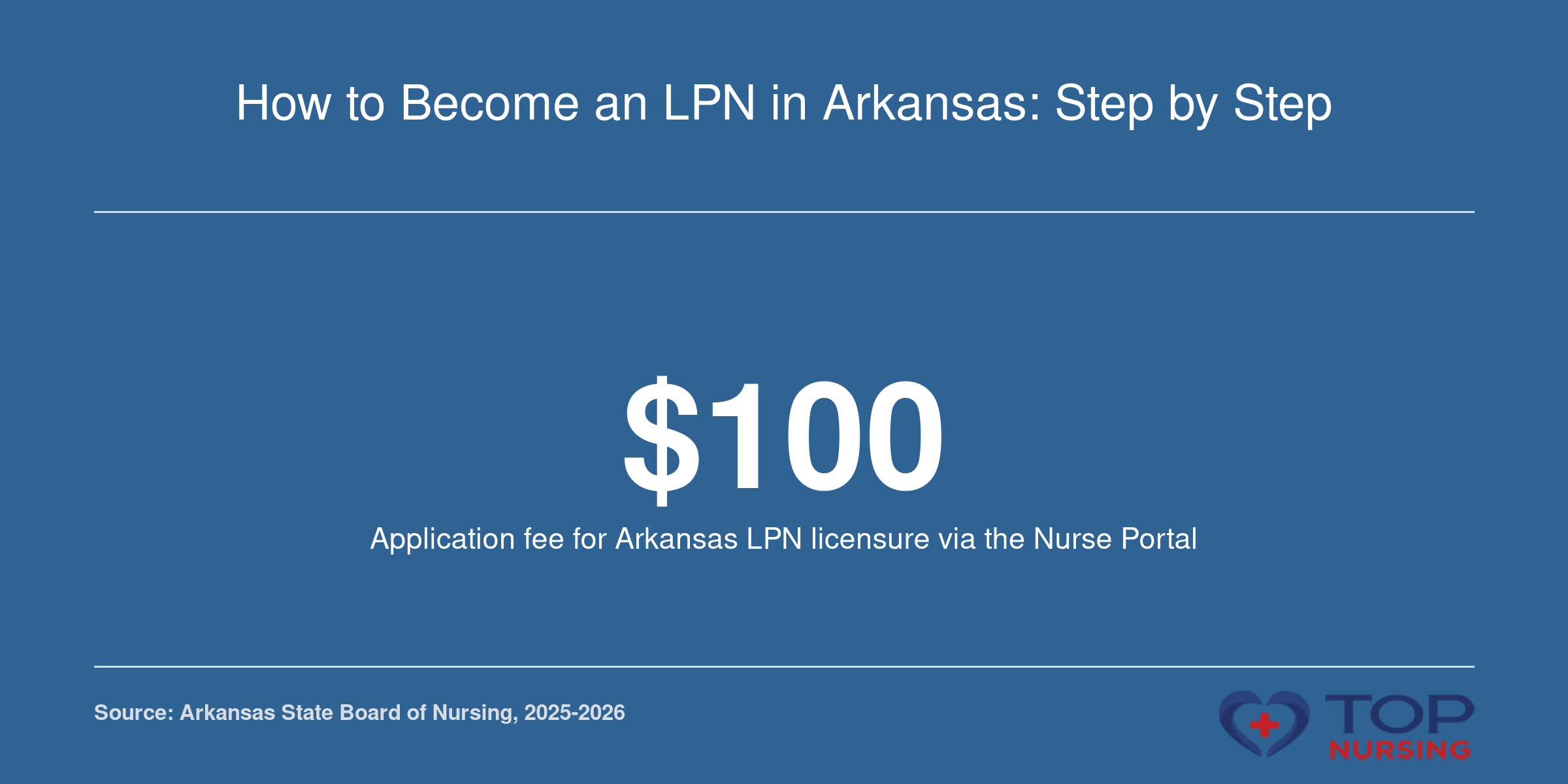
After finishing an ASBN-approved practical nursing program and passing the NCLEX-PN, you apply for licensure through the Arkansas Nurse Portal. The application includes a state and federal fingerprint background check and a nonrefundable fee. Once licensed, renewal is required every two years with continuing education.
Prerequisite and Admission Requirements for Arkansas LPN Programs
Meeting the Arkansas State Board of Nursing's licensure prerequisites is only the starting point; each LPN program sets its own admissions bar, and those requirements can differ markedly from one school to the next. While the ASBN outlines the minimum education and background checks needed to sit for the NCLEX-PN, individual programs often impose additional hurdles: specific entrance exams, higher GPA cutoffs, prerequisite coursework, or even a current CNA certification. Understanding these layered LPN education requirements early can save you application fees and months of prep work.
Admissions Testing: TEAS, HESI, and Other Exams
Most Arkansas LPN programs require a standardized entrance exam, but the type varies. Some schools, like Arkansas State University Mid-South, use the ATI TEAS (Test of Essential Academic Skills), while others may opt for the HESI A2. A handful of community colleges accept either test or set their own institution-specific assessments. Check the program's admissions page to see which exam is mandated, what the minimum composite score is, and whether sub-scores in math or science carry extra weight. If a program only posts a suggested score, aim well above it, because many seats are competitive and tested applicants with stronger profiles have an edge.
Academic Prerequisites and GPA Benchmarks
A high school diploma or GED is universal, but beyond that, expect to see a list of prerequisite courses. Common requirements include anatomy and physiology, medical terminology, and college-level math. Some programs embed these into the LPN curriculum; others require them to be completed before you can even apply. Minimum GPA thresholds typically range from 2.0 to 2.75, but a published minimum often doesn't reflect the competitive reality: at UAMS, for example, admitted cohorts routinely exceed the stated baseline. Courses must usually be completed with a grade of C or better, and many programs look at your most recent attempt if a course was retaken.
CNA Certification and Additional Requirements
Several Arkansas LPN programs, especially those at community and technical colleges, require proof of an active Certified Nursing Assistant (CNA) license as a condition of admission. South Arkansas Community College is one such school that lists CNA certification among its prerequisites. Even when not mandatory, CNA experience can bolster an application and give you a head start in clinical rotations. Other common requirements include a current CPR certification (BLS for Healthcare Providers), up-to-date immunizations, a drug screen, and a criminal background check. These are typically due after admission offer but before the first clinical day, so start gathering them early.
Confirming Requirements Directly with Schools
Because specifics change annually and program websites don't always reflect the latest updates, the most reliable step is to contact the nursing department directly. Call or email the admissions coordinator for the program you're targeting. UAMS, Arkansas State University Mid-South, and other listed schools all have points of contact on their nursing pages. Ask about any pending revisions to test requirements, upcoming prerequisite changes, or unspoken preferences that could affect your application. While the ASBN site provides a solid overview of state-level licensure steps, it does not track individual program criteria, so your primary planning should always be guided by the school's latest published materials and a conversation with their admissions staff.
Moving from a practical to a professional nursing license in Arkansas often comes down to a simple choice: pursue a fast, campus-based associate degree bridge or take the longer, more flexible path toward a bachelor’s. Both options lead to RN licensure, but the format, time commitment, and long-term career implications differ. Most Arkansas colleges offer licensed practical nurses an efficient route to an Associate of Applied Science in Nursing (AASN), while a growing number now make it possible to bypass the ADN entirely and jump directly to a Bachelor of Science in Nursing.
Where Arkansas Schools Offer LPN-to-RN Bridge Programs
LPN-to-RN pathways are widely available across the state, with many programs designed for working nurses. Seven campuses deliver an ADN bridge in 12–18 months, often with hybrid elements that combine online coursework with in-person clinicals:
- UA Little Rock – LPN/Paramedic-to-RN AAS, campus-based, 12 months (60 credits).
- Arkansas State University–Jonesboro – LPN-to-AASN, campus, 12 months.
- ASU–Three Rivers – LPN/Paramedic-to-RN, campus, 12 months.
- ASU–Newport – LPN-to-RN Transition Pathway, hybrid, 12–16 months.
- University of Arkansas Community College at Batesville – LPN-to-RN AAS, campus, 12 months.
- Northwest Arkansas Community College – LPN/Paramedic-to-RN Bridge, hybrid, 12–18 months.
- Baptist Health College Little Rock – Accelerated LPN/Paramedic-to-RN, hybrid, 12 months.
- UA Hope-Texarkana (ARNEC) – LPN/LVN-to-RN Transition AAS, hybrid, 12 months (60 credits).
For nurses aiming higher, two universities offer a direct LPN-to-BSN bridge that can be completed entirely or mostly online:
- University of Arkansas–Fayetteville – LPN-to-BSN, fully online, 24 months (120 credits).
- Arkansas Tech University – LPN-to-BSN, hybrid, 24–36 months (120 credits).
The Financial Case for Moving from LPN to RN
The wage gap between LPNs and RNs in Arkansas is substantial. According to Bureau of Labor Statistics data, registered nurses in the state earn a median annual salary tens of thousands of dollars higher than licensed practical nurses. Over a career, that difference translates into hundreds of thousands of dollars in additional earnings. Since most bridge programs require only one year of full-time study and often accept prior LPN coursework as transfer credit, the tuition investment is modest compared to the long-term payback. Many employers also offer tuition assistance for RN advancement, further reducing out-of-pocket costs.
Choosing Between an ADN and BSN Bridge
An ADN bridge is the faster and more affordable option, typically costing less and allowing you to sit for the NCLEX-RN in as little as 12 months. It’s ideal if your goal is to start earning an RN salary quickly, especially in long-term care, clinics, or rural hospitals. A BSN bridge, by contrast, takes roughly two years but opens doors to public health roles, magnet hospitals, and leadership positions. UA-Fayetteville’s online LPN-to-BSN program is especially attractive for those who need maximum flexibility, while Arkansas Tech’s hybrid format blends some campus attendance with online learning. If you choose an ADN first, many ADN-to-BSN programs across the state later accept your RN credits, making it easy to upgrade your education when the time is right.
Did You Know?
Arkansas LPN programs offer a fast, affordable route into nursing. Most can be finished in under 18 months, with tuition costs well below the regional average. Graduates start earning a reliable wage right away, and clear LPN-to-RN bridge programs make it easy to advance your career and income over time.
Frequently Asked Questions About LPN Programs in Arkansas
Choosing an LPN program raises practical questions about time, cost, and outcomes. We compiled the most frequently asked questions from Arkansas nursing students and answered them with information from the guide above.
How long does it take to complete an LPN program in Arkansas?
Most full-time LPN programs in Arkansas take 12 to 18 months to finish. Part-time or weekend tracks may extend the timeline to 24 months. The schedule you choose depends on the school's offerings and your availability. For the fastest options, check the section on accelerated LPN programs.
How much do LPN programs cost in Arkansas?
Tuition for Arkansas LPN programs typically ranges from $4,000 to $15,000 for the full program. Costs vary by school type (community college vs. private institution) and whether you qualify for in-state tuition. Our program cost comparison table breaks down estimated expenses, including fees and supplies.
Are there online LPN programs available in Arkansas?
Yes, a few Arkansas schools offer hybrid LPN programs that combine online coursework with in-person clinical rotations. Fully online LPN programs are rare because of state clinical-hour requirements. The online and hybrid section lists current options with details on how the blend works.
What is the NCLEX-PN pass rate for Arkansas LPN programs?
NCLEX-PN pass rates vary by school, but Arkansas programs collectively average around 85 to 90 percent for first-time testers. Individual program rates appear in the NCLEX pass rate section. A high pass rate signals strong exam preparation, so compare programs you are considering.
Can you go from LPN to RN in Arkansas?
Absolutely. Several colleges in Arkansas offer LPN-to-RN bridge programs that let you earn an associate degree in nursing (ADN) in one to two years. These programs build on your LPN knowledge and prepare you for the NCLEX-RN. Our LPN-to-RN section lists bridge options around the state.
What are the requirements to become an LPN in Arkansas?
You need a high school diploma or GED, completion of an approved LPN program, and a passing NCLEX-PN score. Admission to schools often requires a TEAS or HESI entrance exam, CPR certification, background check, drug screen, and immunizations. The prerequisite section covers admission steps in detail.
Are there evening or weekend LPN programs in Arkansas?
Some Arkansas LPN schools offer evening or weekend tracks for students who work during the day. Availability changes, so contact programs directly to confirm flexible schedules. Not all campuses provide this option, but a handful of community colleges and private schools design part-time LPN pathways.
More LPN Programs in Arkansas to Consider
Beyond the top-ranked programs, Arkansas offers several other solid LPN training options. The directory below covers schools across the state, organized by region, with key details on format and net cost.