Top CNA Programs for Vermont Students: 2026 Rankings

Compare tuition, outcomes, and online options for Vermont's aspiring nursing assistants.

By Maria Delgado, RNReviewed by TopNursing.org TeamUpdated May 29, 202624 min read
Top CNA Programs for Vermont Students (2026 Rankings)

Points of interest…

  • Vermont has no in-state CNA programs, so students choose nationally available online programs.
  • The state requires 80 hours of LNA training, including 30 clinical hours.
  • VSAC forgivable loans and employer-sponsored training can eliminate tuition costs.
  • The LNA certification exam is administered by Pearson VUE.

Vermont regulates entry to the nursing assistant role through an 80-hour training standard, with 30 hours reserved for hands-on clinical work. The resulting Licensed Nursing Assistant (LNA) credential carries the same weight as the CNA title used elsewhere, but the state’s own training infrastructure is sparse.

No in-state CNA programs appear in our verified rankings. Accredited online programs, however, accept Vermont students and align with state requirements. This out-of-state reliance shifts the key selection criteria: clinical site access, total cost, and exam pass rates become the practical filters for Vermont learners.

Why No In-State Programs? What Vermont Students Should Know

Vermont mandates a minimum of 80 hours of approved LNA training, with at least 30 hours of that total dedicated to hands-on clinical work in a healthcare setting.1 This specific, state-defined pathway explains why a search for “CNA programs in Vermont” often returns sparse results on national education directories.

Vermont’s LNA-Specific Credentialing System

The state does not use the Certified Nursing Assistant (CNA) title. Instead, Vermont licenses individuals through the Licensed Nursing Assistant (LNA) credential. The Vermont Board of Nursing (VBON) sets training requirements that differ from many other states’ CNA criteria. A nationally advertised online CNA program might cover the right material, but if it lacks the required in-person clinical component, it will not lead to Vermont LNA licensure. The board explicitly does not accept fully online programs for initial credentialing. Only programs that include in-person skills labs and clinical rotations, described as hybrid programs, meet the standard.2

Why Traditional In-State Programs Are Scarce

Vermont’s small population limits the number of brick-and-mortar LNA training sites. Many traditional programs are tied to local high school career centers or community colleges, and they fill quickly. National databases often overlook these programs because they use “CNA” as the search term, not “LNA.” The result is a perceived shortage that pushes students toward online options. Hybrid programs bridge this gap by delivering coursework virtually while arranging clinical rotations at Vermont-based facilities. This model allows students across the state to train without relocating.

Verifying Clinical Placement Before Enrolling

Before committing to any program, contact the Vermont Board of Nursing to confirm that the program’s clinical hours will be accepted for LNA licensure. An out-of-state or online program may promise a generic CNA certificate, but if its clinical component does not match Vermont’s 30-hour minimum delivered in a health facility, you risk being ineligible to sit for the state exam.1 Ask whether the program has a history of placing Vermont students and can provide letters of agreement with in-state clinical sites.

Employer-Sponsored Training as an Alternative

Many Vermont healthcare employers, including Dartmouth Health and UVM Health Network, run their own LNA training courses or apprenticeships. These programs are state-approved, often free or low-cost, and combine classroom instruction with paid on-the-job clinical hours.2 They are a practical route for students who want direct entry into the workforce and do not want to navigate the hybrid-approval process independently. Employer-sponsored training is covered in more detail later in this article.

Best Online CNA Programs for Vermont Students

These nationally available online CNA programs are ranked by a composite of institutional quality signals including graduation rates, net price, and student outcomes, making them strong options for Vermont residents seeking remote training. While no in-state programs currently offer fully online CNA training, the following schools deliver hybrid courses that combine online theory with in-person clinical components, often allowing Vermont students to arrange local clinical placements.

Factors considered
  • Graduation rates
  • Net price after aid
  • Long-term earnings
  • Program flexibility
  • Institutional reputation
Data sources
RankSchoolLocationNet priceBest for
#1
Infinity College
Lafayette, LA$0/yr (net price)Quick two-week hybrid program

Infinity College offers a fast-paced Nursing Assistant program that can be completed in just two weeks through a hybrid format combining online learning with in-person clinicals. The school reports an institution-wide graduation rate of 84.8% and an average net price of $230, making it an extremely affordable choice. Program-specific earnings are not yet available, but the college's low median graduate debt of $6,333 suggests strong financial outcomes for graduates.

Nursing Assistant — Hybrid
  • Complete in as few as two weeks
  • Hybrid delivery with online and in-person components
  • Evening classes accommodate working students
  • 80 clock hours including an 80-hour externship
  • Covers infection control, safety, and personal care
  • Small class sizes for individualized instruction
  • Affordable tuition with certification exam fee separate

Northeast Wisconsin Technical College's Nursing Assistant technical diploma blends online coursework with hands-on clinical experiences at approved Wisconsin sites. The institution-wide graduation rate is 50.9%, and the average net price is $9,918. College Scorecard data shows median earnings of $44,553 ten years after entry, indicating solid long-term returns. Vermont residents can typically complete theoretical components online, though clinical placements may need to be arranged locally or at approved Wisconsin facilities.

Nursing Assistant — Hybrid
  • Technical diploma approved by Wisconsin DHS
  • Hybrid delivery with online and in-person classes
  • Offered at multiple locations with day/evening/weekend options
  • 3 credits, 80% minimum pass rate
  • Clinical experience in long-term care settings
  • Graduates eligible for Wisconsin CNA exam
  • 91% graduate employment rate (Wisconsin region)

Odessa College's Certified Nurse Aide program is an accelerated 8‑week hybrid course that includes 60 classroom hours and 40 clinical hours, with a total tuition of $1,900 that covers textbooks, scrubs, and the state exam fee. The institution-wide graduation rate is 37%, but the net price is a low $6,368, and ten‑year median earnings are $42,026. For Vermont students, the online theory portion is fully remote; clinical rotations must be completed in Texas or arranged at an approved local facility.

Certified Nurse Aide CNA Program — Hybrid
  • 8-week accelerated course
  • $1,900 tuition covers textbooks, scrubs, and exam
  • Hybrid: online theory plus weekend clinicals
  • 60 classroom hours, 40 clinical hours
  • Preparation for Texas Nurse Aide exam
  • Small class sizes with simulation lab
  • Focus on elderly and long-term care
  • Payment plans and tuition assistance available

Cloud County Community College's Certified Nurse Aide course is a 90‑hour blended program with online learning and face‑to‑face clinical sessions. The institution's graduation rate is 55.3%, and the average net price is $11,685. Ten‑year median earnings are $39,883, and the median debt is $8,000. Vermont students can complete online portions from home, but must attend in‑person clinicals in Kansas or coordinate local clinical sites.

Certified Nurse Aide — Hybrid
  • 90-hour comprehensive blended course
  • Hybrid online and face-to-face format
  • Prepares for Kansas state certification
  • Hands-on clinical sessions included
  • Military and financial aid eligible
  • Gateway to nursing and allied health pathways
  • Small 12:1 student-faculty ratio

Pima Medical Institute in Aurora, Colorado, offers a Nursing Assistant/Nurse Aide certificate that can be completed in about six weeks on campus, though some online components may be available. The institution-wide graduation rate is 72.1%, but the net price is higher at $23,255, and program-level earnings data are not reported. For Vermont students, the program is primarily in‑person and would require relocation or travel to Colorado for clinical training.

Nursing Assistant/Nurse Aide — Hybrid
  • Certificate program, approximately six weeks
  • On-campus delivery with some hybrid elements
  • Training includes infection control and emergency procedures
  • Hands-on lab and clinical externship
  • Eligible to sit for CNA exam
  • Multiple campus locations in several states
  • ABHES-accredited
  • Financial aid available

Mid-State Technical College's Nursing Assistant technical diploma is an 81‑hour program with a very low total program cost of approximately $445, combining online theory with in‑person skills labs and clinical practicums. The institution-wide graduation rate is 51.9%, the net price is $10,873, and ten‑year median earnings are $42,253. Vermont students can complete online coursework remotely, but in‑person components require attendance at a Wisconsin campus or approved clinical site.

Nursing Assistant — Hybrid
  • Short-term 81-hour technical diploma
  • 27-hour clinical practicum
  • Multiple campus locations in Wisconsin
  • Hybrid/blended delivery
  • Prepares for state certification exam
  • Very affordable total program cost ($445.15)
  • Part-time daytime and evening classes
  • State-recognized training program

Brightpoint Community College offers a Nurse Aide/Medication Aide Career Studies Certificate that combines online coursework with in‑person clinical internships. The institution-wide graduation rate is 38.3%, but the net price is an affordable $5,490, and ten‑year median earnings are $41,223. Vermont students may complete the online theory portion from home; however, clinical placements are typically in Virginia and may require travel. The program is eligible for Virginia's G3 tuition assistance, which may not apply to out‑of‑state students.

Nurse Aide/Medication Aide, CSC — Hybrid
  • Career Studies Certificate program
  • Hybrid format with in-person internships
  • Covers anatomy, safety, infection control
  • Medication aide training included
  • Internship provides field experience
  • Eligible for Virginia G3 tuition assistance for state residents
  • Prepares for nurse aide and medication aide roles

Chippewa Valley Technical College's Nursing Assistant technical diploma can be completed in 14 weeks or less through a face‑to‑face program, though some hybrid elements may be available. The institution-wide graduation rate is 50%, the net price is $12,285, and ten‑year median earnings are $46,297, the highest among schools on this list. For Vermont students, this program requires in‑person attendance at Eau Claire or River Falls, Wisconsin, and clinicals in local long‑term care facilities.

Nursing Assistant — Hybrid
  • Technical Diploma, 14 weeks or less
  • Face-to-face with some online components
  • Estimated total cost $423
  • Combines lecture, lab, and clinical practice
  • Prepares for Wisconsin CNA certification
  • Credits apply to Nursing associate degree
  • 78% graduate employment rate in region
  • 358 regional job openings for nursing assistants

Victoria College's Nurse Aide program is a hybrid course that includes a free 60‑hour online theory prerequisite from Texas Health and Human Services, followed by 50‑60 clinical hours on campus or in local agencies. The institution-wide graduation rate is 29.3%, but the net price is only $3,043, and ten‑year median earnings are $42,382. Vermont students can take the online theory free, but must travel to Texas for the clinical component and exam.

Nurse Aide — Hybrid
  • Hybrid program with free online theory prerequisite
  • 50-60 clinical hours completed in Texas
  • Tuition $650 includes textbook
  • Prepares for Texas Nurse Aide Registry Exam
  • Offered at Victoria Main Campus and Gonzales Center
  • Flexible evening classes available
  • State-approved continuing education program
  • Hands-on skills lab and clinicals

The College of Western Idaho's Certified Nursing Assistant Preparation is a 12‑week hybrid program that costs $945, with online instruction and in‑person skills training at the Nampa campus. The institution-wide graduation rate is 30.6%, the net price is $8,500, and program-level earnings are not reported. Vermont students can access online classes but must complete hands‑on training and clinicals in Idaho, requiring relocation or travel.

Certified Nursing Assistant Preparation — Hybrid
  • 12-week comprehensive program
  • Hybrid online and in-person delivery
  • Cost: $945
  • Minimum age 16 years
  • Prepares for Idaho CNA certification exam
  • Hands-on skills training at Nampa Campus
  • Workforce Development short-term training
  • On-ramp to nursing and allied health programs

Vermont CNA vs. LNA: Understanding the Credential

Is a CNA the same as an LNA in Vermont? If you've been comparing training programs, you've likely noticed that Vermont often uses the term Licensed Nursing Assistant (LNA) while most other states say Certified Nursing Assistant (CNA). The short answer: the job is the same, but the title and licensing process differ.

What's in a name? LNA vs. CNA

Vermont is one of a handful of states that grant licensure rather than certification for entry-level nursing assistants. The scope of practice for a Vermont LNA mirrors that of a CNA elsewhere: basic direct patient care such as bathing, feeding, mobility assistance, and, in some settings, medication administration under supervision.2 The Vermont Board of Nursing sets the standards, and any person practicing as a nursing assistant in Vermont must hold an active LNA license.1

Why the terminology matters when searching for programs

Because most online and out-of-state training programs use the term CNA, Vermont students can easily overlook options that would fully prepare them for a career. When searching for classes, use both keywords: "CNA programs" and "LNA programs" as well as phrases like "CNA classes for Vermont licensure". Many programs advertise for CNA certification, but their curriculum aligns with the LNA competency exam, so they are equally valid. Just confirm with the provider that the program meets Vermont's training requirements.

Bringing an out-of-state CNA credential to Vermont

If you already hold an active CNA certification from another state, Vermont offers a pathway to LNA endorsement. The process through the Vermont Board of Nursing requires:

  • Good standing: Your out-of-state credential must be in good standing.
  • Work experience: You'll need to show at least 400 hours of work as a CNA within the past two years (or 960 hours within the past four years).
  • Exam waiver: You are not required to retake the NNAAP or other competency exam.
  • Application: Submit the endorsement application with a $235 fee. Processing typically takes 4, 8 weeks.
  • Background check: A criminal background check is required as part of the application.

No additional training or exam is needed as long as you meet the work-hour threshold and your license is active. This makes mobility much smoother for those moving to Vermont with current CNA experience.1

CNA Program Costs and Financial Aid Options

Many online CNA programs accessible to Vermont students participate in federal financial aid, and a large share of their students receive Pell Grants. Vermont residents may also qualify for funding through the Vermont Student Assistance Corporation (VSAC), including forgivable loans and workforce scholarships. The effective net price shown is an institution-wide average; what you actually pay will vary based on your financial circumstances and aid package.

SchoolIn-State TuitionOut-of-State TuitionEffective Net Price After Aid
Infinity CollegeN/AN/A$230
Durham Technical Community College$2,240$7,531$1,664
Lamar State College-Port Arthur$1,770$8,070$2,846
Victoria College$4,440$5,328$3,043
Florida State College at Jacksonville$2,657$9,631$4,128
Rappahannock Community College$5,102$11,540$4,343
Midland College$4,920$6,180$4,512
Kilgore College$4,056$5,256$5,364
Brightpoint Community College$5,082$11,520$5,490
Odessa College$4,032$4,926$6,368

Questions to Ask Yourself

The Vermont Board of Nursing requires specific clinical training hours. If the program's clinical component isn't approved, you won't be eligible for licensure, wasting time and money.

Many online programs partner with local facilities for clinical rotations. If no Vermont site is available, you may need to travel out of state, adding cost and logistical challenges.

Balancing work and study is critical. A rigid schedule might force you to reduce work hours or delay progress, while flexible options help maintain income and manage personal obligations.

Vermont CNA Certification and Exam Process

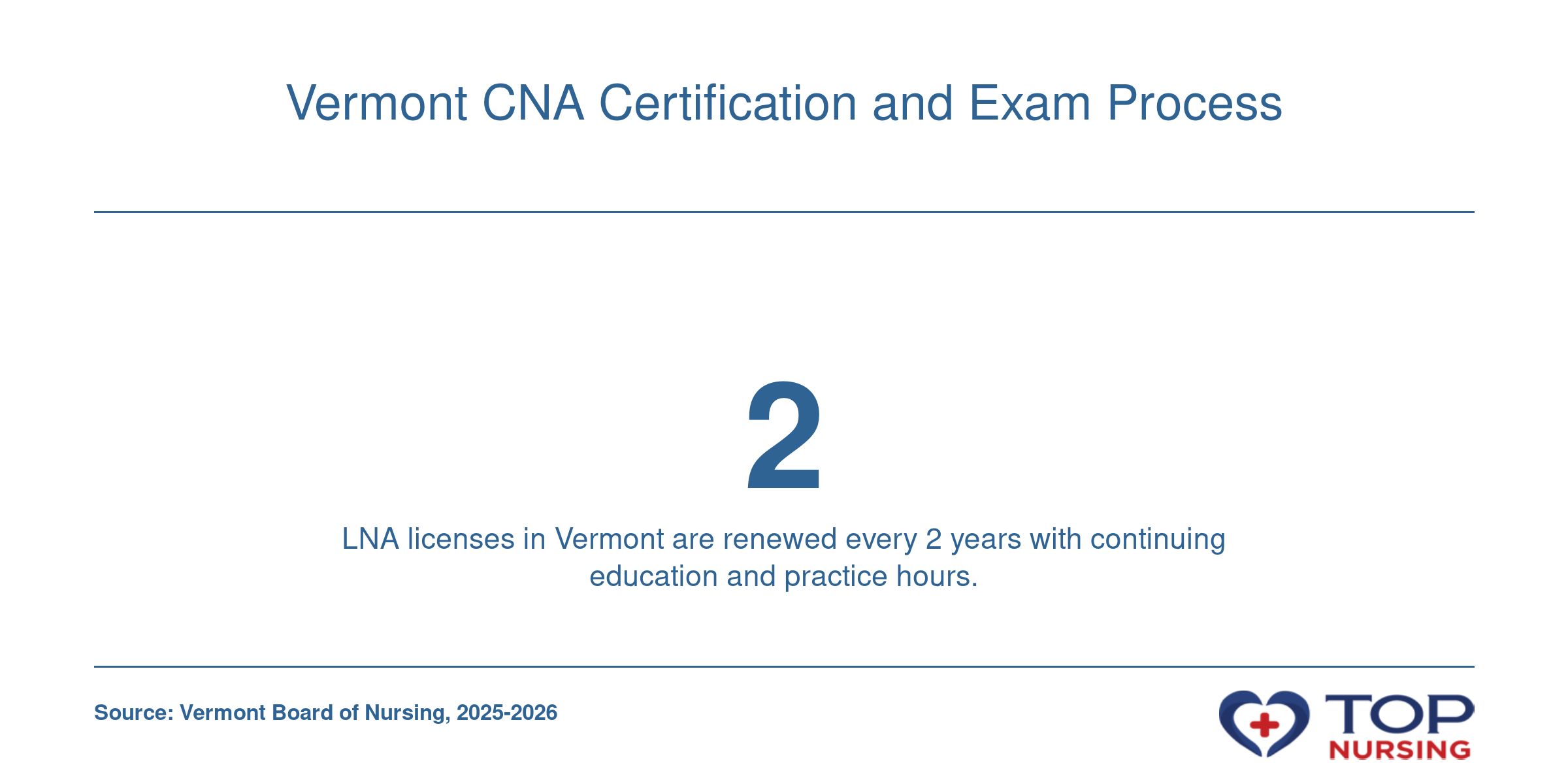
Vermont's path to becoming a Licensed Nursing Assistant (LNA) starts with a state-approved training program. After training, candidates apply to Pearson VUE for the NNAAP-style exam, which includes a written (or oral) multiple-choice section and a skills demonstration. Once both parts are passed, you apply for LNA licensure through the Vermont Board of Nursing, and the credential is valid for two years, requiring renewal with continuing education and practice hours to stay active.

A visual illustrating the 2-year LNA license renewal period in Vermont.

Employer-Sponsored CNA Training and Apprenticeships in Vermont

Who offers paid LNA training in Vermont? Instead of paying tuition for an online program, many aspiring nursing assistants secure employer-sponsored training that comes with a paycheck and a guaranteed job. This pathway is especially appealing in states like Vermont where in-person LNA programs are scarce, shifting the cost burden from the student to the employer in exchange for a work commitment.

How Employer-Sponsored Training Works

Under these arrangements, the hiring organization pays for your LNA training, often at no cost to you. In return, you agree to work for the same facility for a set period, typically one to two years. This model benefits both sides: you avoid student debt and enter the workforce immediately, while the employer builds a loyal and properly credentialed staff.

Central Vermont Medical Center’s Nurse Assistant Trainee Program

A concrete example is the Nurse Assistant Trainee Program at Central Vermont Medical Center, part of the UVM Health Network. The 2026 cohort begins on July 20, 2026, with applications due by June 1, 2026. Trainees are hired as full-time employees from day one, earning between $21.63 and $31.49 per hour while they learn. The program is delivered in person, covers all clinical skills needed to sit for the Vermont LNA exam, and requires candidates to hold a high school diploma or GED and be at least 18 years old. Upon licensure, graduates fulfill a work obligation at the medical center, ensuring a smooth transition to paid employment.

Other Employer Pathways and Workforce Partnerships

While the Central Vermont model is one of the most clearly defined, other healthcare employers across the state, including Dartmouth Health facilities and long-term care providers, frequently run similar earn-while-you-learn programs. UVM Health Network also supports a Pathway Program in partnership with Vermont State University, though it targets a broader set of high-demand clinical roles (such as respiratory therapist) rather than the LNA credential specifically.2 The Vermont Department of Labor maintains a registered apprenticeship framework for healthcare, and asking a prospective employer about state-subsidized training can uncover additional support. Still, these initiatives signal that Vermont healthcare systems are actively investing in workforce pipelines, making it worthwhile to check career pages at local hospitals and nursing homes for current training opportunities.

Is an Employer-Sponsored Program Right for You?

If you value immediate income, hands-on experience, and a guaranteed job, employer-sponsored training is a compelling alternative to paying for a standalone online program. The trade-off is the required work commitment, which means less flexibility in your first years of practice. However, for many Vermont students, the financial and practical advantages outweigh the limitations, making this route a smart first step into a nursing career.

CNA vs. PCT: Pay, Roles, and Which to Pursue

In hospitals and long-term care facilities, nursing assistants follow two distinct career tracks: the Certified Nursing Assistant who focuses on daily living care, and the Patient Care Technician who layers on clinical procedures. Understanding the differences helps you choose the nursing career path that fits your goals, timeline, and long-term earning potential.

Training and Duties: What's the Difference?

CNAs complete state-approved training programs that cover basic nursing skills, followed by a competency exam. Their work revolves around activities of daily living: bathing, dressing, feeding, and mobility assistance, plus taking vital signs and reporting changes to nurses. The credential is nationally recognized with state-level certification.

PCTs build on that foundation with additional training in phlebotomy, electrocardiograms, advanced wound care, and sometimes catheterization. While the CNA role is regulated by state nursing boards, the PCT title is not a separate license in most states, including Vermont. Instead, employers may hire CNAs and provide on-the-job training to upgrade their skills to the PCT level, or they may accept a national certification like the CPCT/A from the National Healthcareer Association. The extra technical procedures open doors to acute care settings where CNAs alone might not qualify.

Who Gets Paid More, CNA or PCT?

Nationally, Patient Care Technicians out-earn CNAs by a noticeable margin. According to 2026 data:

  • CNA median annual wage: $31,000 to $37,000, with hourly rates typically between $15 and $181.
  • PCT median annual wage: $40,000 to $44,000, translating to $17 to $22 per hour1.

The pay gap reflects the broader skill set: drawing blood, performing EKGs, and assisting with more complex bedside procedures command higher reimbursement rates. In Vermont, the differential holds, though wages may skew slightly lower given the state's cost of living and facility mix. Because PCT is not a state-issued credential, employers often set pay based on the tasks you can demonstrate, so a CNA who completes in-house training for phlebotomy and EKG might see a $2-to-$4 hourly bump.

Which Path Should You Choose?

If you are new to healthcare and want to start working quickly, the CNA route offers a shorter training period and immediate entry into the workforce. Many Vermont nursing homes and assisted living facilities hire newly certified LNAs (Vermont's term for CNAs) year-round. From there, a lateral move to PCT is common: you can seek out employers who sponsor upskilling or enroll in a phlebotomy/EKG program while employed.

For those who already know they want hands-on clinical procedures in a hospital, aiming directly for PCT roles makes sense if you can find a training program that packages the necessary modules. Be aware that in Vermont, job postings may use "Patient Care Technician" and "Licensed Nursing Assistant" interchangeably, so verify the duties and required competencies before applying.

Career Advancement Pathways from CNA

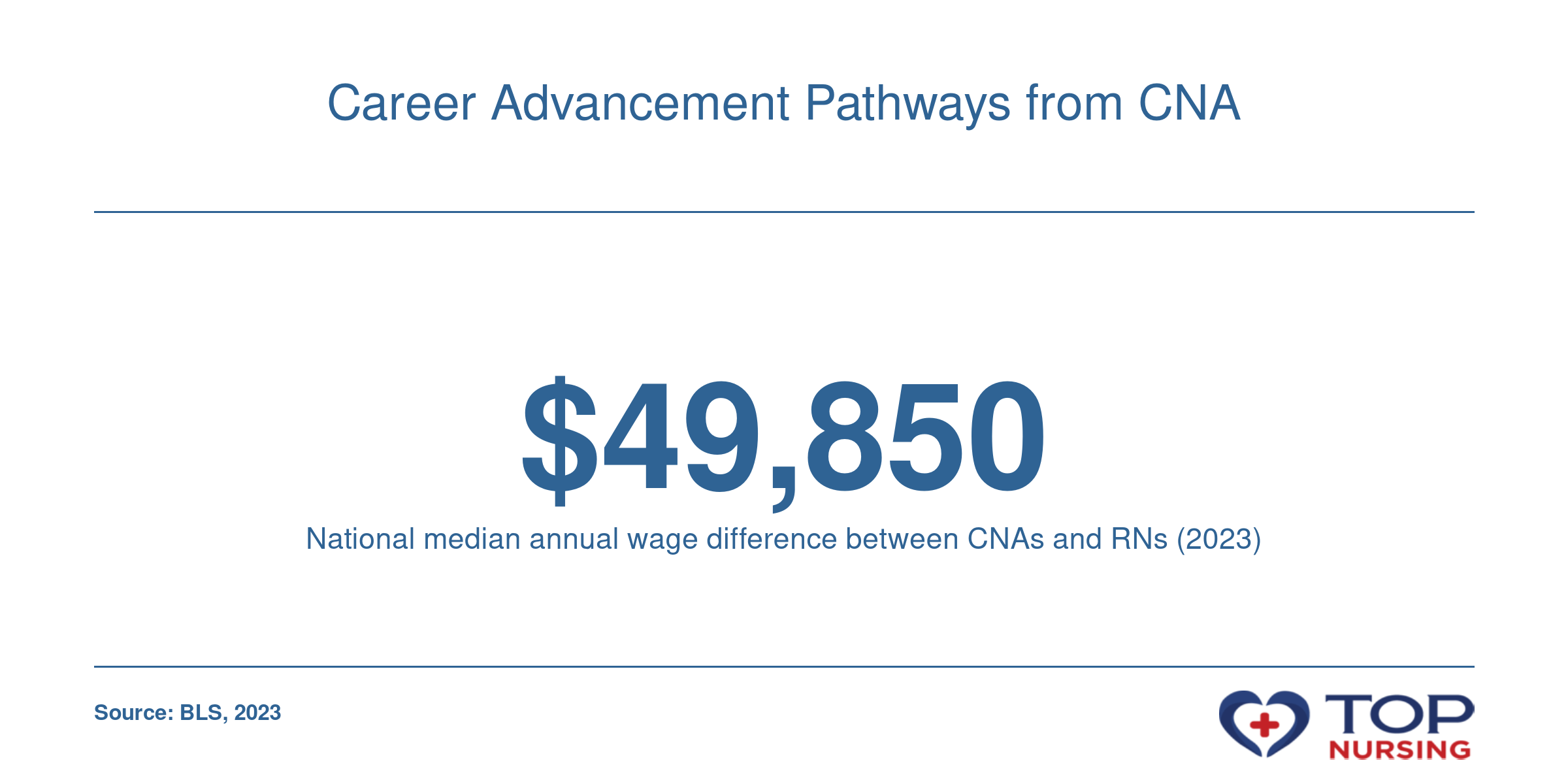
Starting as a certified nursing assistant (CNA) or licensed nursing assistant (LNA) gives you a hands-on foundation in patient care that directly boosts nursing school applications. From there, the path runs through licensed practical nurse (LPN), registered nurse with an associate degree (ADN), and finally a bachelor's degree in nursing (BSN), each step adding roughly 12 to 24 months and $6,000 to $80,000 in tuition depending on the degree. Alternatively, some assistants move laterally into patient care technician (PCT) roles for broader clinical responsibilities without immediate degree investment.

Bar chart showing a $49,850 higher median salary for registered nurses compared to certified nursing assistants nationally in 2023.

Frequently Asked Questions About Vermont CNA Programs

These are the most common questions from Vermont students exploring CNA programs. We cover online training, certification timelines, salary expectations, and scheduling options.

Can you get your CNA online in Vermont?
No, fully online CNA programs are not accepted for Vermont LNA licensure because you must complete in-person clinical hours and skills assessments. However, several programs offer a hybrid format where you study theory online and attend clinical sessions at approved sites.
How long does it take to become a CNA in Vermont?
Most programs take between 4 and 10 weeks to complete. For instance, Stafford Technical Center’s LNA program runs 10 weeks with 144 total hours, while other accelerated options may finish in as little as one month, depending on the schedule and intensity.
How much do CNAs get paid in Vermont?
Pay varies by employer and experience. Acute care hospitals and skilled nursing facilities typically pay more. For the most current median hourly wage and annual salary breakdowns, check the salary and job outlook table in this article.
Which is the best school to study CNA?
The best program depends on your schedule, location, and learning preferences. This guide highlights multiple top-rated options, including LNA Health Careers’ hybrid courses, the evening program at Center for Technology, Essex, and the comprehensive training at Stafford Technical Center.
What is the highest paid CNA?
CNAs in specialized settings like ICUs or government facilities (e.g., the VA) tend to earn top wages. Additional certifications and years of experience also raise pay. Granular earnings data by percentile is available in the salary section.
Is a CNA the same as an LNA in Vermont?
Yes. Vermont officially uses the title Licensed Nursing Assistant (LNA) instead of CNA. The training, exam, and responsibilities are equivalent, so the terms are interchangeable in the state.
Are there evening or weekend CNA classes available for Vermont students?
Yes. Several programs accommodate working students. The Center for Technology, Essex offers an evening LNA track, Stafford Tech may schedule clinicals on weekends, and LNA Health Careers provides a blended program with flexible online theory.

More Online CNA Programs Available to Vermont Students

Beyond the top-ranked options, these additional online programs accept Vermont students and offer flexible paths to CNA certification. Each program appears with its home state, learning format, and net price to help you compare costs.

Midland College
Midland College's Nurse Aide program prepares students with 72 hours of classroom instruction and 48 hours of clinical training. No high school diploma is required, and hybrid and online options accommodate various schedules. Net price: $4,512.
  • Nurse Aide
Midland, TX · Hybrid
Laramie County Community College
Laramie County Community College's CNA program combines online theory with a 30-hour clinical experience. The state-approved curriculum prepares you for the Wyoming certification exam. Net price: $7,287.
  • Certified Nursing Assistant (CNA)
  • CNA
Cheyenne, WY · Hybrid
Northcentral Technical College
Northcentral Technical College offers a 3-credit technical diploma in Nursing Assistant, recognized by Wisconsin DHS. The hybrid program includes online flexibility and multiple campus locations for lab and clinical work. Net price: $10,303.
  • Nursing Assistant (CNA)
Wausau, WI · Hybrid
Lake Region State College
Lake Region State College's CNA program provides 75-80 hours of training with hybrid and face-to-face formats. North Dakota has high demand for CNAs, and multiple pathways ensure state certification readiness. Net price: $13,577.
  • Certified Nurse Assistant (CNA) Training Program
Devils Lake, ND · Hybrid
Lamar State College-Port Arthur
The Nurse Aide Certificate at Lamar State College-Port Arthur is a one-semester hybrid program preparing students for the Texas CNA exam. It covers basic caregiving and safety with clinical experience included. Net price: $2,846.
  • Nurse Aide Certificate
Port Arthur, TX · Hybrid
Rappahannock Community College
Rappahannock Community College's Patient Care Technician Certification is a 10-week hybrid program that earns both Certified Nurse Aide and Certified Medical Assistant credentials. Tuition and fees are covered by a grant. Net price: $4,343.
  • Patient Care Technician Certification
Glenns, VA · Hybrid
Johnson County Community College
Johnson County Community College's Certified Nurse Aide program is a 96-hour hybrid course with online coursework and in-person labs. It prepares students for the Kansas state exam and offers potential tuition assistance through the Kansas Promise Scholarship. Net price: $14,176.
  • Certified Nurse Aide (CNA) Certificate
Overland Park, KS · Hybrid
Durham Technical Community College
Durham Tech's Nurse Aide Certificate is a short-term program with online and campus options. It requires 13 credit hours and prepares students for the North Carolina Nurse Aide I Registry exam. Net price: $1,664.
  • Nurse Aide Certificate
Durham, NC · Online
Sheridan College-Northern Wyoming Community College District
Sheridan College's CNA program is delivered in a hybrid format with 6 or 14 weeks of online learning and five in-person days for labs and clinicals. It covers basic nursing, personal care, and life support. Net price: $9,346.
  • Certified Nursing Assistant
Sheridan, WY · Hybrid
Alvin Community College
Alvin Community College's Certified Nursing Assistant program is a 112-hour hybrid course meeting Texas requirements. It includes lecture and clinical components with evening and weekend schedules available. Net price: $8,525.
  • Certified Nursing Assistant
Alvin, TX · Hybrid
Gaston College
Gaston College offers Nurse Aide I and II levels through a hybrid format that includes classroom, lab, and clinical experiences. It prepares students for the North Carolina Nurse Aide Registry. Net price: $6,592.
  • Nurse Aide
Dallas, NC · Hybrid
John Wood Community College
John Wood's Basic Nursing Assistant Program is a hybrid 7-credit-hour program with classroom theory, lab, and clinical practice. It covers patient care, anatomy, and rehabilitation at an in-district tuition of $1,190. Net price: $7,050.
  • Basic Nursing Assistant Program
Quincy, IL · Hybrid
Pima Medical Institute-East Valley
Pima Medical Institute's Nursing Assistant/Nurse Aide Certificate Program can be completed in six weeks on-campus. It provides hands-on training from experienced instructors and prepares students for the CNA exam. Net price: $22,453.
  • Nursing Assistant/Nurse Aide Certificate Program
Mesa, AZ · Hybrid
Florida State College at Jacksonville
FSCJ's Nursing Assistant (CNA) program is a 5-week hybrid course with a 40-hour clinical rotation. It costs $1,228 and prepares students for the Florida Board of Nursing Certification exam. Net price: $4,128.
  • Nursing Assistant – CNA (W.C.)
Jacksonville, FL · Hybrid
Mississippi Gulf Coast Community College
Mississippi Gulf Coast Community College's Certified Nursing Assistant program is a hybrid non-credit training with 84 hours online or on-campus and 16 hours clinical. Total program cost is $700. Net price: $6,962.
  • Certified Nursing Assistant
Perkinston, MS · Hybrid

Recent Articles