Top CNA Programs in Oklahoma for 2026

Compare costs, schedules, and pass rates for state-approved CNA training across Oklahoma.

By Maria Delgado, RNReviewed by TopNursing.org TeamUpdated May 29, 202619 min read
Top CNA Programs in Oklahoma (2026 Rankings)

Points of interest…

  • Oklahoma requires 75 training hours including 16 hours of supervised clinical work in a licensed facility.
  • Prometric administers the two part state exam covering both written knowledge and hands on skills.
  • Selecting a program with high pass rates helps you avoid costly retake fees and certification delays.
  • CNAs in Oklahoma earn a median annual wage below $31,000 with strong job growth projected.

Finding the Right CNA Program in Oklahoma

The tension for many Oklahoma nursing assistant candidates is between getting certified quickly and getting enough hands-on practice to pass the state exam on the first attempt. With program lengths as short as four weeks, CNA training is one of the fastest entry points into healthcare, but not all programs deliver the same result. Hospitals, nursing homes, and assisted living facilities across the state are hiring aggressively as the 65-and-older population grows, yet passing the Prometric competency exam hinges on clinical repetition, not just classroom content. For prospective CNAs, choosing a program often means deciding whether a low sticker price or a flexible schedule is worth the risk of a retest.

Best CNA Programs in Oklahoma: 2026 Rankings

Canadian Valley Technology Center stands out for its state-approved CNA training that blends classroom instruction with hands-on clinical experience. The program serves both high school students and adults, offering flexible pathways to certification and advanced healthcare roles.

Factors considered
  • Affordability and net price
  • Clinical hours and hands-on training
  • Graduation and retention rates
  • Program flexibility and tracks
  • Career advancement opportunities
Data sources
RankSchoolLocationNet priceBest for
#1
Canadian Valley Technology Center
El Reno, OK$10,000 – $15,000/yrCentral Oklahoma adults needing flexible CNA training

Canadian Valley Technology Center offers a comprehensive Health Careers program that prepares students for Oklahoma's CNA and Advanced Unlicensed Assistant (AUA) certifications. With campuses in El Reno, Chickasha, and the Yukon area, the program includes a minimum of 16 clinical hours in long-term care settings and spans 480 to 960 clock hours depending on the track. Schools offering this program have graduation rates of 70.7% and a student-faculty ratio of 15:1, supporting hands-on learning. The program also provides pathways to specializations like EKG Technician and Phlebotomy, and adults can access a short-term Flex Health option that combines online and in-person instruction.

Health Careers - CNA/AUA — On-Campus
  • High school and adult tracks available at multiple campuses
  • Covers medical terminology, anatomy, physiology, and clinical skills
  • Completion leads to Certified Nursing Assistant and Advanced Unlicensed Assistant credentials
  • Includes at least 16 hours of clinical experience in long-term care facilities
  • Second-year students can specialize as EKG Technicians or Phlebotomists
  • No entrance exam required, making it accessible for diverse learners
  • Short-term Flex Health format for working adults at the Cowan campus

How to Become a CNA in Oklahoma

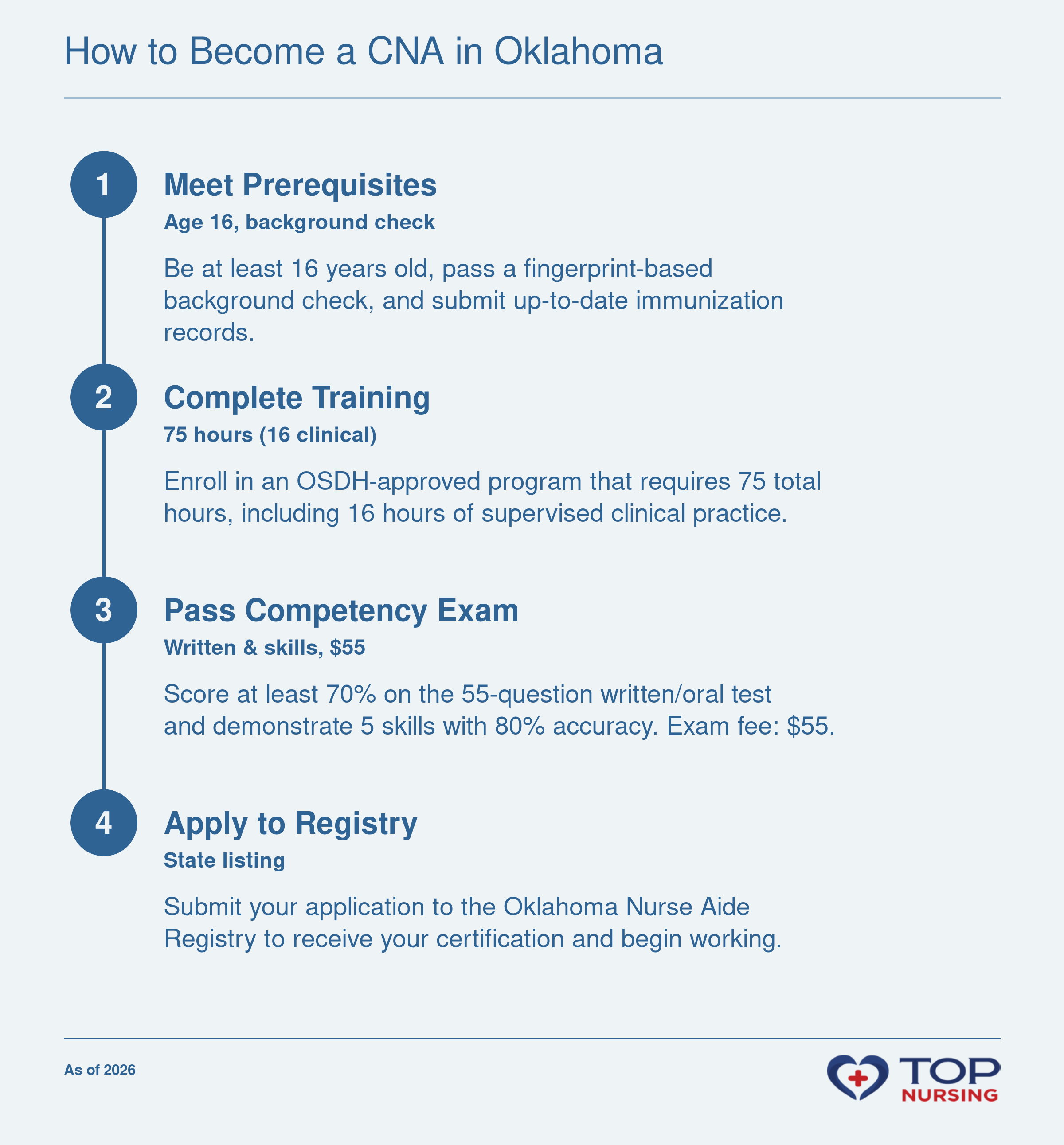
The path to becoming a certified nursing assistant in Oklahoma follows a clear sequence of steps that most students complete in 4 to 12 weeks. From meeting age and background check requirements to passing the state exam, each stage moves you closer to a spot on the Nurse Aide Registry.

Four-step process to become a CNA in Oklahoma: meet prerequisites, complete training, pass exam, and apply to registry.

Oklahoma CNA Training Requirements

The Oklahoma State Department of Health (OSDH) sets a firm floor for nurse aide education: at least 75 total hours of training, with a minimum of 16 of those hours spent in hands-on clinical work. These requirements align with the federal OBRA-87 standards, but Oklahoma specifies how those hours break down. Most approved programs distribute the time as roughly 53 hours of classroom theory, 8 hours of skills lab practice, and 16 hours of supervised clinical experience in a licensed nursing facility.

What the Required Hours Cover

The classroom and lab components build foundational knowledge. You will learn about basic nursing skills, personal care techniques, effective communication, safety protocols, infection control, residents’ rights, psychosocial care, and how to work with special populations. Hands-on lab sessions let you practice tasks like taking vital signs, assisting with transfers, and using mobility devices before you ever enter a real patient setting. The clinical component then places you directly in a nursing home or long-term care facility, where you apply those skills with residents under the watch of a licensed nurse.

Only OSDH-Approved Programs Lead to Certification

Not every CNA training option qualifies you to sit for the competency exam. Oklahoma requires that your program be officially approved by the OSDH. Approval involves a curriculum review, inspection of the training site, vetting of instructors, and compliance reporting. Before you enroll, verify the program is on the OSDH’s current list of approved providers. Completing an unapproved course will block your path to the registry, no matter how many hours you log. When you finish an approved program, the supervisor signs an Original Training Verification Form that you must bring to the exam.

Clinical Rotations: Where and Under Whose Supervision

Your clinical hours are spent in a licensed nursing facility, such as a skilled nursing home, where you work directly with real patients. An RN or LPN supervises every shift, ensuring you practice safely and correctly. This is not passive observation; you are actively performing the duties of a nurse aide under guidance. Programs coordinate the clinical site, so you generally do not need to arrange your own placement. The location must be an OSDH-approved training facility to count toward the minimum hours.

How Long Will It Take?

Full-time programs typically finish in 4 to 8 weeks, with classes held during regular business hours. Evening and weekend formats stretch the timeline, often running 10 to 16 weeks. Some schools offer accelerated options that still meet the 75-hour minimum, condensing the material into a dense schedule. Note that the OSDH allows up to four months for training completion, but most students finish faster. If you want more clinical practice, look for programs that exceed the minimum, some provide 120 hours or more, giving you extra hands-on time before you test.

What Does a CNA Program Cost in Oklahoma?

What Does a CNA Program Cost in Oklahoma?

Questions to Ask Yourself

Most CNA programs in Oklahoma hold classes weekdays, but some colleges and technical centers offer evening or weekend tracks. Verify the schedule before applying to avoid conflicts with work or family.

Accelerated full-time programs finish faster but require full-day attendance. Part-time or hybrid courses spread over 8-12 weeks, giving you more flexibility if you're balancing a job or caregiving.

Certain long-term care facilities and hospitals in Oklahoma cover CNA tuition if you agree to work for them for a set period, typically 6-12 months. This can eliminate out-of-pocket costs if the location and commitment suit you.

Online and Hybrid CNA Classes in Oklahoma

Every CNA program in Oklahoma must include a minimum of 16 hours of supervised clinical training inside a licensed long-term care facility, hospital, or other approved healthcare setting. While the classroom theory portion can shift online, that clinical requirement locks in a mandatory in-person component. No state-approved program exists entirely on a screen.

What’s Actually Online vs. In-Person

Oklahoma’s Nurse Aide Registry, overseen by the Oklahoma State Department of Health (OSDH), splits training into two buckets: didactic coursework and clinical skills. Didactic topics, including infection control, resident rights, and safety procedures, can be delivered through self-paced online modules, recorded lectures, or live virtual classes. Clinical hours, however, must be performed face-to-face so an instructor can directly observe you transferring a resident, taking vital signs, and practicing personal care. This means even programs marketed as “online” are really hybrid formats.

How Hybrid Programs Work

Most hybrid CNA classes in Oklahoma combine flexible online learning with scheduled clinical rotations. You might complete readings, quizzes, and video demonstrations on your own time during the week, then report to a partner facility on weekends or over a concentrated two-week block for hands-on practice. Some schools listed in our ranking offer both daytime and evening clinical cohorts, letting you fit the in-person work around a job or family responsibilities. When a program on the list is tagged as “Both” or “Online,” it’s signaling this hybrid structure, not a fully remote path.

Avoiding Non-Approved Programs

Be wary of any provider claiming to offer fully online CNA certification in Oklahoma. The OSDH does not approve programs that lack in-person clinical evaluations. If a school says you can become a certified nurse aide without stepping into a facility, it is not a valid route to the state competency exam or Registry placement. Always verify a program’s approval status through the OSDH website before enrolling.

Program Formats on Our List

In the ranked schools above, designations like “Online” or “Both” indicate that the didactic portion is available remotely. For example, a program marked “Online” may still require you to travel to the school’s clinical site for several full-day sessions. These labels are practical guides: they tell you where you can save commute time on the classroom side, but they never override the required in-person clinical clock hours.

CNA Certification Exam and Oklahoma Nurse Aide Registry

The Two-Part Prometric Competency Exam

To earn your Oklahoma nurse aide certification, you must pass a state-approved competency exam administered by Prometric. The exam consists of two separate components that evaluate both your knowledge and your hands-on skills.

The written (or oral) knowledge test includes 60 multiple-choice questions. You have 90 minutes to complete it, and a score of at least 70% is required to pass. If you have difficulty reading English, you can request an oral version at the test site without prior notice. The questions cover the core topics taught in your CNA training program, including infection control, patient rights, safety procedures, and basic nursing skills.

The clinical skills evaluation tests your ability to perform five randomly selected skills from a pool of about 20 possible tasks. You will be given 25 to 30 minutes to demonstrate each skill correctly. A nurse evaluator watches you and marks off critical steps. You must perform all five skills without missing any key steps to pass this portion.

Both parts of the exam must be passed to qualify for registry placement. If you fail one part, you can retake that part only, though retesting policies and fees vary. Check with your test site for specific retake rules.

Registration and What to Bring on Test Day

Registration for the exam takes place at the test site on the day of testing. There is no online pre-registration system. Plan to arrive early with the required documentation and be prepared to pay the exam fee directly at the site. Cash, money order, or a cashier’s check are common payment methods, but confirm acceptable forms with your testing location beforehand.

You must bring valid government-issued photo identification and proof that you successfully completed an approved CNA training program. This typically means your training certificate or a letter from your program director. Without these documents, you will not be permitted to test.

Results are generally available shortly after you finish both exam components. In many cases, you receive unofficial results on the spot, with official notification following within a few business days from the Oklahoma State Department of Health (OSDH) once they process your scores.

Oklahoma Nurse Aide Registry Placement

After passing both parts of the exam, your name is added to the Oklahoma Nurse Aide Registry. This statewide database is maintained by the OSDH and serves as the official list of certified nurse aides eligible for employment in licensed facilities. Employers verify your active status directly through the online registry. Be sure to keep your contact information current with the OSDH after you first register, because renewal notices and important updates go to the address on file.

Renewal Requirements

Certification must be renewed every 24 months. To qualify for renewal, you must have performed paid nursing or nursing-related services during that period. Even a single day of qualifying work is enough to keep your status active. If you go the full two years without working as a CNA, your certification expires and you will need to retrain and retest.

The OSDH sends a renewal reminder by mail. When it arrives, follow the instructions to submit proof of employment and any required fee. Employers routinely check the online registry during the hiring process, so an expired certification can delay or prevent employment.

Understanding Pass Rates and Choosing a Program

Program-level pass rates offer a straightforward way to gauge how well a training program prepares students for the exam. Although the OSDH does not publish a statewide aggregate pass rate, many schools voluntarily share their first-attempt pass rates on their websites or in admissions materials. When comparing programs, ask each one about their recent pass rates. A strong program often maintains a first-attempt pass rate above 80 percent, while a lower rate may suggest gaps in skill practice or test preparation. Checking these figures can help you choose a school where graduates consistently succeed on testing day.

Did You Know?

CNA competency exam pass rates differ widely among Oklahoma programs. Selecting an OSDH approved training program with a strong track record of high pass rates can help you avoid the expense and delay of retaking the exam, saving both time and money. Always check recent pass rates before enrolling.

CNA Salary and Job Outlook in Oklahoma

What can certified nursing assistants expect to earn in Oklahoma, and how strong is the demand for their skills?

CNA Wages in Oklahoma

According to May 2023 data from the Bureau of Labor Statistics, nursing assistants in Oklahoma earn an average annual wage of $39,530.1 The bottom 10% of earners make about $31,390, while the top 10% reach $50,140. These figures include base pay only and do not reflect overtime, shift differentials, or bonuses that many employers offer. Entry-level CNAs fresh out of a training program often start closer to the 25th percentile, gaining raises as they accumulate experience and additional certifications.

How Oklahoma Stacks Up Nationally

Nationally, the median annual wage for nursing assistants was $38,200 in 2023, with an average of $39,610.2 Oklahoma's average wage tracks closely with the national figure, but the state's lower cost of living means your earnings stretch further. Housing, transportation, and healthcare costs in Oklahoma are all below the national average, giving CNAs more purchasing power than their base salary might suggest in higher-cost states.

Where You Work Matters: Urban vs. Rural Pay

The BLS does not publish metropolitan-level wage data specifically for nursing assistants in Oklahoma, but local salary surveys and job postings suggest that CNAs in larger cities like Oklahoma City and Tulsa typically earn $1 to $3 more per hour than those in rural communities. Facilities in metropolitan areas often have higher patient volumes and greater funding, enabling them to offer more competitive wages. Still, rural positions may provide other advantages, such as a quieter pace and closer-knit teams.

Job Outlook and Demand in Oklahoma

Nationwide, employment of nursing assistants is projected to grow 2% from 2024 to 2034, with about 211,800 openings each year due to workers leaving the field or retiring.3 Oklahoma's aging population and expanding healthcare sector suggest demand will remain steady. Long-term care facilities, hospitals, and home health agencies across the state are the primary employers. Many nursing homes, especially in non-metro areas, face staffing shortages, which can translate into signing bonuses and faster hiring for qualified CNAs. In total, over 1.3 million nursing assistants worked in the United States in 20232, highlighting the scale of this essential workforce.

CNA Career Advancement Pathways in Oklahoma

Two common advancement paths for CNAs in Oklahoma lead in opposite directions: one deepens clinical responsibility through nursing licensure (LPN or RN), and the other expands medication administration duties through the Certified Medication Aide (CMA) credential. Choosing the right route depends on your time horizon, work setting preference, and long-term career goals.

CNA-to-LPN and CNA-to-RN Bridges

Oklahoma CNAs often leverage their bedside hours as a launch point for licensed nursing roles. Several community colleges and technology centers offer articulated pathways that recognize CNA training and work experience. While each institution sets its own policies, many LPN programs give admission preference to applicants with active CNA certification, and some grant limited credit for foundational nursing skills.

  • Find approved programs: Check the Oklahoma Board of Nursing website for a current list of approved LPN and RN programs, and filter by those that advertise articulation agreements with CNA training providers.
  • Explore school websites: Visit individual program pages for community colleges and vocational-technical schools, where you can confirm bridge-specific details such as credit transfer, advanced placement testing, and prerequisite waivers.
  • Contact admissions offices: Ask directly whether your CNA certification shortens program length or reduces clinical-hour requirements. Even where no formal bridge exists, many instructors value the hands-on bedside skills CNAs bring.

Once licensed as an LPN, you may return for an LPN-to-RN transition program, further broadening your scope of practice and earning potential.

Certified Medication Aide (CMA) Pathway

If you prefer to remain in a direct-care role while adding medication administration to your duties, the CMA credential is a practical step. The Oklahoma State Department of Health governs CMA training and certification.

  • Training requirements: Typically, applicants complete a minimum of 80 hours of combined classroom instruction and supervised clinical practice, covering drug classifications, dosage calculations, and safe administration techniques.
  • Examination: After training, candidates must pass a state-approved medication aide competency exam.
  • Eligibility: You must hold an active CNA certification and have worked a designated number of hours in a licensed facility before enrolling in a CMA course.

Review the latest regulations on the Oklahoma State Department of Health website, as training-hour minimums and clinical experience prerequisites may be updated.

Career Outlook and Next Steps

Moving from CNA into an LPN or RN role consistently boosts both hourly wages and job stability. While BLS national medians show nursing assistants at $35,760 (May 2024), LPNs earn roughly $59,730 and RNs about $86,070 nationally. Keep in mind that Oklahoma wages often fall below these national figures, but the relative gap between roles remains.

For the most accurate local data, visit BLS.gov to review occupation profiles for nursing assistants, LPNs, and RNs in Oklahoma. Consider joining the Oklahoma Nurses Association for mentorship, continuing education, and legislative updates. Combining a targeted school search with professional networking can help you transition from bedside assistance into a higher-earning, autonomous clinical career.

Frequently Asked Questions About CNA Programs in Oklahoma

Navigating the path to becoming a certified nurse aide in Oklahoma raises common questions about training, costs, and certification. Here are straightforward answers to help you make informed decisions about your CNA education and career.

How long does it take to get CNA certified in Oklahoma?
Training typically takes 4 to 12 weeks depending on the program schedule. Oklahoma requires a minimum of 75 hours: at least 59 classroom hours and 16 clinical hours. After completing an approved program, you'll schedule the competency exam. Processing exam results and registry placement may take a few additional weeks, so plan on 2 to 4 months from enrollment to full certification.
How much does a CNA program cost in Oklahoma?
Program costs generally range from $400 to $1,200. Community colleges and technical centers often charge $500 to $800, while private schools may be higher. Many programs include textbooks, supplies, and exam fees in the tuition. Financial aid, scholarships, or workforce grants can reduce out-of-pocket expenses. Some employers will sponsor your training in exchange for a work commitment.
Can you get CNA certified online in Oklahoma?
Partially. Online didactic courses are available through some Oklahoma providers, but you must complete the mandatory 16 hours of clinical instruction in person at an approved facility. State regulations require hands-on skills practice, so no fully online program is permitted. Always confirm that any program you consider is approved by the Oklahoma State Department of Health before enrolling.
What are the requirements to become a CNA in Oklahoma?
You must be at least 16 years old, complete a state-approved 75-hour training program, pass a criminal background check, and successfully pass both parts of the Oklahoma competency exam. While not required by the state, many programs expect a high school diploma or GED. You'll also need current immunizations, a physical exam, and CPR certification for most training programs.
How do I get on the Oklahoma Nurse Aide Registry?
After you pass the written or oral and skills competency exam, your testing site submits your results to the Oklahoma State Department of Health Nurse Aide Registry. A cleared criminal history check is also required. There is no separate application; placement is automatic upon meeting all criteria. You'll receive a certification card, and your status will be visible to employers online.
What is the CNA competency exam in Oklahoma?
The exam has two parts: a knowledge test (written or oral) and a skills demonstration. For the skills portion, you are asked to perform five random nurse aide tasks from a list of about 25 procedures. It is administered by approved testing vendors like Prometric. You must pass both sections to be certified. Retakes are allowed but may involve additional fees and waiting periods.
Do Oklahoma CNA certifications transfer to other states?
Yes, through reciprocity. Most states recognize an Oklahoma CNA certification if your record is in good standing with no findings of abuse or neglect. You'll apply to the new state's nurse aide registry, provide proof of your Oklahoma certification, and possibly undergo a fresh background check. Some states may also require you to pass their own competency exam, so verify requirements early.

Recent Articles