Compare costs, outcomes, and program details for every state-approved LNA/CNA program in NH.
By Maria Delgado, RNReviewed by TopNursing.org TeamUpdated May 29, 202621 min read
Points of interest…
New Hampshire calls its CNAs Licensed Nursing Assistants (LNAs), but the role is identical.
Program costs vary from under $2,000 at hospital-based programs to over $15,000 at public two-year colleges.
The Manchester-Nashua metro area employs more nursing assistants than any other region in the state.
St. Joseph School of Nursing grants LPNs up to 17 credits toward a 12-month associate degree in nursing.
Top CNA Programs in New Hampshire for 2026
Community college programs can cost under $2,000, while hospital-sponsored training often runs higher but provides immediate clinical immersion. These are two distinct entry points into New Hampshire’s nursing workforce, where CNAs are officially titled Licensed Nursing Assistants (LNAs). With a limited pool of state-approved programs, picking the right one carries weight.
Beyond cost, pass rates on the state competency exam and the quality of clinical placements vary broadly. Employers increasingly favor graduates from programs with strong local healthcare partnerships and verified exam success, making program research essential before enrolling.
Best CNA Programs in New Hampshire, 2026 Rankings
Our 2026 rankings emphasize affordability and return on investment, weighing net price, financial aid metrics, and graduation outcomes heavily. We also factor in median alumni earnings and the flexibility of program delivery. Data is drawn from federal institutional records, graduate earnings databases, and independent research.
NCES-IPEDS federal institutional data — nces.ed.gov
Rank
School
Location
Net price
Best for
#1
River Valley Community College
Claremont, NH
$15,000/yr (net price)
Dartmouth Health paid pathway candidates
River Valley Community College in Claremont offers a Licensed Nursing Assistant (LNA) program with a standout paid training pathway through Dartmouth Health, allowing select students to train at no cost as employees. The program holds ACEN accreditation and NH Board of Nursing approval, and runs on a rotating schedule at campuses in Claremont, Keene, and Lebanon. With a net price of $14,804 and an institution-wide graduation rate of 21.9%, the school serves a high proportion of Pell Grant recipients (64.5%), and graduates report median earnings of $44,700 a decade out. A free BLS CPR course and flexible readiness assessments further reduce barriers for aspiring nursing assistants.
White Mountains Community College in Berlin delivers a 120-plus-hour Licensed Nursing Assistant program emphasizing professionalism, infection prevention, and home care skills. With an institution-wide graduation rate of 61.8% and a retention rate of 84%, the college demonstrates strong student outcomes. The net price is $15,474, median graduate debt is a low $11,000, and 72.3% of students receive Pell Grants. Graduates’ median earnings are $35,037. The program provides a direct pathway to LNA exam eligibility and advanced nursing roles.
120-hour plus curriculum covering core nursing skills
Campus-based program in Berlin, New Hampshire
Prepares for NH Board of Nursing LNA exam
Emphasizes infection prevention and nutrition
Focuses on mental health and home care skills
Develops professionalism and strong work ethic
Provides a pathway to advanced nursing roles
Contact admissions for current cost and requirements
#3
Manchester Community College
Manchester, NH
~$14,000/yr (est.)
Hybrid learners balancing work and study
Manchester Community College offers a hybrid Licensed Nursing Assistant certificate through its Workforce Development Center, combining online coursework with in-person training. The institution reports a 41.3% graduation rate and a 61% retention rate. Net price is $14,143, and graduates earn a median of $49,063, the highest among this group. With 61.1% Pell Grant recipients, the college supports many low-income students. The flexible format suits career changers and working adults seeking quick entry into healthcare.
Hybrid format combining online and in-person training
Quick certification for immediate healthcare entry
Patient care training with hands-on skills practice
Flexible scheduling for working adults and career changers
Covers critical medical procedures and communication
Prepares graduates for essential roles in medical settings
Affordable net price with financial aid options
Ideal for recent high school graduates entering healthcare
#4
Great Bay Community College
Portsmouth, NH
$16,000/yr (net price)
Great Bay Community College in Portsmouth runs a six-week intensive Licensed Nursing Assistant (LNA) Training Program approved by the NH Board of Nursing. The curriculum focuses on direct patient care, infection control, safety, and body mechanics. With an institution-wide graduation rate of 33.5% and retention rate of 66%, the school has a net price of $15,768 and a median graduate debt of $13,828. Median alumni earnings reach $42,397. The compressed schedule appeals to those needing rapid entry into the healthcare workforce.
Licensed Nursing Assistant (LNA) Training Program — On-Campus
Covers infection control, safety, and body mechanics
Prepares for entry-level healthcare roles in various settings
Quick pathway for career changers and new workers
Comprehensive skills for nursing assistant certification
Affordable training with median debt under $14,000
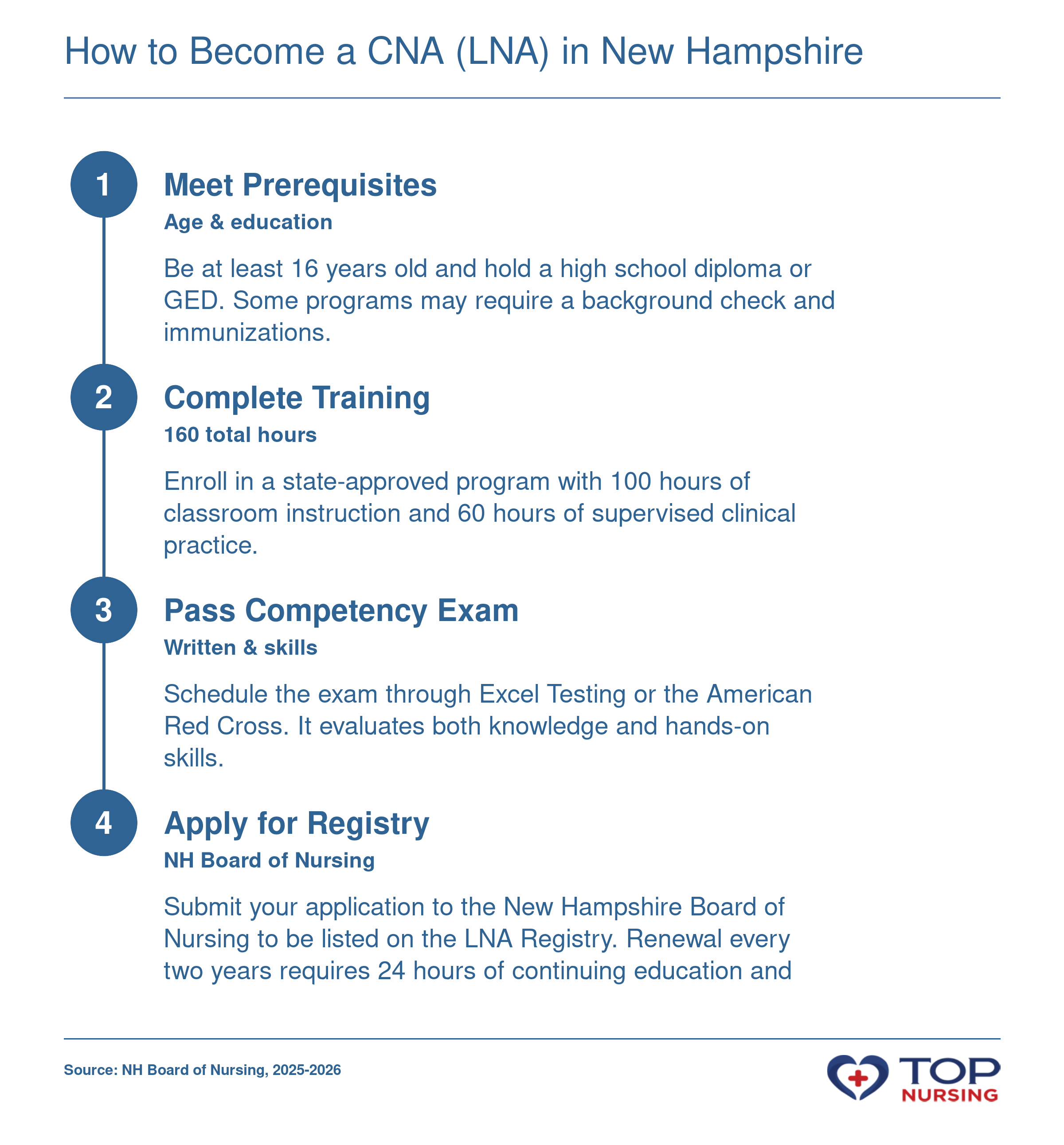
How to Become a CNA (LNA) in New Hampshire
New Hampshire uses the title Licensed Nursing Assistant (LNA), which is functionally the same as the CNA role in other states. The path to certification follows a state-defined sequence of training, examination, and registry listing.
Admission Requirements & How to Apply to NH CNA Programs
Admission to New Hampshire CNA programs is accessible, though applicants should expect some standardized prerequisites along with program-specific criteria.
Common Prerequisites for NH CNA Programs
Age: Most programs set a minimum age of 16, though some may require 18. LNA Health Careers and Great Bay Community College accept students at 16.12
Education: A high school diploma, GED, or HiSET is strongly preferred. St. Joseph School of Nursing explicitly requires one,5 and some schools like River Valley Community College assess reading and math proficiency through placement tests (70% or higher) or TEAS scores.3
Health screenings: A two-step TB test or IGRA within 12 months is standard.14 COVID-19 vaccination may be required (LNA Health Careers mandates it1). Immunizations for Hepatitis B, Varicella, MMR, Tdap, and seasonal influenza are common, Lakes Region Community College requires all five.4 Some schools also require proof of health insurance.4
Background check: All programs require a criminal history screening. The state mandates a fingerprint-based FBI and state check.6 Great Bay, River Valley, and Lakes Region additionally require drug screening and checks against registries like BEAS and OIG, often through platforms like CastleBranch.234
CPR certification: Basic Life Support (BLS) from the American Heart Association is typically required before clinicals.23
Application Deadlines and Enrollment Windows
Many CNA programs in New Hampshire offer rolling admissions with new cohorts starting every few weeks. Community colleges may have set semester start dates, while private training centers provide more flexible enrollment. Great Bay Community College runs multiple sessions per year, each with its own deadline. Because placement testing or prerequisite completion can affect registration, planning ahead is wise; seats often fill quickly.
Employer-Sponsored Program Requirements
Some healthcare facilities, such as nursing homes, offer free CNA training in exchange for a work commitment after certification. These programs may cover tuition, books, and exam fees but typically require you to work for the employer for a set period (e.g., six months to a year). Additional requirements might include passing the facility's pre-employment screening and agreeing to specific shift schedules. Review the contract carefully before accepting.
State Requirements for CNA (LNA) Certification
To become a Licensed Nursing Assistant in New Hampshire, you must complete a state-approved 100-hour training program (including 16 hours of pre-direct care instruction)6, pass a competency evaluation with written/oral and skills components6, and clear a fingerprint-based background check6. The licensure application fee is $286. These represent the minimums; individual programs may add their own prerequisites as described above.
CNA Program Costs in New Hampshire & Financial Aid Options
CNA program costs in New Hampshire range widely, from under $2,000 at some community colleges and hospital-based programs to over $15,000 when considering full-time in-state tuition and fees at public two-year schools. Your actual cost depends heavily on the type of program, any financial aid you receive, and whether an employer covers the training.
How Much Do CNA Programs Cost in New Hampshire?
The total price tag for a CNA program varies by institution. At Manchester Community College, in-state tuition runs $7,090 per year, while out-of-state students pay $15,340. However, CNA certificates are often shorter and less expensive than a full year of study. For example, River Valley Community College advertises a total program cost of $1,900 for its Licensed Nursing Assistant (LNA) certificate. Similarly, the hospital-based St. Joseph School of Nursing program charges $1,782 for seven weeks of training. When comparing schools, note that the listed tuition rates reflect full-time enrollment; most CNA programs are shorter and may have a different fee structure.
It’s also worth looking at the average net price after aid. For all students at New Hampshire community colleges with CNA programs, this figure ranges between about $14,100 and $15,800 per year, according to federal data. While this institution-wide number isn’t specific to CNA students, it shows that most attendees receive substantial grants and scholarships to offset costs.
Financial Aid Options to Lower Costs
Several financial aid sources can reduce what you pay out-of-pocket for CNA training.
Federal Pell Grants: At the four community colleges in our ranking, over 57% of students receive Pell Grants, with rates as high as 72% at White Mountains Community College. If you qualify, Pell funds can cover a significant portion of tuition and fees.
WIOA Grants: The New Hampshire Workforce Innovation and Opportunity Act (WIOA) provides up to $6,500 for eligible individuals, including low-income adults, public assistance recipients, and veterans or their spouses. These grants can fully fund most CNA programs.
Institutional Aid: Some hospital-affiliated programs, like St. Joseph Hospital, offer their own financial aid packages up to $6,500 for LNA students.
Payment Plans: Many programs allow you to spread payments over several months, making costs more manageable.
Employer-Sponsored Free CNA Training in NH
A growing number of New Hampshire healthcare employers will pay for your CNA training in exchange for a work commitment after certification. This can eliminate upfront costs entirely while providing a paid job during or after training.
Concord Hospital Health System offers an 8-week LNA training program. You are hired as a full-time employee with benefits from day one, and the hospital covers all tuition.
Dartmouth Hitchcock and Cheshire Medical Center run a tuition-paid program with a small cohort of eight students, starting in 2026.
Ridgewood Center in Bedford provides a paid, 4-month CNA training program where you earn wages while learning and have tuition covered.
Genesis HealthCare operates nurse aide training programs across its New Hampshire locations, often with employer-paid tuition.
These programs are competitive, so apply early and be prepared to commit to working for the sponsoring facility for a set period after you earn your license.
For more details on program costs at specific schools, check the admissions or financial aid pages of each institution listed in our ranking.
Questions to Ask Yourself
Are you comfortable providing hands-on personal care, such as bathing, feeding, and repositioning patients?
CNAs are the frontline caregivers. If you are uneasy with intimate tasks, the daily reality may feel draining rather than rewarding.
Can you fit classroom and clinical hours into a schedule that may include evenings or weekends?
Many New Hampshire programs require in-person attendance with limited flexibility. Juggling training with work or family obligations can be challenging without careful planning.
Are you looking for a fast entry into healthcare with a path to become an LPN or RN later?
CNA training can take just a few weeks. If your goal is to test the waters before committing to a longer nursing program, this route offers a practical stepping stone.
Program Length, Schedules & Online Availability in NH
The shift toward hybrid CNA training in New Hampshire means aspiring LNAs can now complete theory work from home, but every approved program still requires hands-on clinical hours in a real care setting.
How Long Does It Take to Become a CNA in New Hampshire?
Most full-time CNA programs in New Hampshire last between 3 and 8 weeks, with total instructional hours ranging from 110 to 126. Part-time or evening/weekend tracks typically extend to 10–12 weeks. For example, LNA Health Careers offers an intensive 3-week hybrid program that includes 50 hours of online theory, 16 hours of lab, and 60 hours of clinical work. Other options like St. Joseph School of Nursing (7 weeks, 126 hours) and Concord Hospital (8 weeks, in-person) spread the same content over a longer period. Great Bay Community College runs a 7- to 8-week hybrid cohort during the day, making it a solid fit for recent high school graduates or career changers who can attend full-time.
Schedule Flexibility: Day, Evening, and Weekend Cohorts
Not all programs offer the same scheduling flexibility. LNA Health Careers stands out by providing day, evening, and weekend cohorts, which can be a lifeline for students balancing a job or family responsibilities. River Valley Community College’s LNA track meets during the day only, while other in-person programs, such as Team Select Home Care’s 4-week course, operate on a fixed daytime schedule. If you need to work while training, confirm cohort times before enrolling.
Can You Take CNA Classes Online in New Hampshire?
New Hampshire regulations permit hybrid delivery, meaning the theory portion of LNA training, covering topics like infection control, vital signs, and patient rights, can be completed online. However, all clinical hours must take place at an approved healthcare facility under the supervision of a licensed nurse. This hybrid model is now common: LNA Health Careers and Rockingham County Senior Living both move roughly 50–60 hours of classroom instruction online, reserving in-person time for skills lab and clinical rotations. Great Bay Community College also introduced a hybrid option in 2026. Fully in-person programs remain available at schools such as Concord Hospital, Team Select Home Care, and River Valley Community College for students who prefer a traditional classroom environment.
Hybrid vs. In-Person: What the Top Programs Offer
Among the highly rated CNA programs in New Hampshire, the mix of delivery modes gives you genuine choice. Hybrid programs like those at LNA Health Careers, Great Bay Community College, and Rockingham County Senior Living let you study theory on your own schedule before attending scheduled lab and clinical sessions. In-person programs, Concord Hospital, the St. Joseph School of Nursing, Team Select Home Care, and River Valley Community College, provide face-to-face instruction throughout. Neither format is inherently better; the right pick depends on your learning style, commute, and outside obligations.
CNA Exam Pass Rates & Graduate Outcomes in New Hampshire
Nursing assistant training programs in New Hampshire are increasingly evaluated based on the competency exam pass rates of their graduates, yet public data remains fragmented. For aspiring CNAs, finding reliable pass rate information requires knowing where to look: DHHS, testing vendors, or the schools themselves.
Where to Find Official Pass Rate Data
The New Hampshire Department of Health and Human Services (DHHS) oversees CNA (Licensed Nursing Assistant in NH) training and competency evaluation, but the agency does not currently publish a centralized report of program-level or statewide aggregate pass rates. Prospective students can check the DHHS website for updates or contact the Bureau of Health Facilities Licensing directly. The testing vendors, Prometric and Pearson VUE, administer the exam. However, publicly available pass rate data by school is not routinely posted on their sites. Inquiring with their support teams may yield limited information.
What Individual Training Programs Report
Many community colleges, vocational schools, and healthcare facilities voluntarily publish their pass rates. When researching programs on topnursing.org or school websites, look for a “student outcomes” or “program effectiveness” page. Some programs report a 90% or higher first-time pass rate, while others may not share data. If a program does not list its rates, call the admissions office and ask for the most recent cohort’s performance. Programs accredited by the New Hampshire Board of Nursing are required to track and maintain records, so even if not public, administrators can typically provide figures.
Interpreting Employment Outcomes for NH CNAs
Pass rates indicate exam readiness, but employment outcomes tell a more complete story. The Bureau of Labor Statistics projects steady demand for nursing assistants nationwide, with growth driven by an aging population. In New Hampshire, the healthcare sector remains one of the largest employers, and CNAs are essential in long-term care facilities, hospitals, and home health agencies. Although program-specific job placement data is not standardized, high pass rates often correlate with stronger employability. Ask about graduate job placement services and local employer partnerships when evaluating a school.
Beyond the Numbers: Choosing the Right Program
A high pass rate is encouraging, but it shouldn't be the only factor. Consider the program’s clinical hour requirements, instructor qualifications, and support for state exam preparation. Some programs offer free or low-cost retake vouchers if a student fails the exam. Make sure the program qualifies you for the New Hampshire Nursing Assistant Registry, which is required for employment. A program’s relationship with local healthcare networks can also streamline job placement.
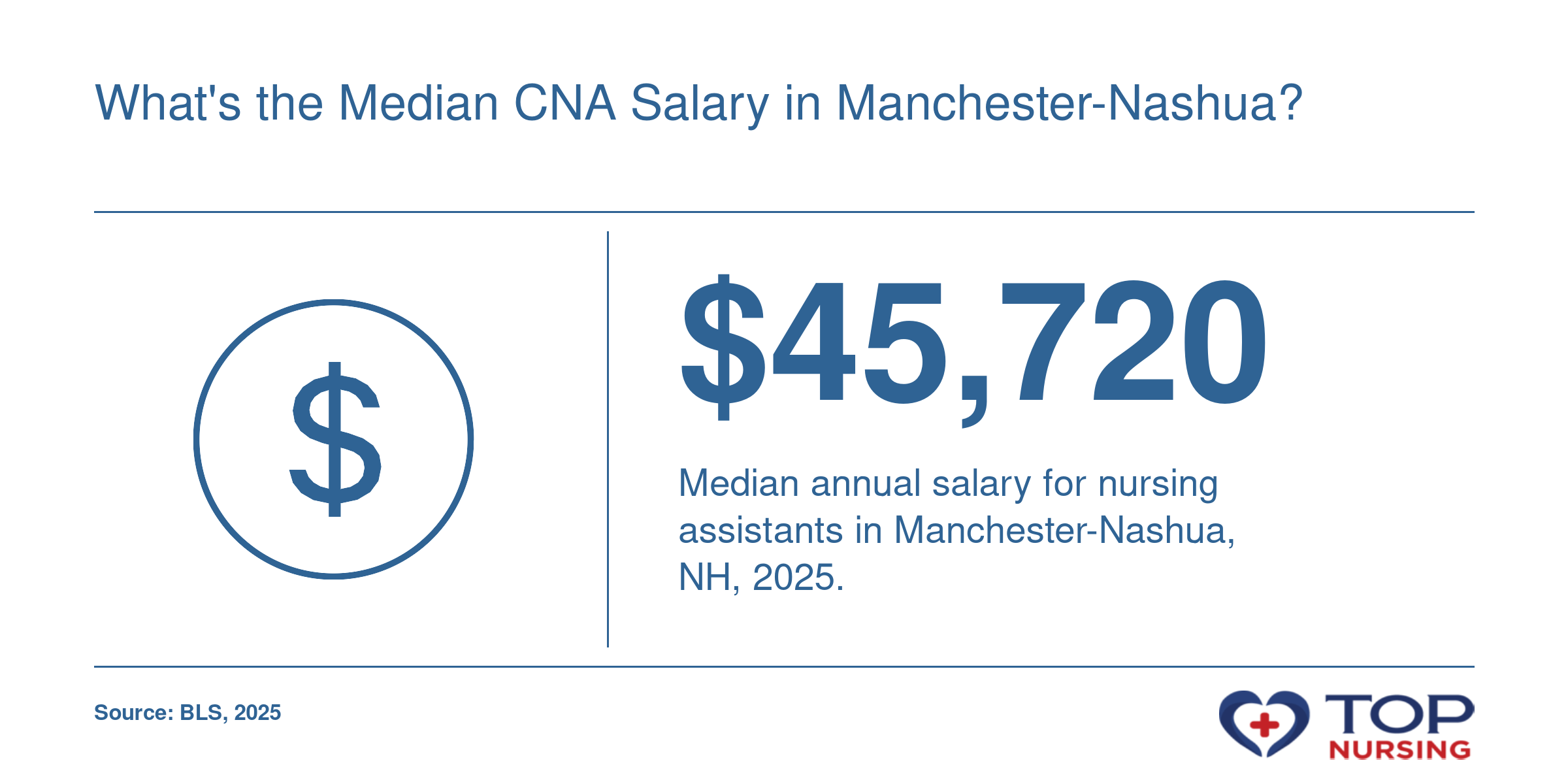
What's the Median CNA Salary in Manchester-Nashua?
The Manchester-Nashua metro area employs the largest number of CNAs in New Hampshire. Here's the median annual wage according to the latest BLS data.
Career Advancement: CNA to LPN to RN Pathways in NH
St. Joseph School of Nursing allows LPNs to transfer up to 17 nursing credits into its 12-month ASN program, carving a direct pathway from licensed nursing assistant to registered nurse. New Hampshire’s nursing career ladder is structured, pragmatic, and increasingly accelerated by bridge programs that reward prior clinical experience.
From LNA to LPN
Most advancement journeys begin with the Licensed Nursing Assistant (LNA), New Hampshire’s term for CNA, moving into practical nursing. Nashua Community College’s LPN Certificate Program explicitly requires current NH LNA licensure as a prerequisite, and it offers a waiver option that can streamline entry for experienced assistants. The Community College System of New Hampshire (CCSNH) runs a 12-month LPN program designed as an on-ramp to the RN level, meaning students are positioned to continue their education without losing momentum. This structure lets LNAs earn a practical nursing credential quickly, often while working part-time in the same clinical settings where they trained.
LPN-to-RN Bridge Programs
Once licensed as an LPN, several state schools offer dedicated bridge tracks. River Valley Community College’s LPN-to-RN Bridge Program and NHTI’s LPN-to-RN completion option are built for working nurses, with schedules that accommodate shift work. St. Joseph School of Nursing’s ASN program for LPNs packs the curriculum into a single year and accepts both nursing (up to 17 credits) and non-nursing (up to 27 credits) transfer hours, significantly shortening the time to an associate degree and RN licensure. These bridges recognize that LPNs already possess fundamental clinical competencies and focus on building assessment, leadership, and complex care skills.
Employer Tuition Assistance
Clinical site partnerships sweeten the deal: St. Joseph Hospital provides tuition reimbursement for employees pursuing higher nursing degrees, a benefit not uncommon among New Hampshire’s larger healthcare networks. CNAs and LPNs working in long-term care, acute care, or home health often find that their employer will cover part or all of tuition for LPN or RN programs in exchange for a work commitment after graduation. Checking with human resources about current tuition assistance policies is a practical first step before enrolling in any bridge program.
Connecting to Higher Nursing Degrees
After earning an RN license, the ladder extends to BSN and beyond. Many New Hampshire RN-to-BSN programs are designed with flexibility for working nurses, and some accept credits from the same CCSNH schools that train LPNs and ADN graduates. For those eyeing advanced practice, the state’s NP program pages outline master’s-level entry points that often require a BSN and RN experience. Mapping the full arc from LNA to NP early can help students select bridge programs that keep doors open, for instance, choosing an ADN program with an articulation agreement into a BSN completion track avoids repeating coursework later.
Frequently Asked Questions About CNA Programs in NH
Navigating the path to becoming a nursing assistant in New Hampshire comes with common questions about terminology, timelines, and costs. Below are clear answers to help you move forward with confidence.
What is the difference between a CNA and an LNA in New Hampshire?
In New Hampshire, the official credential is Licensed Nursing Assistant (LNA) rather than Certified Nursing Assistant (CNA). The role and scope of practice are identical to a CNA in other states. LNAs complete the same type of training and competency exam, so you can think of LNA as New Hampshire's equivalent title.
How long does it take to become a CNA in NH?
Most state-approved training programs take between 4 and 12 weeks to complete, depending on whether you attend full-time or part-time. After finishing the required 100-plus hours of instruction and clinical practice, you are eligible to take the competency exam. Once you pass, your name appears on the New Hampshire LNA Registry.
Can you take CNA classes online in New Hampshire?
While fully online CNA programs are unavailable due to mandatory hands-on clinical hours, many schools offer hybrid formats. These combine online coursework for theory and knowledge with in-person lab and clinical sessions. Always verify that the program is approved by the New Hampshire Board of Nursing before enrolling.
How much does CNA get paid in NH?
According to the U.S. Bureau of Labor Statistics, nursing assistants in New Hampshire earn a median annual wage of approximately $39,000, though pay varies by location, facility type, and experience. Metropolitan areas like Manchester and Nashua often offer higher wages. Full-time positions typically include benefits such as health insurance and paid time off.
What are the requirements to become a CNA in New Hampshire?
You must be at least 16 years old (some programs require 18), have a high school diploma or GED, and complete a state-approved training program of at least 100 hours. After training, pass the written and skills competency exam. A criminal background check, including fingerprinting, and a physical exam with immunization records are also required.
How much do CNA programs cost in New Hampshire?
CNA program costs in New Hampshire range from about $400 to $2,000, depending on the institution. Community colleges and vocational centers tend to be more affordable, while private programs may charge more. Many employers, such as nursing homes, offer tuition reimbursement or free training in exchange for a work commitment after certification.
Do CNA certifications from other states transfer to New Hampshire?
Yes, New Hampshire offers licensure by endorsement for out-of-state nursing assistants. If you hold a current, equivalent CNA credential from another state and are in good standing, you can apply online with the New Hampshire Board of Nursing. The application fee is $28, and a state and federal fingerprint-based background check costs $48–50. No additional exam is required.