Top CNA Programs in Missouri: Compare Top-Ranked Schools

Side-by-side rankings of Missouri's state-approved CNA programs by cost, length, format, and outcomes.

By Hannah Pierce, BSNReviewed by TopNursing.org TeamUpdated May 29, 202625+ min read
Top CNA Programs in Missouri for 2026 | Compare & Enroll

Points of interest…

  • Total CNA training costs in Missouri range from $800 to $1,200, with free employer-sponsored programs widely available.
  • Accelerated courses can be completed in just four weeks, while the state requires 175 hours including 100 hours of clinical work.
  • Certification requires passing the NACES exam after finishing a state-approved program, unlocking entry-level jobs with pathways to higher nursing roles.

Missouri’s healthcare sector added thousands of nursing assistant positions over the past year, and facilities from St. Louis to rural Bootheel communities continue to report urgent staffing needs. State-approved CNA programs fill that demand pipeline, offering training that can be completed in as little as four weeks.

The price of entry matters. Among eight programs ranked by topnursing.org, net prices range from under $6,000 to over $13,000, a spread that can shape where a student enrolls. Matching a low-cost program with a facility that offers tuition reimbursement often makes certification virtually free.

2026 Best CNA Programs in Missouri, Ranked

Our ranking of Missouri's top CNA programs prioritizes affordability, but also considers program flexibility, state approval, and the availability of quick-entry pathways to employment. The schools below offer a mix of traditional campus programs, hybrid options, and stackable credentials to fit different learning styles and career goals.

Factors considered
  • Net price for in-state students
  • Program length and scheduling
  • State approval and exam pass preparation
  • Clinical partnership strength
  • Earnings outlook for graduates
Data sources
RankSchoolLocationNet priceBest for
#1
St. Charles Community College
Cottleville, MO$6,000/yrQuick-start local career changers

St. Charles Community College's CNA program combines a DHSS-approved curriculum with a strong local workforce focus, offering standard and accelerated tracks that can get students into the job market in as little as two months. Students train at skilled nursing facilities throughout St. Charles County, gaining hands-on experience in a holistic learning environment.

Certified Nursing Assistant (CNA) — On-Campus
  • Missouri DHSS-approved program meeting state requirements
  • 75 hours of online classroom instruction plus 100-hour clinical internship
  • Tuition ranges from $600-$950; financial assistance may be available
  • Prepares students for the Missouri CNA certification exam
  • Accelerated hybrid option available for quicker completion
  • Clinical rotations in St. Charles County and West St. Louis County facilities
  • Background check, drug screening, and current vaccinations required
  • Spring and summer start dates with flexible daytime clinical scheduling

State Fair Community College provides a flexible pathway with stackable credentials, from a short Nurse Aide Skills Certificate up to an associate degree, allowing students to enter the workforce quickly or advance into higher nursing roles. The program prepares learners for both Missouri CNA and CMT exams, with online and campus delivery available to fit busy schedules.

Nurse Aide — On-Campus
  • 16.5-credit Skills Certificate for quick entry
  • Prepares solely for the Missouri CNA exam
  • Available on-campus in Sedalia and online
  • Develops foundational nursing and patient care skills
  • Taught by experienced healthcare instructors
  • Can stack into the Professional Certificate and AAS
  • Prepares for both Certified Nurse Assistant and Certified Medication Technician exams
  • Stackable credentials: start with 16.5-credit Skills Certificate
  • Online and on-campus delivery in Sedalia
  • Pathway includes Professional Certificate (31.5 cr) and AAS degree (61.5 cr)
  • Meets certification requirements for Missouri, Illinois, and Kansas
  • Focus on compassion and communication skills for healthcare teams
  • Career services support available

Crowder College's CNA certificate is a short, affordable on-campus program that emphasizes immediate employability, with graduates earning around $18 per hour. The 8-credit curriculum includes background checks and TB testing, and the college's multiple locations make it accessible across the region.

Certified Nursing Assistant — On-Campus
  • 8-credit hour certificate completed in one semester
  • Prepares for Missouri CNA certification and state exam
  • Campus-based training at Neosho or other Crowder locations
  • Average wages for CNAs in the region around $18 per hour
  • Affordable tuition; financial aid available for qualifying students
  • Background check and TB test required for clinical placement
  • Opens doors to flexible full-time work in hospitals and long-term care
  • Short-term program ideal for immediate employment

Metropolitan Community College-Kansas City offers a comprehensive CNA program with 75 hours of theory and lab plus 100 hours of clinical experience, all in person. Tuition covers the state exam, textbook, and equipment, making it a straightforward option for launching a healthcare career in the Kansas City area.

Certified Nurse Assistant — On-Campus
  • 75 hours of theory and lab plus 100 hours of supervised clinical training
  • All training delivered in person at Kansas City campus
  • Tuition covers the state exam, textbook, stethoscope, and gait belt
  • Background check included in program fees
  • Prepares for Missouri Certified Nurse Assistant assessment
  • No prior healthcare experience required; admission application needed
  • Covers essential skills: vital signs, bathing, feeding, transfers
  • Prepares students for entry-level roles in diverse healthcare settings

Jefferson College's CNA program is a 12-week in-person training that costs $2,550 and includes an optional apprenticeship, with a clear pathway to its PN and RN programs. The college's strong transfer agreements and full state board approval make it a strategic starting point for nursing career advancement.

Certified Nurse Assistant (CNA) — On-Campus
  • 12-week in-person program with a fixed $2,550 cost
  • 75 classroom hours and 100 clinical practice hours
  • Prepares for both state knowledge and skills exams
  • Optional apprenticeship opportunity for hands-on experience
  • No prior experience or educational prerequisites required
  • Clinical training in long-term care facilities under instructor supervision
  • Eligible for Missouri CNA certification upon exam passage
  • Focus on basic nursing care, resident safety, and communication
  • PN certificate as the first step in Jefferson's Bi-Level Nursing Program
  • Full approval by the Missouri State Board of Nursing
  • Day and evening class options available
  • Credits can transfer to a BSN program through guaranteed agreements
  • Provides a direct pathway to the Level II/RN Associate Degree
  • Prepares for the NCLEX-PN licensure exam
  • Entry into the nursing career ladder with strong job prospects

East Central College's CNA program offers small cohort sizes (capped at 15 students) and a supportive environment, with costs ranging from $800 to $1,500 and state funding available. No high school diploma is required, and graduates are prepared for Missouri's certification exam after 14-16 weeks of combined classroom and clinical instruction.

Certified Nursing Assistant (CNA) — On-Campus
  • 75 classroom hours plus 100 clinical hours in approved facilities
  • Program costs range from $800 to $1,500; state funding available
  • No GED or high school diploma required; must be 18 years old
  • Small class size: limited to 15 students for personalized instruction
  • Campus-based program lasting 14-16 weeks
  • Graduates prepared for the Missouri CNA certification exam
  • Clinical placements provided in regional healthcare settings
  • Strict attendance policy ensures comprehensive hands-on learning

Saint Louis Community College, in partnership with BJC HealthCare, delivers a 9-week hybrid Patient Care Technician program that graduates can convert into full-time employment. The curriculum blends online coursework with hands-on clinical practice at partner hospitals, with funding available for eligible students and no prior experience needed.

Patient Care Technician Training — On-Campus
  • 9-week hybrid program combining online and in-person classroom
  • Direct partnership with BJC HealthCare for clinical placements
  • Hands-on clinical practice with partner hospital shifts
  • Funding available for qualified students; no upfront experience needed
  • Graduates eligible to challenge the Missouri CNA exam
  • Certificate of completion and potential full-time employment with BJC
  • Flexible scheduling with 12-hour clinical shifts, including weekends
  • Covers patient care, vital signs, and teamwork in healthcare

Missouri State University-West Plains embeds CNA training within a Certificate of Pre-Nursing, positioning students to both earn Missouri CNA certification and satisfy prerequisites for the university's nursing programs. The 28-31 credit hour curriculum integrates foundational sciences and clinical practice, making it ideal for those aiming to continue toward an associate or bachelor's degree in nursing.

Certificate of Pre-Nursing — On-Campus
  • 28-31 credit hour certificate including CNA theory (ALH 100) and clinical (ALH 105)
  • Campus-based delivery with fall and spring semesters
  • Satisfies prerequisites for the university's nursing program application
  • Requires an active CNA license or completion of the embedded CNA courses
  • Curriculum covers anatomy, physiology, medical terminology, and psychology
  • Prepares for Missouri CNA certification and entry to an ASN program
  • Focuses on foundational skills: vital signs, patient mobility, documentation
  • Designed for students planning to continue to PN, RN, or BSN degrees

How Much Does CNA Training Cost in Missouri?

CNA training costs in Missouri reflect the price of a short-term certificate program designed to get you working quickly. While tuition is the headline number, the true out-of-pocket expense includes several smaller fees that first-time students often overlook. Looking at both program prices and required extras gives you a realistic budget before enrollment.

Typical Tuition for CNA Programs

Community college programs are the most common starting point, with many falling between $500 and $2,000 for the entire course. Franklin Technology Center, for example, charges $820 in tuition, though the $125 state competency exam is a separate fee paid directly to the testing vendor. The Missouri Health Care Association (MHCA) offers a 175-hour hybrid course for $700 for members and $1,400 for non-members, with an online theory component and in-person clinical hours. Some schools, like East Central College, even run no-cost CNA pre-apprenticeships through grant funding, bringing tuition down to zero for eligible students. Private training centers may charge higher rates, but the median self-pay price across the state sits around $1,000–$1,500.

Hidden Costs to Budget For

Beyond tuition, several required expenses quickly add up:

  • Uniforms: $40–$120 for scrubs and non-slip shoes.
  • Background check and health screenings: $50–$200, depending on the provider and required immunizations.
  • Textbooks and supplies: Costs vary, but many programs include materials in tuition; always confirm.
  • State certification exam: $125, paid to Headmaster (the current testing vendor) at the time of testing.

These extras can push the total to $1,500 or more, even when tuition looks low. Always ask the program coordinator for a full breakdown before enrolling.

How Institutional Pricing Data Compares

The ranked schools on this page show a net price effective range from $5,837 to $13,128, but those figures represent the average amount all students pay across every program at each institution, not just CNA training. Shorter certificate programs like the CNA frequently cost far less than an associate degree pathway, so the program-specific prices above give a much clearer picture. Free and employer-sponsored training options are explored in more detail later in this guide.

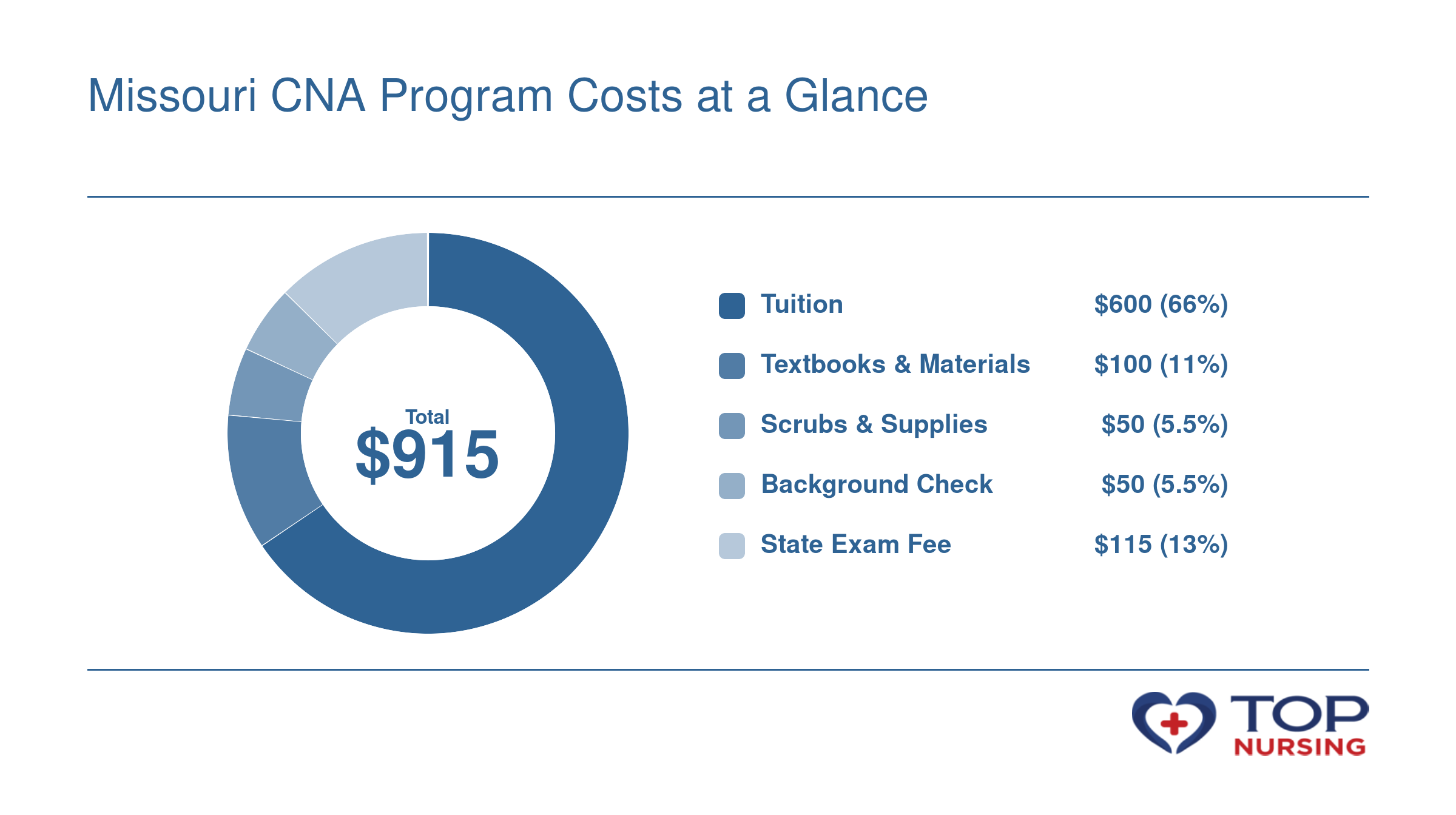
Missouri CNA Program Costs at a Glance

The total cost to become a certified nursing assistant in Missouri typically ranges from $800 to $1,200 depending on the program type. This example uses a mid-range community college program to illustrate the key expenses.

Breakdown of total cost to become a CNA in Missouri: $600 tuition, $100 textbooks, $50 scrubs, $50 background check, $115 exam fee, totaling $915.

Free CNA Training Options in Missouri

Is it really possible to earn your CNA certification in Missouri without paying out of pocket? Yes, and it is more common than many aspiring nursing assistants realize. Several pathways exist, from employer-sponsored programs at nursing homes and hospitals to state and federal grants that wipe out tuition completely. The trade-off is often a work commitment, but for many, that is a fair exchange for launching a healthcare career with zero training debt.

Employer-Sponsored CNA Training at Nursing Homes and Hospitals

Federal rules require Medicare- and Medicaid-certified nursing homes to offer nurse aide training, and many facilities turn that mandate into a direct hiring pipeline. In Missouri, you will find well-known names investing heavily in free apprenticeship models.

  • Delmar Gardens CNA Apprentice Program: Provides 175 hours of paid training and gives you up to 120 days after hire to pass the state certification exam. You earn a paycheck while you learn.
  • Bethesda Health Group Apprenticeship: Pays you during training and sweetens the deal with bonus incentives for completing milestones.
  • STL Training CNA Apprenticeship: Runs a ten-week, completely free program designed to move you quickly into a skilled role.
  • Large hospital systems like BJC HealthCare: Often maintain their own courses or partner with local colleges to train and hire CNAs directly for their units.

These programs are a win-win: you avoid tuition and fees, and the employer builds a reliable, homegrown workforce. Just be ready to hit the ground running because clinical rotations typically happen right where you will eventually work.

State and Grant-Funded Programs That Cover Training Costs

If you need more flexibility or a college-based setting, Missouri offers several grant-backed options that cover 100% of your CNA training costs.

  • East Central College CNA Pre-Apprenticeship: Charges zero dollars, is funded entirely by a grant, and requires students to be at least 18 years old. It serves as a direct on-ramp to local healthcare employers.
  • Missouri SkillUP: Designed for SNAP recipients, this workforce development program can pay for CNA training and requires 80 hours per month of work-focused activity. Unlike many employer-sponsored tracks, SkillUP has no post-certification work commitment attached.
  • Health Profession Opportunity Grants (HPOG): Although grant cycles change, HPOG funds have historically supported free CNA cohorts at community colleges and training providers throughout the state, East Central’s pre-apprenticeship is one example of this type of funding in action.

Even online training, such as the program offered through the Missouri Health Care Association, may become virtually free if a partnering facility sponsors your enrollment, so it is worth asking about tuition reimbursement when interviewing with potential employers.

The Work Commitment Behind Free Training

The catch with most free CNA programs is the service agreement. Employer-sponsored courses almost always require you to work for the sponsoring facility for a set period after you earn your license, typically six months to one year. If you leave early, you may owe back the full cost of training, which can run several hundred dollars. Always read the fine print before you sign. Programs funded by public grants like SkillUP generally do not carry this obligation, making them an attractive option if you want the freedom to choose your first job.

Can Federal Financial Aid Help?

Short CNA programs that last only a few weeks are generally not eligible for Pell Grants, but longer programs bundled into a community college certificate or degree can qualify. For example, Franklin Technology Center’s CNA course includes 175 classroom hours and 100 clinical hours, making it a more substantial training block that may meet federal aid duration rules. If you are already enrolled in a practical nursing or patient care technician track, your CNA coursework often fits inside that larger program and can be covered by Pell Grants or other Title IV aid, effectively reducing your out-of-pocket cost to zero.

Fastest CNA Programs in Missouri

A rigorous four-week intensive course and a semester-long evening program both lead to the same CNA certification in Missouri. The path you choose depends on your availability and urgency.

Understanding Accelerated CNA Programs

Some Missouri training sites offer compressed schedules that let you finish in as little as four to six weeks. These fast-track options typically run full-time during weekdays and demand heavy focus, but they deliver rapid entry into the job market. The Missouri Department of Health and Senior Services maintains a public list of state-approved CNA training programs, which frequently includes course-length estimates and direct contact information. Starting there is the fastest way to identify which schools near you offer a short-form track.

Finding a Schedule That Works for You

The U.S. Bureau of Labor Statistics provides a Find a School tool that lets you search for CNA programs by location and filter by training format. It can display typical completion timelines, although the details may be generic. For the real picture, call admissions offices directly. Ask point-blank: “What is the shortest possible path to sitting for the state exam, and when does the next accelerated section start?” Not all schools prominently advertise their quickest option, and some may let you test out of basic modules if you have prior healthcare experience.

Community colleges and vocational schools are often the best source for evening or weekend CNA classes. These follow a standard academic calendar, running 8 to 12 weeks, and are designed for working adults. While not as fast as a full-time sprint, they offer consistency and the ability to keep a job while training.

Where to Look in Missouri

Public technical colleges in the St. Louis, Kansas City, and Springfield metro areas routinely offer multiple CNA class formats. Smaller rural campuses across the state may only run a few cycles per year, but their websites often call out accelerated summer sessions. Always verify program length and eligibility directly, as course hours and prerequisites can shift. The Missouri Department of Health and Senior Services website lists contact details for every approved program, so you can call and compare.

Questions to Ask Yourself

Full-time programs take four to six weeks but require daytime attendance. Flexible schedules accommodate work but add two to four weeks to completion.

Employer-paid programs remove tuition costs but typically require a one-year work agreement, restricting immediate job changes after certification. You save money upfront but trade flexibility for at least a year.

Programs with articulated college credit or prerequisites can shorten your path to advanced nursing roles and save on future tuition.

Online and Hybrid CNA Classes in Missouri

Balancing online flexibility with the essential hands-on experience of CNA training is a central decision for many aspiring nurses in Missouri. The state mandates a total of 175 training hours, including a minimum of 100 hours of supervised clinical practice and 75 hours of classroom instruction. While some classroom theory can be completed online through approved programs, the clinical component must be conducted in person at a licensed healthcare facility. The Missouri Department of Health and Senior Services (DHSS) does not pre-approve a blanket list of fully online or hybrid programs; instead, it reviews each training entity’s curriculum on a case-by-case basis. This means you should verify a program’s status directly with the school and the state before enrolling.

How Missouri Structures CNA Training Hours

The 175-hour minimum is split to ensure you gain both the knowledge and the practical skills required for certification. The 75 classroom hours cover topics like infection control, patient rights, and communication. The 100 clinical hours involve direct patient care under an instructor’s supervision. DHSS regularly updates training standards, so always check the DHSS website for the most current breakdown. For the 2025-2026 cycle, no major shifts have been announced, but small adjustments to online allowances may occur. Contact DHSS directly if you find conflicting information between a school’s claims and state rules.

Where Online Learning Fits In

Online CNA classes in Missouri can cover the theoretical portion of the curriculum, often through self-paced modules, video lectures, or virtual simulations. However, the clinical hours cannot be replaced by online work. Schools that offer hybrid formats typically deliver the classroom segment online and arrange in-person clinical rotations at partner nursing homes or hospitals. Because DHSS approval is program-specific, not all online offerings are automatically accepted for certification. Ask the program coordinator to confirm that their online components meet DHSS standards and that the clinical site is approved for the required number of hours.

Locating Approved Hybrid Programs

There is no single public database of DHSS-approved hybrid CNA programs, so you will need to do some detective work. Start by visiting the websites of community colleges, vocational schools, and healthcare training centers in your area. Look for language about ‘online’, ‘hybrid’, or ‘blended’ formats. Then, reach out to the admissions office to ask whether the program has current DHSS approval for its online components. Professional organizations such as the Missouri Health Care Association sometimes provide lists of member training programs, which can serve as a useful shortcut. Keep in mind that a program that was hybrid last year may have changed its format, so always verify for the current enrollment period.

Confirm Requirements Before You Enroll

Before committing, verify the program’s accreditation, the number of clinical hours included, and the total cost. Check the DHSS website for any recent bulletins or memos regarding online training waivers or updates. The Bureau of Labor Statistics (BLS) can offer broad job market insights, Missouri CNAs are projected to see steady demand, but rely on DHSS for exact training mandates. Once you have a shortlist of approved hybrid programs, compare their clinical site locations, schedules, and student support services to find the best fit for your situation.

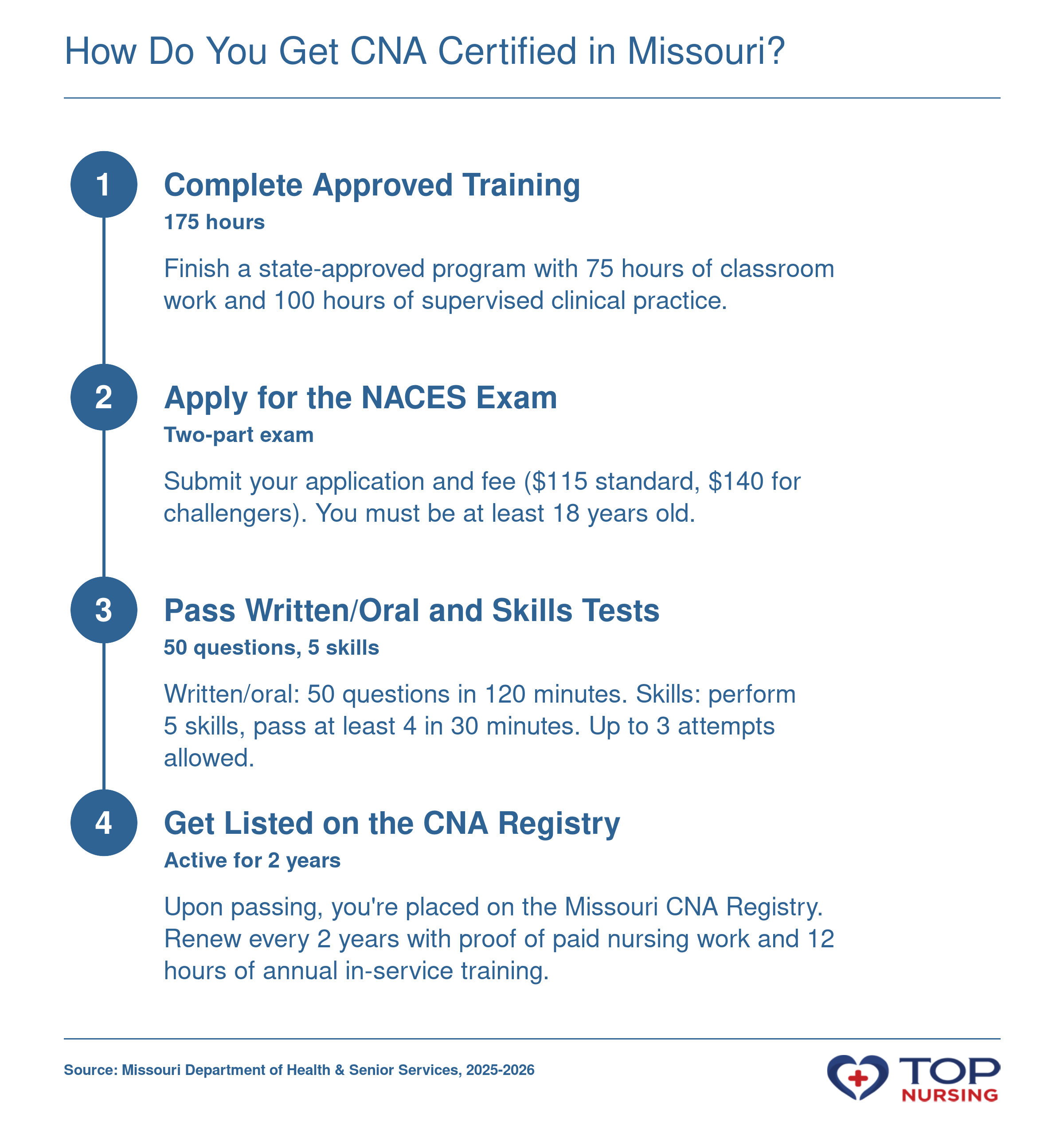
How Do You Get CNA Certified in Missouri?

Step-by-step process to become a CNA in Missouri: complete 175-hour training, pass NACES exam, and get listed on the state registry.

How to Get Certified as a CNA in Missouri

Becoming a CNA in Missouri follows the general steps to becoming a CNA, centered on completing a state-approved 175-hour training course and passing the NACES competency examination. Once you clear both, the Missouri Nurse Aide Registry adds your name, making you eligible to work in licensed settings. The pathway is straightforward, but each step has details you need to know before you begin.

Training: 175 Hours of Instruction and Practice

Missouri requires all aspiring CNAs to finish a training program with exactly 175 hours of instruction. The breakdown is fixed: 75 hours of classroom learning and 100 hours of supervised clinical practice. Classroom hours cover basic nursing skills, infection control, patient rights, and safety procedures. Clinical hours take place in a nursing home or long-term care facility where you work directly with residents under instructor supervision. Programs must be approved by the Missouri Department of Health and Senior Services (DHSS) and typically last 4 to 12 weeks. You cannot challenge the competency exam without completing an approved program, so choosing a DHSS-listed provider is non-negotiable.

The NACES Exam: Written Knowledge and Skills Demonstration

After finishing training, you sit for the National Nurse Aide Assessment Program (NACES) exam, which Missouri uses for certification. The exam has two parts: a written (or oral) knowledge test and a skills demonstration. The written test includes 70 multiple-choice questions covering typical aide responsibilities; you can request an oral version if you prefer listening to questions. You need a score of 75% or higher to pass. The skills component requires you to perform five randomly selected nursing assistant tasks correctly from a list of about 25 possible skills. A state evaluator watches and rates your performance. If you fail either part, you may retake it up to three times within two years before you must re-train. You must present a social security card and valid photo ID on exam day.

Registry Listing and Renewal

Passing both exam sections triggers an automatic application to the Missouri Nurse Aide Registry. Within a few weeks, you appear on the state’s online database, which employers check before hiring. The state also requires a fingerprint-based background check; any disqualifying criminal convictions may block registry listing. Once listed, your credential stays active for 24 months. To renew, you must provide proof of at least 8 hours of paid CNA work in a nursing home, hospital, or home health agency during the two-year period. If you haven’t worked the required hours, you can retake the competency exam instead. Renewal also needs completion of 8 hours of in-service or continuing education training per cycle.

CNA Salary and Job Outlook in Missouri

Certified nursing assistants in Missouri earn pay that reflects entry-level healthcare roles, but the state's low training costs make the field financially accessible. While exact graduate earnings for the ranked programs are not yet available from the College Scorecard, broader institutional data shows that former students from these schools typically see median earnings of $35,000 to $42,000 per year a decade after starting college, a range that suggests solid wage potential for many who complete short-term CNA training.

What Nursing Assistants Earn Across Missouri

Missouri employed roughly 32,650 nursing assistants in 2024, with wages spanning a wide range depending on experience, employer, and location. According to state labor data:

  • Low-end (10th percentile): $31,390
  • Typical entry (25th percentile): $34,770
  • Typical mid-career (75th percentile): $40,170
  • High-end (90th percentile): $50,140

Half of CNAs in Missouri earn between about $34,770 and $40,170 annually. That spread gives a realistic picture: new graduates often start near the lower end, but earnings grow with experience, additional credentials, and shift differentials.

Metro Area Pay Differences

Where you work in Missouri matters. Though precise metro-level data fluctuates, historical patterns show that urban hubs tend to pay more:

  • St. Louis – Wages often run 5–10% above the state median, driven by large hospital systems.
  • Kansas City – Salaries are comparable to St. Louis, with strong demand in both Missouri and Kansas portions of the metro.
  • Springfield – Pay is typically closer to the statewide median, but the lower cost of living can stretch earnings further.

Rural areas may offer fewer openings but sometimes compete for aides with higher starting pay or sign-on bonuses.

Job Growth and Demand in Missouri

Nationally, the BLS projects only 2% growth for nursing assistants from 2024 to 2034, slower than average. However, Missouri’s aging population and high concentration of long-term care facilities suggest local demand may outpace that figure. Turnover in the field is high, which creates continuous job openings even in a flat-growth environment. Hospitals, skilled nursing facilities, and home health agencies remain the biggest employers, and many offer on-the-job training advancement paths toward LPN or RN roles.

Strong ROI: Low Training Cost vs. Steady Pay

CNA training in Missouri typically costs between $800 and $1,500, and many programs can be completed in just a few weeks. Even a full-time worker earning at the 10th percentile ($31,390) can recoup training expenses within the first month or two. Compare that to the debt often associated with longer healthcare degrees, and the return on investment becomes clear. The modest upfront commitment makes CNA certification a low-risk way to enter healthcare, especially for those considering more advanced nursing careers later.

For a closer look at how training costs break down, the section on program costs earlier in this guide provides detailed tuition ranges and free training options.

CNA Wages by Missouri Metro Area

Where you work as a certified nursing assistant in Missouri can noticeably affect your paycheck. Metropolitan areas with larger healthcare systems and higher costs of living tend to offer higher median wages.

Median annual CNA wages in St. Louis ($38,030), Kansas City ($37,280), Columbia ($35,620), Springfield ($34,460), Cape Girardeau ($32,480), and Joplin ($32,050) based on May 2024 BLS data.

CNA Career Advancement Pathways in Missouri

CNA experience in Missouri builds a direct foundation for advancing into higher-paying nursing roles, with each step up the career ladder bringing significant salary increases and expanded responsibilities.

From CNA to LPN: Next Step on the Ladder

Moving from a certified nursing assistant to a licensed practical nurse typically takes 10 to 12 months of full-time study, such as the accelerated practical nursing program at Cass Career Center that runs just over 10 months. While Missouri does not have a formal CNA-to-LPN bridge program that grants advanced standing, your hands-on patient care hours strengthen your application to any state-approved practical nursing program. Nationally, the median annual wage for nursing assistants was $36,220, while LPNs earned $55,860, a difference of roughly $19,640 per year. Actual Missouri wages may vary by region and employer, but the earning potential makes the year of training a sound investment. Use the LPN program directory on this site to compare approved schools in your area.

LPN-to-RN Bridge Programs in Missouri

Once you hold an LPN license, several Missouri colleges offer dedicated bridge pathways to an associate degree in nursing (ADN) or a bachelor of science in nursing (BSN). Bolivar Technical College runs an RN Bridge Program, Missouri State University-West Plains has an LPN to RN Track, and Moberly Area Community College offers an LPN to ADN option. Metropolitan Community College also provides a bridge program that builds on your existing nursing knowledge. The RN bridge programs directory on this site includes these and other Missouri options.

Medication Aide: An Incremental Pay Boost

If you want to earn more without committing to a full LPN program, consider becoming a medication aide. Missouri regulates this role, requiring CNA-level certification plus additional state-approved training focused on medication administration in long-term care settings. Although salary data for medication aides is less standardized, the credential often adds $2 to $4 per hour above a typical CNA wage and can serve as a stepping stone toward LPN training.

Beyond RN: Advanced Practice Options

After becoming an RN, you can continue your education with RN-to-BSN completion programs or eventually pursue advanced practice roles such as nurse practitioner. Each advancement widens your scope of practice and increases earning power, making your initial CNA certification the start of a long-term nursing career in Missouri.

Frequently Asked Questions About CNA Programs in Missouri

Before you choose a CNA program, get answers to the most common questions about costs, timelines, online options, and what happens after certification. These quick answers reflect Missouri’s current requirements and training landscape.

How much does CNA training cost in Missouri?
CNA program costs in Missouri typically range from $500 to $1,500, depending on the institution and whether you qualify for financial aid. Community colleges and technical schools often charge on the lower end, while private training centers may be higher. Many employers, nursing homes, and workforce development programs offer free or sponsored training, significantly reducing out-of-pocket expenses.
How long does it take to become a CNA in Missouri?
Most Missouri CNA programs require 4 to 12 weeks to complete, depending on whether you attend full-time, part-time, or an accelerated course. The state mandates a minimum of 75 hours of training, including classroom instruction and clinical practice. After finishing your program, you can take the competency exam within a few weeks, allowing you to earn certification in as little as two months.
Can you take CNA classes online in Missouri?
Yes, several Missouri programs offer hybrid or fully online classroom components, but hands-on clinical hours must be completed in person at a healthcare facility. Online theory courses provide flexibility for working students, covering topics like infection control and resident rights. Always verify that the program is approved by the Missouri Department of Health and Senior Services to ensure eligibility for the state exam.
Are there free CNA training programs in Missouri?
Yes, many nursing homes, long-term care facilities, and hospitals cover training costs in exchange for a work commitment. Additionally, Missouri workforce development boards and community colleges sometimes offer grants or scholarships for eligible students. The MO HealthNet and WIOA programs are common funding sources. These free options often include exam fees and materials, making certification accessible with minimal financial burden.
What are the requirements to become a CNA in Missouri?
To enroll in a Missouri CNA program, you generally need a high school diploma or GED, be at least 18 years old, pass a background check, and provide proof of immunizations. After completing a state-approved training program with at least 75 hours, you must pass the written and skills competency exam. Once certified, your name is added to the Missouri Nurse Aide Registry, which must be renewed every two years.
What comes after CNA certification?
After becoming a CNA, many choose to gain experience in hospitals, nursing homes, or home health agencies while pursuing further education. Common advancement paths include becoming a Licensed Practical Nurse (LPN) or Registered Nurse (RN) through bridge programs that often offer credit for your CNA background. Some CNAs also specialize in areas like restorative care or move into administrative roles within healthcare facilities.
Do Missouri CNA certifications transfer to other states?
Missouri does not have a formal reciprocity agreement for CNAs, but you can typically transfer your certification to another state by applying for reciprocity or endorsement. The new state may require proof of your active Missouri certification, work history, and possibly additional background checks. Some states require a challenge exam if the training hours differ. Always contact the destination state's nurse aide registry for specific steps.

Recent Articles