Top Online CNA Programs for Alaska Students in 2026
Compare ranked programs by cost, outcomes, and flexibility — plus Alaska certification requirements and salary data.
By Maria Delgado, RNReviewed by TopNursing.org TeamUpdated May 29, 202622 min read
At a Glance
Alaska CNAs earn median wages above the national average, driven by high demand and cost of living.
No fully online CNA programs exist in Alaska, requiring students to complete clinical hours locally.
State-approved programs require 140 training hours: 60 classroom and 80 clinical, plus a two-part exam.
CNA-to-LPN bridge programs take as few as nine months, enabling rapid career advancement.
Alaska’s vast distances and limited public transportation mean that aspiring CNAs often face a choice: relocate temporarily to an urban training site or enroll in an online program from an out-of-state provider.
With no in-state programs meeting our ranking criteria, online options have become the default pathway for most Alaskan students. These programs deliver coursework remotely but require local clinical placements, a hurdle in a state where healthcare facilities are concentrated in a handful of cities. Alaska nursing assistants earn wages significantly above the national median, driven by high demand in tribal health clinics and long-term care settings, yet the training bottleneck persists.
Best Online CNA Programs for Alaska Students
Alaska does not currently host any online CNA programs that meet our ranking criteria, so the following nationally available online programs offer a pathway for Alaska students. These programs deliver didactic coursework remotely, but clinical and skills hours must be arranged at a local healthcare facility; always confirm site availability before enrolling. Rankings emphasize online delivery flexibility, affordability, and program quality.
Infinity College offers a two-week Nursing Assistant program with hybrid evening classes and small class sizes. The curriculum includes infection control, safety, personal care, and an 80-hour externship. The college reports an institution-wide graduation rate of 85%, and its low net price makes it a standout for cost-conscious learners.
Northeast Wisconsin Technical College's Nursing Assistant technical diploma prepares students for state certification with a hybrid format and flexible class schedules. The program combines classroom learning with clinical experiences and is approved by the Wisconsin Department of Health Services. The college has a graduation rate of 51% and a strong graduate employment rate of 91%.
Hybrid delivery with day, evening, weekend options
3 credits required
80% minimum pass rate
Includes clinical experience at local facilities
Eligible for Wisconsin competency exam
Graduates report 91% employment rate
#3
Odessa College
Odessa, TX
$3,000 – $5,000/yr
Budget-focused students wanting all-inclusive pricing
Odessa College's accelerated eight-week CNA program blends online learning with weekend clinical rotations, making it accessible for working students. The program is competitively priced and includes all required materials, and graduates are prepared for the Texas Nurse Aide exam. The institution has a graduation rate of 37% and serves a high Pell-eligible population.
Cloud County Community College's 90-hour Certified Nurse Aide program uses a blended online and in-person format to prepare students for state certification. The program emphasizes hands-on clinical sessions and is eligible for military and financial aid. The college has a graduation rate of 55% and a student-faculty ratio of 12:1, indicating a supportive learning environment.
Pima Medical Institute's Nursing Assistant/Nurse Aide certificate program takes about six weeks and is offered at multiple campuses, including Aurora, Colorado. The curriculum covers clinical skills, infection control, and communication, with hands-on training from experienced instructors. The institute reports a 72% graduation rate and provides career services to support job placement.
Mid-State Technical College offers an 81-hour Nursing Assistant technical diploma that combines online and on-campus learning with a clinical practicum. The program cost is remarkably affordable, and multiple campus locations provide flexibility. The college has a graduation rate of 52% and a 13:1 student-faculty ratio.
Brightpoint Community College's Nurse Aide/Medication Aide Career Studies Certificate is a hybrid program covering anatomy, safety, and medical documentation. Students complete an internship for hands-on experience, and eligible Virginians may receive G3 tuition assistance. The college has a graduation rate of 38% and serves a student body where over 80% receive Pell Grants.
Chippewa Valley Technical College's Nursing Assistant technical diploma can be completed in 14 weeks or less, with face-to-face learning at Eau Claire and River Falls campuses. The program cost is an estimated $423, and credits can transfer toward an associate degree in Nursing. The college reports a 50% graduation rate and a 78% graduate employment rate.
Victoria College's Nurse Aide program pairs a free 60-hour online theory course with 50-60 clinical hours on campus and at local healthcare agencies. Tuition of $650 includes a textbook, and successful completion leads to the Texas Nurse Aide Registry exam. The college has a graduation rate of 29% and a notably low net price.
Offered at Victoria Main Campus and Gonzales Center
Flexible scheduling options
#10
College of Western Idaho
Nampa, ID
~$9,000/yr (est.)
College of Western Idaho's Certified Nursing Assistant Preparation program spans 12 weeks and blends online instruction with in-person skills training. The program is priced at $945 and is open to students age 16 and older. The college has a graduation rate of 31% and a student-faculty ratio of 20:1.
Are Online CNA Programs Available for Alaska Students?
Online education has transformed how Alaskans access career training, but nursing assistant certification still demands a blend of virtual learning and real-world practice. The state’s low population density and limited training infrastructure outside Anchorage, Fairbanks, and Juneau explain why brick-and-mortar CNA programs rarely appear in local rankings. For students in remote or rural areas, an online program is often the only practical gateway to becoming a certified nursing assistant.
How Online CNA Programs Blend Virtual and In-Person Learning
An online CNA program is not fully remote. Classroom theory, such as infection control, anatomy, and patient rights, is delivered through a digital platform, allowing you to study from home. The hands-on portion, including skills labs and 80 hours of clinical experience, must be completed in person at an approved healthcare facility. This hybrid model lets you focus on academic work independently while gaining direct patient care experience under supervision.
Meeting Alaska’s 140-Hour Training Minimum
The Alaska Board of Nursing mandates 140 total training hours: 60 hours of classroom instruction and 80 hours of clinical practice. Online programs do not automatically satisfy this standard. Only courses that are state-approved or qualify through an endorsement or equivalency pathway will make you eligible for the NNAAP credentialing exam. Before enrolling, request a detailed hour breakdown from any online provider and compare it to Alaska’s minimums. The state’s training program approval list, maintained by the Board, can help you verify a program’s status.
Arranging Your Clinical Placement in Alaska
The biggest hurdle for online students is securing a clinical site. The Board of Nursing accepts clinical hours completed in Alaska only if the training program is Alaska-approved or if you are pursuing certification via endorsement. Reach out to potential programs early and ask whether they have existing partnership agreements with hospitals in Anchorage, Fairbanks, or Juneau. These urban centers are the most likely to host student rotations. If you live in a smaller community, be prepared to travel, or confirm that the program can coordinate with a local long-term care facility. Do not assume a program’s out-of-state approval transfers automatically.
A Pathway Built for Rural Alaskans
Despite the logistical effort, an online program remains the most accessible route for students who cannot relocate for a semester or more. The ranked options on this page have been selected because their structures align with Alaska’s 140-hour requirement and they offer clear guidance on setting up clinical placements inside the state. For a student in Nome, Ketchikan, or Bethel, this hybrid model removes the barrier of uprooting for classroom lectures while still meeting the Board’s standards for certification.
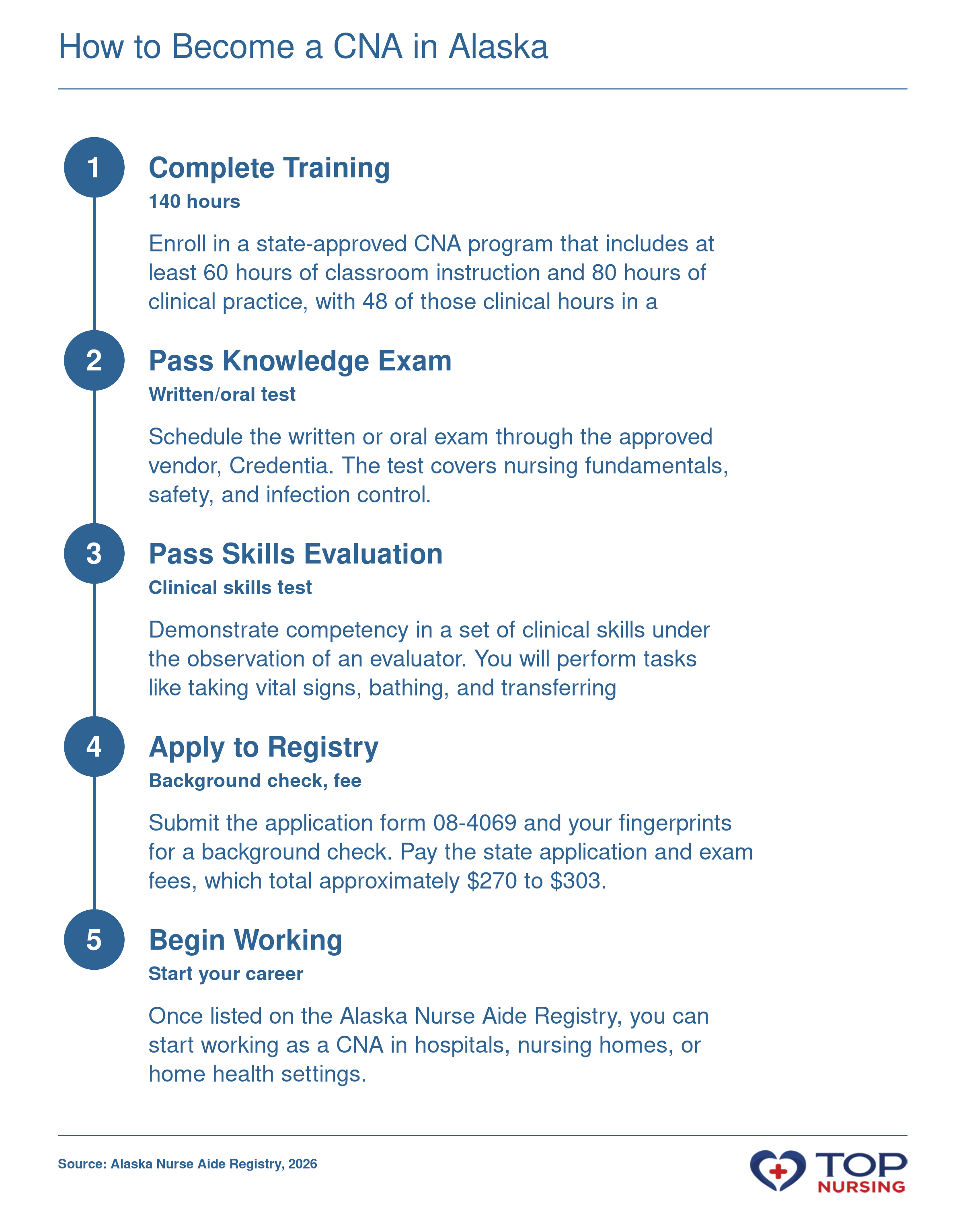
How to Become a CNA in Alaska
Becoming a CNA in Alaska follows a clear sequence that can be completed in a matter of months. Here is the typical path from enrollment to your first job.
Alaska CNA Certification Requirements and Exam Details
Alaska requires a clear set of steps before you can sit for the state certification exam. The process starts with completing a state-approved training program and ends with passing a two-part competency evaluation.
Training Hour Breakdown
Alaska mandates a minimum of 140 hours of training. This includes a mix of classroom instruction and hands-on clinical practice. While specific hour splits can vary by program, the standard model dedicates roughly half the time to theory (covering infection control, patient rights, and basic nursing skills) and half to supervised clinical work in a skilled nursing facility. The clinical component ensures you practice real patient care under instructor guidance. You must complete the training before applying to test.
The Two-Part Credentia/NNAAP Exam
Alaska uses the National Nurse Aide Assessment Program (NNAAP) administered by Credentia. The exam evaluates both knowledge and performance. You must pass both parts within the same testing window.
Written Knowledge Test: 70 total questions (60 scored, 10 unscored pretest items). The multiple-choice format tests factual understanding and clinical judgment. You have 120 minutes to finish. An oral version is available in English or Spanish if you have reading difficulties; the content mirrors the written test.
Clinical Skills Evaluation: You perform five randomly selected skills in front of a Nurse Aide Evaluator. Skills are drawn from a set of about 20 possible tasks (hand washing, measuring vital signs, transferring a resident, etc.). The evaluator watches for accuracy, safety, and infection control. Time limit ranges from 23 to 30 minutes depending on the assigned skills.
Passing scores are set by the Alaska Board of Nursing. Both parts must be passed to earn certification. If you pass one part but fail the other, you retest only the failed portion.
Retake Policies and Costs
Alaska follows standard NNAAP retake rules. Generally, candidates get up to three attempts to pass both parts. If you fail after three tries, you must retrain before testing again. Waiting periods between retests are typically around 7 days, but exact gaps depend on test center availability. Retest fees apply per part: expect roughly $30-$50 for each retake of the written or skills component. Check with your program or the test center for current Alaska-specific fees, as they can shift annually.
Prerequisites: Background Checks and TB Testing
Before you can take the exam, your training program will verify you meet health and safety prerequisites. Almost all programs require a negative tuberculosis (TB) skin test or chest X-ray and a criminal background check. Some employers or facilities where clinical rotations happen may also require fingerprinting. After passing the exam, the Alaska Nurse Aide Registry will process your results and may conduct an additional background screen before issuing your certification. Be sure to complete any required documentation from your training provider before scheduling your test date.
What About Exam Pass Rates?
Alaska does not publicly release CNA exam pass rate data. Nationally, NNAAP first-time pass rates often fall between 70% and 80%, but this varies by state and training program. The best proxy for your likelihood of success is your program’s reputation and recent graduate experiences. Ask your program coordinator about their recent pass rates when selecting a school.
Questions to Ask Yourself
Can I arrange clinical hours at a healthcare facility near me in Alaska, or will I need to travel to Anchorage, Fairbanks, or Juneau?
Rural Alaska often lacks nearby clinical sites, making travel to larger cities necessary. This can inflate costs and disrupt your schedule, so verify placement options before enrolling.
Does my chosen online program meet Alaska's 140-hour training minimum, and is it approved by the Alaska Board of Nursing?
Alaska requires at least 140 hours of training from a board-approved program. Completing an unapproved program may leave you ineligible for certification, wasting time and money.
Am I prepared for the physical demands of CNA work, especially in rural Alaska settings with limited support staff?
CNAs in remote clinics often handle higher patient loads with fewer colleagues. You will need stamina for lifting, long shifts, and working independently under challenging conditions.
CNA Program Costs and Financial Aid for Alaska Students
Alaska students can choose from several online CNA programs with widely varying costs. The table below shows each school’s published out‑of‑state tuition, the net price students typically pay after accounting for federal, state, and institutional aid, and its graduation rate. Beyond these figures, many Alaska residents qualify for additional support, including Pell Grants (at four of these schools, Pell recipients represent over 80% of the student body) and employer‑sponsored training from organizations such as Providence Alaska, the Yukon‑Kuskokwim Health Corporation, and the Alaska Native Tribal Health Consortium, which run paid CNA programs. State‑based aid, like the Alaska Performance Scholarship (up to $4,755) and the Alaska Education Grant, may also help cover tuition for eligible applicants.
Nursing assistants in Alaska earn wages that typically exceed the national median, reflecting the state's higher cost of living and the need to attract healthcare workers to remote communities. Consistent demand is fueled by an aging population and a limited local workforce pipeline, making CNA roles stable across the state.
Metric
Alaska
National
Total Employment
1,660
1,500,000
Mean Annual Wage
$48,550
N/A
Median Annual Wage
$45,840
$39,530
25th Percentile Annual Wage
$41,840
N/A
75th Percentile Annual Wage
$50,700
N/A
CNA Career Advancement Pathways in Alaska
Bridging from CNA to LPN or RN
Alaska values healthcare workers who climb the career ladder, and the CNA credential is an excellent first rung. CNA-to-LPN bridge programs often condense coursework into nine to twelve months because your nursing assistant experience confirms you already understand fundamentals like patient hygiene and vital signs. At the LPN level, you handle basic wound care, administer certain medications, and supervise CNAs. Many LPN programs give admission preference to applicants with active CNA certification and recent paid hours in the field.
For the RN pathway, CNA experience similarly streamlines the journey. An associate degree in nursing (ADN) typically takes two years once prerequisites are met, while a bachelor of science in nursing (BSN) is a four-year degree. Both recognize CNA work as direct patient care exposure, which can fulfill clinical experience requirements or boost application points. A number of Alaska facilities also award clinical placement priority to their own employees, so working as a CNA while enrolled can solve the logistical puzzle of securing practicum slots.
University of Alaska Nursing Programs
The University of Alaska Anchorage and University of Alaska Fairbanks both run nursing programs that CNA credential holders can transition into directly. UAA offers a practical nursing certificate as well as an associate degree in nursing, while UAF provides a pre-nursing track that feeds into a bachelor’s degree. Because these are public institutions, tuition is more affordable for Alaska residents, and the curricula are designed with the state’s rural and frontier healthcare needs in mind. Earning a CNA first and working for a year or two gives applicants a competitive edge, particularly for programs that use a point-based admission system. Checking the nursing department pages on topnursing.org for Alaska LPN programs and RN programs can help you compare prerequisites and application windows.
Specialty Certifications That Boost Pay
Without committing to a full nursing degree, you can increase your earnings by adding specialty certifications. The medication aide certification trains CNAs to administer routine oral and topical medications under supervision. The geriatric aide endorsement, aligned with the state’s aging population, deepens skills in dementia care and falls prevention. Typically these involve a short training course, maybe four to eight weeks, followed by a competency exam. Many employers bump hourly pay by one to three dollars for such add-ons, and they often fund the training entirely if you agree to stay on for a set period.
Employer Tuition Reimbursement Benefits
Alaska’s major hospital systems, tribal health organizations, and long-term care operators actively court CNAs who want to become LPNs or RNs. Tuition reimbursement programs frequently cover the majority of tuition, books, and fees in exchange for a work commitment after graduation. As a CNA, you already have a foot in the door; speaking with a human resources representative about education benefits can reveal financial support you might otherwise overlook. These arrangements can dramatically reduce out-of-pocket costs for LPN and RN bridge programs, making the promotion from CNA to higher nursing roles far more accessible than it first appears.
Did You Know?
For Alaska CNA students, the most common bottleneck in online programs is arranging local clinical rotations, as facilities in rural areas often have limited capacity. Contact your program's clinical coordinator as soon as you enroll to secure a placement, especially if you live outside Anchorage or Fairbanks. Start the search early: many sites fill up months in advance.
Frequently Asked Questions About CNA Programs for Alaska Students
Here are answers to common questions about becoming and working as a CNA in Alaska, covering training timelines, online options, exam details, costs, out-of-state license transfer, renewal steps, and free program opportunities.
How long does it take to become a CNA in Alaska?
Most Alaska CNA programs can be completed in 4 to 12 weeks, depending on the schedule and format. After finishing the state-approved training, you must pass the competency exam to get listed on the Alaska Nurse Aide Registry. Accelerated tracks may be available, but all include required clinical hours.
Can you get your CNA certification online in Alaska?
No fully online program leads to initial CNA certification in Alaska because state rules require in-person clinical hours. However, hybrid options exist, combining online theory coursework with on-site skills labs and clinical rotations at approved facilities. Check with local schools for hybrid availability.
What is the CNA exam like in Alaska?
Alaska uses the National Nurse Aide Assessment Program (NNAAP) exam. It has a written (or oral) knowledge test and a hands-on skills evaluation. You will be asked to demonstrate five randomly selected nurse aide skills correctly while an evaluator observes. Both parts measure competency for safe practice.
How much do CNA programs cost for Alaska students?
Tuition varies, typically between $500 and $2,000, but many students access free or reduced-cost training. Employers, tribal health organizations, and workforce development grants frequently sponsor programs. Inquire directly with hospitals, nursing homes, and local job centers for current financial assistance options.
Does Alaska accept CNA licenses from other states (reciprocity)?
Yes, Alaska grants certification by endorsement. Applicants must hold a current, unencumbered CNA credential from another state, have passed a competency evaluation, and pass an Alaska background check. The total cost is $275 (application, certificate, fingerprints). An additional exam may be required if training is not equivalent.
How do you renew your CNA license in Alaska?
Renewal occurs every two years by March 31 of even-numbered years. You must complete 24 hours of continuing education and document at least 160 hours of paid CNA work during the renewal period. The fee is $100. A temporary 150-day license may be available under certain conditions.
Are there free CNA training programs in Alaska?
Yes, free and low-cost programs exist through employer sponsorships, tribal health organizations, and workforce grants. Many nursing homes and hospitals cover tuition in exchange for a work commitment. Regional Alaska job centers and workforce development boards can direct eligible residents to current funded training opportunities.
More Online CNA Programs Available to Alaska Students
If you're an Alaska resident seeking additional options, the following schools offer online or hybrid CNA programs that accept out-of-state students. Compare costs, formats, and program lengths to find a fit for your schedule and budget. All programs prepare you for certification in the state where the training is completed.
Midland College's Nurse Aide program requires 72 hours classroom and 48 hours clinical training, with total costs ranging from $670 to $970. The hybrid format combines online and in-person components, preparing students for Texas CNA certification.
LCCC's CNA program costs around $1,200 and uses a hybrid format with online theory and a 30-hour clinical experience. It prepares students for the Wyoming state exam and requires CPR certification and a background check.
Northcentral Technical College offers a 3-credit Nursing Assistant diploma costing about $583. The hybrid program includes 120 course hours and prepares students for Wisconsin's CNA competency evaluation.
Lake Region State College's 75-to-80 hour CNA training provides hybrid and classroom options, preparing for North Dakota certification. The college's average net price is $13,577.
Lamar State College, Port Arthur offers a one-semester Nurse Aide Certificate in a hybrid format, with an average net price of $2,846. It covers caregiving, infection control, and prepares for the Texas CNA exam.
Rappahannock Community College's 10-week Patient Care Technician program is hybrid and leads to both CNA and Medical Assistant certifications. Grant funding may cover tuition, making it an affordable path.
Johnson County Community College's 96-hour Certified Nurse Aide program is hybrid and prepares students for the Kansas CNA exam. The college's average net price is $14,176.
Durham Tech's Nurse Aide Certificate is available online with an estimated tuition of $1,122. The short-term program includes clinical rotation and qualifies graduates for the NC Nurse Aide Registry.
Nurse Aide Certificate
Durham, NC · Online
Sheridan College-Northern Wyoming Community College District
Sheridan College's CNA program combines 6 or 14 weeks of online learning with five in-person lab days and clinicals. It prepares for the Wyoming state exam, with an average net price of $9,346.
Alvin Community College's 112-hour hybrid CNA program costs approximately $1,420 and includes evening classes and weekend clinicals. It meets Texas state requirements and prepares for the certification exam.
Gaston College offers Nurse Aide I and II training in a hybrid format with tuition between $230 and $250. The program includes clinical experience and prepares for the North Carolina Nurse Aide Registry.
John Wood Community College's 7-credit Basic Nursing Assistant program is hybrid and costs $1,190 in-district. It covers patient care, anatomy, and clinical practice.
Florida State College at Jacksonville's 5-week hybrid CNA program costs $1,228 and includes a 40-hour clinical rotation. It prepares for the Florida Board of Nursing exam.
Mississippi Gulf Coast Community College's hybrid CNA program costs $700 for 100 total training hours. It is state-approved and prepares for the national exam.