Best LPN Programs in Washington for 2026

Compare tuition, NCLEX pass rates, program formats, and career outcomes at every approved LPN school in Washington.

By Hannah Pierce, BSNReviewed by TopNursing.org TeamUpdated May 27, 202619 min read
Best LPN Programs in Washington State (2026 Rankings)

At a Glance

  • Washington LPNs earn $79,700 median annual pay, with top earners above $86,500.
  • State-approved practical nursing programs span 9 to 18 months and include clinical training.
  • The LPN workforce is projected to grow 10.52% by 2032 across the state.

By 2032, Washington expects a 10.52% increase in its LPN workforce, a projection that reflects sustained demand for bedside caregivers. Practical nursing certificates, earned in as little as nine months at public community colleges, offer the fastest entry into licensed nursing roles.

Programs vary sharply in price, pace, and admission selectivity. Full-time LPN tracks at affordable LPN programs may cost under $6,000 in tuition, while part-time and hybrid options stretch the timeline to 21 months to accommodate working students. NCLEX-PN pass rates and bridge agreements with RN programs add another layer of comparison.

Washington LPNs earn a median $79,700 annually, well above the national figure, but seats in accredited programs remain limited: admissions often rely on points-based scoring and waitlists that reward experienced healthcare workers.

2026 Best LPN Programs in Washington: Ranked

Washington’s LPN programs offer a variety of schedules and price points, from quick nine-month certificates to part-time evening options that span nearly two years. The schools below stood out for their combination of affordability, NCLEX-PN performance, and practical training. Use this ranking to find the program that aligns with your timeline and career goals.

Factors considered
  • Affordability and net price
  • NCLEX-PN pass rates
  • Program format flexibility
  • Graduate earnings data
  • Quality of clinical partnerships
Data sources
RankSchoolLocationNet priceBest for
#1
Grays Harbor College
Aberdeen, WA$5,000/yr (net price)Rural learners needing affordable hands-on training

Grays Harbor College in Aberdeen offers a Practical Nursing Certificate of Proficiency that prioritizes hands-on clinical skills and ethical practice. The competitive program requires a current NA-C license, TEAS exam, and a 2.5 GPA, reflecting its focus on prepared, committed students. With a low net price and small class sizes, it serves rural learners well, and institution-wide, graduates earn a median of about $40,900 ten years after entry, with typical debt under $12,000.

Practical Nursing Certificate of Proficiency — On-Campus
  • Approved by Washington State Board of Nursing
  • Competitive placement; requires 2.5 GPA and TEAS exam
  • Current NA-C license required for admission
  • 84 total credits: 45 general education, 39 nursing core
  • Covers anatomy, microbiology, and pharmacology
  • Emphasizes hands-on clinical experience and ethical healthcare
  • Prepares graduates for NCLEX-PN licensure

Bellingham Technical College’s Practical Nursing Certificate is a part-time, evening program designed for working students, featuring small cohorts of just 10 and strong ties to Whatcom County employers. The 18-month, ACEN-accredited program boasts a 100% licensure pass rate and 96% job placement, with the school reporting starting annual wages around $101,900. Graduates leave with solid earning potential and a pathway to the LPN-RN associate degree, while institution-wide median earnings sit at about $49,700 a decade after enrollment.

Practical Nursing Certificate — On-Campus
  • ACEN and NCQAC accredited
  • Part-time, evening classes; 18-month program
  • Small cohorts of 10 students, cohort-based
  • 100% NCLEX-PN pass rate, 96% job placement (as reported)
  • Clinical partnerships with local employers for hands-on experience
  • Prepares for NCLEX-PN; pathway to LPN-RN program
  • Total program tuition $16,000; financial aid available

Yakima Valley College’s Practical Nurse program is a fast-paced, four-quarter cohort that includes a clinical preceptorship and a 100% NCLEX pass rate in 2024. The 78-credit program is approved by the Washington State Board of Nursing and offers a clear career launch. With a significant Pell-eligible population and institution-wide median earnings of $43,500 a decade later, it’s an accessible option in Central Washington.

Practical Nursing — On-Campus
  • Washington State Board of Nursing approved; ACEN candidate
  • Four-quarter (one year), starts winter; full-time cohort
  • 78 total credits; includes clinical preceptorship in final quarter
  • 100% NCLEX-PN pass rate in 2024
  • 2.0 GPA minimum, TEAS exam, prerequisite courses required
  • BLS/CPR certification provided if accepted
  • Financial aid available; estimated equipment costs $434

Green River College in Auburn provides a flexible Practical Nursing program with full-time, part-time hybrid, and online study options, letting students complete in as few as 9 months or up to 17 months. The program reports a 92% NCLEX-PN pass rate and total costs around $7,000-$8,000. Institution-wide, graduates earn a median of $50,700 ten years after entry, making it a high-return choice for learners who need adaptable scheduling.

Practical Nursing — Online
  • Full-time (9 months), part-time hybrid/online (17 months)
  • 92% NCLEX-PN pass rate
  • Estimated total cost $7,000-$8,000
  • Admission requires 2.5 GPA in prerequisites
  • Background check and immunizations required
  • Hands-on clinical training included
  • Flexible scheduling to fit working students
  • Medical assistant credential holders receive credit
  • Full-time, hybrid, and online delivery options
  • 92% NCLEX-PN pass rate
  • Estimated total cost $7,000-$8,000
  • Selective admissions; 2.5 GPA minimum
  • Accredited by NLN CNEA
  • Strong technical literacy recommended for online learning

Bates Technical College in Tacoma offers a three-quarter, full-time Practical Nurse program with a 3.0 GPA admission requirement and NLN CNEA accreditation. The program provides childcare and transportation support, plus transfer pathways to ADN or BSN degrees. Institution-wide median earnings are around $50,100 ten years after enrollment, and the average net price is a low $6,292.

Practical Nurse — On-Campus
  • NLN CNEA accredited; approved by Washington State Board of Nursing
  • Full-time, three-quarter (fall start), 80 credits
  • Cohort-based structure; apply by June 30
  • 3.0 GPA minimum in prerequisites; $50 application fee
  • Average wage $30.42 per hour (per institution)
  • Childcare and transportation assistance available
  • Transfer options to ADN or BSN programs

Clover Park Technical College in Lakewood delivers a campus-based Licensed Practical Nurse Certificate over three quarters, emphasizing simulation technology and clinical experience. Admission is points-based, favoring work experience, veteran status, and bilingual skills. Institution-wide median earnings are $41,800 a decade later, with a manageable average net price and a supportive environment for diverse learners.

Licensed Practical Nurse Certificate — On-Campus
  • Campus-based, three-quarter program
  • Hands-on clinicals with simulation technology
  • 2.7 GPA minimum; points-based admissions
  • Extra points for work experience, veteran status, bilingual skills
  • Focus on patient care and clinical techniques
  • Prepares for NCLEX-PN certification exam
  • Supportive environment for diverse learners

Edmonds College in Lynnwood runs a part-time, 21-month hybrid Practical Nursing Program tailored for current healthcare workers who need to balance employment and study. With NLN CNEA accreditation and a seamless LPN Direct Transfer Agreement to RN or BSN programs, it's a strategic stepping stone. Institution-wide, graduates earn a median of $48,100 ten years out, and the average net price is about $11,000.

Practical Nursing Program — Hybrid
  • NLN CNEA accredited; designed for current healthcare workers
  • Part-time, 21-month hybrid program; fall start
  • 2.5 GPA minimum; TEAS or HESI exam required
  • Six months of direct patient care experience required for admission
  • Aligned with LPN Direct Transfer Agreement for seamless RN/BSN transition
  • Clinical rotations in long-term care, hospitals, and community settings
  • Application deadline in June; one start per year

Pima Medical Institute-Seattle is a private, for-profit campus offering a 12-month on-campus Practical Nursing Certificate with a high institution-wide graduation rate and strong retention. The program prepares students for NCLEX-PN with hands-on patient care training, including vital signs and medication administration. Median graduate debt is low at $9,500, though institution-wide earnings are modest at $38,700 a decade out.

Practical Nursing Certificate Program — On-Campus
  • 12-month on-campus certificate program
  • Hands-on training in vital signs monitoring and medication administration
  • Covers anatomy, physiology, and nursing theory
  • Eligible to sit for NCLEX-PN upon completion
  • Financial aid options available for eligible students
  • High institution-wide graduation rate and strong retention
  • Private, for-profit campus in Seattle

Tuition & Cost Comparison Across Washington LPN Programs

Below is a side-by-side comparison of annual tuition and net price for Washington LPN programs, based on the most recent institutional data (2023). Net price represents the average cost after grants and scholarships for all students; individual LPN program costs may differ. Where available, we also list estimated additional fees for materials, exams, and supplies (2025-2026).

SchoolIn-State Tuition (2023)Out-of-State Tuition (2023)Net Price (2023)Additional Program Costs (Est.)
Grays Harbor College$5,593$12,553$4,783Not available
Bellingham Technical College$4,431$5,809$5,997Not available
Bates Technical College$6,027$12,165$6,292Not available
Clover Park Technical College$6,634$6,634$9,864Not available
Edmonds College$4,810$10,875$11,010~$5,350 (2025-2026)
Yakima Valley College$5,312$5,873$11,843Not available
Green River College$4,711$5,263$13,803~$2,400 (2025-2026)
Pima Medical Institute-SeattleN/AN/A$31,016Not available

Questions to Ask Yourself

Full-time programs are intensive and get you licensed faster, but they can be hard to manage if you have a job or family. Part-time options stretch the timeline, offering more flexibility for working adults.

An LPN program is a fast route into the nursing workforce, and many later bridge to RN. If your end goal is a BSN, you might compare the total time and cost against a direct BSN program.

Many LPN students continue working during school. A campus close to home or online coursework can reduce commuting and scheduling conflicts, making it easier to stay on track.

Program Format Breakdown: Full-Time, Part-Time & Hybrid Options

A program’s format determines when, where, and how you complete your LPN training. In Washington, most practical nursing programs are campus-based certificates that run full-time and take 9 to 18 months. Because LPN training requires extensive hands-on clinical practice, fully online programs are practically nonexistent here. Instead, schools offer variations that blend classroom learning with in-person labs and clinical rotations to fit different schedules.

Traditional Full-Time Campus Programs

The most straightforward route is the full-time, on-campus certificate. For students who want the fastest LPN programs, options like Clover Park Technical College’s nine-month Licensed Practical Nurse Certificate deliver entirely in person, with cohorts starting each fall and spring. Bates Technical College offers a nine-month Practical Nurse Certificate with full-time, part-time, and hybrid tracks1, but full-time students still attend campus for all lab and clinical components. These accelerated paths work best for students who can devote most of their week to classes, labs, and study.

Part-Time and Evening/Weekend Options

For working adults or parents, part-time scheduling can be the difference between starting now or putting school on hold. Green River College stands out with two part-time hybrid tracks: a weekday option and a dedicated weekend cohort.2 Both take about 18 months over six quarters. The weekend program combines online coursework with required in-person sessions on Saturdays and Sundays, so you can keep your weekday job. Bates Technical College also lists a part-time track for its Practical Nurse Certificate, though specific evening or weekend availability may depend on the cohort.

Hybrid Formats: Online Didactic, In-Person Clinicals

Hybrid programs split theory and practice. Edmonds College structures its LPN pathway as a hybrid3, with online or blended classroom theory paired with in-person lab and clinical hours. This model reduces the number of days you must commute to campus, making it appealing for healthcare workers with unpredictable shifts. Green River applies a similar approach in its part-time hybrid pathways. However, even in hybrid plans, all clinical training remains face-to-face because the skills assessment requires direct supervision.

Why Clinical Hours Require In-Person Attendance

Washington LPN programs mandate 400 to 600 or more clinical hours, depending on the school. Students practice medication administration, wound care, vital signs, and patient communication under the watch of a licensed nurse preceptor. These competencies cannot be accurately assessed through a screen. State board regulations and employer expectations both insist that LPN graduates are proficient in hands-on care, a standard that can only be met by working with real patients, not simulated telehealth scenarios. So while didactic courses can move online, the core of LPN training will always be anchored in a physical clinical site.

Admission Requirements & How Competitive Each Program Is

Getting into a practical nursing program in Washington means more than hitting a minimum GPA. With limited seats and points-based scoring at many community colleges, your application becomes a calculated effort to stand out. Some schools operate waitlists that can stretch across quarters, while universal clearance steps like background checks and immunizations add non-negotiable layers. Understanding the landscape, from prerequisite coursework to exam expectations, helps you target programs where your profile aligns with their selection criteria.

Common Prerequisites Across WA LPN Programs

Most Washington LPN programs expect a high school diploma or GED along with college-level prerequisites. Required coursework typically includes anatomy and physiology, English composition, and college math, though the exact number of classes varies. For example, Bates Technical College lists 7 prerequisite courses for its Practical Nursing AAS. Grade thresholds hover in the 2.5–3.0 range. Bates requires a 3.0 minimum GPA for 2025–2026, while Clover Park Technical College sets the bar at 2.7 and Grays Harbor College at 2.5. Standardized entrance exams are not universal: Grays Harbor mandates the TEAS, but Bates does not require an entrance exam. Grays Harbor also expects applicants to hold a current Washington State nursing assistant certification (NA-C), a distinctive extra layer not found at every school. Verify each program’s exact list early, missing a required course can delay your application by months.

Competitive Admissions and Points-Based Systems

Admission to Washington’s community college LPN programs is rarely first-come, first-served. Many use a competitive, points-driven rubric that ranks applicants on academic performance, healthcare experience, and other attributes. Clover Park Technical College explicitly runs a points-based process, awarding extra points for healthcare work, veteran status, and bilingual ability. Bates Technical College operates a cohort-based model with a waitlist and requires applicants to submit an essay and resume, signaling that soft skills and background matter alongside grades. Edmonds College introduced a holistic scoring admissions system for 2025–2026, further evidence that programs are moving toward multi-factor evaluations. This setup rewards candidates who intentionally build a strong composite, a solid GPA alone no longer guarantees a seat.

Waitlist Timelines and Application Cycles

Impatience can be costly: several Washington LPN programs maintain waitlists that can delay entry by one to two quarters. Bates Technical College admits students for spring (part-time) and summer (full-time) start dates, and because seats fill on a cohort basis, applicants may be placed on a waitlist even if they meet requirements. Other schools, particularly those with annual admit cycles, may leave qualified candidates waiting until the next year’s cohort opens. If you need a predictable start date, investigate the admission frequency and average wait times before committing. Programs with rolling or twice-yearly intakes, like Bates, offer more flexibility than those admitting only once per year.

Universal Admission Hurdles: Background Checks and Immunizations

Regardless of the program you choose, Washington LPN admission processes include universal clearance steps. Every school requires a criminal background check and often a drug screening before clinical placements begin. Immunizations must be up-to-date, typically including hepatitis B, MMR, varicella, TDap, and a negative TB test or chest x-ray. These requirements are non-negotiable and can take weeks to complete if you are missing records or titers. Start gathering documentation early. Missing a vaccination or an expiring background check can stall your enrollment even after you have been conditionally accepted, so treat this step as a high-priority action item alongside your application paperwork.

How to Become an LPN in Washington State

The path to LPN licensure in Washington involves completing a state-approved program (12–18 months), registering for the NCLEX-PN through Pearson VUE (scheduling takes 2–6 weeks), passing the exam, and applying to the Nursing Care Quality Assurance Commission. After a background check via Washington State Patrol and a $130–$140 fee, you can start practicing once the license is issued, typically within 2–4 weeks.

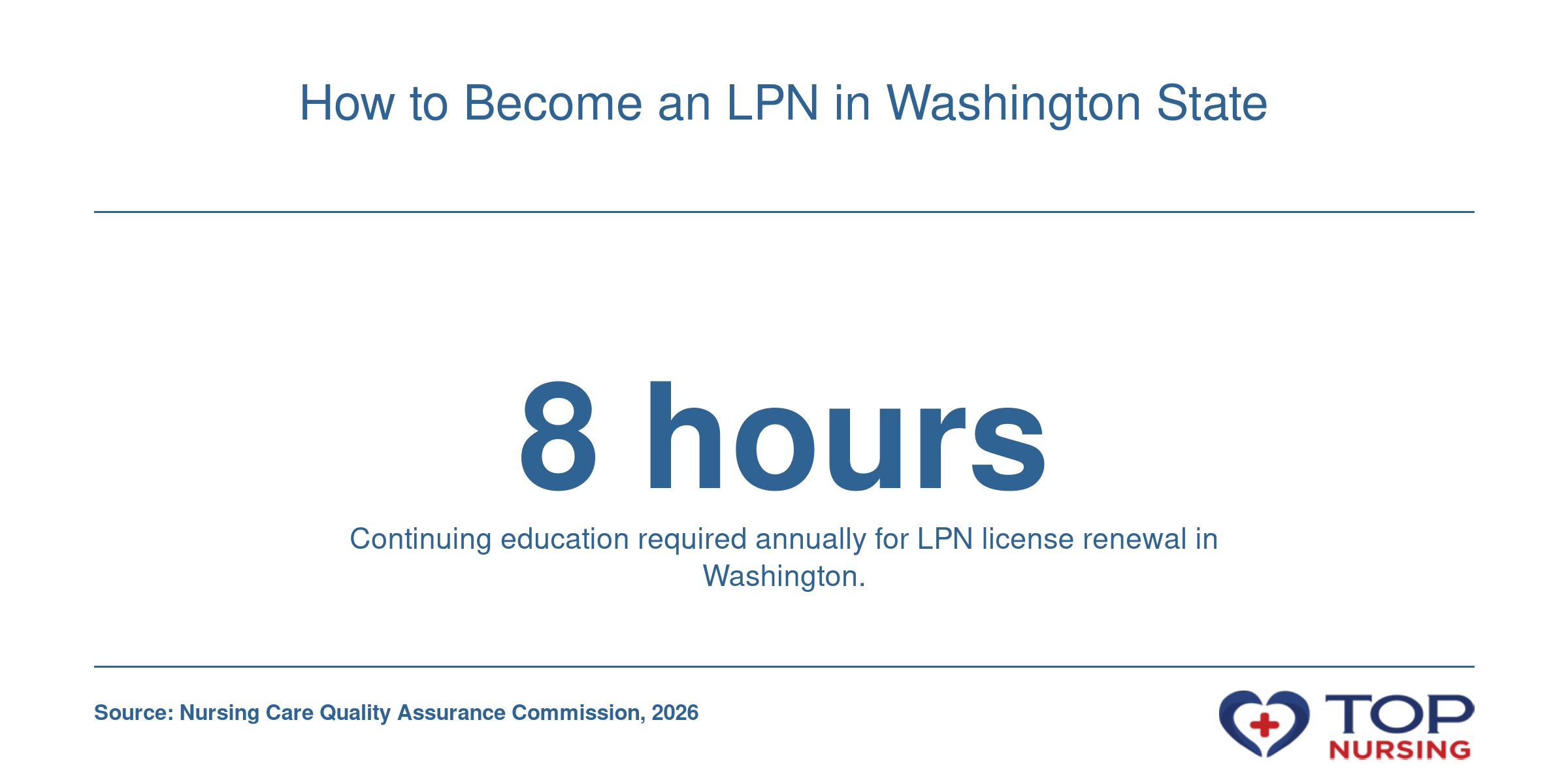
Washington LPNs must complete 8 hours of continuing education annually to renew, including health equity and suicide prevention training.

Washington’s LPN workforce is projected to grow by 10.52% between 2022 and 2032, according to a 2025 demand report from the Washington Center for Nursing. That growth signals strong demand for newly licensed practical nurses, driven by expanding healthcare needs in long-term care and outpatient settings.

LPN-to-RN Bridge Programs in Washington

After earning your LPN license, many nurses choose to advance their careers by becoming an RN. Washington state offers several structured bridge programs that let LPNs build on their existing training, often shaving months off the typical RN timeline.

LPN-to-ADN: The Most Common Bridge Path

The LPN-to-ADN pathway is the most widely available bridge option in Washington. These programs typically take three to four quarters (12–18 months) of additional coursework after LPN completion. LPNs receive credit for clinical fundamentals and often skip the introductory nursing courses that entry-level students take. The result is an Associate Degree in Nursing (ADN or AAS-T) and eligibility to sit for the NCLEX-RN exam.

Many ADN programs maintain articulation agreements with four-year universities in the state, allowing graduates to later pursue a Bachelor of Science in Nursing (BSN) without losing credits.

Washington Colleges Offering LPN-to-ADN Programs

  • Edmonds College: LPN to Associate in Nursing DTA/MRP, delivered in a hybrid format.
  • Shoreline Community College: Nursing – LPN to RN Advanced Placement Option, AAS-T. The program lasts 3–4 quarters and is campus-based.
  • Pierce College: LPN-RN (LADN) Transition, completed in 3 terms on campus. Pierce has formal articulation agreements with several universities, including University of Washington Tacoma, Saint Martin's University, Pacific Lutheran University, and Washington State University, to support BSN completion.
  • Lower Columbia College: Nursing – LPN2RN eLearning (Associate in Nursing DTA/MRP). This hybrid/e-learning program requires applicants to have at least 1,000 hours of LPN work experience.
  • Olympic College: Associate Degree in Nursing (LPN to RN), spanning 5 quarters.
  • Skagit Valley College: LPN to RN Bridge, designed to be finished in 3–4 quarters.

LPN-to-BSN Pathways in Washington

Some universities in Washington offer direct LPN-to-BSN programs, though these are less common and take longer to complete, typically 2 to 3 years. Columbia Basin College provides an LPN to BSN program requiring 7 quarters and using a hybrid delivery model. Saint Martin's University offers a 2-year LPN to BSN pathway with 15 credits of advanced standing, also in a hybrid format. Walla Walla University has an L.P.N. to B.S. Entry option that awards 16 credits for prior learning.

These programs are ideal for LPNs who want to earn a bachelor's degree right away, often providing a faster route than an ADN followed by an RN-to-BSN completion.

Credit and Articulation Considerations

Most bridge programs grant significant credit for the LPN's prior education, effectively waiving fundamentals of nursing, pharmacology basics, and introductory clinical rotations. This recognition of prior learning can shorten the RN program by a full quarter or more. Articulation agreements, such as those at Pierce College, create a clear path from LPN to ADN to BSN, minimizing redundant coursework and helping students keep their momentum toward a four-year degree.

LPN Salary & Job Outlook in Washington

In Washington, licensed practical nurses earn a median annual wage of $79,700, with top earners exceeding $86,500. The state employs 6,450 LPNs, compared to 64,690 registered nurses who earn a median of $112,180. Nursing instructors, with 1,340 employed, earn a median of $78,000.

OccupationTotal EmploymentMean Annual Wage25th PercentileMedian Annual Wage75th Percentile
Licensed Practical and Licensed Vocational Nurses645079970731407970086550
Nursing Instructors and Teachers, Postsecondary1340856806437078000105880
Registered Nurses6469011574098570112180130420

LPN Pay by Metro Area: Seattle, Spokane & Tacoma

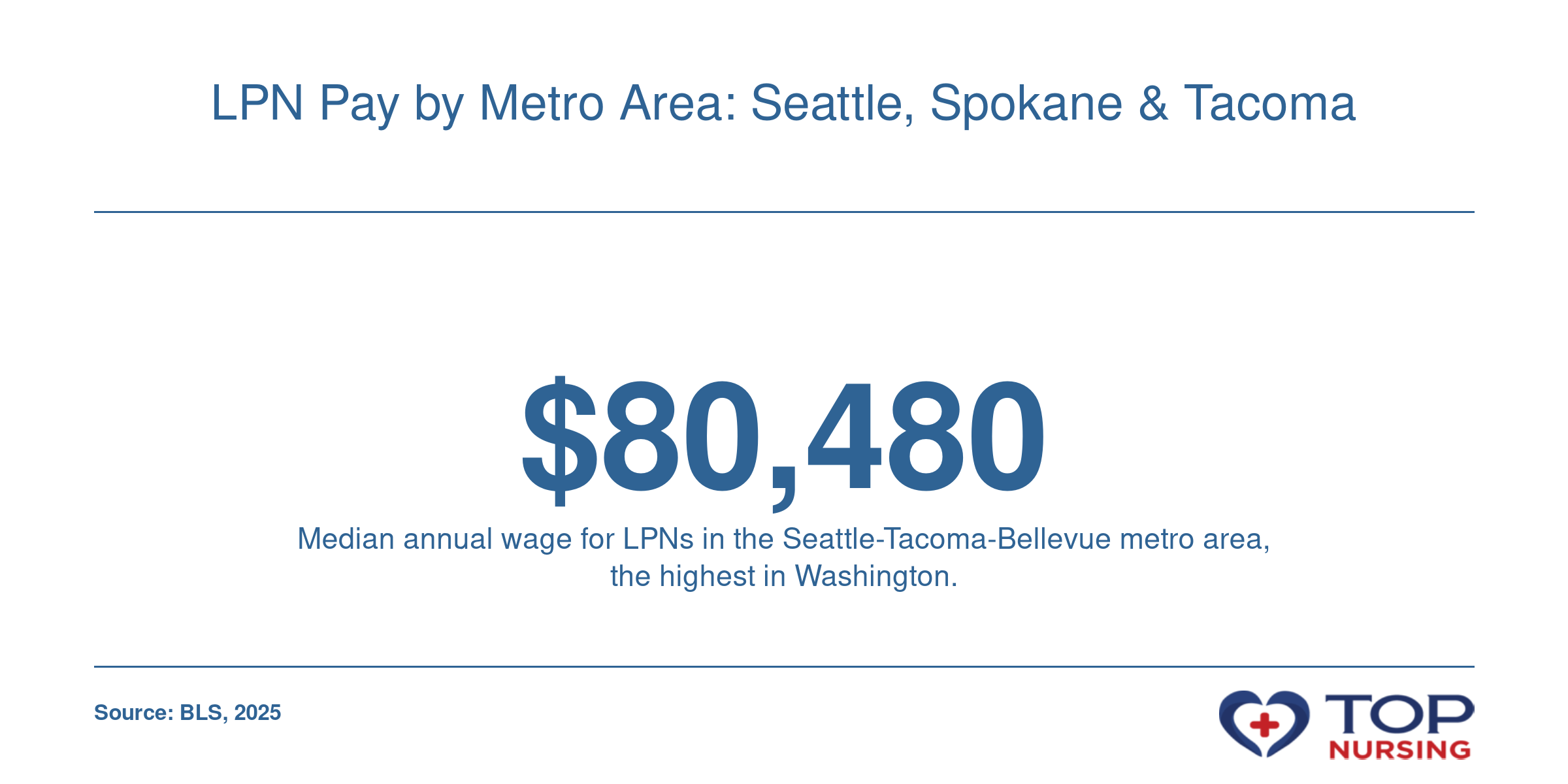
LPN pay varies significantly across Washington state. The Seattle-Tacoma-Bellevue metro area offers the highest median wages, but a higher cost of living can offset those gains. Spokane and other metros offer competitive pay with a lower cost of living.

A visual highlighting that Seattle-Tacoma-Bellevue LPNs earn a median of $80,480, the top pay among Washington metros in 2025.

Frequently Asked Questions About LPN Programs in Washington

If you are researching practical nursing pathways in Washington, you probably have questions about program length, cost, and career steps. Below are answers to common queries, drawing on data from Washington LPN programs and state nursing board requirements.

What are the best nursing programs in Washington state?
The best LPN programs depend on your priorities, but top options often include community and technical colleges with strong NCLEX-PN pass rates and accreditation. Our ranking section highlights Washington programs that excel in affordability, student support, and career outcomes.
How long does it take to complete an LPN program in Washington?
Most full-time LPN programs in Washington take 12 to 18 months. Part-time tracks may extend to 24 months. The exact timeline varies by school; for example, some quarter-based programs finish in four quarters, while others spread coursework over three semesters.
Are there online LPN programs available in Washington?
Fully online LPN programs are not available due to required clinical hours. However, several Washington schools offer hybrid formats where theory classes are online and labs or clinicals take place in-person at local healthcare facilities.
How much does an LPN program cost in Washington state?
Tuition for Washington LPN programs typically ranges from about $3,000 to $15,000 at public community colleges, while private schools may charge higher. Additional costs for uniforms, textbooks, and exams usually add several hundred dollars.
What is the difference between an LPN and an RN in Washington?
In Washington, LPNs provide basic bedside care under RN or physician supervision, while RNs perform assessments, develop care plans, and can supervise LPNs. Becoming an RN requires an associate or bachelor's degree and a broader scope of practice.
Can I work as an LPN while completing an RN bridge program?
Yes, many LPN-to-RN bridge programs in Washington are designed for working nurses, offering evening, weekend, or part-time schedules. Your LPN experience can also sometimes count toward clinical hours, making the transition smoother.

Recent Articles