Top LPN Programs in Pennsylvania: 2026 Rankings & Guide

Compare tuition, NCLEX pass rates, program length, and outcomes for every approved LPN school in PA.

By Hannah Pierce, BSNReviewed by TopNursing.org TeamUpdated May 27, 202625+ min read
Top LPN Programs in Pennsylvania for 2026 | Ranked

Points of interest…

  • NCLEX-PN first-time pass rates from the Pennsylvania State Board of Nursing reveal program quality over five years.
  • Public community college LPN programs in Pennsylvania cost about $9,500 after financial aid.
  • Full-time LPN training in Pennsylvania can be completed in as little as 12 months with in-person clinicals.
  • LPN-to-RN bridge programs at schools like Lehigh Carbon Community College shorten the path to an ADN.

Pennsylvania faces an estimated LPN deficit of 18,700 by 2030, fueling demand across hospitals, nursing homes, and outpatient clinics. Some aspiring nurses choose a 12-month accelerated program at a community college like Bucks County or Lehigh Carbon, where in-state tuition runs roughly $5,300 to $9,300. Others enroll in 16- to 18-month programs at private institutions, with sticker prices reaching $35,000 and beyond.

Net costs after aid can drop significantly: many affordable LPN programs exist at public two-year colleges, where students often net under $10,000, while some private career schools still exceed $20,000. Program formats vary, too: most require on-campus attendance for clinical labs, but a handful, such as Harrisburg Area Community College, now offer hybrid coursework.

In a state where an LPN license opens doors in hospitals, long-term care, and clinics, choosing the right program means weighing location, cost, and NCLEX pass rates against expected wages and bridge-path flexibility.

2026 Best LPN Programs in Pennsylvania

This ranking of Pennsylvania's top LPN programs for 2026 balances affordability with student success indicators, drawing from federal IPEDS and College Scorecard data. Each entry highlights a school's practical nursing offering, including program length, format, and institutional graduation rates. Individual program earnings data are not yet available, but we include each school's median graduate earnings ten years out as a guide to long-term value.

Factors considered
  • Net price and affordability
  • Institutional graduation rates
  • Post-graduate median earnings
  • Program duration and scheduling
  • Admissions selectivity
Data sources
RankSchoolLocationNet priceBest for
#1
Butler County Community College
Butler, PA$5,000 – $10,000/yrCounty residents on LPN-to-RN path

Butler County Community College is the only practical nursing provider in Butler County, re-established recently to meet western Pennsylvania's LPN shortage. Its 3-semester certificate includes an Anatomy and Physiology Track and a direct LPN-to-RN bridge into BC3's associate degree program, with lower tuition for county residents and clinical partnerships at major regional systems like Independence Health and UPMC.

Practical Nursing - Anatomy and Physiology Track, Certificate — On-Campus
  • 3-semester, 48-credit certificate program
  • Prepares for the NCLEX-PN licensure exam
  • Hands-on clinical experiences at 10+ regional healthcare sites
  • Chemistry prerequisite required
  • Anatomy and Physiology Track offers in-depth body systems study
  • Lower in-county tuition for Butler County residents
  • Direct LPN-to-RN bridge into BC3's Nursing A.A.S. program
  • Only practical nursing program in Butler County

Reading Area Community College offers a one-year, full-time PN certificate with a proven track record. The program reports a 100% NCLEX-PN pass rate and 100% job placement, giving graduates a fast, reliable entry into Berks County healthcare. Advanced placement into RACC's ADN program creates a clear pathway to registered nursing.

Practical Nursing — On-Campus
  • 1-year, full-time day program
  • 100% NCLEX-PN pass rate
  • 100% job placement rate
  • Clinical rotations at Reading-area hospitals and nursing homes
  • Advanced placement pathway to RACC's Associate Degree Nursing
  • ACEN accredited
  • Covers adult, pediatric, obstetric, and geriatric nursing
  • Graduate salary range of $40,000-$50,000

Bucks County Community College runs a 12-month, full-time PN program starting each July with NCLEX pass rates consistently above the national average. The Monday-through-Friday schedule and lack of prerequisite coursework make it an accessible, fast-track option for students in the Newtown area, with an efficient bridge to RN at the same college.

Practical Nursing — On-Campus
  • 12-month, full-time program (M-F 8 a.m.-3:30 p.m.)
  • Starts each July; one annual cohort
  • No prior nursing coursework required
  • Clinical experiences in diverse healthcare settings
  • NCLEX pass rates above the national average
  • Pathway to associate degree in nursing and RN licensure
  • Approved by Pennsylvania State Board of Nursing
  • TEAS entrance exam required

Laurel Business Institute in Uniontown provides a 12-month PN diploma with a strong hands-on focus. Students log 300 hours in the skills lab and 670 clinical hours, covering pharmacology, nutrition therapy, and medical-surgical nursing. Small class sizes and admission thresholds based on Wonderlic SLE or ATI TEAS support a structured, intensive learning environment.

Practical Nursing — On-Campus
  • 12-month diploma program
  • 300 hours in skills lab
  • 670 clinical hours in long-term care and other settings
  • Covers pharmacology, nutrition therapy, and med-surg nursing
  • Admission requires 2.0 GPA and Wonderlic SLE or ATI TEAS
  • Small class sizes for individualized instruction
  • Prepares for NCLEX certification
  • Hands-on clinicals at local healthcare facilities

Lehigh Carbon Community College's three-semester PN certificate leverages a state-of-the-art Patient Simulation Center with high-fidelity manikins to build clinical confidence. Multiple campus locations serve the Lehigh Valley, and ACEN accreditation plus an LPN-to-RN pathway provide both quality assurance and a clear route to an associate or bachelor's degree.

Practical Nursing Certificate — On-Campus
  • Three-semester, 43-credit certificate program
  • State-of-the-art Patient Simulation Center
  • Pathway to Associate Degree in Nursing (RN) and BSN
  • Multiple campus locations including Schnecksville and Allentown
  • Approved by Pennsylvania State Board of Nursing
  • ACEN accredited
  • Starts summer; apply by February 1, 2026
  • Prepares for NCLEX-PN with simulation-based training

Northampton Community College positions itself as one of Pennsylvania's most affordable nursing schools, offering a one-year calendar completion with evening and weekend classes. The 44-credit PN certificate includes clinical practicums in geriatric, maternal, and mental health settings, and transfer agreements ease the transition to a BSN.

Practical Nursing Certificate — On-Campus
  • 44-credit certificate (27 nursing + 17 gen ed)
  • Evening and weekend classes for working students
  • One-year calendar completion
  • Clinical practicum in geriatric, maternal, and mental health nursing
  • Transfer agreements to BSN programs
  • ACEN accredited
  • Prepares for NCLEX-PN
  • Designated one of Pennsylvania's most affordable nursing schools

Harrisburg Area Community College's PN program stands out with a hybrid format and a 97.6% job placement rate. It operates in a stackable LPN-RN model, allowing graduates to transition seamlessly into HACC's RN program. Clinical placements span central Pennsylvania sites in Harrisburg, Lancaster, and York.

Practical Nursing — Hybrid
  • Four-semester hybrid format with some online coursework
  • 97.6% job placement rate
  • TEAS entrance exam required
  • Mandatory nursing information session before applying
  • Clinical placements in Harrisburg, Lancaster, and York
  • Stackable LPN-to-RN transition program
  • ACEN accredited since 1991
  • Approved by Pennsylvania State Board of Nursing

Carlow University's 16-month Practical Nurse Certificate draws on 75 years of nursing education in Pittsburgh, a top LPN employment market with a projected shortfall of 18,700 LPNs across Pennsylvania by 2030. Private-university tuition is offset by a free application and rolling admissions, and the curriculum emphasizes community engagement and cultural competency.

Practical Nurse Certificate — On-Campus
  • 16-month, on-campus certificate program
  • 48 credits at $559 per credit
  • 75 years of nursing education in Pittsburgh
  • Clinical experiences in long-term care, home health, and rehabilitation
  • Free application with rolling admissions and fall start
  • Prepares for NCLEX-PN
  • Addresses Pennsylvania's projected LPN deficit of 18,700 by 2030
  • Pittsburgh: second-largest LPN employer in Pennsylvania

Laurel Technical Institute in Hermitage delivers a 12-month PN diploma with an emphasis on medication administration, IV therapy, and patient care essentials. Admission thresholds mirror those of its Uniontown sister campus, and small cohorts ensure personalized attention throughout the program.

Practical Nursing — On-Campus
  • 12-month diploma program
  • Covers medication administration and IV therapy
  • Small class sizes for personalized instruction
  • Admission: 2.0 GPA and Wonderlic SLE or ATI TEAS
  • Hands-on clinical experiences
  • Prepares for industry certifications and NCLEX
  • Located in Hermitage, Pennsylvania
  • No prior healthcare experience required

Central Pennsylvania Institute of Science and Technology's 1,500-hour PN diploma features tightly controlled cohorts with a 1:12 teacher-student ratio. Approved by both the Pennsylvania Department of Education and Board of Nursing, the program runs two annual start dates and emphasizes an integrated theory-to-practice model for central Pennsylvania learners.

Practical Nursing — On-Campus
  • One-year, 1,500-hour diploma program
  • Tuition of $17,618 for FY2025/2026
  • Maximum 36 students per class with 1:12 teacher ratio
  • Two start dates: January and August
  • Approved by PA Dept. of Education and PA Board of Nursing
  • Courses include fundamentals, anatomy, pharmacology, and med-surg
  • Prepares for state licensure examination
  • Integrated theory and hands-on clinical model

How to Compare LPN Programs in PA

NCLEX-PN pass rates fluctuate year to year, but they remain the clearest public measure of a program's ability to prepare students for licensure. The Pennsylvania State Board of Nursing publishes five-year NCLEX-PN spreadsheets that let you see how a school performed during the 2023 through 2025 testing cycles. (Program-level data for 2026 is not yet available, so these are the most recent complete figures.) As of the latest national report, the overall pass rate for the NCLEX-PN was 77.3% in 2025, while first-time, U.S.-educated candidates earned an 86.0% pass rate in early 2026. Those benchmarks help you spot programs that consistently outperform or fall below the average.

Check NCLEX-PN Pass Rates First

Pennsylvania programs show a wide range. For example, Franklin County Career and Technology Center's Practical Nursing Program recorded a 100% pass rate in 2024, while others, like Penn Commercial's Practical Nursing Program, logged a 71.22% rate for the 2021-2022 period. A single weak year is not always a red flag, but a multi-year downward trend deserves attention. Access the raw numbers directly through the State Board of Nursing's website, and don't hesitate to call a program's admissions office to ask for their most recent cohort outcomes.

Look Beyond Tuition to True Total Cost

Sticker-price tuition is just the starting point. You will also need to cover fees, textbooks, scrubs or uniforms, clinical supplies, a physical exam and immunizations, and the NCLEX-PN exam fee itself. Some schools bundle many of these into the published total, while others list them separately. Request a full cost worksheet from every program you consider, and ask whether financial aid, payment plans, or employer tuition reimbursement can offset the true total.

State Approval vs. National Accreditation

In Pennsylvania, every LPN program must hold approval from the Pennsylvania State Board of Nursing for graduates to sit for the NCLEX-PN and become licensed. However, fewer than 20% of practical nursing programs nationwide also carry programmatic accreditation from a national nursing accreditor such as ACEN or ABHES. National accreditation signals that a program meets a higher, peer-reviewed standard, and it often makes it easier to transfer credits later into an LPN-to-RN bridge program. If seamless academic advancement matters to you, prioritize schools that list continuing ACEN or ABHES accreditation alongside state approval.

Ask About Clinical Placements and Employer Partnerships

Your clinical rotations shape hands-on skills and often lead to job offers. Call admissions and ask where current students complete clinicals, how many hours of direct patient care are included, and whether the program has established relationships with hospitals, long-term care facilities, or home health agencies. Some programs also maintain formal employer partnerships that can fast-track graduates into open positions. A few direct questions early on will reveal how well a program is connected to the healthcare employers you hope to work for after licensure.

What LPN Programs in Pennsylvania Actually Cost

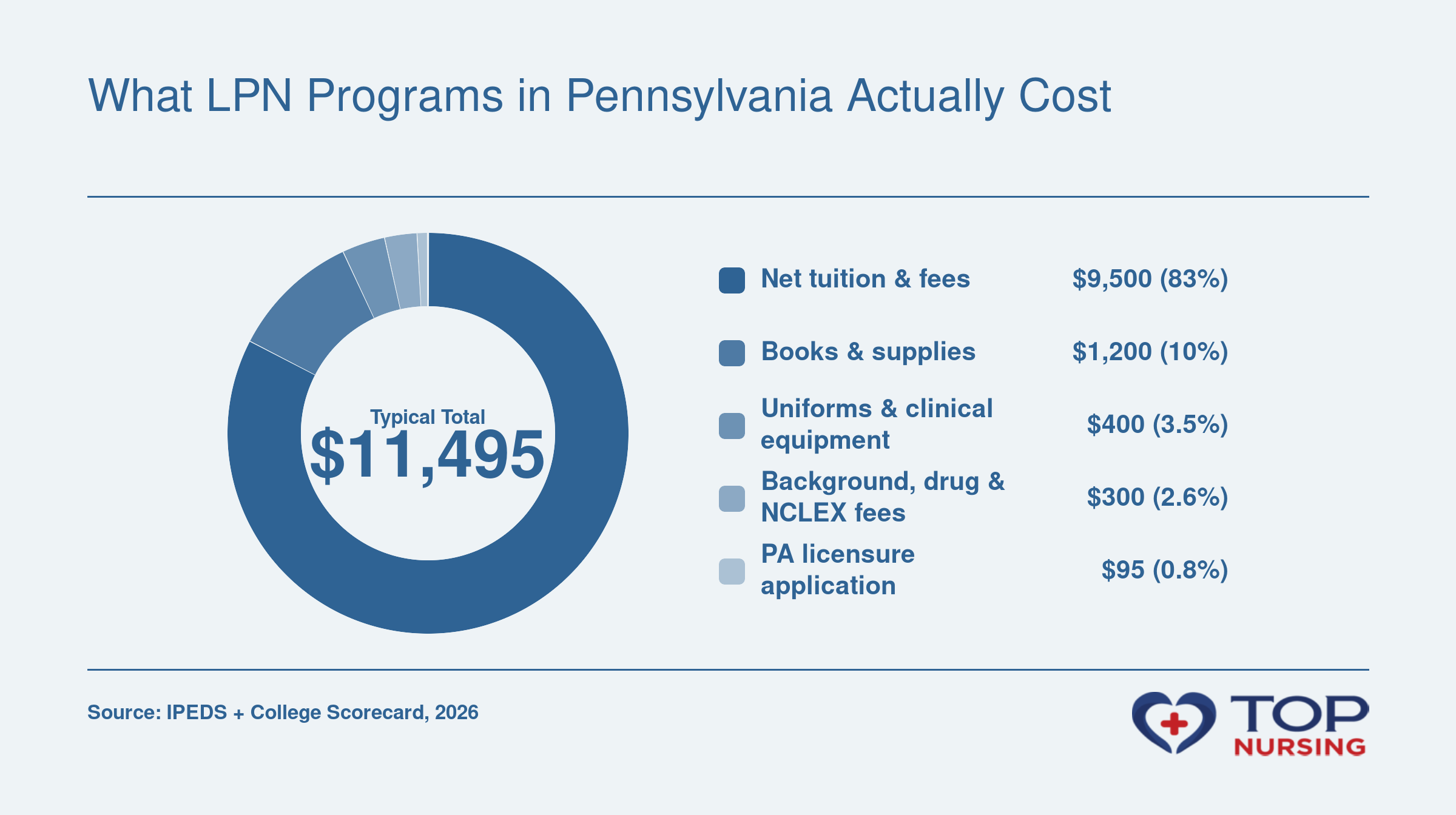
The total cost of an LPN program in Pennsylvania goes beyond tuition. After financial aid, a typical student at a public community college may pay around $9,500 in net tuition, with additional expenses for books, supplies, uniforms, equipment, background checks, and licensure exams adding another $1,700 to $3,400. Here's how those costs break down.

Breakdown of typical LPN program costs in Pennsylvania: net tuition $9,500, books and supplies $1,200, uniforms and clinical equipment $400, background checks and exam fees $300, licensure application $95, total $11,495.

LPN Program Costs and Financial Aid in Pennsylvania

What You’ll Actually Pay

The net price you pay depends heavily on whether you choose a public community college, a private career school, or a vo-tech center. Among the state’s most affordable LPN programs, net prices range from roughly $6,200 to $9,300 per year. Community colleges like Butler County Community College and Bucks County Community College sit at the lower end, around $6,200–$6,400, while private institutions such as Laurel Technical Institute fall near $6,800. Even the higher-cost options in this group, including Lehigh Carbon Community College, stay under $9,300. These figures already account for typical grants and scholarships, so they represent what students actually pay after aid. Keep in mind that programs at for-profit schools or those in higher-cost areas can push total expenses well above that range, making it essential to compare each school’s net price calculator before enrolling.

Pennsylvania-Specific Financial Aid Options

Two state programs often reduce LPN tuition dramatically. The PHEAA State Grant is open to Pennsylvania residents enrolled in eligible diploma, associate, or bachelor’s programs. You must file the FAFSA to be considered, and award amounts vary by school, enrollment status, and financial need. However, not every LPN certificate qualifies, your program must meet PHEAA’s approval guidelines. If your LPN program is not eligible for the State Grant, look at the PA Targeted Industry Program (TIP). TIP supports workforce-training programs that last between 10 weeks and less than two academic years and that are not already covered by the State Grant. Many LPN programs fit this description perfectly, and TIP can cover a significant portion of tuition for students who qualify.

Federal Grants and Loans

Federal aid is another major piece of the puzzle. At the most affordable LPN schools in Pennsylvania, between 74% and 87% of students receive Pell Grants, a strong signal that LPN students at all income levels qualify. If your Pell Grant does not cover the full cost, a Federal Supplemental Educational Opportunity Grant (FSEOG) may add a few hundred to a few thousand dollars more. For any remaining gap, federal student loans for certificate programs can help. Just remember that borrowing should be a last resort after exhausting all grant and scholarship options.

Employer and Local Funding Sources

Many Pennsylvania hospital systems and long-term care facilities offer tuition reimbursement or direct sponsorship for LPN training. If you already work in healthcare, contact your HR department to ask about education benefits, UPMC, Geisinger, and similar networks frequently promote these programs. Even if you are not yet employed in the field, local Workforce Development Boards administer WIOA-funded healthcare training grants. A quick call to your county’s board can reveal no-cost or low-cost pathways into an LPN career. Always check whether your employer or a nearby healthcare employer will pick up the tab before taking on debt.

Questions to Ask Yourself

Many LPN students hold jobs or have family obligations. A program's schedule directly affects whether you can balance school with earning a paycheck, so confirm before enrolling that the format matches your real life.

PA Board approval is mandatory to sit for the NCLEX-PN and get licensed. National accreditation alone does not grant eligibility, and attending an unapproved program can leave you with debt and no path to practice.

Out of pocket expenses like scrubs, stethoscopes, background checks, drug screens, and the NCLEX fee can add hundreds of dollars. A program that looks affordable on paper may strain your finances if these are not planned for.

Clinical rotations often serve as extended interviews. If your placements are far from your preferred hospitals or long term care facilities, you may miss the chance to get hired where you really want to work.

Program Length, Schedule, and Format Options for PA LPN Students

LPN programs in Pennsylvania offer flexible scheduling to fit the lives of career changers, parents, and working students, but every pathway shares one common requirement: all clinical hours must be completed in person.

Typical Program Lengths and Pacing

The majority of full-time LPN programs in the state run between 10 and 14 months, with intensive daytime schedules that cover both didactic coursework and hands-on clinical rotations. For students who need a lighter load, part-time evening and weekend tracks typically stretch to 18 to 24 months. The extra months allow learners to balance employment or family commitments while progressing through the same curriculum.

Franklin County Career and Technology Center, for example, packs its program into 12 months of full-time day classes, meeting Monday through Thursday from 6:45 a.m. to 3:15 p.m. Two cohort starts each year, in March and September, give prospective students multiple entry points. At the other end of the pacing spectrum, Holy Temple Training Institute (HTTI) runs a part-time format designed explicitly for working adults, taking 22 months to complete during evening and weekend hours.

Schedule Formats Across Pennsylvania

Pennsylvania LPN programs commonly arrange their calendars around these schedule types:

  • Full-time day: The traditional format seen at schools like Franklin County CTC. Classes and clinicals occur on weekdays, often covering roughly 1,500 total clock hours in under a year.
  • Part-time evening/weekend: Offered by institutions such as HTTI (22 months) and Penn State Berks (18 months), these tracks put lectures and labs on weeknights or Saturdays. Clinical rotations are still scheduled during the daytime, so students must plan for some weekday availability.
  • Full-time evening: A less common variant, available at places like PITC Institute, where day and evening classes are both advertised. In some cases, an evening track may function as an extended-hours full-time option, packing the curriculum into the same number of weeks as a day program but running later in the day.
  • Hybrid with in-person clinicals: While didactic portions are usually classroom-based, a few schools incorporate limited online learning. Penn State Berks, for instance, offers some online didactic content, though the program remains anchored by in-person sessions at its Berks County campus and clinicals at local healthcare sites.

Online Didactic and the In-Person Clinical Rule

Fully online LPN programs do not exist in Pennsylvania because state licensing requires direct patient care experience. Any school that lists "online" or "hybrid" components is referring only to the lecture portion of the curriculum. At Penn State Berks, limited online coursework supplements the on-campus schedule, but students still come to the physical classroom regularly and complete all clinical hours face-to-face in medical facilities.

Most programs, including those at Franklin County CTC and HTTI, keep all instruction on campus, prioritizing hands-on lab practice before students enter the clinical setting. When researching a program, always confirm where and when clinical rotations will take place: your schedule flexibility can drop once you are assigned to a hospital, nursing home, or clinic site, even if lecture attendance is flexible or remote.

How to Become an LPN in Pennsylvania

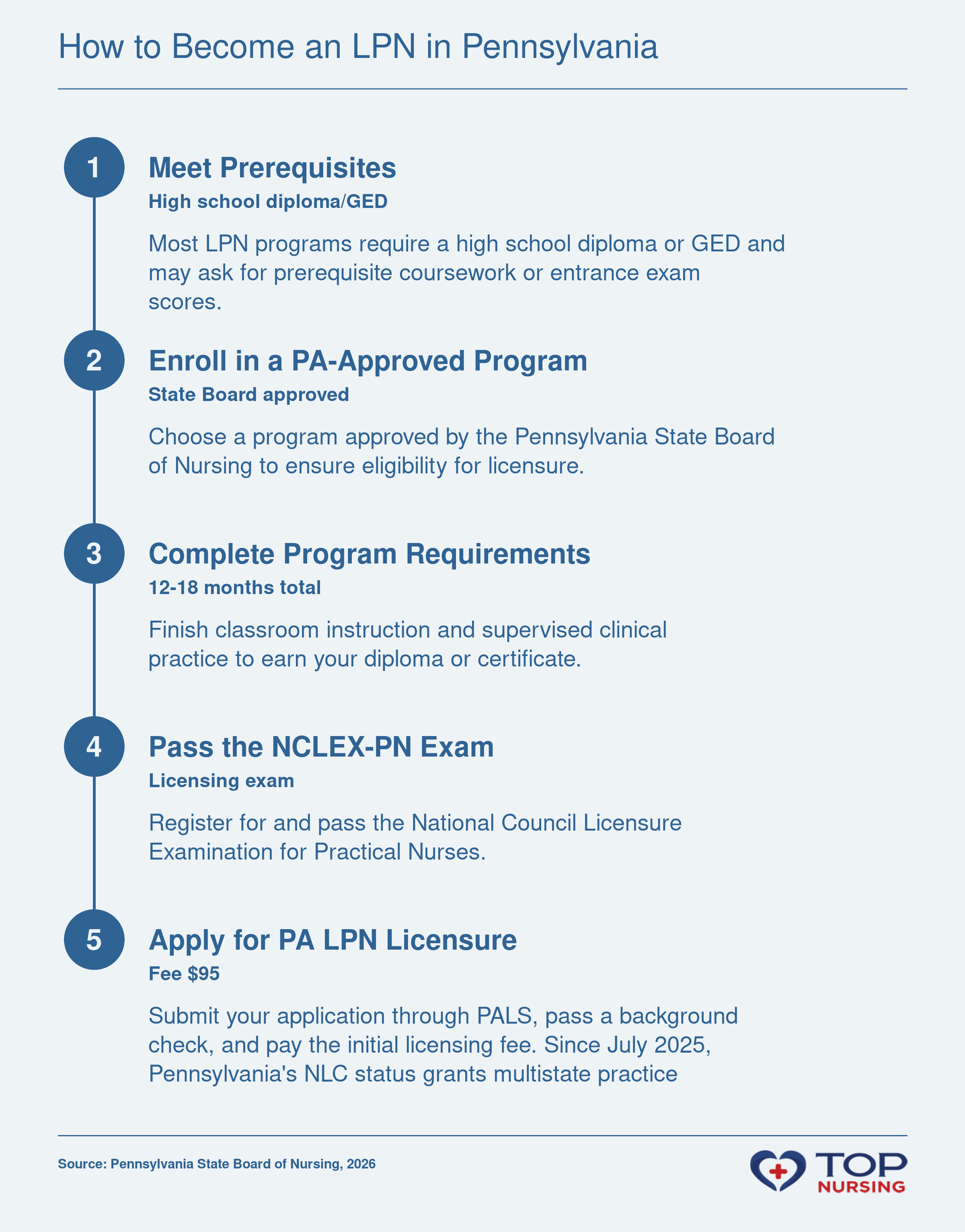
Step-by-step guide to becoming an LPN in Pennsylvania: meet prerequisites, enroll in an approved program, complete training (12-18 months), pass the NCLEX-PN, and apply for state licensure through PALS.

LPN Salary and Job Outlook in Pennsylvania by Region

How LPN Pay Varies Across Pennsylvania

Licensed practical nurse salaries depend heavily on where you work. The same LPN license can earn noticeably different wages in Philadelphia, Pittsburgh, or smaller metros like Lancaster. Understanding these regional differences helps you weigh job offers and decide where to apply after graduation.

The Bureau of Labor Statistics tracks wage data for LPNs nationwide under SOC code 29-2061. Nationally, the median annual wage was $59,730 as of May 2023. The bottom tenth of earners made roughly $45,670, while top performers reached about $77,870. But these are countrywide figures; Pennsylvania’s own metro areas paint a more detailed picture.

BLS Metro-Level Wage Snapshots

To get precise Pennsylvania numbers, you can use the BLS Occupational Employment and Wage Statistics query tool. Filter by SOC 29-2061 and select individual Pennsylvania metropolitan divisions. For example, the Philadelphia-Camden-Wilmington metro often posts median wages above the national average, driven by higher living costs and strong healthcare demand. Pittsburgh and Harrisburg-Carlisle tend to land closer to the state median, while Scranton–Wilkes-Barre and Lancaster may report slightly lower figures. Checking each area’s 10th and 90th percentiles reveals the range: some employers in rural counties offer pay near the lower end, while specialty clinics or long‑term care facilities in urban hubs may exceed $70,000. This gap means commuting 30 minutes across county lines can translate to a meaningful pay difference.

Alongside wages, the BLS table shows employment counts per metro. These numbers tell you where the most LPN jobs are concentrated. Philadelphia claims the largest LPN workforce in the state, followed by Pittsburgh. Even in smaller metros like Allentown-Bethlehem-Easton, steady hiring reflects the ongoing need for bedside care, home health, and rehabilitation services.

Pennsylvania’s Job Growth Through 2034

For long‑term outlook, the Pennsylvania Center for Workforce Information & Analysis publishes industry and occupational projections. Their 2024–2034 reports estimate LPN employment change across the state. While national projected growth sits at 3%, Pennsylvania’s aging population and expansion of outpatient settings could push demand slightly higher in certain regions. Check their latest projections to see whether your target metro expects above‑average openings or flat staffing. The BLS also estimates about 54,400 annual job openings nationally, accounting for retirements and turnover, not just new positions. In tight local labor markets, that churn creates reliable opportunities for new graduates. Rural hospitals and correctional facilities also hire LPNs, often with competitive starting wages to attract candidates.

Real‑Time Salary Intelligence

Government data runs a few years behind. To supplement BLS figures, search active LPN job postings on Indeed and Glassdoor. Filter by city and review the salary estimates or posted ranges. Job boards often reveal hiring surges in specific Pennsylvania counties, such as increased home health demand in Lehigh Valley or sign‑on bonuses at Pittsburgh‑area nursing homes. Local LPN program directors and the Pennsylvania Association of Practical Nursing can also share informal salary surveys and employer feedback. Combining these sources gives you a current, grounded sense of what to expect.

What PA LPN Graduates Actually Earn After Completing Their Program

Program-level earnings outcomes for Pennsylvania LPN programs are not currently published by the U.S. Department of Education. This section will compare median earnings for graduates of top programs as soon as the data becomes available.

Median earnings data for PA LPN graduates one year after program completion is not yet available.

LPN-to-RN Bridge Programs and Career Advancement in Pennsylvania

What's the fastest way to go from LPN to RN in Pennsylvania? LPN-to-RN bridge programs let you apply your practical nursing knowledge toward an associate degree (ADN) without repeating fundamentals. In Pennsylvania, several community colleges run dedicated transition tracks. Lehigh Carbon Community College offers an LPN-to-RN pathway leading to an Associate of Applied Science in Nursing. Westmoreland County Community College also has an LPN-to-RN option. Pennsylvania College of Technology's LPN-to-RN program spans 24 months and requires a 2.5 GPA along with prerequisites in biology, composition, and mathematics, plus placement testing. Most LPN-to-ADN sequences add about 12 to 24 months of study beyond your LPN diploma, depending on transfer credits and course load; an active Pennsylvania LPN license is almost always required.

LPN-to-BSN Options at Four-Year Universities

If your goal is a bachelor's degree from the start, a few Pennsylvania universities offer LPN-to-BSN tracks. Penn State Altoona accepts LPNs with at least 1,000 hours of recent work experience (within the last 3 years). Immaculata University's LPN-to-BSN program runs 7 semesters and prepares graduates to sit for the NCLEX-RN. These programs typically take 21 to 24 months and may require you to hold an active, unencumbered Pennsylvania LPN license. They compress nursing theory and clinicals, treating your LPN background as advanced standing.

Additional Certification and Career Moves

Not every advancement requires an RN license. LPNs can pursue specialized certifications such as IV therapy, wound care, or long-term care leadership. These credentials can increase your earning potential and open roles like charge nurse or unit coordinator in skilled nursing facilities. Many employers support certification through tuition reimbursement or on-site training.

Planning the Full Career Ladder

For those aiming higher, transitioning to an RN is often the first leg of a longer climb. Once you earn an ADN or BSN, you can enter an RN-to-BSN completion program (often fully online) or eventually pursue a nurse practitioner degree. Topnursing.org maintains statewide directories of RN-to-BSN and NP programs in Pennsylvania to help you map out each stage.

Frequently Asked Questions About LPN Programs in Pennsylvania

If you are considering a practical nursing career in Pennsylvania, these answers address the most common questions about program length, prerequisites, costs, and more. Use them to plan your next steps with confidence.

How long does it take to complete an LPN program in Pennsylvania?
Most full-time LPN programs in Pennsylvania require 12 to 18 months. Some accelerated options can be finished in as few as 11 months, while part-time tracks may extend to 24 months. The total includes classroom instruction, lab skills, and supervised clinical rotations, preparing you to sit for the NCLEX-PN exam immediately after graduation.
Are there online or hybrid LPN programs available in Pennsylvania?
Yes, several Pennsylvania schools offer hybrid LPN programs that combine online coursework with on-site labs and in-person clinicals. Fully online LPN programs are not permitted because state regulations require hands-on clinical hours. Hybrid models allow flexibility for working students, but you must still attend scheduled campus sessions and clinical placements throughout the state.
Which LPN programs in Pennsylvania have the highest NCLEX-PN pass rates?
The Pennsylvania State Board of Nursing publishes annual NCLEX-PN pass rates for all approved programs. Consistently high-performing schools include those with pass rates above 90 percent. When comparing programs, check the most recent three-year average on the board’s website, as rates can fluctuate. Many technical and community college programs have strong reputations for exam preparation.
What are the prerequisites for LPN programs in PA?
Common prerequisites include a high school diploma or GED, a minimum GPA (often 2.5), completion of entrance exams like the TEAS, and a background check. Some programs also require CPR certification, immunizations, and drug screening. Prerequisite courses in biology or algebra may be needed, but many programs incorporate these into the curriculum if not already completed.
Can I work while enrolled in an LPN program?
Many students maintain part-time employment, but the intensive schedule, including clinical days, requires careful planning. Most schools recommend working no more than 20 hours per week. Evening and weekend clinical options exist at some institutions, which help accommodate jobs. Speak with program advisors about realistic workloads before enrolling to ensure academic success.
Do LPN programs in Pennsylvania accept transfer credits?
Some programs accept transfer credits for general education courses like English or psychology, but nursing core classes typically must be taken in sequence at the same school. Articulation agreements between community colleges and universities may also apply. Always request an official credit evaluation from the admissions department to confirm which prior coursework will be accepted toward your LPN certificate.

Complete List of LPN Programs in Pennsylvania by City

This directory covers additional LPN programs in Pennsylvania beyond the top-ranked schools. Each entry includes the school, location, format, and a short description to help you compare options. Follow the program links on topnursing.org to request more information.

Northwestern Pennsylvania

Mercyhurst University
One-year, 30-credit LPN certificate program with hands-on simulation training, NLN CNEA accreditation, and nearly 100% job placement. Graduates are eligible for the NCLEX-PN and can bridge to an RN associate degree.
  • Practical Nursing (LPN)
Erie, PA · On-Campus

Northeastern Pennsylvania

Fortis Institute-Forty Fort
Campus-based Practical Nursing program with hands-on clinical training, designed to prepare students for the licensing exam and diverse healthcare settings. Financial aid available for those who qualify.
  • Practical Nursing
Forty Fort, PA · On-Campus
Pennsylvania State University-Penn State Hazleton
18-month Practical Nursing certificate program from Penn State, blending evidence-based curriculum with nearby clinical experiences. Prepares for NCLEX-PN; ideal for fast-track nursing career.
  • Practical Nursing Program
Hazleton, PA · On-Campus
Fortis Institute-Scranton
Hybrid Practical Nursing program blending on-campus and online courses with clinical experiences. Prepares for NCLEX-PN; financial aid and career services available.
  • Practical Nursing
Scranton, PA · On-Campus

Lehigh Valley

Lincoln Technical Institute-Allentown
Diploma in Practical Nursing with comprehensive training in patient care, pharmacology, and medical-surgical nursing. Includes clinical experiences; graduates eligible for NCLEX-PN.
  • Practical Nursing, Allentown
Allentown, PA · On-Campus

South Central Pennsylvania

Lancaster County Career and Technology Center
Offers 12- or 18-month daytime and evening LPN programs with clinical experiences, covering medical-surgical nursing and pharmacology. Graduates are eligible for NCLEX exams.
  • Licensed Practical Nurse (LPN)
Willow Street, PA · On-Campus
Pennsylvania State University-Penn State Berks
18-month non-credit Practical Nursing certificate with part-time evening and weekend classes, covering medication administration and legal-ethical practice. Clinicals in Berks County; prepares for NCLEX-PN.
  • Practical Nursing Program
Reading, PA · On-Campus

Southeastern Pennsylvania

Orleans Technical College
52-week full-time day program in Philadelphia covering classroom, lab, and clinical experiences. Prepares for NCLEX-PN; requires TEAS exam and background clearances.
  • Practical Nursing (PN)
Philadelphia, PA · On-Campus
Lansdale School of Business
Diploma program approved by the PA State Board of Nursing, combining nursing theory, lab studies, and clinical rotations. Prepares for the Nursing Board exam and careers in long-term care or surgical centers.
  • Practical Nursing
North Wales, PA · On-Campus
PITC Institute
Practical Nursing program leading to an Associate in Skilled Technology Degree, with day and evening classes and state-of-the-art simulation. Prepares for PN-NCLEX; financial aid options available.
  • Practical Nursing
Wyncote, PA · On-Campus

Recent Articles