Top LPN Programs in Ohio for 2026: Compare Costs & Outcomes

Ranked by affordability, completion rates, and graduate earnings to help you choose the right program.

By Maria Delgado, RNReviewed by TopNursing.org TeamUpdated May 27, 202625+ min read
Top LPN Programs in Ohio (2026 Rankings & Guide)

Points of interest…

  • LPN program net prices in Ohio range from $4,000 at community colleges to over $47,000 at private schools.
  • First-time NCLEX-PN pass rates vary sharply, with top schools exceeding 95% and others below 70%.
  • Ohio employs 36,440 LPNs statewide, with earnings varying by experience and location.
  • Most Ohio LPN programs require a 2.0-2.5 GPA, a background check, and in-person clinical hours.

Where can Ohio nursing students get the strongest return on their LPN education? Long-term care and ambulatory clinics continue to fuel demand for licensed practical nurses across the state, but program costs diverge sharply.

Among the 24 schools in this year’s ranking, net price after grants and scholarships stretches from under $4,000 to over $47,000. That gap means two graduates sitting for the same NCLEX-PN exam may carry vastly different debt loads.

Cost-conscious students can find the best LPN programs that pair low tuition with solid NCLEX pass rates, but the search requires looking past sticker prices to outcomes that matter.

2026 Best LPN Programs in Ohio

Our 2026 ranking of Ohio LPN programs is built around what matters most: delivering a quality nursing education without overwhelming debt. We emphasize net price and financial aid data, while also factoring in graduation rates, graduate earnings, and program-level details like licensure exam pass rates. This approach surfaces schools that balance affordability with strong student outcomes.

Factors considered
  • Net price after financial aid
  • Institutional graduation rates
  • Graduate earnings
  • Pell Grant recipient share
  • Licensure pass rates
Data sources
RankSchoolLocationNet priceBest for
#1
North Central State College
Mansfield, OH$5,000/yr (net price)Working adults needing evening classes

North Central State College’s Practical Nursing Certificate is a fast, evening-based program tailored for working adults in north central Ohio. Completed in just two semesters from May to December with classes from 5:30 to 9:30 p.m., it blends clinical experiences with coursework. The college offers a clear internal pathway from LPN to ADN and now a BSN completion option, making it a strong choice for career-long nursing education.

Practical Nursing Certificate — On-Campus
  • One-year program completed in two semesters, May-December
  • Evening classes 5:30-9:30 p.m., no Friday commitments
  • Approved by Ohio Board of Nursing and Ohio Board of Regents
  • Requires 2.3 GPA and 77% minimum course grade
  • Prepares for NCLEX-PN licensure exam
  • Seamless LPN-to-ADN and BSN completion pathways available
  • Health physical, immunizations, background check required
  • Limited enrollment; clinicals start each fall

Lorain County Community College’s Practical Nursing certificate is one of Ohio’s most affordable LPN programs, with a net price of $3,967. The one-year, campus-based program covers medical-surgical, maternity, pediatric, and geriatric nursing and requires the ATI TEAS for admission. Small cohorts and dedicated faculty provide hands-on clinical training, and the college offers credit for prior learning and articulation agreements for those seeking advanced degrees.

Practical Nursing — On-Campus
  • One-year technical certificate, 38 credit hours
  • ATI TEAS entrance exam required; 2.0 GPA minimum
  • Curriculum includes medical-surgical, maternity, pediatric, and geriatric care
  • Prepares for NCLEX-PN licensure
  • Hands-on clinical experiences in various settings
  • Credit for prior learning and articulation agreements available
  • American Heart Association certification required
  • Small cohorts with dedicated faculty

Washington State Community College’s Certificate of Practical Nursing Education boasts a 100% licensure pass rate and strong clinical partnerships with Marietta Memorial Hospital and Camden Clark Medical Center. The campus-based program prepares students through a blend of classroom instruction and hands-on rotations. With a net price of $7,714 and a Pell Grant share of 75.9%, it balances cost-effectiveness with proven outcomes.

Certificate of Practical Nursing Education — On-Campus
  • 100% licensure pass rate on NCLEX-PN
  • TEAS entrance exam required; apply by March 12, 2026
  • Clinical rotations at Marietta Memorial and Camden Clark hospitals
  • Prepares for entry-level LPN roles across healthcare settings
  • Campus-based program with supportive faculty
  • Includes acute, long-term, and community clinical experiences
  • Limited enrollment; early application encouraged

Edison State Community College’s ACEN-accredited Practical Nursing Certificate can be completed in two consecutive terms. The campus-based program emphasizes evidence-based, client-centered care and requires a high school chemistry background and a 2.5 GPA for admission. Graduates are eligible for the NCLEX-PN, and the college’s graduates earn a median of $41,360 ten years after entry (institution-wide), with a net price of $7,142.

Practical Nursing (PN) Certificate — On-Campus
  • Two-term completion, campus-based at Piqua or Eaton
  • ACEN accredited
  • Requires high school chemistry or equivalent and 2.5 GPA
  • Focus on evidence-based, client-centered nursing practice
  • Prepares for NCLEX-PN licensure
  • Hands-on experience in hospitals and nursing homes
  • Eligible for financial aid

Rhodes State College’s Practical Nursing Certificate is a one-year, fall-start program limited to 40 students per cohort, ensuring personalized attention. It features high-fidelity simulation labs and a pathway into the college’s Associate Degree Nursing program. A 100% NCLEX-PN pass rate (2019) and scholarships like Choose Ohio First enhance its appeal, though the net price is slightly higher at $8,757.

Practical Nursing Certificate — On-Campus
  • One-year program, starts fall only; 40-student cohort
  • Practice on high-fidelity simulators
  • 100% NCLEX-PN pass rate (2019)
  • Requires 2.0 GPA and prerequisite courses
  • Scholarships available, including Choose Ohio First
  • Articulation pathway into ADN program
  • Ohio Board of Nursing approved
  • Prepares for NCLEX-PN with above-average scores

Southern State Community College’s three-semester Practical Nursing program reports a 92% licensure pass rate and 100% job placement. Day classes are held at Central and Brown County campuses, and the curriculum includes e-books at reduced cost. With a net price of $9,674 and 81.7% Pell Grant recipients, it’s a solid choice for those seeking strong employment outcomes in the Hillsboro area.

Practical Nursing — On-Campus
  • Three-semester program, 35 credit hours
  • 92% NCLEX-PN pass rate, 100% job placement
  • Day classes available at Central and Brown County campuses
  • E-books at reduced cost; requires Windows or Mac technology
  • Lecture, lab, and clinical experiences integrated
  • Minimum C grade required in nursing courses
  • Financial aid available; Health Sciences Navigator support

Columbus State Community College’s LPN certificate is a full-time, four-semester program with day and evening options, making it accessible for students in the Columbus metro area. Entry requires a HESI A2 score of 73% or higher. The program is approved by the Ohio Board of Nursing and serves as a career path for nursing assistants, with a net price of $8,400 and median graduate debt of $8,749.

Licensed Practical Nurse (LPN) Certificate — On-Campus
  • Four-semester full-time program with day and evening options
  • HESI A2 entrance exam; 73% score required
  • Prepares for NCLEX-PN licensure
  • Ideal for nursing assistants seeking advancement
  • Combines lecture, lab, and clinical experiences
  • Ohio Board of Nursing approved
  • Affordable net price and low median graduate debt

Stark State College offers a Practical Nursing certificate with the lowest tuition in northeast Ohio, taught in small classes at the Akron campus. With day and evening/weekend tracks and 46 seats per cohort, it provides flexibility and a clear LPN-to-ADN bridge. The net price is $5,986, and 76.9% of students receive Pell Grants, underscoring its affordability.

Practical Nursing — On-Campus
  • Lowest tuition in northeast Ohio
  • TEAS entrance exam; 2 start dates (fall/spring)
  • Cohort-based with 46 seats; small class sizes
  • Flexible day and evening/weekend tracks at Akron campus
  • Hands-on simulation lab training
  • Pathway to RN via ADN program
  • Clinical sites within 75 miles
  • Prepares for NCLEX-PN

Central Ohio Technical College’s ACEN-accredited Practical Nursing certificate can be completed in three semesters with three annual start dates (summer, fall, spring) at multiple campuses. The program reports an 86% NCLEX pass rate and includes a free college application. Graduates benefit from an LPN-to-RN transition option and a median institutional earnings of $39,168, though the net price is higher at $9,948.

Practical Nursing Certificate — On-Campus
  • ACEN accredited; three-semester program
  • Three start dates per year (summer, fall, spring)
  • 86% NCLEX-PN pass rate
  • HESI entrance exam required; prerequisite biology
  • Free college application and scholarships available
  • Multiple campus locations; LPN-to-RN transition pathway
  • Hands-on clinical lab experience; selective admission

Northwest State Community College’s Practical Nursing certificate provides a straightforward entry into nursing with an optional LPN-to-RN bridge. The campus-based program is part of the Nursing and Allied Health department, though public details are limited. The net price of $13,555 is the highest on this list, but median graduate debt is low at $9,750, and 70.9% of students receive Pell Grants.

Practical Nursing — On-Campus
  • Campus-based certificate program
  • Curriculum includes patient care, medication administration, and health assessment
  • Combines classroom learning with clinical experiences
  • Part of Nursing and Allied Health department
  • LPN-to-RN bridge program available for advancement
  • Prepares for entry-level practical nursing roles

How Much Do Ohio LPN Programs Cost?

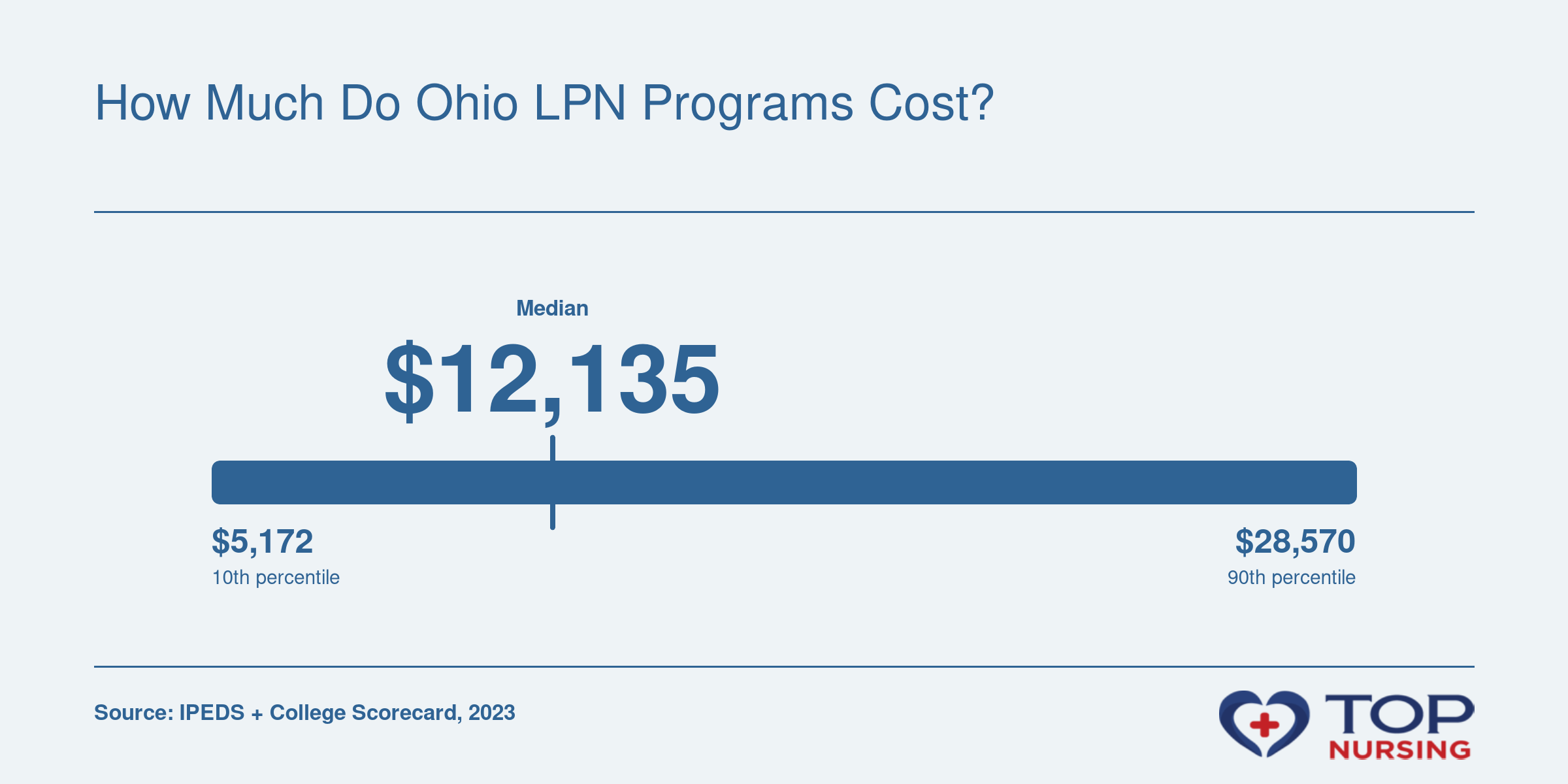
The cost of an LPN program in Ohio varies widely, from about $4,000 at community colleges to over $47,000 at private institutions. These figures reflect the average net price after grants and scholarships, the amount students actually pay, not the published tuition. Your actual cost will depend on your financial aid eligibility and enrollment status.

Net price percentiles for Ohio LPN programs: 10th percentile $5,172, median $12,135, 90th percentile $28,570 in 2023

LPN Program Costs and Financial Aid in Ohio

The sticker price of an LPN program covers only part of what you will spend to earn your license. Understanding every line item before you enroll helps you avoid surprises and plan a realistic budget.

Breaking Down the Full Cost of an LPN Program

Tuition is the biggest expense, but many other costs quickly add up. When comparing Ohio LPN programs, look beyond the per-credit rate and ask about these typical out-of-pocket items:

  • Textbooks and course materials: Some programs bundle books into tuition, while others require you to buy them separately, often costing several hundred dollars per term.
  • Uniforms and clinical supplies: You will need scrubs in specific colors, a lab coat, a stethoscope, a blood pressure cuff, a penlight, and comfortable nursing shoes. Prices vary, but plan on at least a few hundred dollars.
  • Liability insurance: Most programs require students to carry professional liability coverage. Schools may include this in a student fee or have you purchase a policy on your own.
  • Background check and drug screening: Clinical placement typically mandates a criminal background check and a drug test. These are usually paid directly to the screening company.
  • NCLEX-PN exam fee: After graduation, you must register and pay for the licensure exam. This is a separate charge set by the testing vendor.

Always visit each program's official website and look for a dedicated tuition and fees page. Many schools publish a comprehensive cost of attendance that includes estimates for books, supplies, transportation, and personal expenses. If you cannot find the information, call the school’s bursar or admissions office.

Licensing and Examination Fees in Ohio

Once you complete your LPN program, you will apply for licensure through the Ohio Board of Nursing. The board charges an application fee that is nonrefundable. On top of that, you must pay the NCLEX-PN registration fee directly to Pearson VUE. Check the Ohio Board of Nursing’s website for the most current fee schedule and any additional fingerprinting charges. Their FAQ page also covers common hidden costs, such as the fee for a temporary permit while you wait to test.

Financial Aid Options for Ohio LPN Students

LPN programs in Ohio qualify for many of the same need-based grants and workforce development funds that degree programs do, but some aid is specific to certificate students. Here is where to look:

  • Ohio College Opportunity Grant (OCOG): This state grant provides aid to low- and moderate-income students. While traditionally targeted at degree-seeking students, some certificate programs may be eligible if they meet certain credit or clock-hour thresholds. Ask the financial aid office at any school you are considering whether its LPN certificate qualifies for OCOG.
  • Workforce development grants: OhioMeansJobs.com, the state’s employment resource portal, lists training grants for in-demand fields, including nursing. Use the site’s scholarship search tool or visit your local OhioMeansJobs center to find programs that may cover a portion of your LPN training.
  • Professional association scholarships: The Ohio Nurses Association and the Ohio League for Nursing occasionally offer scholarships or grants for LPN students. Contact these organizations directly or visit their websites for current opportunities. Awards may be based on merit, financial need, or commitment to practice in underserved areas.
  • Federal student aid: Complete the Free Application for Federal Student Aid (FAFSA) even for a certificate program. Many Ohio LPN programs are eligible for Pell Grants and federal student loans, which do not need to be repaid while you are enrolled at least half-time.

How to Get Accurate Cost Estimates

Costs can change from year to year, so always use the current school year’s data. When researching, create a simple spreadsheet that lists each expense category and the amount quoted by every school. Then, visit the Ohio Board of Nursing’s website for the latest licensing fees. A thorough list lets you compare total program costs rather than just tuition, helping you find the best value in Ohio LPN education.

Questions to Ask Yourself

Many LPN programs are accelerated and daytime only. If you need flexibility, look for part-time or evening options early, as not all schools offer them.

Graduates who plan to pursue an RN may benefit from programs with strong articulation agreements or co-enrollment tracks that save time later.

Clinical rotations often occur at facilities up to an hour away. Factor in travel time and costs, especially during winter weather in Ohio.

How to Become an LPN in Ohio

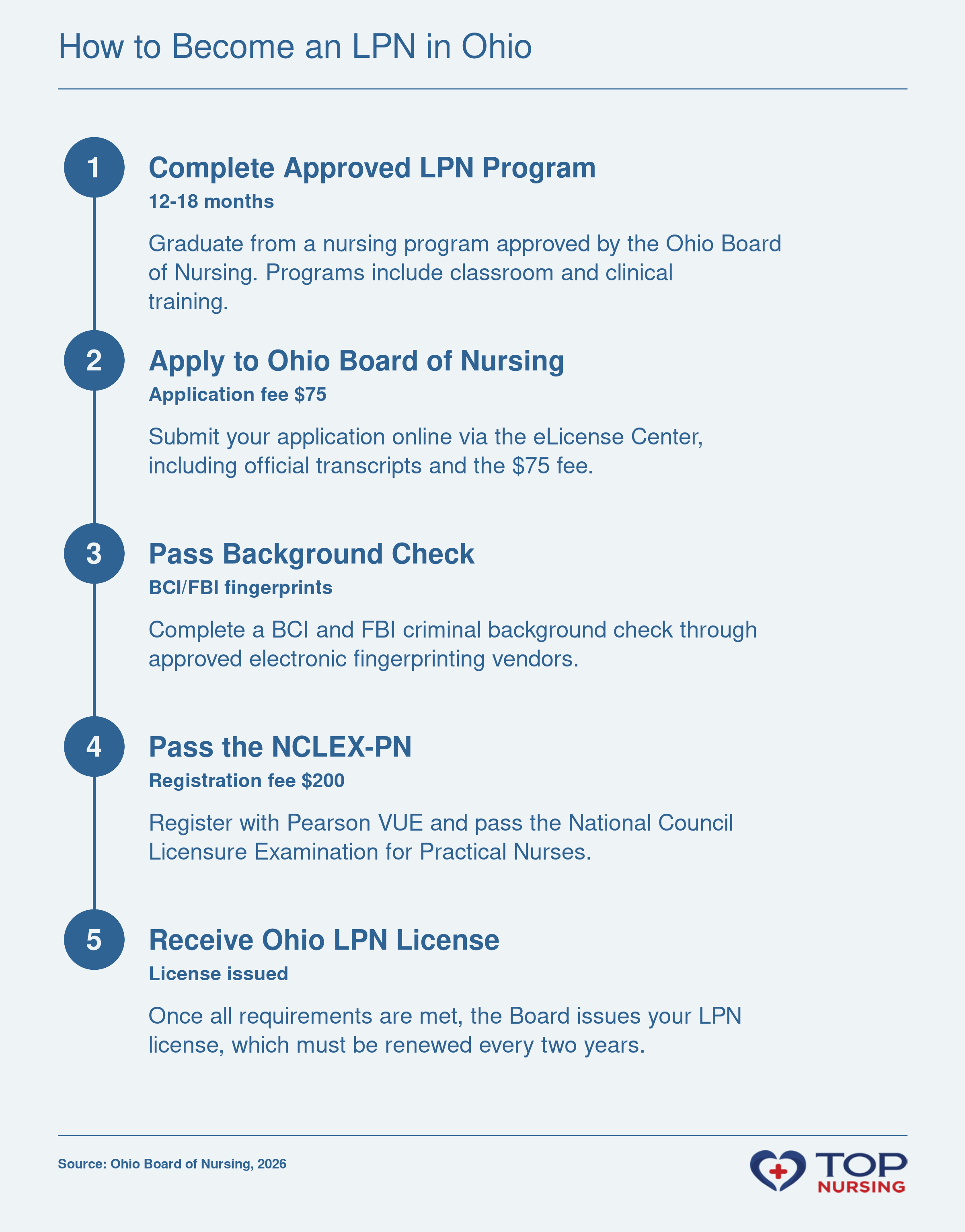
Ohio requires graduation from a state-approved LPN program and a current BCI/FBI background check before you can sit for the NCLEX-PN. The Ohio Board of Nursing sets all licensure requirements.

Five-step pathway to an Ohio LPN license: complete approved program, apply to Board, pass BCI/FBI background check, pass NCLEX-PN, receive license.

Admission Requirements and Program Length for Ohio LPN Programs

Most Ohio LPN programs set a minimum cumulative GPA between 2.0 and 2.5, though individual schools may have higher thresholds, Columbus State Community College, for instance, requires a 2.4.

Admission Prerequisites

Before applying, you will need a high school diploma or GED. Beyond that, nearly every program asks for:

  • Entrance exam: TEAS or HESI A2; Columbus State demands an overall HESI A2 score of 73% or higher, while Vantage Career Center requires at least 70% in reading, vocabulary, and math.
  • Background check and drug screening: These are standard across Ohio LPN schools.
  • Health requirements: Expect to provide immunization records, a physical exam, and CPR certification.
  • Prerequisite coursework or certifications: Some programs add extra layers. Ohio Medical Career College requires you to already hold a CNA or MA certification before entering its practical nursing track.

Once admitted, you will also need to maintain any program-specific academic standards throughout the curriculum.

Program Length and Scheduling Options

Full-time programs are typically 12 months, but accelerated and part-time tracks are becoming more common, a gap many competitors miss when comparing schools.

  • Accelerated 9‑month option: Ohio Medical Career College offers a 9‑month full-time evening program, one of the fastest ways to become an LPN in the state.
  • Standard 11–12 months: Vantage Career Center (11 months), Professional Skills Institute (11 months, hybrid with 270 clinical hours), and Galen College of Nursing Cincinnati (12 months) represent the typical timeline.
  • Part‑time paths: Galen College offers a 21‑month part-time option for students who need a slower pace.
  • Evening and hybrid delivery: Columbus State runs an evening program, Ohio Medical Career College holds evening classes, and Professional Skills Institute uses a hybrid format that blends online coursework with in-person clinicals.

No program on our radar currently advertises dedicated weekend-only tracks, but part-time schedules often include evening or flexible clinical placements that can accommodate working students.

Certificate vs. Associate Degree Impact

Most Ohio LPN programs award a certificate or diploma, not an associate degree. This distinction matters if you plan to later enroll in an LPN-to-RN bridge program. Credits from a diploma track often do not transfer as seamlessly toward an associate or bachelor’s in nursing, which means you may need to repeat some coursework when pursuing your RN. During your research, check each school’s articulation agreements if that pathway is in your future.

Online and Hybrid LPN Programs in Ohio

On-campus LPN programs offer daily face-to-face interaction, but hybrid formats blend online coursework with in-person labs and clinical rotations. The Ohio Board of Nursing does not approve any fully online LPN program because state regulations require supervised hands-on clinical hours. Labels like “online LPN program” actually refer to hybrid models where only the theory portion moves to a digital platform.

No Fully Online LPN Programs in Ohio

The Ohio Board of Nursing mandates that all practical nursing programs include in-person clinical training. Didactic coursework can be completed remotely, but lab skills assessments and patient-care rotations must occur at approved healthcare facilities. This means no legitimate LPN program in the state is 100 percent online.

Hybrid Programs in Ohio

Several ranked schools deliver their LPN curriculum through a hybrid approach. Fortis College-Columbus, ATA College-Cincinnati, American Institute of Alternative Medicine (AIAM), and Stautzenberger College-Brecksville all list a hybrid program type in current records. Beyond the ranked list, other Ohio institutions also advertise hybrid practical nursing tracks, including Academia Medical Institute in Columbus, United Career Institute, Professional Skills Institute in Toledo, and the RISE Partnership. Most of these programs span 9 to 15 months, with start dates throughout the year.

What to Expect from a Hybrid LPN Program

The typical hybrid structure divides the workload into three components: - Online lectures and coursework: Didactic material is delivered through a learning management system, covering anatomy, pharmacology, nursing fundamentals, and ethics. - Scheduled on-campus labs: Students attend in-person skills labs where they practice procedures like IV therapy, wound care, and vital sign assessment under instructor supervision. - Clinical rotations: The bulk of hands-on training happens at partner hospitals, long-term care facilities, or clinics, often during daytime or weekend shifts.

Check Clinical Site Locations Before You Enroll

Hybrid programs may place students at clinical sites that are far from the campus or your home. In urban areas like Columbus or Cincinnati, multiple facilities keep commutes reasonable, but rural partnerships can mean a drive of 30 miles or more. Always ask the program coordinator for a list of current clinical affiliates and whether you can request a specific site. Verifying logistics upfront helps avoid scheduling conflicts or excessive travel once the program begins.

NCLEX-PN Pass Rates at Ohio LPN Schools

The NCLEX-PN is the national licensing exam that every practical nursing graduate must pass to earn the Licensed Practical Nurse (LPN) credential. Ohio LPN programs report their first-time pass rates each year, giving you a clear window into how well a school prepares students for entry-to-practice. A consistently high pass rate points toward strong instruction, relevant clinical experiences, and effective test-preparation support. A lower rate may signal curriculum gaps or less individualized attention.

Where to Find Ohio NCLEX-PN Pass Rates

The primary source is the Ohio Board of Nursing. Its website (nursing.ohio.gov) publishes an annual report that lists NCLEX-PN pass rates by school for the most recent testing years, typically covering the last three to five years. Look for the "NCLEX Pass Rates" section or program review data. The report breaks out first-time test-takers and includes the number of graduates, so you can see both the percentage and the cohort size. A 100% pass rate means little if only four students sat for the exam that year; compare enrollment figures alongside the rate.

The National Council of State Boards of Nursing (NCSBN) also provides searchable pass rate information. You can filter by state, program type, and year, though you may need to select Ohio from a drop-down menu and then scroll through the results. NCSBN data tends to align with the Board’s numbers but offers an additional verification layer.

Another cross-reference point is the Integrated Postsecondary Education Data System (IPEDS). While IPEDS doesn’t show NCLEX-PN results directly, it does report program completers and can help you confirm the school’s overall LPN program size and graduation counts. Use this to double-check that the pass rate applies to a healthy, ongoing program rather than a single tiny cohort.

Requesting Pass Rates Directly from Schools

Most LPN programs list their NCLEX-PN pass rates on their nursing department webpages. If you can’t find them, email the program director or admissions office and ask for the last three years of first-time pass rates. Legitimate programs will share this information freely. Be wary of any school that hesitates or only provides a single year’s rate without context.

What to Look for in Pass Rate Data

  • First-time vs. ultimate pass rates: The Ohio Board of Nursing reports first-time pass rates, the percentage of graduates who pass on their initial attempt. Ultimate rates (including retakes) are sometimes higher, but first-time rates better reflect the program’s readiness focus.
  • Cohort size and trends: A small cohort with a 100% rate may not be as telling as a program with 50, 100 annual graduates maintaining an 85, 95% rate over multiple years. Look for stability and a rising trend.
  • Year-over-year comparison: A one-year dip may be an anomaly, especially during periods of curriculum change or pandemic disruptions. Compare at least three years of data to gauge consistency.
  • State average as a benchmark: Ohio’s overall LPN NCLEX-PN pass rate typically hovers between 80% and 85%. A school consistently above the state average is a good sign; one well below it deserves deeper scrutiny.

Interpreting Pass Rates Alongside Other Factors

NCLEX-PN pass rates are one important metric, but they don’t tell the whole story. Consider them alongside program accreditation, clinical placement quality, graduate employment rates, and the total cost. A program with a modest but improving pass rate might still offer excellent value if it provides strong job placement support and affordable tuition. Use pass rates to narrow your list, then visit campus, talk to current students, and review the full curriculum before making your decision.

Did You Know?

Ohio LPN program NCLEX-PN pass rates vary widely: some programs report rates below 70%, while top performers exceed 95%. Selecting a program with a strong track record increases your likelihood of passing on the first try and beginning your nursing career sooner.

LPN Salary and Job Outlook in Ohio

Ohio employs 36,440 licensed practical nurses, with wages that span from entry-level to experienced roles. The table below breaks down annual wage percentiles for LPNs across the state based on the most recent occupational data. Program-specific graduate earnings are not yet available, so these statewide figures serve as a broad earning potential indicator.

Wage MeasureAnnual Wage
25th Percentile$53,930
Median$60,990
75th Percentile$64,850
Mean (Average)$60,600

LPN-to-RN Bridge Programs and Other Advancement Pathways in Ohio

For many licensed practical nurses, the next logical career step is becoming a registered nurse. Ohio offers multiple bridge pathways that let you build on your LPN education and experience, earning an RN credential faster than starting from scratch.

Common Bridge Pathways

  • LPN-to-ADN (Associate Degree in Nursing): This is the most direct route to the NCLEX-RN. You complete the core nursing courses in as little as 12 to 18 months, then sit for the RN exam.
  • LPN-to-BSN (Bachelor of Science in Nursing): This pathway integrates your LPN background with a full bachelor's degree. It typically takes two to three years and opens doors to leadership, community health, and graduate studies.
  • LPN-to-RN Diploma: Some technical centers offer a diploma program that qualifies you for the NCLEX-RN. Credits from this diploma can often transfer into a BSN completion program later.

Several schools featured in this year's ranking also operate bridge programs, providing a seamless transition for LPN graduates. Professional Skills Institute, Ohio Business College, Collins Career Technical Center, and Central Ohio Technical College all have LPN-to-RN options on campus or in hybrid formats.

Program Lengths and Credit Transfers

Bridge programs are designed to maximize your prior learning. Ohio does not have a single statewide articulation agreement, but many schools use the Industry Transfer Assurance Guide (Industry TAG) to award credit for your LPN education and work experience. Here's how some programs handle advanced standing: - Ohio State University grants 20 credit hours toward its LPN-to-BSN for your LPN license and coursework, reducing the total to about 122 credits over two years. - Collins Career Technical Center offers an 11-month LPN-to-RN diploma that requires a current LPN license, one year of experience, and a passing TEAS score. - Stark State College provides day, evening, and weekend options for its LPN-to-ADN bridge, and the TEAS exam is part of the admission process. - Central Ohio Technical College structures its LPN-to-ADN pathway with 47 program hours out of 65 total, taking about 18 months.

Return on Investment: LPN vs. RN Earnings

The salary jump from LPN to RN in Ohio makes bridge programs a sound financial move. According to the latest data, Ohio's median annual wage for LPNs is approximately $52,000, while registered nurses earn a median of about $78,000, a nearly 50% increase. Since most bridge programs can be completed in 12 to 18 months, the additional earnings quickly offset the cost of tuition.

Beyond the BSN: Advanced Nursing Roles

Once you hold an RN license, additional advancement paths become available. RN-to-BSN completion programs help associate-degree nurses earn their bachelor's, often online while working. For those considering graduate study, RN-to-MSN bridges and direct-entry master's programs exist. The nursing directory at topnursing.org covers top-ranked RN-to-BSN programs across the country, and also profiles nurse practitioner and other advanced practice specializations for longer-term career planning.

Frequently Asked Questions About LPN Programs in Ohio

Choosing the right LPN program is a big decision. Below are answers to common questions about program length, cost, licensing, and career outlook in Ohio to help you move forward with confidence.

How long does it take to complete an LPN program in Ohio?
Most full-time LPN programs in Ohio take 12 to 18 months to complete. Some accelerated options, like 9-month programs, are available for students who can commit to intensive schedules. Program length varies by school and whether you attend part-time. After finishing the program, you'll need to pass the NCLEX-PN to become licensed.
Are there fully online LPN programs in Ohio?
Fully online LPN programs are rare because of required clinical hours. Most Ohio schools offer hybrid programs where coursework is online but labs and clinicals are held in-person at approved healthcare facilities. Check with programs directly about their online components to find one that fits your schedule.
How much does an LPN program cost in Ohio?
Tuition for LPN programs in Ohio ranges widely, from around $1,000 for short certificate programs at career centers to over $20,000 at private colleges. Additional costs include books, uniforms, and licensing fees. Financial aid, scholarships, and employer tuition reimbursement may reduce your out-of-pocket expenses.
What is the NCLEX-PN pass rate for Ohio LPN programs?
Ohio LPN programs report NCLEX-PN pass rates typically between 80% and 100%, with the state average often around 88-90% in recent years. High pass rates are a strong indicator of program quality. Always check a program's first-time pass rate before enrolling, as it reflects how well graduates are prepared.
What are the requirements to become an LPN in Ohio?
To become an LPN in Ohio, you need a high school diploma or GED, completion of a state-approved LPN program, and a passing score on the NCLEX-PN. You must also pass a criminal background check and submit an application to the Ohio Board of Nursing. Some programs may require entrance exams like the TEAS.
How much do LPNs make in Ohio?
According to the most recent Bureau of Labor Statistics data, the median annual wage for LPNs in Ohio is about $52,580. However, pay varies by location, experience, and employer. LPNs in larger metropolitan areas like Columbus or Cleveland often earn higher salaries. Nationally, the median annual wage for LPNs is around $54,620.
Can I work as an LPN while completing an RN bridge program?
Yes, many LPNs work part-time or full-time while enrolled in an LPN-to-RN bridge program. These programs are often designed with flexible schedules, including evening and weekend classes. Balancing work and school requires good time management, but gaining clinical experience while studying can reinforce your learning and accelerate career growth.

More LPN Programs in Ohio to Consider

Beyond the top-ranked schools, Ohio has many more LPN programs across the state. The following directory lists additional options, from city campuses to hybrid formats. Contact schools directly to confirm current enrollment status, tuition, and NCLEX pass rates.

Cincinnati Area

Cincinnati State Technical and Community College
This 3-semester certificate combines classroom theory with clinical practice, preparing students for the NCLEX-PN exam. The program requires a State Tested Nurse Aide prerequisite and offers transfer pathways to RN degrees.
  • Practical Nursing Certificate
Cincinnati, OH · On-Campus
ATA College-Cincinnati
A 15-month hybrid diploma with no prerequisites and no waiting list. The program includes online classes, on-campus labs, and clinical experience, leading to NCLEX-PN eligibility.
  • Practical Nursing Program
Cincinnati, OH · Hybrid
Galen College of Nursing-Cincinnati
Complete this on-campus program in as little as 12 months full-time or 21 months part-time, with four start dates yearly. Clinical coursework and practice-based training prepare you for the NCLEX-PN exam.
  • Practical/Vocational Nursing
Cincinnati, OH · On-Campus

Dayton Area

Ohio Medical Career College
A 40-week campus program with day and evening classes, covering anatomy, physiology, and patient care. Requires CNA or MA certification and CPR training for admission.
  • Practical Nursing
Dayton, OH · On-Campus
Clark State College
This 12-month certificate offers full-time and evening-weekend formats at campuses in Beavercreek, Bellefontaine, and Springfield. Graduates can stack credits into the college's RN programs.
  • Licensed Practical Nursing
Springfield, OH · On-Campus
Ohio Institute of Allied Health
A 12-month accelerated diploma with no entrance exam required. The program features modern labs, offsite clinicals, and a holistic nursing curriculum.
  • Practical Nursing
Huber Heights, OH · On-Campus

Columbus Area

Fortis College-Columbus
A hybrid program with online and on-campus learning, preparing students for the NCLEX-PN. STNAs may qualify for transfer credits, and financial aid is available.
  • Practical Nursing
Westerville, OH · Hybrid
American Institute of Alternative Medicine
This 9-month hybrid program in Columbus focuses on holistic patient care with small class sizes and one-on-one professor time. Prepares for the NCLEX-PN exam.
  • Practical Nursing
Columbus, OH · Hybrid

Northeast Ohio

Fortis College-Cuyahoga Falls
A 16-month campus-based program combining classroom theory and clinical experience. Financial aid is available for those who qualify, and graduates are eligible for the NCLEX-PN.
  • Practical Nursing
Cuyahoga Falls, OH · On-Campus
Bryant & Stratton College-Parma
A 12-month, 41-credit-hour diploma accredited by ACEN and approved by the Ohio Board of Nursing. The program includes hands-on clinical experiences and NCLEX-PN exam preparation.
  • Licensed Practical Nurse Diploma
Parma, OH · On-Campus
Stautzenberger College-Brecksville
A 14-month hybrid program with small class sizes and experienced faculty. Covers anatomy, pharmacology, and clinical skills, with an emphasis on ethics and patient safety.
  • Practical Nursing Diploma Program
Brecksville, OH · Hybrid

Northwest Ohio

Owens Community College
This campus certificate in Perrysburg is designed for LPNs seeking to advance, blending academic and practical learning for diverse nursing roles.
  • Practical Nursing Certificate
Perrysburg, OH · On-Campus
Professional Skills Institute
A 48-week diploma with daytime and evening hybrid classes, including 270 hours of clinical training. Approved by the Ohio Board of Nursing and also meets Michigan licensure requirements.
  • Practical Nurse
Maumee, OH · Hybrid

Eastern Ohio

Eastern Gateway Community College
A one-year certificate in Steubenville with three days of lectures and two days of clinicals per week. Graduates can sit for the NCLEX-PN and have a pathway to the college's LPN-to-ADN program.
  • Practical Nursing
Steubenville, OH · On-Campus

Recent Articles