Compare tuition, NCLEX-PN outcomes, and career earnings across Michigan's highest-rated practical nursing programs.
By Maria Delgado, RNReviewed by TopNursing.org TeamUpdated May 27, 202619 min read
Points of interest…
Michigan LPN tuition ranges from $3,333 at Wayne County Community College to $24,466 at Davenport University.
The state requires LPN programs to maintain a minimum 75% first-time NCLEX-PN pass rate.
Michigan LPNs earn above the national median wage of $62,340, with strong job growth projected.
At least seven colleges, including Washtenaw Community College and Schoolcraft, offer LPN-to-RN bridge programs.
Michigan’s long-term care facilities and hospitals are competing for a limited pool of LPN graduates as the population ages. Twenty-two programs across the state train these nurses, with tuition ranging from $3,333 at public community colleges to over $24,000 at private institutions. Many programs post NCLEX-PN pass rates above 90%, so the real differentiator isn’t exam readiness: it’s net cost, clinical placement quality, and employment outcomes.
How Much Do LPN Programs Cost in Michigan?
Tuition for LPN programs in Michigan ranges widely, from $3,333 in-state at Wayne County Community College up to $24,466 at Davenport University. After financial aid, the net price students actually pay varies even more, with the lowest at $1,527 at West Shore Community College and the highest at $28,525 at Dorsey College in Madison Heights. The net price shown is the institution-wide average after grants and scholarships, not a guarantee for every LPN student. The Pell Grant recipient share indicates the proportion of undergraduates who receive federal need-based aid, offering a rough gauge of financial aid accessibility.
School
In-State Tuition
Out-of-State Tuition
Net Price After Aid
Pell Grant Recipients (%)
West Shore Community College
$6,420
$8,820
$1,527
91.7%
Macomb Community College
$6,630
$8,370
$1,618
83.3%
Schoolcraft Community College District
$5,057
$6,501
$2,260
84.3%
Kalamazoo Valley Community College
$6,904
$9,094
$2,979
79.0%
Alpena Community College
$8,220
$8,220
$3,320
79.3%
Muskegon Community College
$11,970
$16,010
$4,005
85.7%
Delta College
$7,550
$7,880
$4,547
86.4%
Monroe County Community College
$7,511
$8,267
$4,586
75.6%
Kellogg Community College
$6,098
$8,282
$4,858
85.1%
Gogebic Community College
$6,630
$7,530
$5,397
74.8%
Lansing Community College
$7,700
$11,300
$5,437
75.4%
St Clair County Community College
$8,748
$12,150
$5,571
80.7%
Mott Community College
$8,405
$11,460
$5,687
80.3%
Northwestern Michigan College
$10,722
$13,476
$6,231
70.7%
Wayne County Community College District
$3,333
$4,067
$7,656
95.2%
Jackson College
$8,310
$10,200
$7,761
84.3%
Grand Rapids Community College
$8,289
$12,219
$8,621
74.0%
North Central Michigan College
$8,490
$10,590
$10,083
86.4%
Bay de Noc Community College
$9,626
$11,453
$11,949
81.4%
Davenport University
$24,466
$24,466
$17,707
65.3%
Dorsey College-Dearborn
$15,154
$15,154
$25,615
93.8%
Dorsey College
$16,990
$16,990
$28,525
93.8%
Questions to Ask Yourself
Can you commit to a full-time daytime schedule, or do you need evening or weekend classes?
Many Michigan LPN programs run only during weekday business hours. If you work or have caregiving duties, verify whether schools like Dorsey College or Henry Ford College offer part-time, evening, or weekend tracks before applying.
Have you factored in costs beyond tuition such as books, scrubs, background checks, and NCLEX exam fees?
Tuition is just the starting point. For Michigan LPN students, uniforms, physical exams, drug screening, licensure application, and the NCLEX-PN fee can add $800 to $1,200, often not included in the advertised price.
Is there a waitlist at your preferred school, and does your timeline allow for it?
Limited clinical placements and high demand mean several Michigan community colleges, including those in Detroit and Grand Rapids, maintain waitlists that can extend your entrance by six months or more. Ask admissions about current wait times and how they prioritize applicants.
NCLEX-PN Pass Rates for Michigan LPN Schools
A program with a near-perfect NCLEX-PN pass rate and one that hovers just above 75% both satisfy the state’s minimum threshold, yet the first-time pass rate tells a more revealing story about how thoroughly a curriculum prepares students for the licensing exam. When two schools are otherwise similar, this metric can tip the decision.
Michigan and National Averages in Context
In 2024, Michigan’s LPN programs collectively reported an average NCLEX-PN pass rate of 87.40 percent, placing the state just a fraction below the national average of 87.76 percent. The figures draw from the Michigan Board of Nursing’s annual NCLEX Score Summary, which aggregates results from first-time test takers educated in the state. Nationwide benchmarks come from the National Council of State Boards of Nursing (NCSBN). While the gap is small, averages mask wide variation among individual schools, some programs consistently exceed 95 percent, while others struggle to reach 80 percent. Readers can verify the latest numbers through the Michigan Department of Licensing and Regulatory Affairs website.
Why Pass Rates Matter When Choosing an LPN Program
First-time NCLEX-PN pass rates serve as a practical litmus test for program quality. A high rate suggests that the curriculum aligns well with the test plan, clinical placements give students enough hands-on practice, and faculty provide effective remediation. Conversely, a program with persistently low rates may have gaps in instruction, under-resourced simulation labs, or insufficient support for struggling students. Beyond licensure, strong pass rates correlate with smoother entry into the workforce: employers in hospitals and long-term care facilities often ask about NCLEX outcomes when recruiting new graduates.
When evaluating pass rates, look for several indicators:
- Consistency: A rate that stays above 85 percent across three or more years signals steady program performance.
- Cohort size: A 100 percent pass rate with only five test takers is less informative than a 92 percent rate from a cohort of 60.
- Retention alignment: A program that graduates a high percentage of its entering class and also posts strong NCLEX numbers usually demonstrates strong student support end to end.
Where to Find School-by-School NCLEX-PN Data
While this article does not include a program-level pass rate table, such a breakdown requires the latest year’s data from the Michigan Board of Nursing, which may be released after publication, students can access detailed reports directly. The Board’s annual NCLEX summary lists each approved LPN program with the number of first-time candidates, the number who passed, and the resulting percentage. Searching “Michigan NCLEX-PN pass rates 2024” or visiting the LARA website typically surfaces the most current PDF. When reviewing these reports, note the exam year and whether the rate reflects first-time test takers only, as repeat testers can inflate some institutional summaries. Checking a program’s track record across two or three years gives a more reliable picture than a single year’s snapshot.
Can you complete an LPN program online in Michigan? The short answer: fully online programs are virtually nonexistent because hands-on clinical hours are mandatory for licensure. However, a handful of schools now blend online coursework with in-person training, and a few offer evening or weekend schedules that can fit around a job.
What “hybrid” really means for LPN students
In Michigan, a hybrid LPN program usually delivers lectures, readings, and quizzes through an online platform while requiring you to attend campus labs and clinical rotations in person. You still need to be physically present for skills practice and patient care experiences at local healthcare facilities. This format can cut down on commuting time for theory classes but does not reduce the total clinical hours required by the Michigan Board of Nursing.
From the schools on our list, two programs explicitly note a hybrid delivery:
Delta College: The Practical Nursing certificate lists a “blended in-person and online format.” Students complete didactic work online and come to campus for simulation labs and clinicals. The program reports strong pass rates and job placement.
Jackson College: The Practical Nursing Certificate is also designated as hybrid. Admission is competitive, and the curriculum integrates online theory with on-site clinical experiences.
Most other programs in the state, including those at Schoolcraft, Mott, Washtenaw, and Macomb, are campus-based. If online flexibility is essential, these hybrid options are worth a closer look, but expect the same rigorous clinical demands as any traditional track.
Evening, weekend, and part-time options
Flexible scheduling is not widespread among Michigan LPN programs, but there are a few standouts:
Kellogg Community College created a dedicated Nights and Weekends Part-Time Nursing Program for the Practical Nursing Certificate. The schedule typically involves one weeknight class and Saturday clinicals each week, spread over three semesters.1 This can be a fit if you work during standard business hours.
Several other colleges run full-time daytime cohorts. Abcott Institute's Practical Nurse Program and Hondros College of Nursing's Practical Nursing track in Detroit, for example, schedule classes four days a week during business hours. Evening or weekend tracks are not available at every campus, so verify before applying.
Oakland Community College does offer an Evening Nursing Program with weekend clinicals, but that program leads to an Associate Degree in Nursing, not an LPN certificate.2 If you’re set on an LPN path, don’t assume that evening RN programs translate to evening LPN slots, always confirm with the school.
What to ask before enrolling
Because flexible and hybrid formats are still the exception rather than the rule, call or email the program director and ask:
How much of the coursework is actually online versus in-person?
Are clinical hours scheduled during evenings or weekends, or only on weekdays?
Does the program offer a part-time track, and how long does it take to complete?
Are there any mandatory on-campus sessions outside of clinicals, such as labs or exams?
Answering these questions early will help you avoid surprises and find a program that matches your availability without compromising the training quality you need to pass the NCLEX-PN.
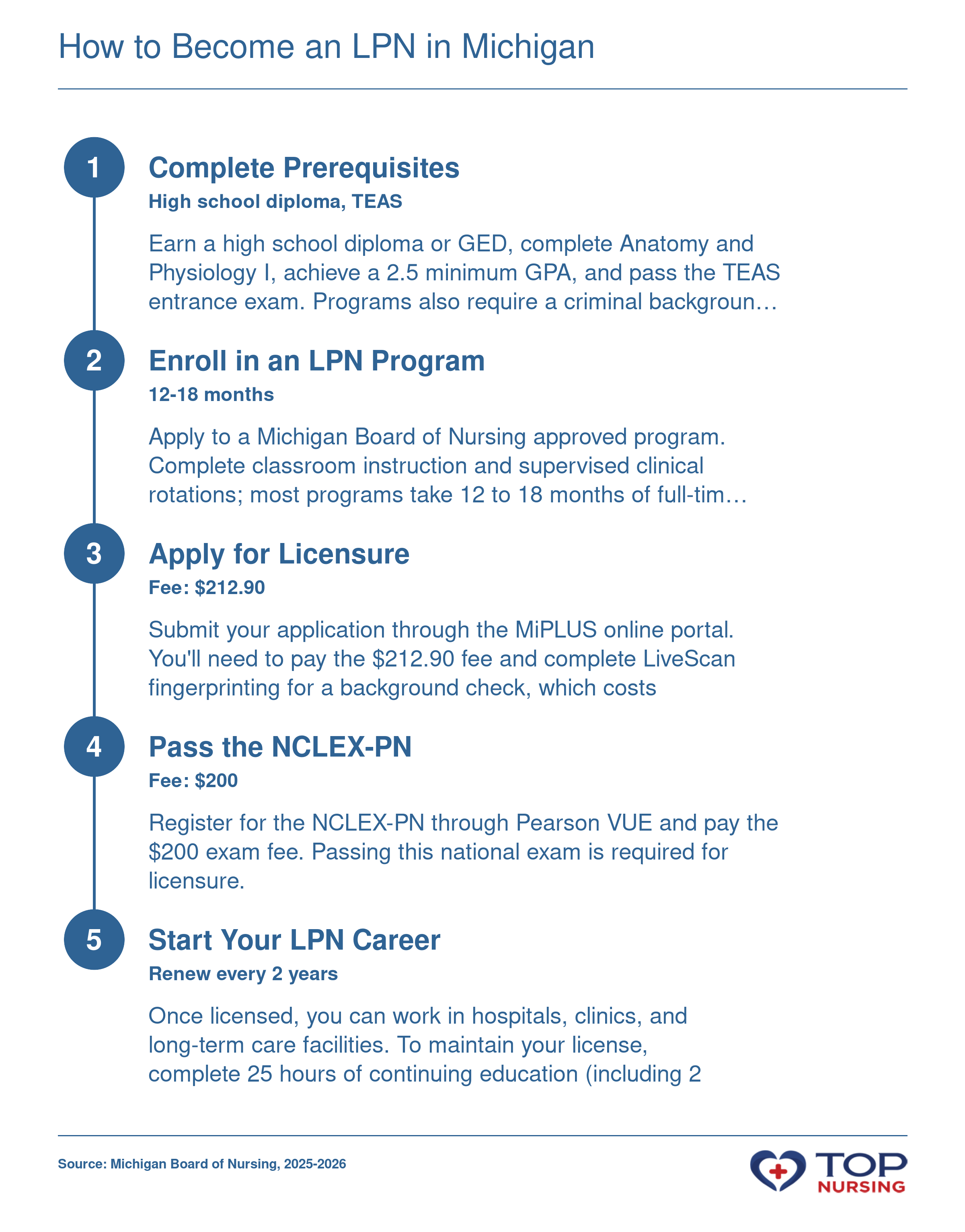
How to Become an LPN in Michigan
Becoming a Licensed Practical Nurse in Michigan requires completing a state-approved program and passing the NCLEX-PN. Here is the step-by-step path from prerequisites to first job, including expected timeframes and costs.
LPN Salary and Job Outlook in Michigan
Licensed Practical Nurses in Michigan earn wages that often exceed the national median, and employment opportunities remain strong across the state. The Bureau of Labor Statistics (BLS) reports that licensed practical nurses nationwide earned a median annual wage of $62,340 in 2024. For the Detroit-Warren-Dearborn metropolitan area, the mean wage was $65,030, indicating that LPNs in Michigan's largest metro can earn above the national benchmark. Understanding local pay scales is essential because state-level medians can hide significant variation; an LPN in a rural Upper Peninsula clinic may earn less than one in a Detroit outpatient surgery center. To see full wage distributions, including the 10th, 25th, 75th, and 90th percentiles for Michigan and specific cities like Grand Rapids-Wyoming, use the BLS Occupational Employment and Wage Statistics (OEWS) query tool and filter by state and metropolitan area.
Employment Outlook for Michigan LPNs
Nationally, the BLS projects growth for licensed practical and licensed vocational nurses over the 2024–2034 decade, driven by an aging population, an increase in chronic conditions, and a shift toward long-term care and home health services. For Michigan-specific projections, the go‑to resources are Projections Central (projectionscentral.org) and the Michigan Department of Technology, Management & Budget (DTMB). These agencies publish long-term occupational outlooks that break down expected job openings and growth rates for LPNs across the state. Accessing these reports gives you a data-driven view of where demand will be strongest, whether in hospitals, nursing care facilities, or home healthcare.
How to Find Real-Time Salary Data
While government statistics provide the gold standard, you can supplement them with current postings on job boards like Indeed and Glassdoor. These platforms show salary ranges advertised by employers right now, along with employee reviews and benefit information. However, always cross-reference job board figures with official BLS data, as crowdsourced salaries can be skewed by small sample sizes or self-reported bias. Pairing these sources gives you a complete picture of what you can earn and where the jobs will be.
BLS OEWS: Filter by state and metro area for detailed LPN wage percentiles.
Projections Central / DTMB: Get 10-year employment projections for Michigan.
Professional networks: Reach out to Michigan nursing schools’ career services, the Michigan Nurses Association, or the Michigan Board of Nursing for regional salary surveys and hiring trend updates.
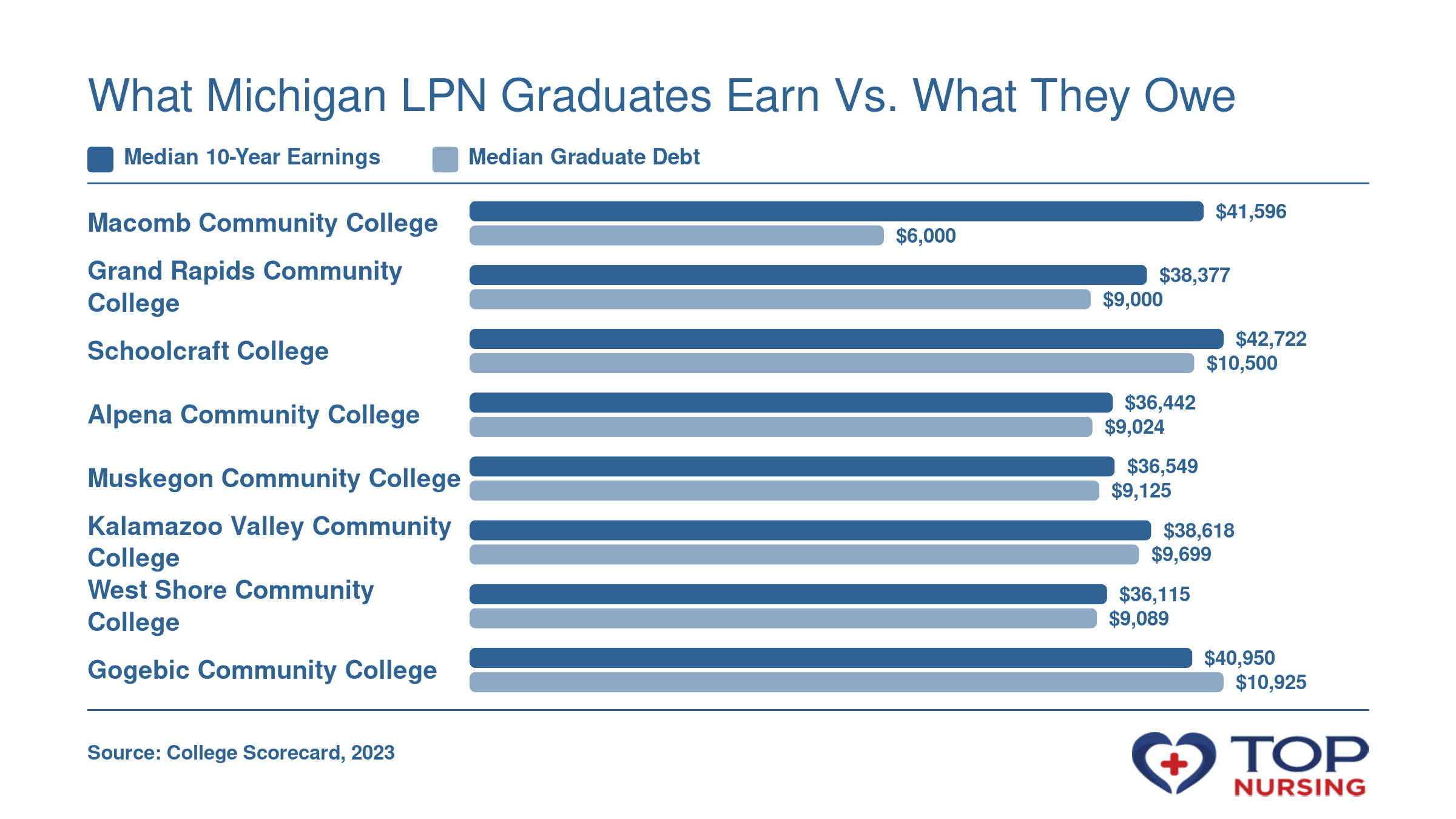
What Michigan LPN Graduates Earn vs. What They Owe
School-by-school comparison of median earnings 10 years after entry and median student debt for LPN program completers at top Michigan schools, using the latest College Scorecard data. Programs with a higher earnings-to-debt ratio deliver stronger early-career returns.
LPN-to-RN Bridge Programs in Michigan
At least seven Michigan institutions, including Washtenaw Community College and Schoolcraft College, offer structured LPN-to-RN bridge pathways. These programs allow licensed practical nurses to earn an associate or bachelor’s degree in nursing and sit for the NCLEX-RN exam, often in less time than a traditional prelicensure track because they award credit for previous education and clinical experience.
How Bridge Programs Work
Because LPNs have already completed foundational nursing coursework and clinical hours, bridge programs are designed to fill the gap between the LPN and RN scopes of practice. Curricula typically cover advanced topics such as critical care, leadership, and community health. Most pathways lead to an Associate of Applied Science (AAS) in Nursing and add about one to two semesters beyond the standard ADN timeline. Some universities offer an LPN-to-BSN track that awards a Bachelor of Science in Nursing and generally requires about three years of full-time study.
Michigan Schools with Bridge Programs
Washtenaw Community College: On-campus APNURL program leading to an AAS in Nursing, completed in about 12 months for qualified LPNs.
Schoolcraft College: On-campus LPN to RN Option that can be finished in 8, 12 months for Michigan-licensed practical nurses.
Henry Ford College: Campus-based Advancement of LPNs to RNs track, with a typical duration of 12, 16 months.3
Wayne County Community College District: A 12-month, campus-based LPN to RN Bridge that awards an AAS.2
Monroe County Community College: Campus-based PN to RN Option taking 12, 18 months; application deadline is the first Monday in March.1
Gogebic Community College: On-campus LPN to RN Bridge (ADN/AAS) that expects a 3.0 minimum GPA and runs about 12 months.4
Madonna University: Campus-based LPN to BSN track offering a Bachelor’s degree in 30, 36 months.5
Most programs are campus-based, though some may offer hybrid components. Admission generally requires a valid Michigan LPN license and a minimum GPA, often in the range of 2.5, 3.0.
What to Expect for Time and Cost
Bridge programs are shorter than starting an RN path from scratch, but the exact timeline depends on the degree. Community college ADN options add roughly 8, 18 months, while an LPN-to-BSN can take two and a half to three years. Costs vary widely by institution and residency status. At community colleges, in-district tuition often falls between $100 and $200 per credit, so total program expenses may range from $5,000 to $15,000 beyond the LPN coursework. University-based tracks, such as the one at Madonna, have higher tuition rates. Budget for additional expenses like textbooks, uniforms, background checks, and NCLEX-RN fees.
Direct Pathways from Ranked LPN Programs
Several schools that appear in our list of top LPN programs in Michigan also operate bridge tracks, creating a continuous educational path within the same institution. Washtenaw Community College, Schoolcraft College, Henry Ford College, and Wayne County Community College District all offer both LPN and LPN-to-RN options, so students can start with practical nursing and transition directly into the ADN program without changing schools. This can streamline advising, financial aid, and clinical placements, making the leap to registered nurse more straightforward.
Frequently Asked Questions About LPN Programs in Michigan
Below are answers to common questions about LPN programs in Michigan, including timelines, online options, prerequisites, and licensing steps. Whether you're starting your nursing career or planning an LPN-to-RN bridge, these insights will help you navigate the process.
How long does it take to complete an LPN program in Michigan?
Full-time LPN programs in Michigan typically take 12 to 16 months to complete, including classroom instruction and clinical rotations. Some schools offer part-time or evening tracks that extend completion to 18 to 24 months. Accelerated options may shorten the timeline. Overall, the total time from application to licensure can range from about 15 to 28 months when factoring in admission processing.
Are there fully online LPN programs in Michigan?
Fully online LPN programs are not practical due to mandatory clinical hours and lab skills training, but several Michigan community colleges offer hybrid formats. These combine online theory coursework with on-campus labs and in-person clinical experiences at local healthcare facilities. Verify state board approval and clinical placement assistance when considering any hybrid LPN program.
What are the prerequisites for LPN programs in Michigan?
Prerequisites vary by school but generally include a high school diploma or GED, minimum GPA of 2.5 or higher, and completion of specific courses such as biology, algebra, and English. Many programs require a passing score on an entrance exam like the TEAS. Some may also require CPR certification, immunizations, and a criminal background check before clinical placement.
How do I apply for LPN licensure in Michigan after graduating?
After completing a state-approved LPN program, you must pass the NCLEX-PN exam. Then submit an application for licensure by examination to the Michigan Board of Nursing, including official transcripts, proof of exam registration, and a background check fingerprinting. The board reviews applications and issues licenses to qualified candidates; processing typically takes a few weeks.
Can I work as an LPN while completing an RN bridge program?
Yes, many LPN-to-RN bridge programs are designed for working nurses, offering flexible schedules such as evenings, weekends, or part-time enrollment. You can continue working as an LPN while in school, but be sure the program's clinical requirements align with your work shifts. Some students reduce work hours during intensive clinical phases to balance demands.
Do Michigan LPN programs have waitlists, and how long are they?
Traditional waitlists are fading; many Michigan programs use competitive admission processes instead. For example, Lansing Community College employs a points-based system with no waitlist, and North Central Michigan College accepts students directly for a January start after an October deadline. The application-to-start timeline can vary from 3 to 12 months depending on the school's cycle.
What is the difference between an LPN and an RN in Michigan?
LPNs provide basic bedside care under RN or physician supervision, with a restricted scope that excludes independent IV medication administration and advanced assessments in Michigan. RNs complete a minimum two-year associate or four-year bachelor’s degree, can perform comprehensive health assessments, start IVs, develop care plans, and supervise LPNs. This expanded scope typically comes with higher salaries and greater responsibility.
Complete List of LPN Programs in Michigan by City
Beyond the top-ranked programs, this directory covers an additional 12 LPN schools across Michigan, from Detroit to the Upper Peninsula. Browse by region to find campus and hybrid options that fit your location and schedule.
Monroe County Community College's Practical Nursing Certificate blends classroom, lab, and clinical training to prepare LPNs. The program is ACEN-accredited and features a PN to RN bridge option for seamless advancement.
Mott Community College offers a Practical Nursing Certificate that combines nursing theory with clinical experience in medical-surgical, family, and child nursing. It serves as the first year of the ADN pathway for those interested in registered nursing.
Dorsey College's Practical Nurse program in Madison Heights can be completed in just one year. The curriculum covers patient care, pharmacology, and medical terminology, preparing graduates for the NCLEX-PN exam.
Also a one-year program, Dorsey College's Dearborn campus offers hands-on clinical training and a comprehensive curriculum that includes anatomy, pharmacology, and geriatric nursing. Graduates are well-prepared for Michigan LPN licensure.
Lansing Community College's Practical Nurse Certificate program is a 42-credit pathway with both traditional and accelerated second-degree tracks. Students learn patient-centered care and pharmacology in long-term care settings.
Jackson College's Practical Nursing Certificate combines classroom, lab, and simulation training. Admission is competitive, with a Kaplan test required; graduates are eligible for the NCLEX-PN and can pursue hospital, clinic, or home health roles.
Grand Rapids Community College's Practical Nursing Certificate is a 35-credit program with hands-on clinical experience. It is accredited by ACEN and prepares students for the NCLEX-PN, with competitive admission requirements.
Davenport University offers a 46-credit Practical Nursing Diploma focused on critical thinking and patient care across all age groups. The program is approved by the Michigan Board of Nursing and includes clinical practice in diverse settings.
North Central Michigan College's Practical Nurse Certificate is an intensive, cohort-based program running January to December. It boasts a 90% licensure pass rate and an 80% job placement rate, with clinical experiences across multiple locations.
Northwestern Michigan College's Practical Nursing Certificate of Achievement can be completed in two semesters after prerequisites. Graduates are eligible for the NCLEX and can work in nursing care facilities, home health, or hospitals.
Bay de Noc Community College's Practical Nurse Certificate spans three semesters and includes clinical experiences in hospitals and long-term care. With nearly 100% employment rates, graduates can transfer credits toward an ADN or BSN.
Gogebic Community College's Practical/Vocational Nursing Program requires a CNA certification for admission and features interactive classroom instruction with certified faculty. Graduates are prepared for the NCLEX-LPN and can pursue RN to BSN pathways.