Top CNA Programs in Indiana for 2026: Find the Right Fit
Compare ISDH-approved CNA training options by cost, length, format, and location across Indiana.
By Hannah Pierce, BSNReviewed by TopNursing.org TeamUpdated May 29, 202617 min read
Points of interest…
Employer-sponsored programs can reduce CNA training costs to zero, while stand-alone classes range from $500 to $2,000.
Evansville Institute in Indianapolis offers an accelerated hybrid program finished in just 16 days.
Indiana prohibits fully online CNA training; all students must complete clinical hours in person.
CNAs in Indiana earn a median annual wage of $37,780, with higher pay in large metro areas.
Fast entry into healthcare in Indiana comes with a clear trade-off: the shortest CNA training programs get you to the state exam in under three weeks, but they often compress the clinical hours that build hands-on confidence. Indiana requires 105 hours of instruction, and demand for nursing assistants remains strong as hospitals, nursing homes, and home health agencies compete for aides. Program costs range from zero when an employer sponsors your training to over $2,000 at a community college. Formats include daytime, evening, and hybrid models, though state rules mandate in-person clinicals for all students. That constraint shapes every scheduling decision, because the quickest route to certification isn’t always the one that leaves you most prepared for the competency evaluation and a career ladder into LPN programs or RN roles.
2026 Best CNA Programs in Indiana
Indiana offers a range of CNA training pathways, from short-term certificates embedded in statewide workforce initiatives to pre-nursing tracks that feed into degree completion. The programs below were selected for their affordability, alignment with Indiana Department of Health standards, and institutional outcomes for graduates.
NCES-IPEDS federal institutional data — nces.ed.gov
Rank
School
Location
Net price
Best for
#1
Ivy Tech Community College
Indianapolis, IN
$7,000/yr
Indiana residents seeking state-approved training
Ivy Tech Community College anchors Indiana's healthcare training pipeline with CNA preparation tightly aligned to Indiana State Department of Health requirements. Students can choose from multiple certificate and associate degree pathways, often stacking short-term credentials into a Healthcare Specialist AAS. The hybrid course format and extensive campus network make it accessible across the state, with a strong record of graduates earning a median of $37,186 ten years after entry, despite an institution-wide graduation rate of 40.5%.
Stackable credentials from short-term certificate to AAS degree
Median salary of $48,470 reported for related healthcare roles
Training in medical terminology, anatomy, physiology, phlebotomy, and EKG
Hands-on clinical practice integrated into the curriculum
Eligible for Indiana's Next Level Jobs workforce grant
Industry-guided curriculum designed for immediate employment
Flexible class formats with campus locations statewide
#2
Vincennes University
Vincennes, IN
~$11,000/yr (est.)
Pre-nursing students on a degree pathway
Vincennes University provides a focused CNA track through its Health Care Professional Pre-Nursing Certificate, designed for students aiming to enter nursing degree programs. The campus-based offering at the Jasper campus emphasizes foundational nursing skills and general education coursework. While program-level earnings are not yet reported, institution-wide data show a median income of $41,110 for graduates after ten years, alongside a graduation rate of 38.9%.
Health Care Professional Pre-Nursing CNA Certificate — On-Campus
Foundational nursing skills and general education integrated
Prepares students for the Indiana CNA certification exam
Serves as a direct pathway into Vincennes nursing degree programs
Institutionally accredited by the Higher Learning Commission
Focus on healthcare employment readiness in pre-nursing context
Certificate program type for quick entry into healthcare
How to Become a CNA in Indiana
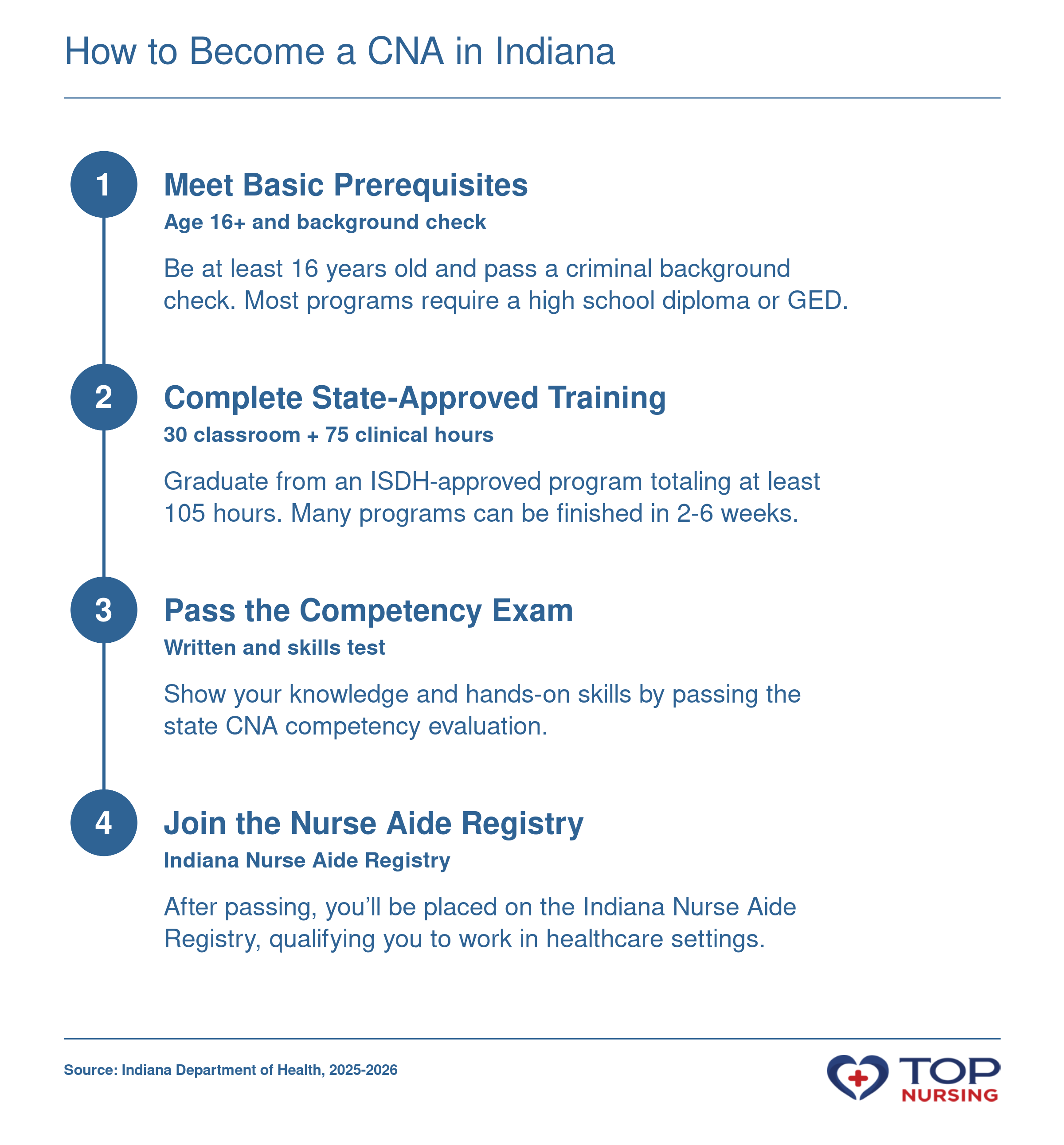
Becoming a Certified Nurse Aide (CNA) in Indiana follows a clear, state-regulated path. You'll need to meet age and background check requirements, finish an approved training program, and pass a competency evaluation. With accelerated options, the entire process can be completed in as little as 2-6 weeks.
CNA Training Costs and Financial Aid in Indiana
CNA training costs in Indiana span a wide range, from zero-cost employer programs to college-based certificates that run several thousand dollars. Most stand-alone CNA classes at nursing homes or career schools charge between $500 and $2,000, covering instruction, textbooks, and basic supplies. The two highly ranked programs on our list illustrate the higher end: Ivy Tech Community College’s Patient Care Technician certificate, which includes CNA preparation, carries an in-state tuition of $5,154, while Vincennes University lists its Pre-Nursing CNA certificate at $7,126 for Indiana residents. These figures represent institutional tuition, so they may include broader coursework beyond the core CNA training.
Free and Employer-Sponsored Training
Several Indiana healthcare employers eliminate tuition altogether. American Senior Communities (ASC) runs a free, 4–5 week CNA training program open to anyone, with no work commitment required afterward. The program provides 30 classroom hours and 75 clinical hours, exactly the state minimums, and applications are accepted online. Other organizations tie training to employment. TLC Management’s Rise Up Healthcare Academy offers on-site CNA training at multiple locations (Albany, Fort Wayne, Indianapolis, and others), though you will need to contact them directly for current pricing. Genesis HealthCare takes a different approach: it hires trainees into paid, non-patient-care roles during a four-month training period, with all costs covered by the employer. Many nursing homes and hospital systems across the state provide similar earn-while-you-learn opportunities, typically with a work commitment after certification.
Financial Aid and Scholarships
If out-of-pocket costs are a barrier, several funding sources can help. The Workforce Innovation and Opportunity Act (WIOA) may cover CNA tuition for eligible individuals through Indiana WorkOne centers. For college-based programs like those at Ivy Tech and Vincennes, federal Pell Grants may apply if the certificate is part of an eligible academic pathway. Some community organizations also offer direct scholarships; Easterseals Northeast Indiana, for instance, provides scholarships for its $1,000 CNA program (next application deadline: May 25, 2026). Always confirm aid eligibility with both the program and the funding agency, as requirements vary.
Don’t Forget Exam Fees
Tuition often does not include the state certification exam. The Indiana CNA knowledge and skills evaluation, administered by a third-party vendor, typically costs $75 to $100. Some employer-sponsored programs cover this fee, but if you are paying for training yourself, budget for it as a separate out-of-pocket expense.
Questions to Ask Yourself
Do you need evening or weekend classes to fit around a current job?
Many Indiana CNA programs run on weekday schedules; if you work full time, confirm the program has an evening or weekend track so you don’t have to leave your job.
Would a free employer-sponsored program (with a work commitment) save you money, or limit your options?
Some employers pay for training in exchange for a work commitment. It saves money upfront but may limit where you can work after certification.
Are you planning to use CNA as a stepping stone to LPN or RN, and does the program you’re considering offer articulation or credit toward those degrees?
If you plan to advance to LPN or RN, check whether the CNA program offers transfer credits or articulation agreements to avoid repeating coursework later.
Online and Hybrid CNA Programs in Indiana
Indiana does not permit fully online CNA training. State law requires every student to complete clinical hours in person under the supervision of a licensed nurse. Programs that advertise a "100% online CNA" are either misleading or not approved by the Indiana State Department of Health (ISDH).
How Hybrid Programs Work
Hybrid CNA programs split the curriculum into two parts. The 30 hours of classroom theory (covering infection control, anatomy, and patient rights) may be delivered online or through self-paced modules. The remaining 75 hours of skills labs and clinical rotations must be done at an approved healthcare facility, providing hands-on practice with tasks such as taking vital signs and assisting with mobility. This blend allows you to study theory on your own schedule while still satisfying the in-person requirements for state certification.
Hybrid Availability in Indiana
Our 2026 rankings feature two top campus-based programs, though both schools offer some flexibility. Ivy Tech Community College in Indianapolis offers a Patient Care Technician program with "flexible campus and format options." Primarily campus-based, its multiple locations and scheduling choices can still accommodate working adults. Vincennes University, with its main campus in Vincennes and a Jasper Campus, runs a traditional campus-based CNA certificate. Although neither program is marketed as purely hybrid, many community colleges and private training centers across Indiana (including those in Fort Wayne, Evansville, and South Bend) combine online theory with in-person clinicals. Contact a program directly to confirm the exact delivery format before enrolling.
ISDH Approval: Don't Get Scammed
Not every training provider listed online is legitimate. The ISDH maintains a list of approved CNA training programs, and graduation from an approved program is mandatory to sit for the state's competency exam. Before paying a deposit, verify the program's status on the ISDH website. Avoid any "online CNA" course promising full certification without in-person clinical hours. Your certificate will not be recognized by Indiana employers or the state registry.
Fastest and Most Flexible CNA Programs in Indiana
Some CNA training programs in Indiana can be completed in as few as 16 days, like the hybrid course offered by Evansville Institute in Indianapolis. For students who need to enter the workforce immediately, accelerated programs compress the full curriculum into two to four weeks of full-time study, a fraction of the six to twelve weeks typical of standard-paced classes.
Accelerated Programs: From 16 Days to 4 Weeks
Accelerated CNA programs are intensive, often requiring daytime attendance five days a week. Humble Hearts Academy in Fort Wayne, for example, runs a four-week program with weekend clinical rotations. Easterseals Arc, also in Fort Wayne, operates a four- to six-week track. These condensed schedules work best for individuals who can commit fully to training without outside employment or caregiving duties during the program.
Standard programs, by comparison, spread the same 105-hour requirement over 10 weeks, as seen at Cardinal School of Care in Fort Wayne, or 6 to 8 weeks at Indy Institute in Indianapolis. While less grueling day to day, they delay entry into the job market.
Evening and Weekend Cohorts for Working Adults
Evening and weekend sections are a major unmet need for working adults, and many Indiana training centers now respond to that demand. In Fort Wayne, Cardinal School of Care holds classes on Monday and Wednesday evenings; Essential Healthcare Academy offers an evening track; and Legacy Medical Academy combines online classroom work with evening sessions. Indy Institute in Indianapolis provides weekend and morning/afternoon options, while Humble Hearts Academy schedules clinicals on weekends. Even traditional daytime programs like ASC Care in Indianapolis occasionally add evening sections.
The American Red Cross CNA program in Indiana is not currently operating, but community colleges and vocational schools across Indianapolis, Fort Wayne, and Evansville fill the gap with flexible cohorts. Always confirm the schedule for the intake you need, as night or weekend sections are not guaranteed every term.
Clinical Placement: The Real Bottleneck
Regardless of pace, every CNA program in Indiana must include in-person clinical hours. Accelerated tracks, in particular, fill rapidly because clinical sites can only accommodate a limited number of students. Before enrolling, verify that the program has a confirmed clinical site and that your slot is secured. Schools like Easterseals Arc and Humble Hearts Academy often have established partnerships, but waitlists can still form. Early application and direct communication with the program coordinator are the best ways to lock in a seat in the fastest or most flexible cohort.
CNA Certification Exam and Renewal in Indiana
Exam Structure and What to Expect
The Indiana CNA competency exam is administered by Ivy Tech Community College through its Central Testing Office. The exam has two separate parts that evaluate both knowledge and practical ability.1
Written test: A 100-question, computer-based knowledge exam covering essential nursing assistant concepts. A passing score of 80% is required.
Skills evaluation: A hands-on demonstration of clinical competency. Candidates perform hand hygiene plus four randomly selected skills from a standard set. Evaluators assess technique, safety, and communication.
Both portions must be passed to earn a spot on the Indiana Aides Registry. Scheduling and site availability are managed directly through Ivy Tech’s testing portal. Many test-takers complete both parts on the same day, though separate scheduling is sometimes possible.
Exam Fees and Retake Policy
Full exam fees are $100 when both written and skills portions are taken together. If you need to retake only one part, the fee is $90 for that single component.1 You get three attempts per part, offering flexibility if you don’t pass on the first try.
If you exhaust all three attempts for either portion, you must typically complete another state-approved CNA training program before becoming eligible to test again. This makes thorough preparation important. Most programs include practice exams and skills labs to help students build confidence before exam day.
Renewal Requirements: Keeping Your Registry Status Active
CNA certification in Indiana follows a 24-month renewal cycle managed by the Indiana State Department of Health (ISDH).1 To maintain active status on the Indiana Aides Registry, you must meet two key requirements during each two-year period:
Paid nursing employment: At least 8 hours of qualifying nursing or nursing-related work for pay within the 24-month window.
In-service education: A total of 24 hours of continuing education, which breaks down to an average of 12 hours per year. These hours can be completed through employer-provided training, online courses, or other approved activities.
If you do not meet these criteria, your CNA certification becomes inactive. Reactivation may require retesting or completing additional training, depending on how long your status has lapsed. Always confirm your renewal date through the ISDH registry portal and keep personal records of completed in-service hours.
What CNAs Earn in Indiana: Salary by Metro Area
Indiana nursing assistants earned a median annual wage of $37,780 as of May 2023, according to the Bureau of Labor Statistics. That works out to roughly $18.16 per hour. Where you work in the state , and the type of facility that employs you , can move that figure noticeably higher or lower.
Statewide Pay Snapshot
The statewide median gives a useful baseline, but the range is wide. The lowest-earning 10% of CNAs in Indiana made less than $29,610 annually, while the top 10% exceeded $47,710. These numbers cover all nursing assistants across every metro area and work setting in the state. Experience, additional certifications, and shift differentials all influence where an individual falls within that spread.
CNA Wages in Indiana Metro Areas
Wages vary meaningfully by location. Among the major Indiana metros, annual median pay breaks down as follows:
Indianapolis-Carmel-Anderson: $38,690
Fort Wayne: $36,630
Evansville: $37,020
South Bend-Mishawaka: $37,310
The Indianapolis area typically runs slightly above the statewide median, while Fort Wayne and Evansville are closer to the lower end. Cost of living differences mean that a modestly lower wage in a smaller metro may still stretch further for housing and everyday expenses. Employers in and around Indianapolis often compete more aggressively for staff, which can push base pay upward.
How Work Setting Affects Pay in Indiana
The employer type matters at least as much as geography. BLS data by industry for Indiana shows clear separation:
Hospitals (general medical and surgical): Median annual pay around $38,780. These settings often offer the highest base wages, along with more predictable schedules and benefit packages.
Nursing care facilities (skilled nursing): Median roughly $37,160. Many CNAs work in this sector, and pay can vary based on facility size, ownership, and rural versus urban location.
Home health care services: Median near $35,790. Although base hourly rates tend to be lower, some home health positions offer mileage reimbursement or flexible scheduling that appeals to working parents or students.
These industry medians are specific to Indiana and reflect only the May 2023 survey period. Actual job postings today may list slightly different ranges, particularly in tight labor markets where signing bonuses and wage adjustments have become common.
When comparing offers, it is wise to look beyond the hourly rate. Shift differentials for evening, night, or weekend work can add a dollar or two per hour. Some employers also cover the cost of continuing education at Indiana nursing programsIndiana nursing programs or provide a clear path to higher-paying patient care technician or medication aide roles. Checking current postings on Indiana Department of Workforce Development job boards or directly with large healthcare employers in your target metro area will give the most up-to-date picture of real-world earnings.
Did You Know?
Indiana CNA programs require 105 training hours, cost between $0 and over $2,000, and can be finished in 2 to 6 weeks. The median salary for CNAs in the state ranges from approximately $33,000 to $37,000 per year.
CNA Career Advancement Pathways in Indiana
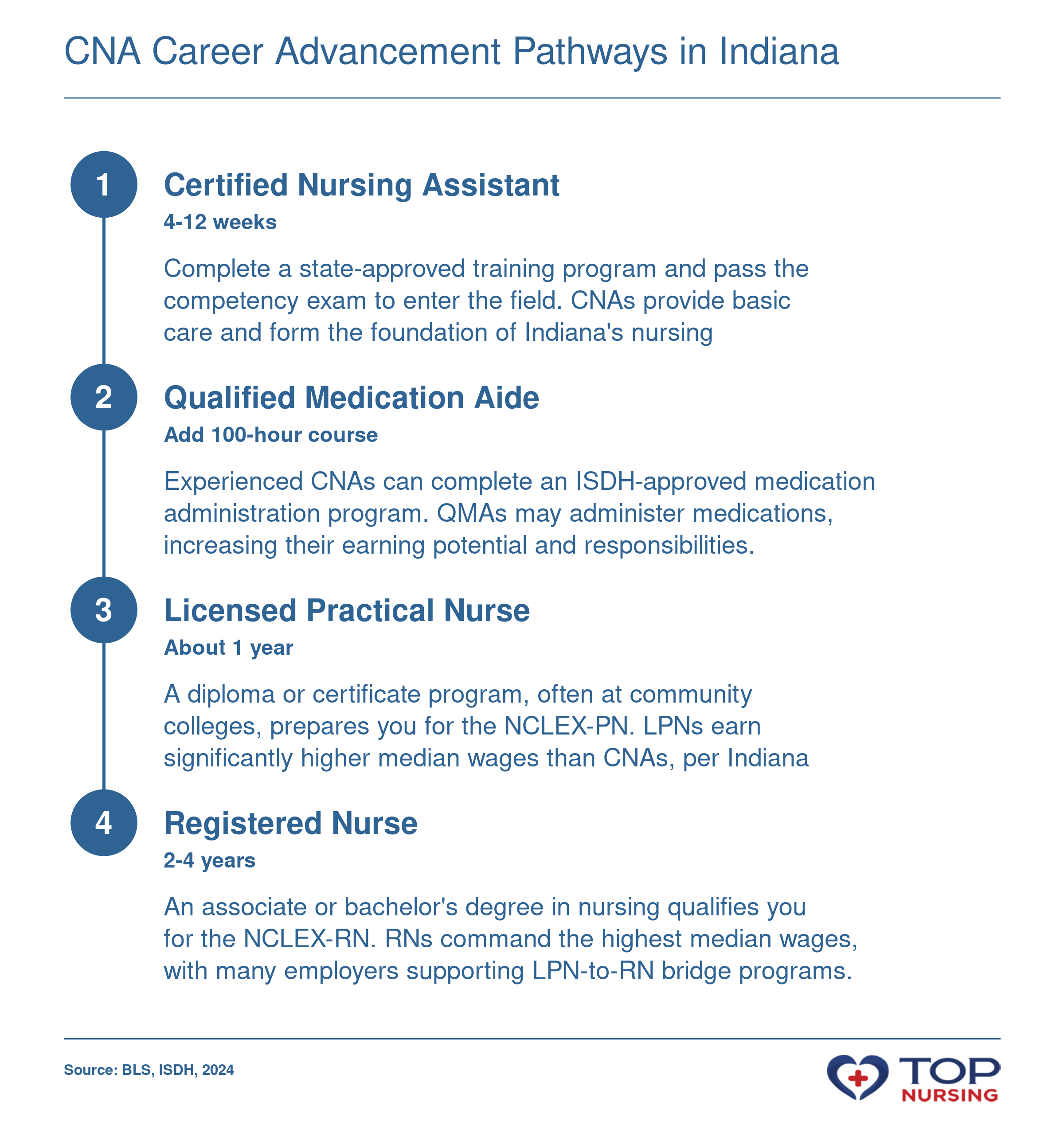
Indiana offers clear pathways for CNAs to advance their careers through additional education and certification. Each step typically brings higher responsibilities and median wages.
Frequently Asked Questions About CNA Programs in Indiana
Considering a nursing assistant career in Indiana? These are the questions we hear most often about CNA training, certification, and earnings. Our answers draw on the detailed program comparisons and state data covered earlier in this guide.
Which is the best school to study CNA in Indiana?
There is no single "best" school for everyone, but programs like Ivy Tech Community College and Fort Wayne Community Schools are widely respected for their thorough training and high state exam pass rates. The right choice depends on your location, schedule, and budget. Review the ranked list earlier in this article to compare top options across the state.
How long does it take to complete a CNA program in Indiana?
Most CNA programs in Indiana can be completed in 4 to 12 weeks, depending on whether you attend full-time or part-time. Indiana requires at least 105 hours of training, including classroom instruction and clinical practice. Accelerated tracks may finish in under a month, while evening or weekend options spread the hours over a longer period.
Can you take CNA classes online in Indiana?
Indiana regulations do not permit fully online CNA programs because hands-on clinical training must be completed in person. However, several schools offer hybrid formats where theory coursework is delivered online, while skills labs and clinical rotations take place at approved facilities. Check the online and hybrid section above for specific program details.
How much does CNA training cost in Indiana?
CNA training in Indiana typically ranges from $400 to $1,200, though prices vary by program length, location, and included materials. Some employers, such as nursing homes, may reimburse costs in exchange for a work commitment. Financial aid options like WIOA grants are also available; see the training costs section earlier for more details.
What is the highest paying CNA salary in Indiana?
According to the latest BLS data, top earners among Indiana CNAs make over $42,000 per year. Wages vary significantly by metro area; for example, Indianapolis and Fort Wayne tend to offer salaries above the state median. The salary by metro section earlier breaks down pay across major Indiana cities.
What type of CNA gets paid the most?
CNAs working in specialized settings like hospitals, surgical units, or ICUs generally earn higher wages than those in long-term care facilities. Additional certifications, such as phlebotomy or EKG, can also boost pay. As shown in the career advancement pathways, gaining experience and pursuing further nursing education leads to the highest earning potential.
Do Indiana CNA programs have evening or weekend classes?
Yes, many programs offer flexible scheduling to accommodate working students. Schools like Ivy Tech and community-based training centers often run evening or weekend cohorts. The fastest and most flexible programs section lists several options with part-time, weekend, and evening tracks designed to fit around a job.